
Black Lines Instead of Text: What Has Happened to Books in russia
5/10/2026
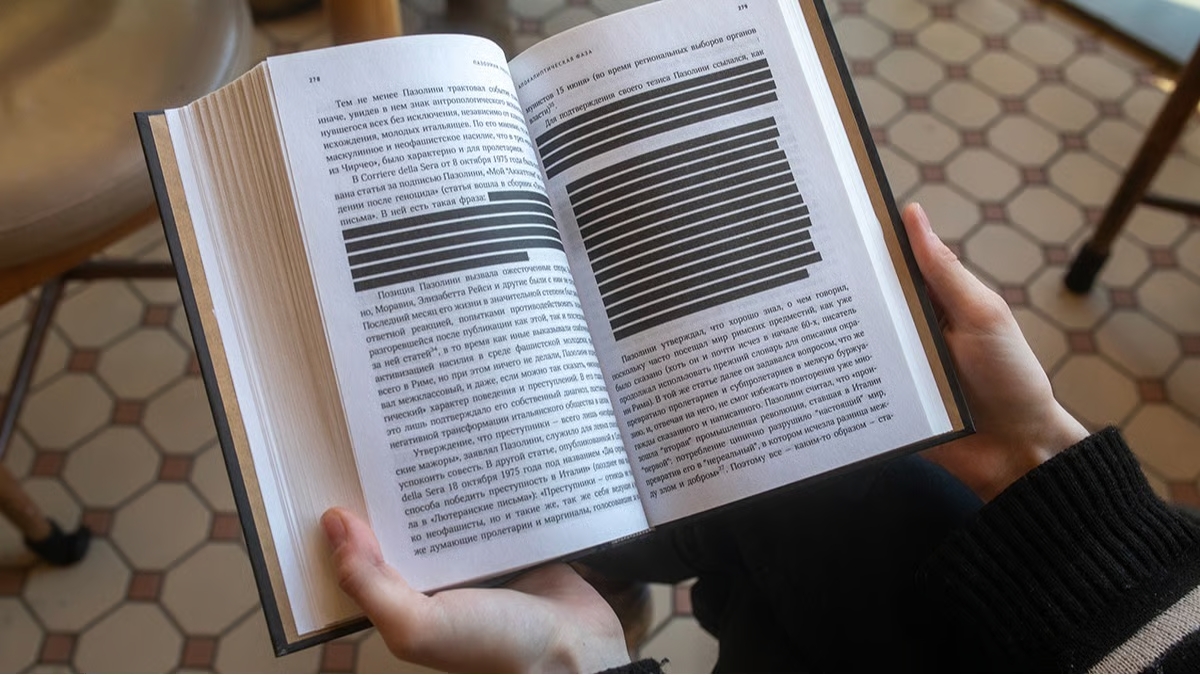
Since the start of the full-scale war against Ukraine, censorship in the russian book industry has taken on a systemic and unprecedented character, transforming not only the market but also the very nature of text as a cultural product. Whereas the state’s intervention in russia was previously limited to selective bans or pressure on individual authors, it is now a large-scale control infrastructure that encompasses the entire book publishing cycle: from manuscript to shop shelf.
A key feature of this new reality has been the emergence of the so-called “blackout” – the physical blacking–out of text fragments. Today, this has become a visual symbol of censorship that is no longer concealed but openly displayed. As a result, the reader receives not a complete work but a fragmented one.
The reason is a sharp tightening of legislative restrictions. In russia, any mention of the war, criticism of russia’s aggression, themes of LGBTQ+, emigration, decolonial discourse, and descriptions related to drugs or suicide have fallen under a ban or strict moderation. As a result, thousands of books are being revised, labeled, or removed from sale. Censorship is applied regardless of when a work was written; even classics of world literature are subject to “cleansing” through new translations or issuing of a revised version.
Some russian publishers have even resorted to using artificial intelligence to identify “undesirable” content. Algorithms analyze texts for potential risks, often mistakenly identifying ordinary words or contexts as violations. This leads to absurd situations where ordinary scenes or even individual words can be banned. At the same time, the final decision rests with editors and lawyers, who are forced to operate under high-risks – ranging from fines to criminal prosecution.
“Blackout” as a poetic device has historically been used in art as a form of protest or reinterpretation of a text. However, in modern russia, it has taken on the opposite meaning: instead of revealing hidden meaning, it serves as a tool for concealing it. At this, the kremlin did not take into consideration the fact that in the digital age, readers can easily find the original text. Instead, a different effect is created – the normalization of absence. Black lines become familiar and are perceived as part of the “rules of the game”.
As a result, the kremlin’s censorship ensures that the book ceases to be a source of knowledge and becomes an object of ideological manipulation, where even the absence of text carries political significance.