A Bomb Targeting the World Congress of Free Ukrainians. Made by the kgb
4/5/2026
At the time, the soviet kgb went to great lengths to prevent the establishment of the World Congress of Free Ukrainians (WCFU) – an international organization whose goals were to consolidate all Ukrainians, draw the global community’s greater attention to the Ukrainian cause, and provide assistance to the Ukrainian people in their struggle for freedom and state independence. When they failed to prevent it, they resorted to all sorts of special measures to sow discord among diaspora organizations, discredit their leaders, artificially introduce dirty tactics into the race for the WCFU presidency, or at the very least disrupt the regular Congress session. Declassified documents from the archives of the Foreign Intelligence Service of Ukraine describe how this unfolded.
In early 1973, the diaspora finally set the date for the second WCFU – November 1–4 in Toronto. The key themes of the Congress were the restoration of Ukraine’s independence, condemnation of soviet imperialist policies, and protection of dissidents. Preparations for such a large-scale international forum, which typically drew over a thousand participants from the United States, Canada, Australia, Europe, and South America, took a great deal of time and effort. At the same time, as shown by archival documents, the kgb was also making preparations – but in its own way.
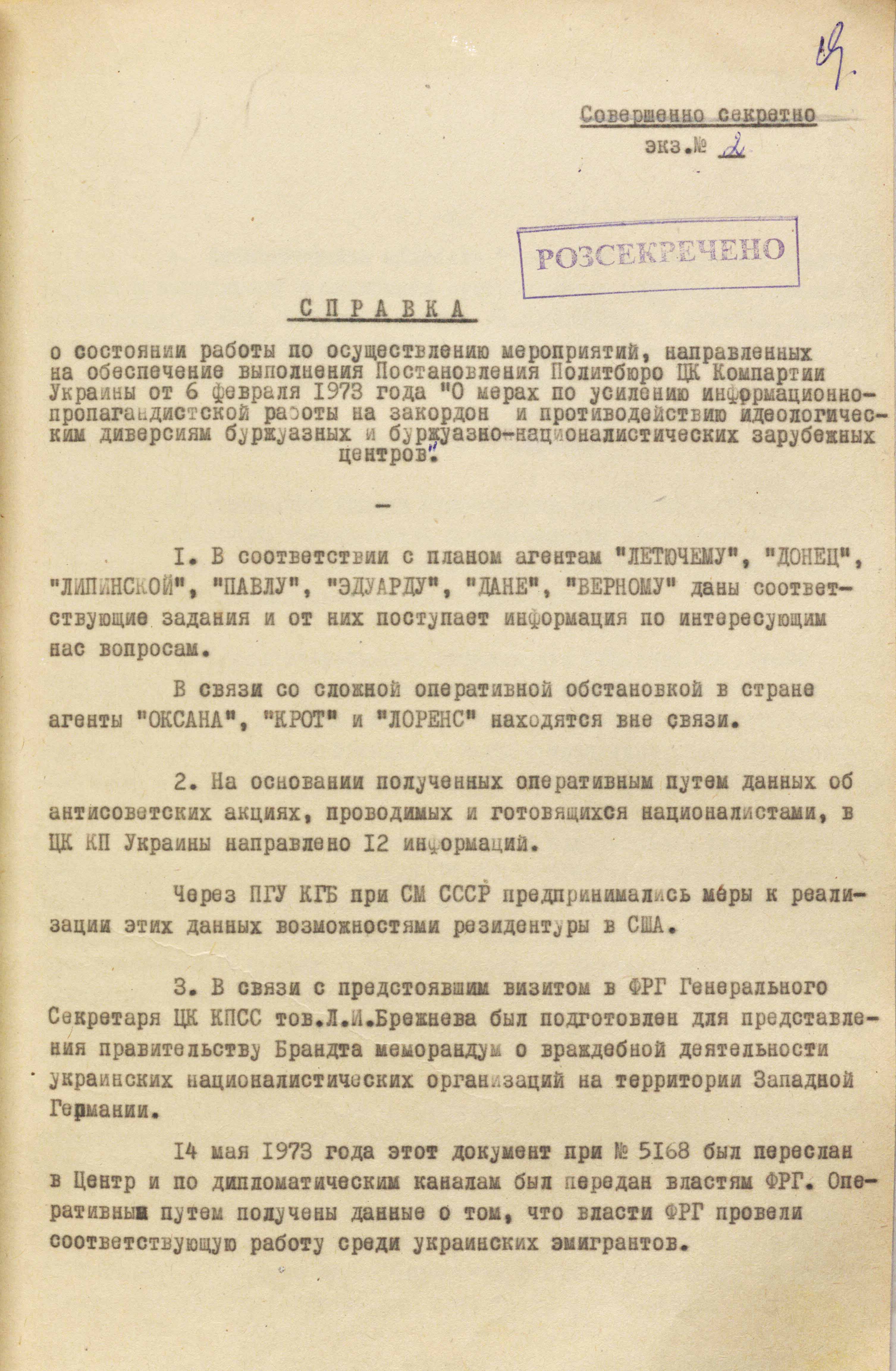
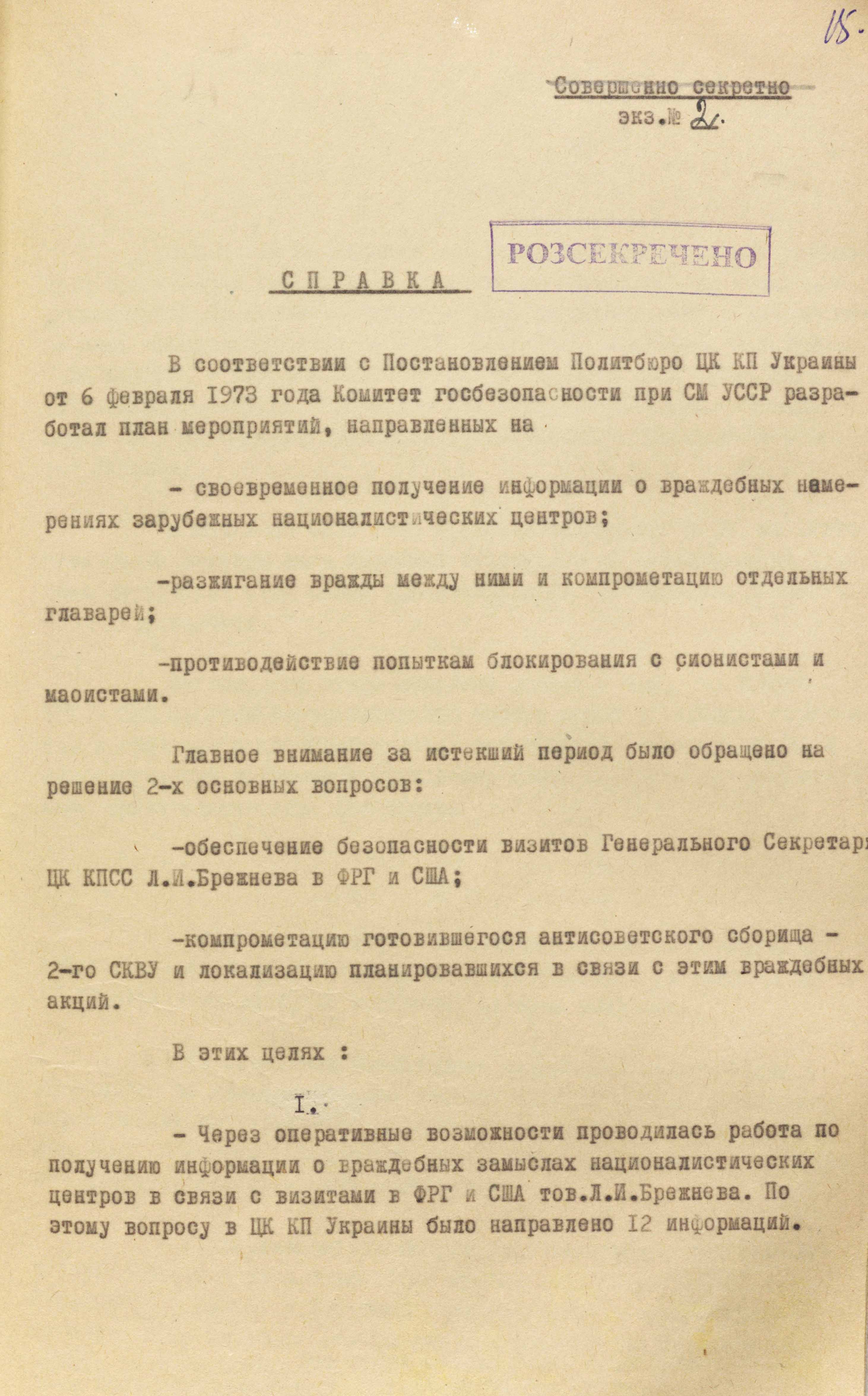
In February 1973, at a meeting of the politburo of the central committee of the communist party of Ukraine, a resolution was adopted entitled “On Measures to Strengthen Information and Propaganda Work Abroad and Counter Ideological Sabotage by Bourgeois and Bourgeois-Nationalist Foreign Centers”. Specific provisions of this resolution called for “discrediting the anti-soviet gathering – the 2nd WCFU – and neutralizing the hostile actions planned in connection with it”. To implement this resolution, the kgb of the Ukrainian ssr developed a plan of special measures.
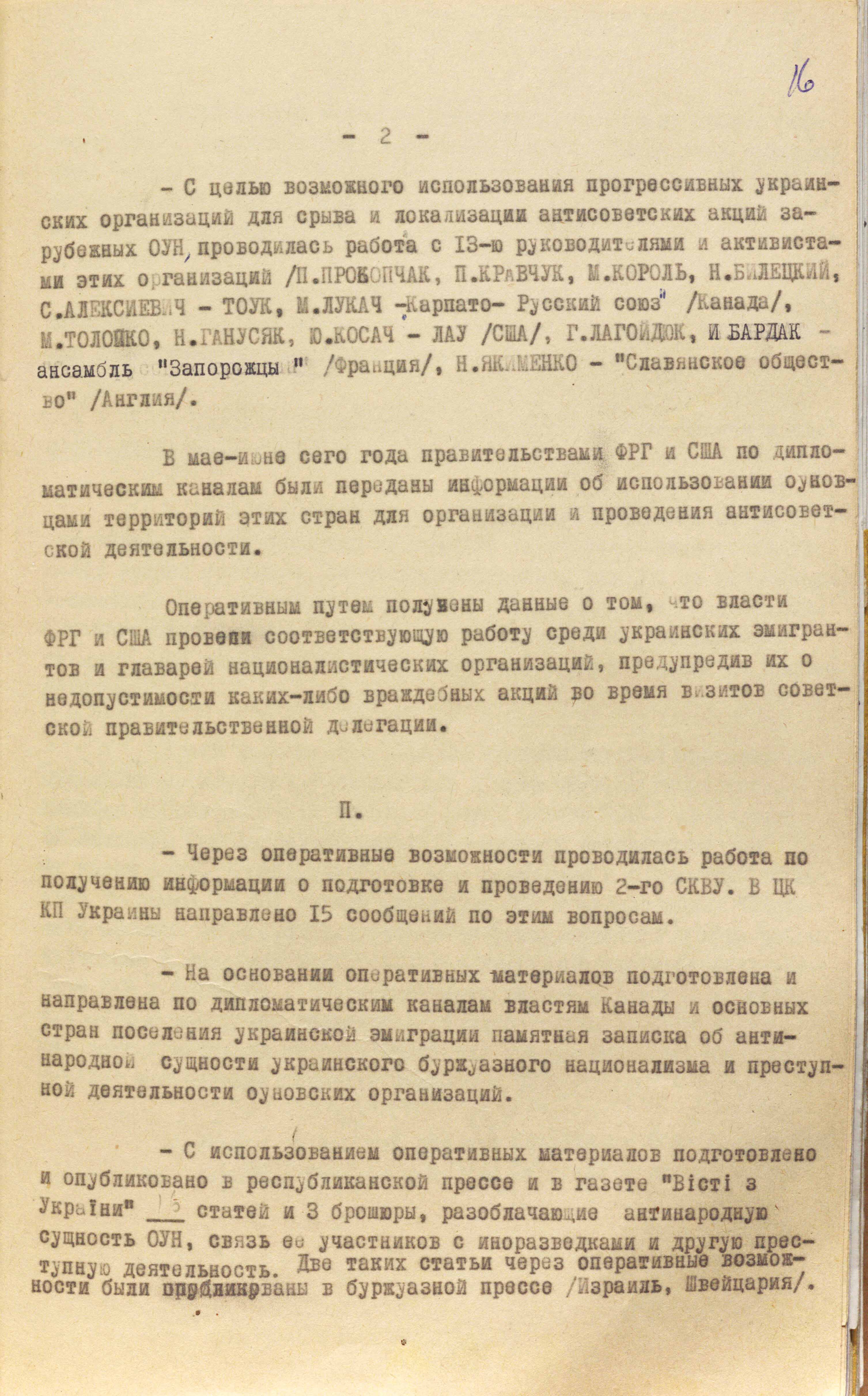
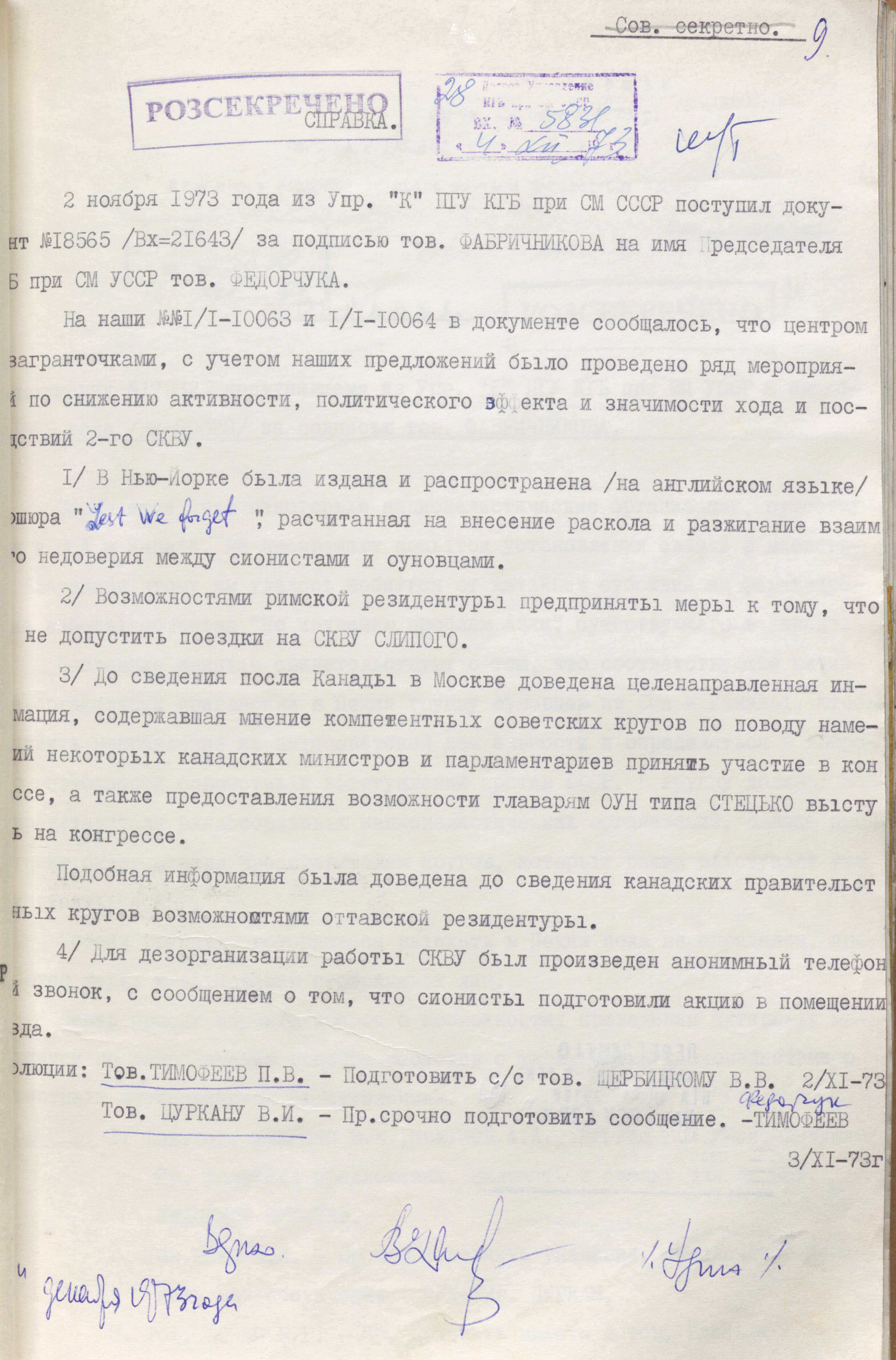
Among the declassified documents, reports on the progress of this plan’s implementation have been found. They provide insight into what measures were developed and how exactly this unfolded in practice. One of the points stated that the kgb had preemptively prepared a “memo on the OUN’s anti-people nature and criminal activities”. It was forwarded to the ussr ministry of foreign affairs, which in turn sent it to the embassies of countries where Ukrainian emigrants resided “for use in work with official representatives of the countries of accreditation”. The same memorandum was forwarded to the UN Secretary-General. It is clear that in it, Ukrainian organizations, movements, parties, and their active members were portrayed in a negative light. In this way, public opinion and attitudes to the WCFU itself and the initiatives and statements proclaimed by the Congress were gradually shaped.
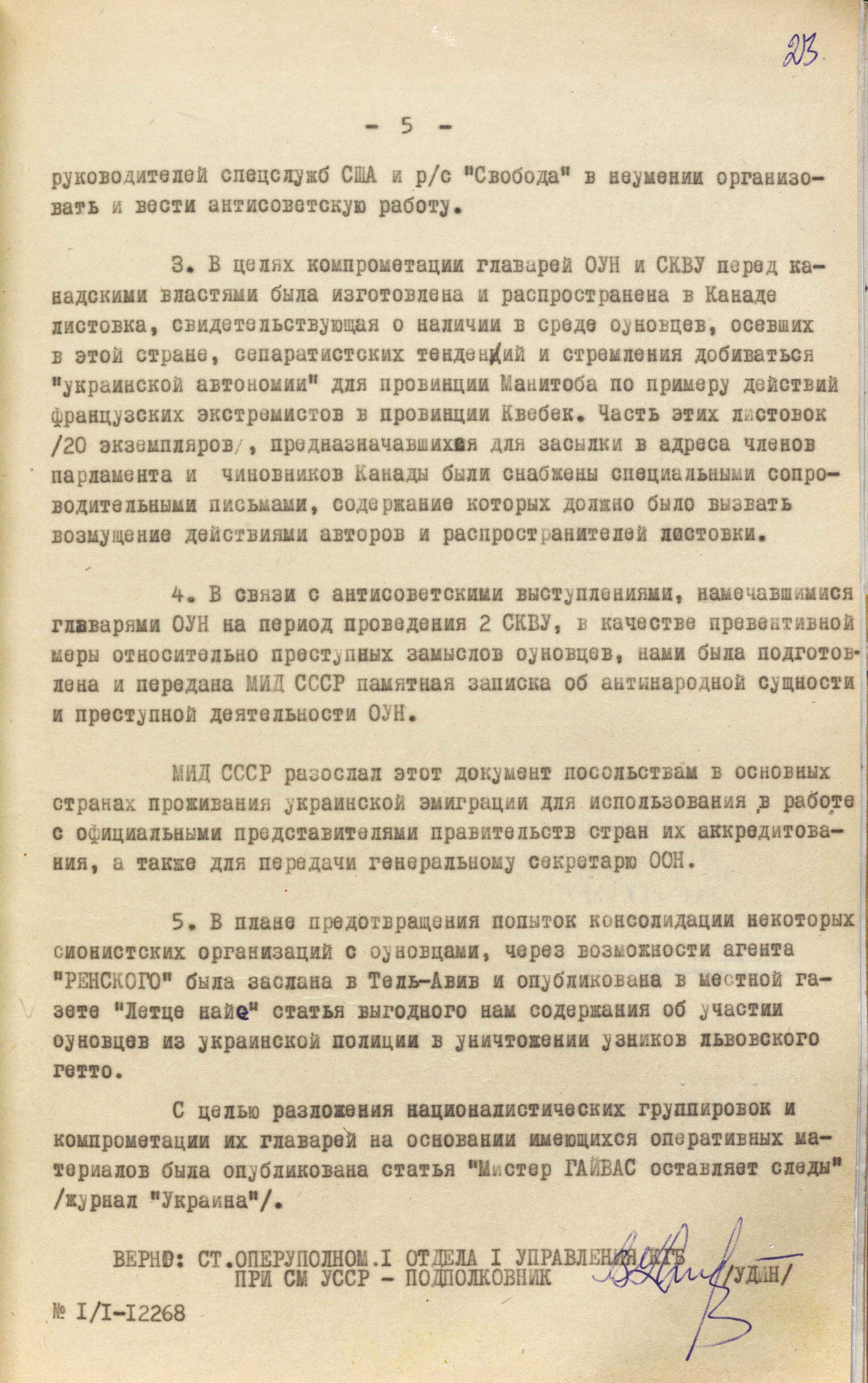
“With the aim of discrediting the leaders of the OUN and the WCFU before the Canadian authorities,” another point stated, “a leaflet was prepared and distributed in Canada, indicating the presence among OUN members who had settled in the country separatist tendencies and a desire to seek ‘Ukrainian autonomy’ for the province of Manitoba, following the example of French extremists in the province of Quebec. Some of these leaflets (20 copies), which were intended to be sent to the addresses of Canadian Members of Parliament and officials, were accompanied by special letters, the content of which was intended to provoke dissatisfaction with the actions of the authors and distributors of the leaflets” (FISU. – F. 1. – Case 12568. – Vol. 4. – P. 23).
Attempts were also made to influence the Canadian establishment in other ways. One report pointed out that “targeted information was conveyed to Canada’s Ambassador in moscow, containing the views of competent soviet circles regarding the intentions of certain Canadian Ministers and MPs to participate in the Congress.” The same “concern” was expressed to certain representatives of government circles directly in Canada through the capabilities of the kgb’s Ottawa residentura.
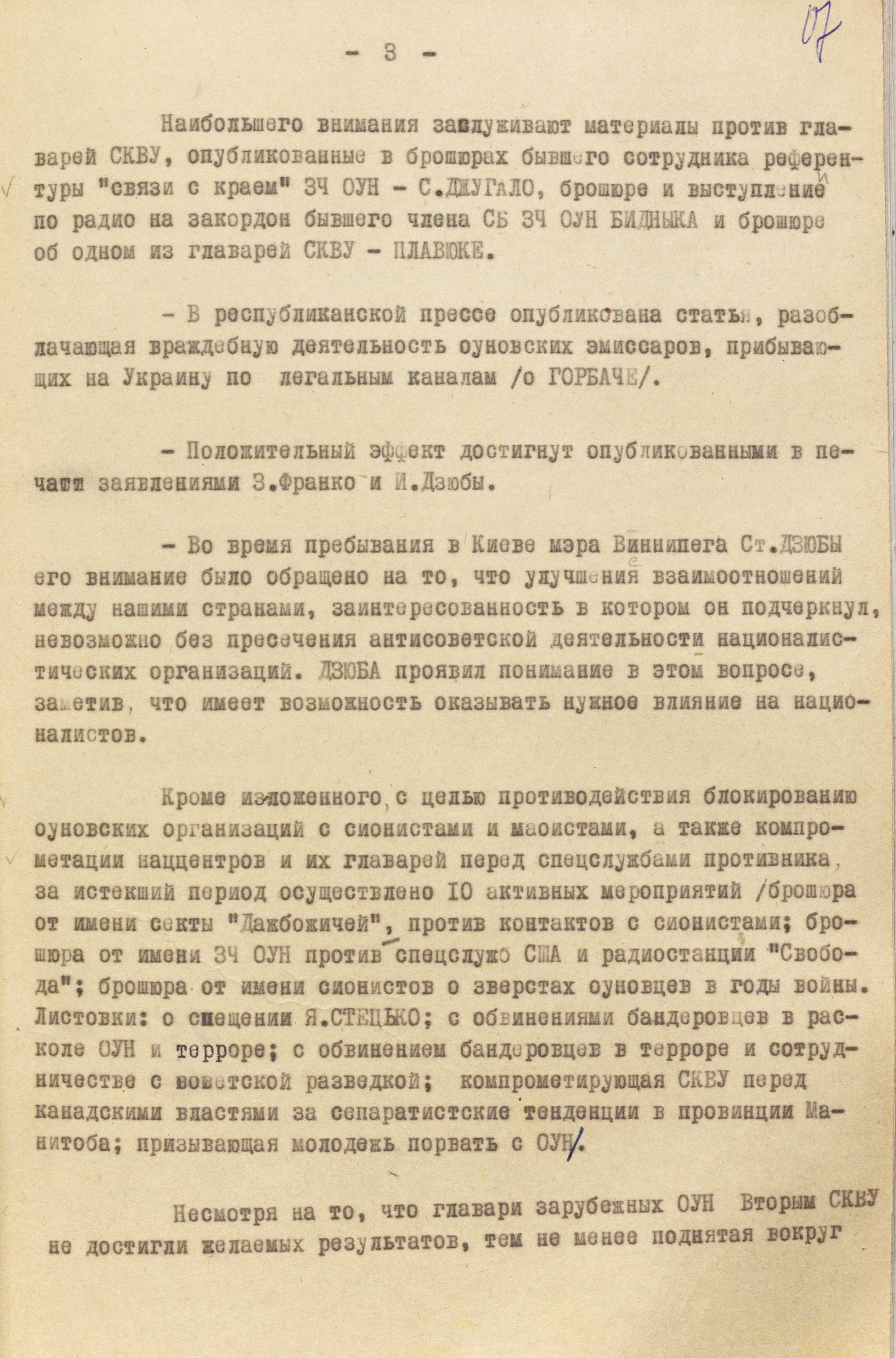
Another report stated that during Winnipeg Mayor Steve Dzyuba’s visit to Kyiv, persistent attempts were made to explain to him that relations between the ussr and Canada could not be improved “without putting an end to the anti-soviet activities of nationalist organizations”. In other words, they were deliberately laying the groundwork for a negative perception of the very fact that an international forum was being held in Canada and made it clear that moscow, so to speak, did not particularly like all of this.
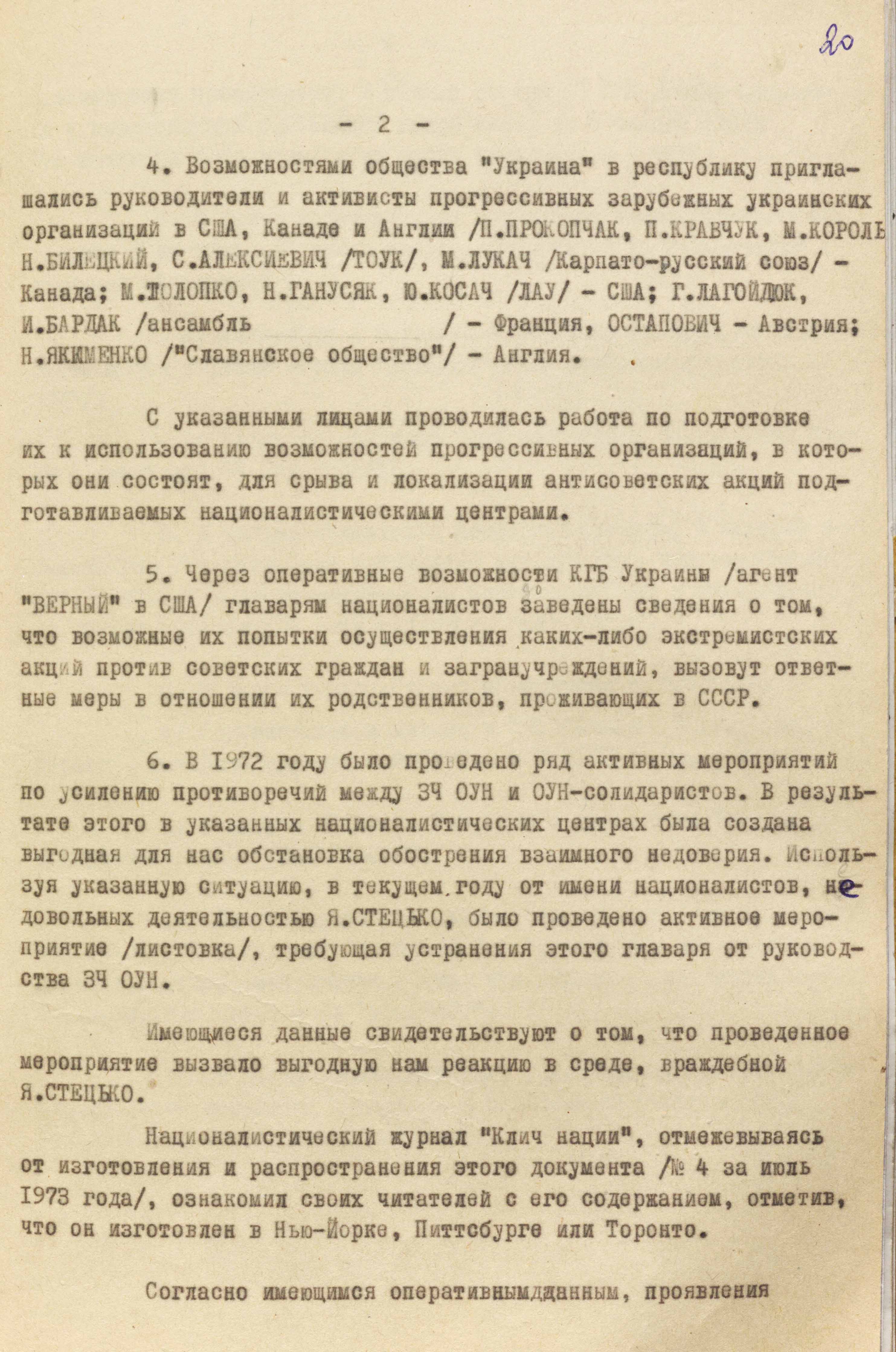
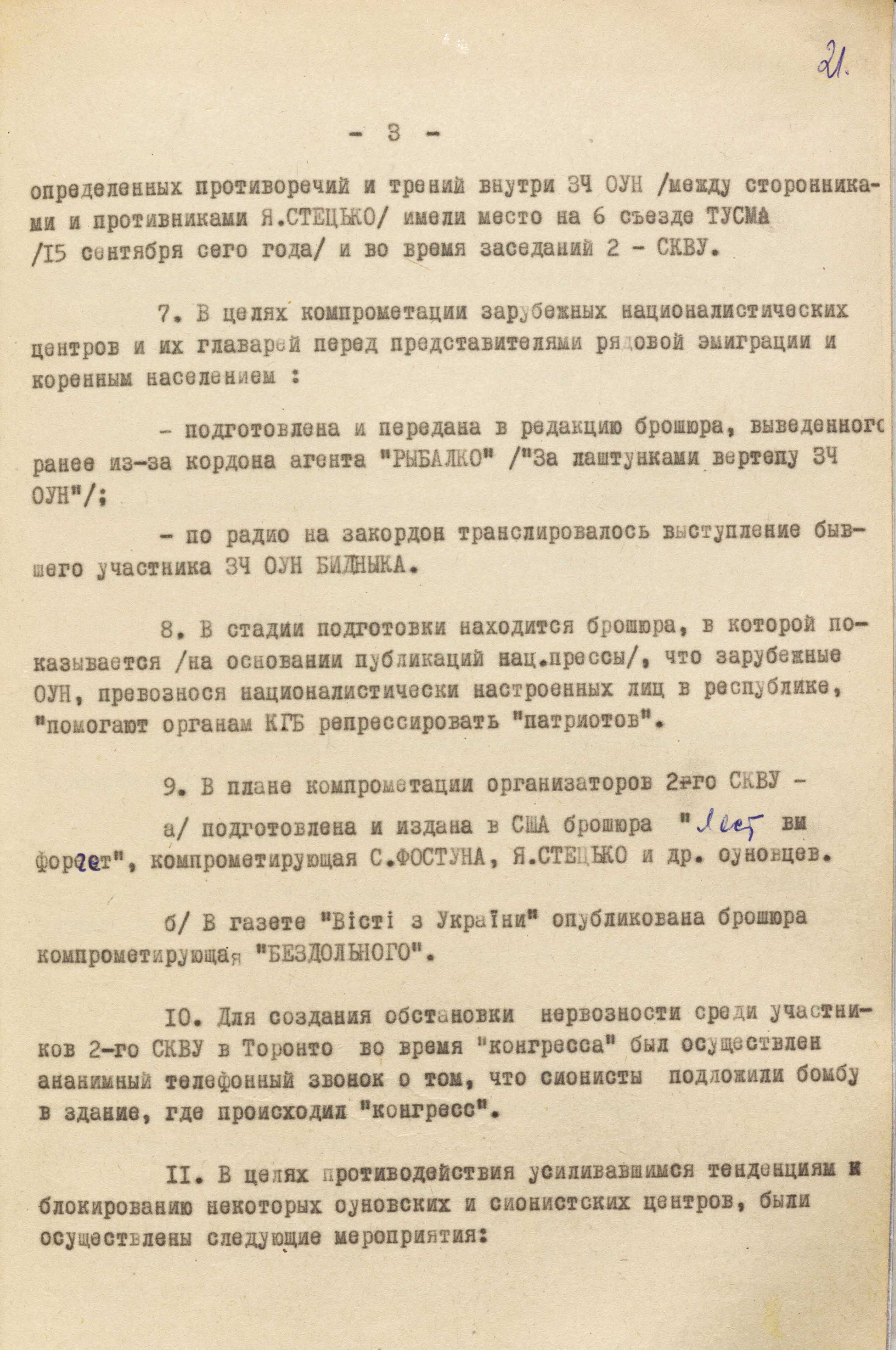
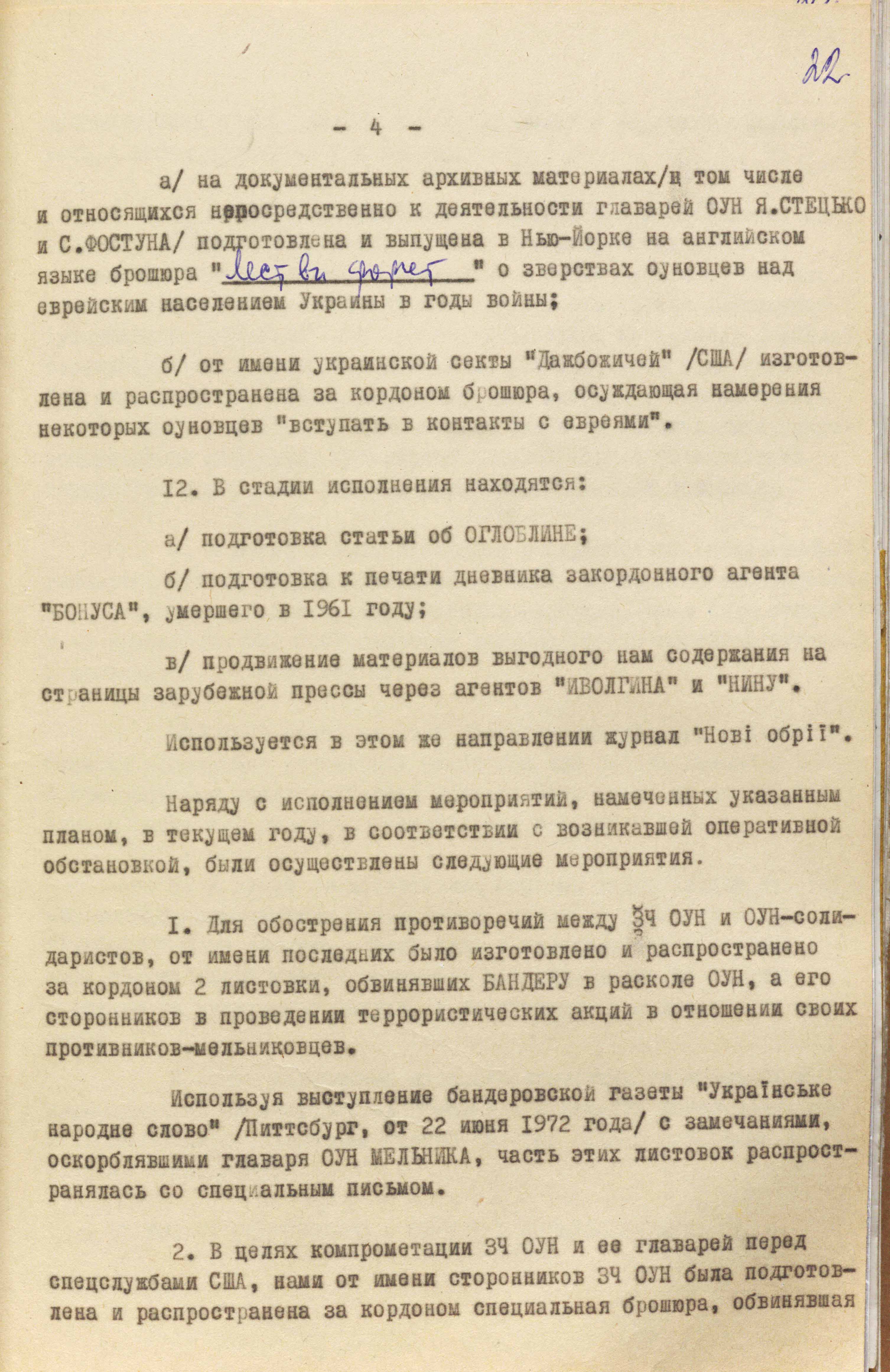
For its part, the kgb of the Ukrainian ssr carried out 10 so-called active measures throughout the entire preparatory period. Among them were the publication of negative brochures against one of the initiators of the WCFU, Mykola Plaviuk, and OUN leader Yaroslav Stetsko; brochures purportedly issued on behalf of the OUN’s Foreign Units against US intelligence agencies and Radio Liberty; articles about contradictions within the Ukrainian liberation movement, intended to spark new debates, fuel confrontation, and prevent unity. According to materials provided by the kgb, 13 articles were published in the republican press and the newspaper “Visti z Ukrainy”, and three separate brochures were issued, which discredited the activities of the OUN and other Ukrainian organizations. Thanks to operational capabilities, two more such articles were successfully published in the “bourgeois press” – in Israel and Switzerland.
Besides, the central apparatus of the kgb of the ussr, through its foreign residenturas, carried out relevant activities targeting so-called progressive Ukrainian organizations – the Association of United Ukrainians of Canada, the “Carpathian-Rusyn Union” (Canada), the “League of American Ukrainians” (USA), the “Slavic Society” (England), and others. In total, with 13 leaders and activists of those organizations. In a report received from moscow summarizing the results of those activities, officials in Kyiv learned that, separately through the capabilities of the kgb’s Rome residentura, the soviet union had taken measures to prevent Cardinal Josyf Slipyj from traveling to the World Congress of Free Ukrainians.
It is known that as early as 1967, on the eve of the convening of the WCFU, representatives of the soviet embassy in Rome met with the Cardinal and informed him that any document bearing his signature sent to the first Congress would be interpreted as an unfriendly act. At that time, Josyf Slipyj allegedly assured them that he would not send greetings in his own name, but would sign an appeal to the Congress on behalf of the Ukrainian Catholic Episcopate. During the second Congress, a demonstration was planned for November 4, 1973, to which Josyf Slipyj, the Bishops of the UGCC and the UAOC, and representatives of Protestant churches were invited to participate. But the kgb did everything in its power to prevent that.
The kgb also resorted to a traditional method it had frequently employed during that period. “To create a climate of nervousness among the participants of the 2nd WCFU in Toronto,” one document notes, “an anonymous phone call was made during the Congress claiming that Zionists had planted a bomb in the building where the Congress was being held” (FISU. – F. 1. – Case 12568. – Vol. 4. – P. 21). Details are not provided, but the fact itself indicates that no methods were spared.
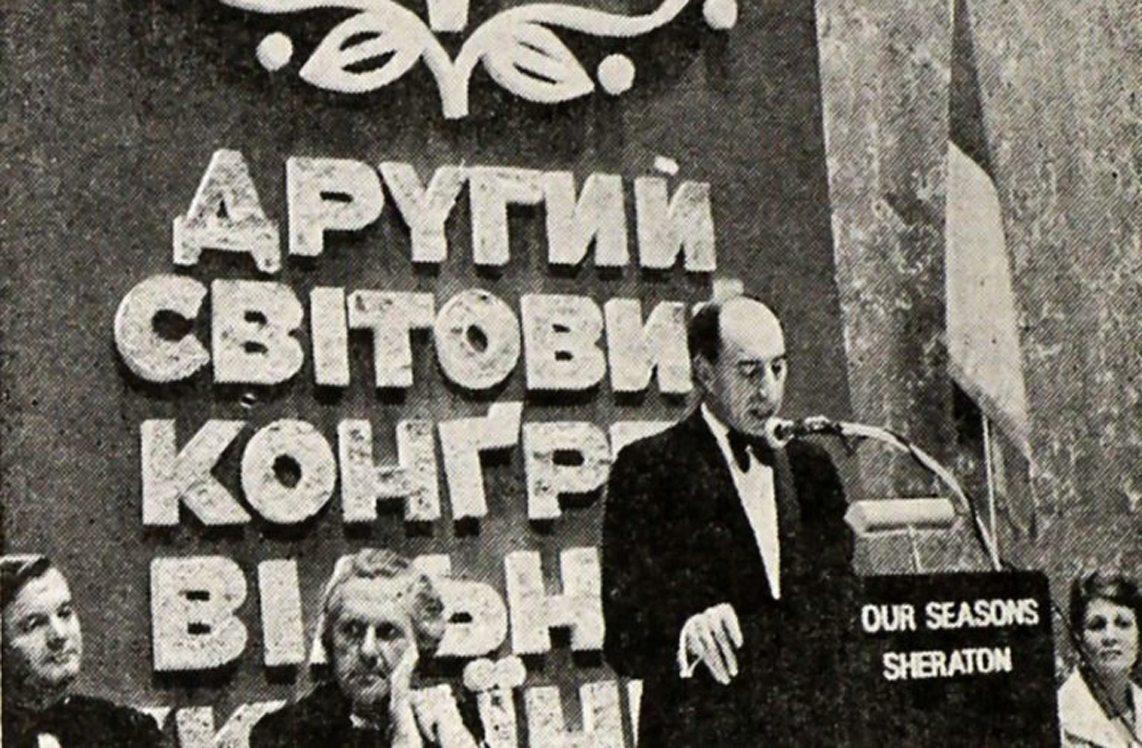
Despite this, the second Congress proceeded exactly as Ukrainian leaders had planned. According to official sources, in addition to the official proceedings, there were also celebratory events, a banquet, and a demonstration under the slogan “For the Freedom of Ukraine”. The banquet was attended by former Prime Minister of Canada and Member of Parliament John Diefenbaker, Minister of Multiculturalism Stanley Haidash, Canadian Senator Pavlo Yuzyk, and Chamber of Communities Ambassador Pavlo Yevchuk, and speeches were delivered by Ontario Premier Bill Davies and Minister of Healthcare Marc Lalonde, who greeted the Congress on behalf of Canadian Prime Minister Pierre Trudeau. Such support demonstrated the broad backing of the Ukrainian community.
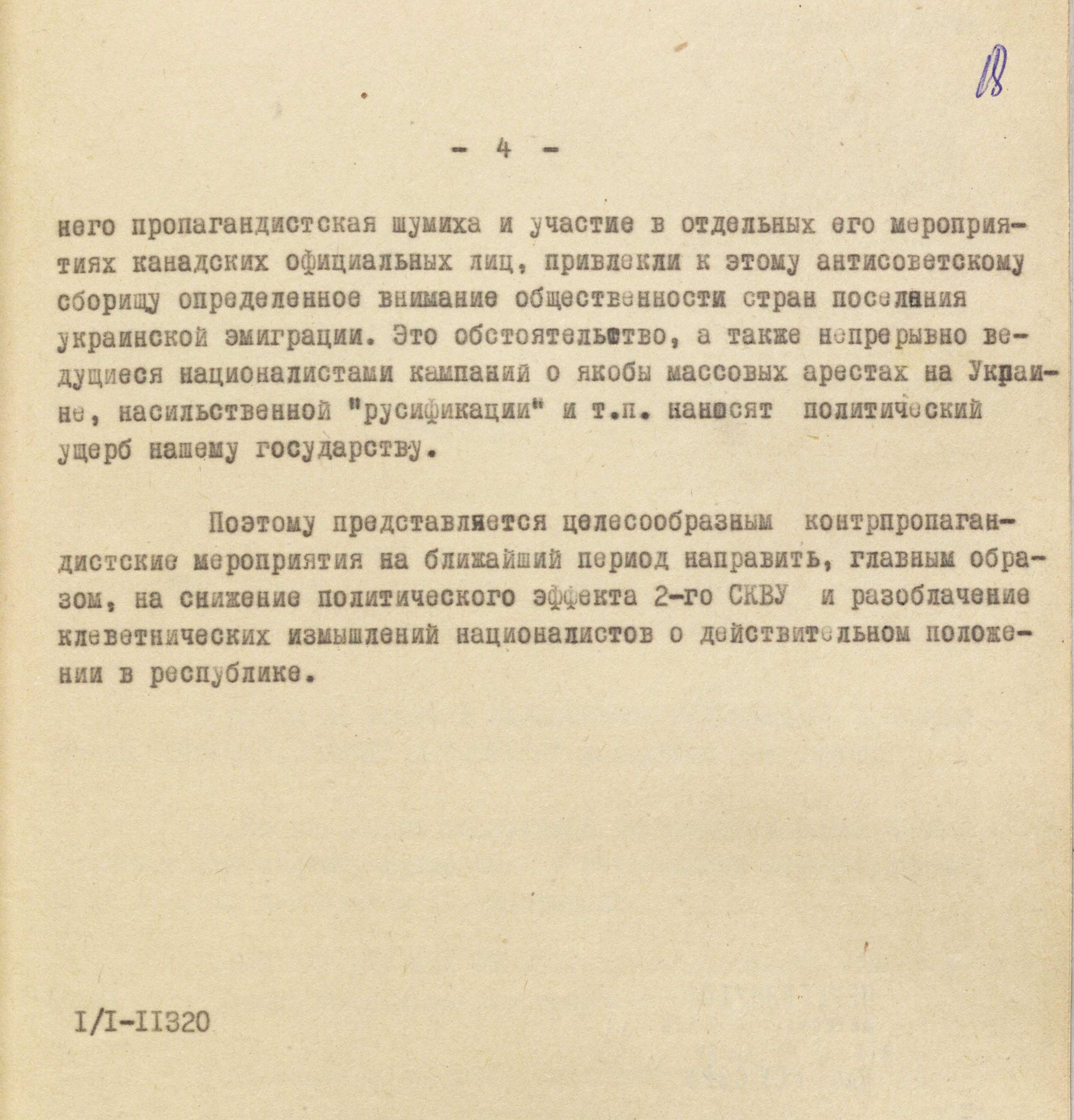
The kgb could not help monitoring all of this. Hence, the report’s conclusions pointed out that the Canadian officials’ participation in those events had nevertheless drawn some public attention to the WCFU in the countries where Ukrainian emigrants resided, which caused political damage to the ussr, and therefore all counter-propaganda measures must be directed at minimizing the political impact of the very existence of this international organization of Ukrainians.
This continued throughout all subsequent years of the work of the WCFU (since 1993 – the Ukrainian World Congress, UWC). The kremlin leadership, with the involvement of special services, resorted to all sorts of information, propaganda, special, and other measures to prevent unity among Ukrainians worldwide. And it continues to do so today.