“Bandera’s Resident Agents in Crimea”. The Story of a Special Report
5/8/2026
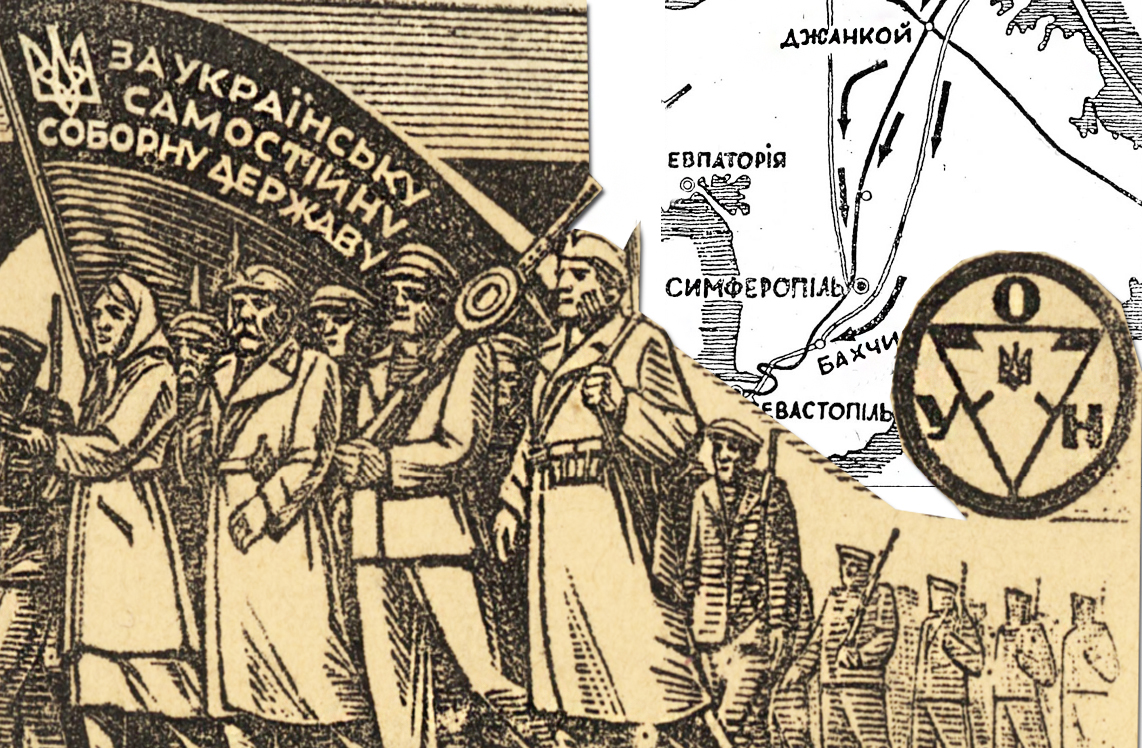
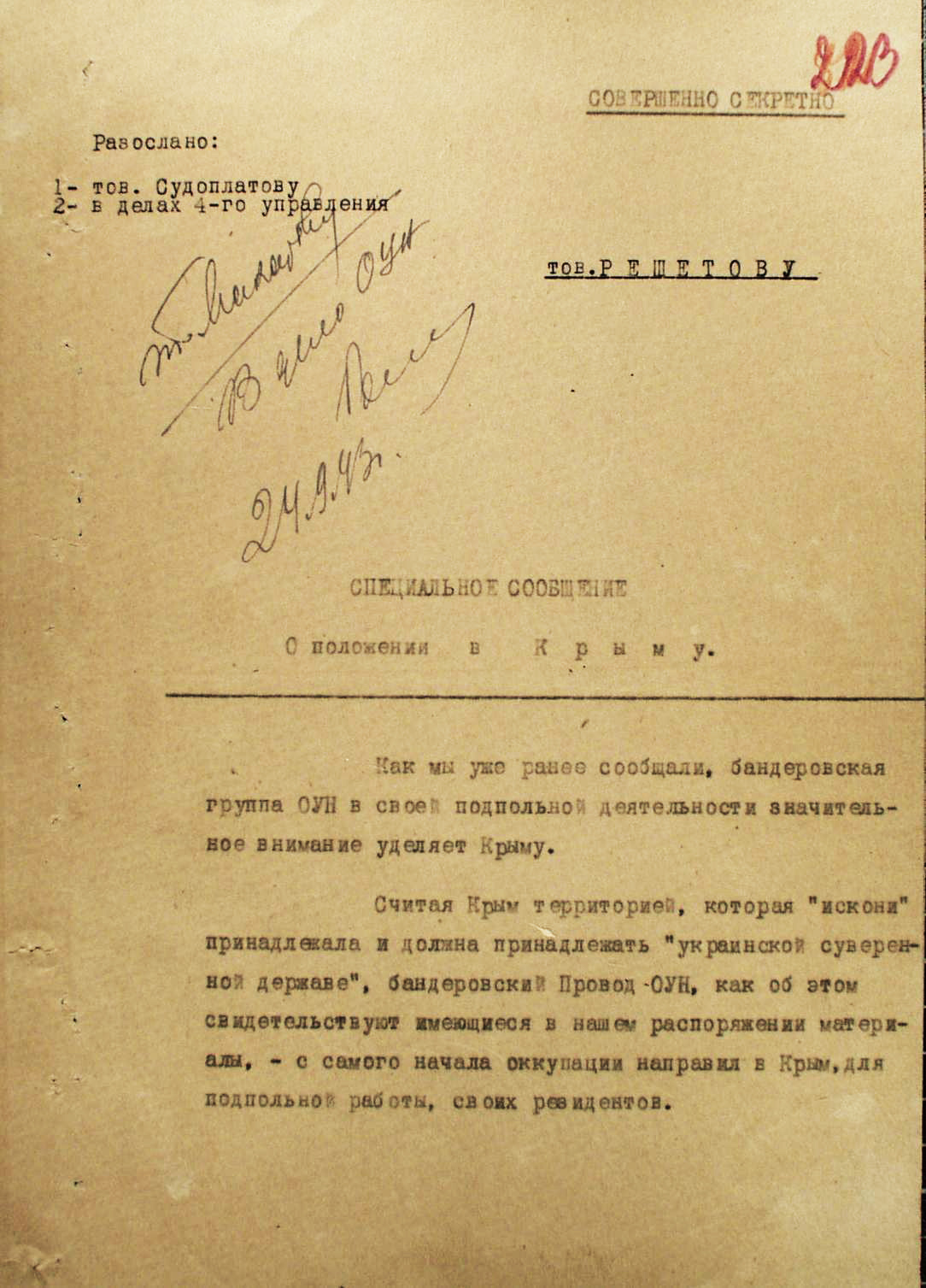
The Ukrainian ssr nkvd’s special report on the activities of the OUN(B) in Crimea during World War II has been discovered in the archives of the Foreign Intelligence Service of Ukraine. In contrast to soviet propaganda and the current “research” by the fsb of the rf devoted to the “collaboration of Ukrainian nationalists with the fascist invaders” on the Crimean Peninsula during the war, in this document, the chekists themselves, citing a political report by the OUN(B), de facto help debunk ideological myths about how the Ukrainian national resistance movement operated in the temporarily occupied territories.
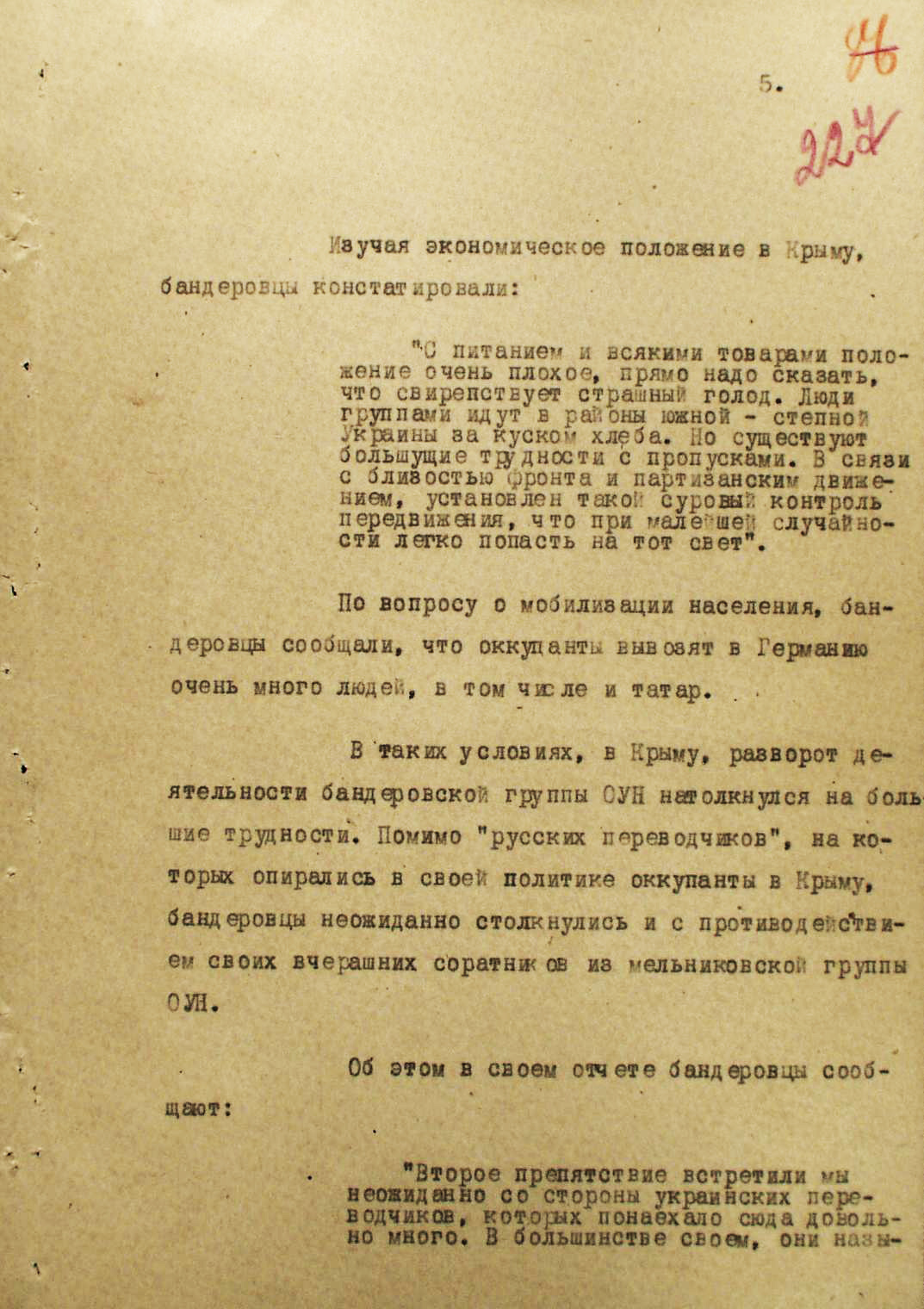
A special report entitled “On the Situation in Crimea” was signed by people’s commissar of state security of the Ukrainian ssr s. savchenko and addressed to chief of the 4th (intelligence and sabotage) directorate of the nkvd of the ussr p. sudoplatov. It is dated September 24, 1943. At that time, the Crimean Peninsula was still under occupation. Therefore, information about what was happening there was obtained through operational channels. It was then that a political report from the OUN(b) underground in Crimea fell into the hands of the nkvd, describing the socio-political situation on the Peninsula, the circumstanses under which undergrounders had to operate, their relations with various strata of the local population, their attitude to the occupying authorities, and the difficulties and problems they faced in their work.
There is no information on how the report ended up with the nkvd or who drafted it. The case file on the “counterrevolutionary organization of Ukrainian nationalists (OUN)”, opened by the 4th directorate of the nkvd of the Ukrainian ssr, does not even contain the full text of the report itself. At the same time, its detailed citation in a special report (translated into russian) allows us to see the events of that time in a somewhat different light. Until now, different studies have primarily analyzed the chronological events of the activities of the expeditionary groups of the Bandera and Melnyk factions of the OUN, the development of the underground, the existence of centres in a number of cities, and the circumstances of the arrests of active members.
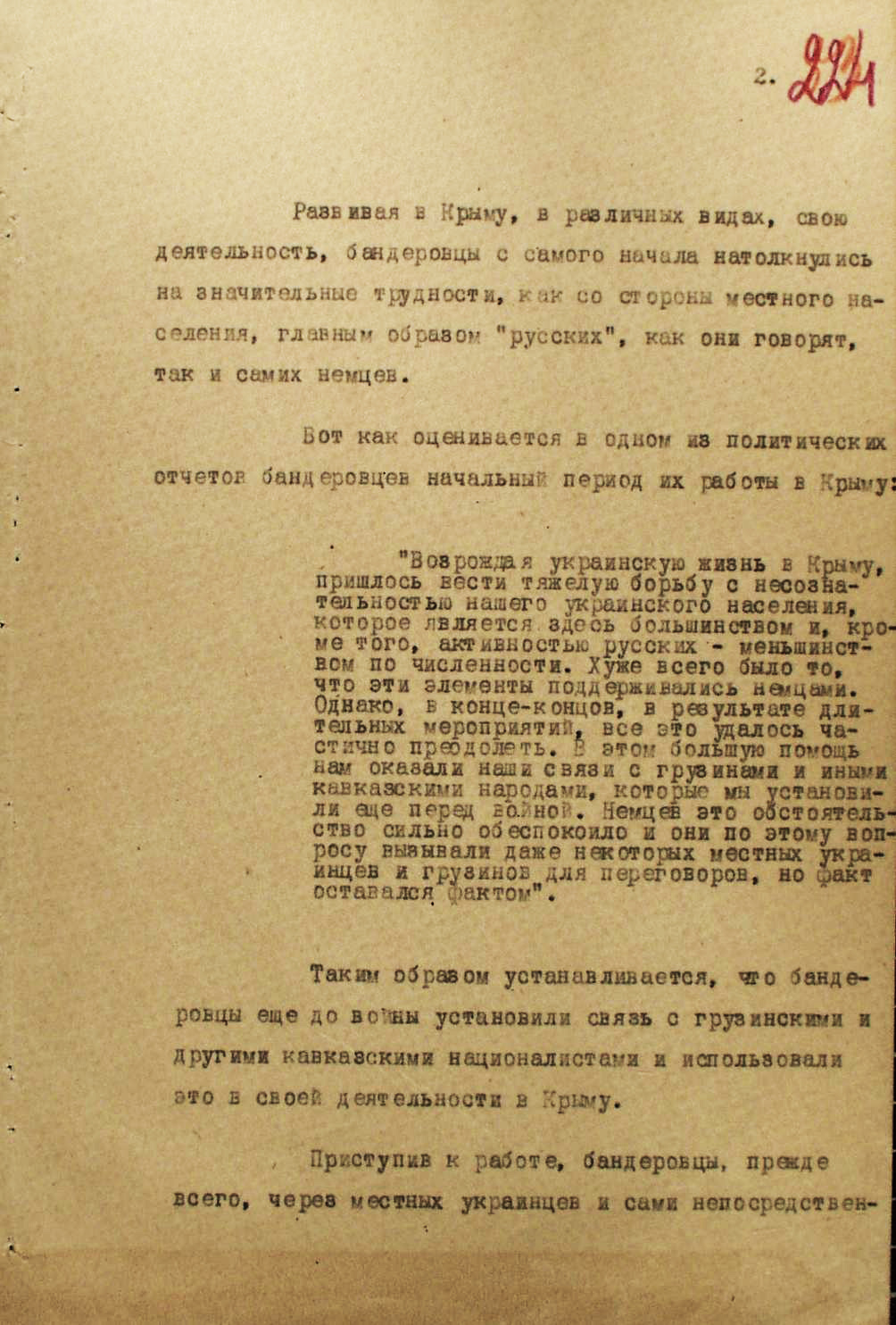
The beginning of the document explains why the Bandera-led OUN Provid immediately sent its representatives to Crimea for underground work. The goal was to spread the national idea in those areas for the future struggle for an independent Ukrainian state. At the same time, it is noted that Banderites immediately encountered significant difficulties from the local population and the German occupiers.
“In reviving Ukrainian life in Crimea,” reads the report of the OUN(b), “we had to wage a difficult struggle against the ignorance of our Ukrainian population, which constitutes the majority here, as well as against the activity of the russians, who are a numerical minority.”
The worst part is that these elements were supported by the Germans. Eventually, through sustained efforts, we managed to partially overcome the situation. Our connections with the Georgians and other Caucasian peoples – which we had established even before the war – proved to be of great assistance to us. This situation greatly troubled the Germans, and they even summoned some local Ukrainians and Georgians for negotiations on this matter, but the fact remains”.
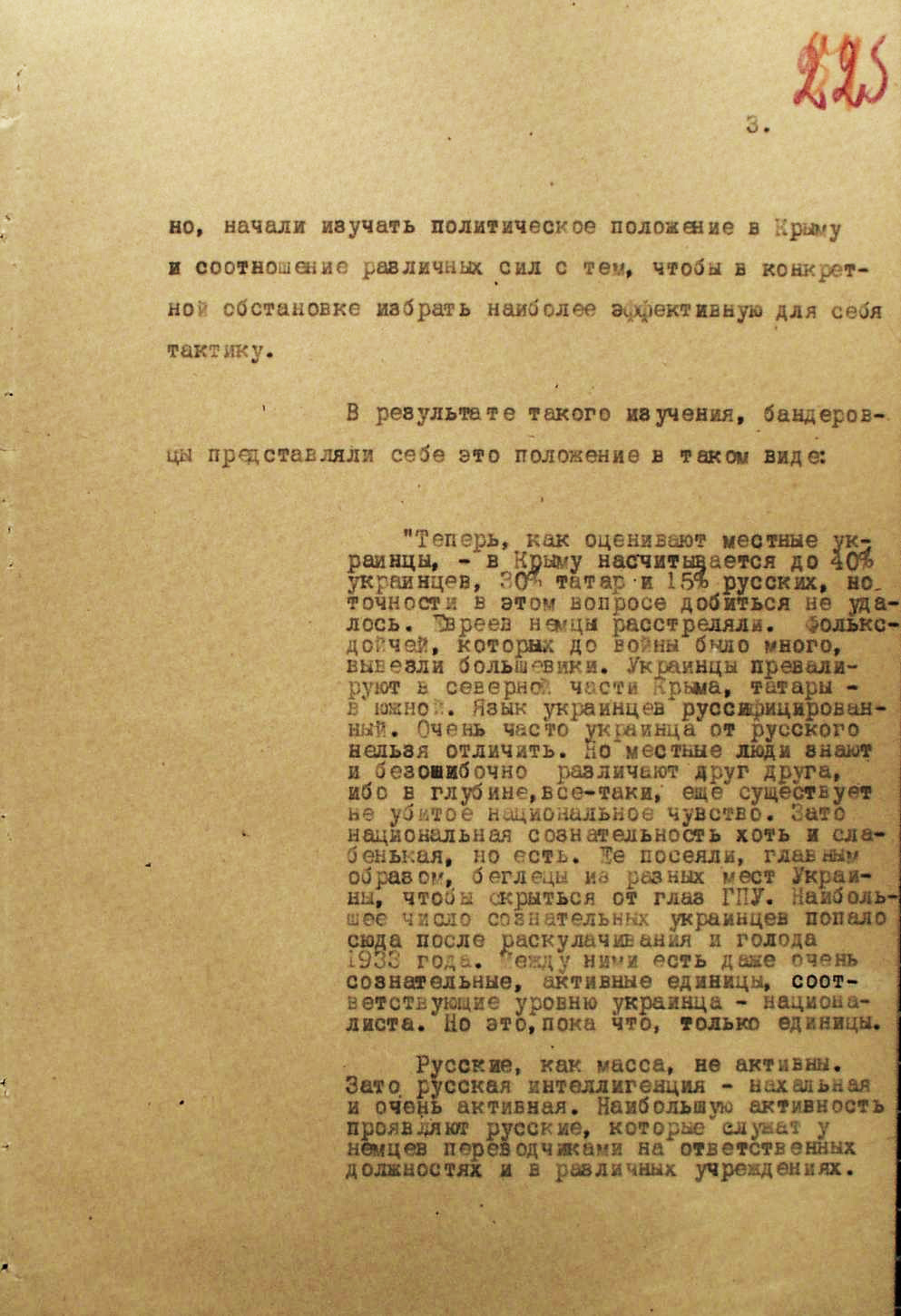
Based on an analysis of the report, the special message concluded that OUN members had thoroughly studied the balance of power on the Peninsula, the ethnic composition of the population, public sentiment, and interrelationships in order to properly organize their work. Based on this, they provided certain information.
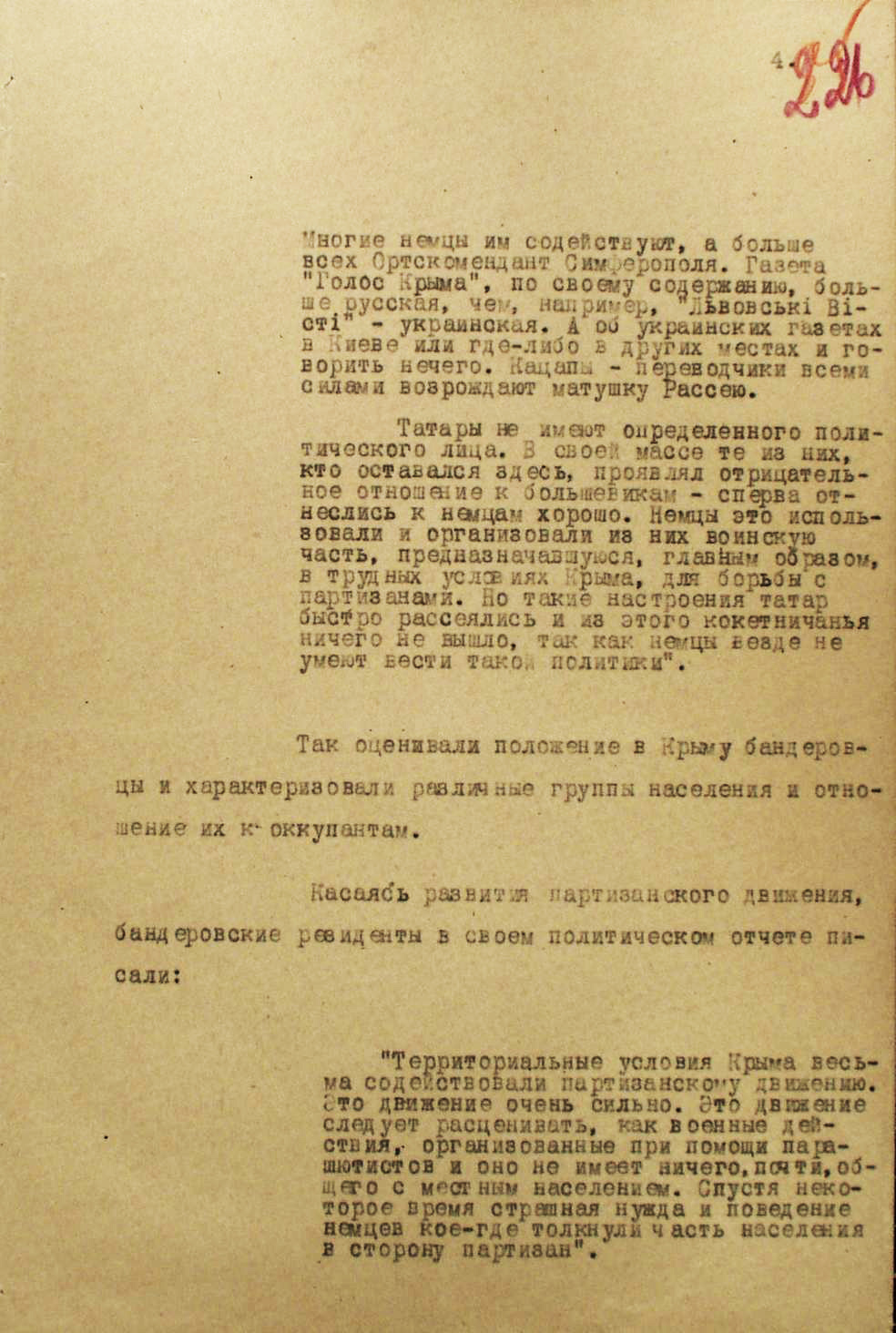
“According to estimates by local Ukrainians,” reads the report, “40% of the population of the Crimea are Ukrainians, 30% – Tatars, and 15% – russians, but it was not possible to achieve precision on this matter. Jews were shot by Germans. The Volksdeutsche, who were numerous before the war, were deported by the bolsheviks. Ukrainians predominate in the northern part of Crimea, Tatars – in the southern part. The Ukrainian language has been russified. Very often, it is impossible to tell a Ukrainian from a russian. But the local residents know and can tell them apart without fail, because deep down, a national sentiment that has not been completely extinguished still exists. National consciousness, though weak, does exist. It was sown mainly by refugees from different parts of Ukraine who came to hide from the gpu. The largest number of politically conscious Ukrainians arrived here following the dispossession of the kulaks and the famine of 1933. Among them there are even highly conscious, active individuals who meet the standard of a Ukrainian nationalist. But so far, these are few. russians, as a general mass, are not active. The russian intelligentsia, however, is arrogant and very active. The most active are the russians who serve the Germans as translators in positions of responsibility and in various institutions… russian translators are doing everything in their power to revive mother russia”.
The nkvd’s special message draws attention to the fact that despite such difficulties and certain contradictions with the Melnykites, the Bandera followers still tried to advance cultural and educational life. Moreover, through local Ukrainians, they organized a bold protest against the “dominance of russians” and conveyed this in writing to the German occupying authorities.
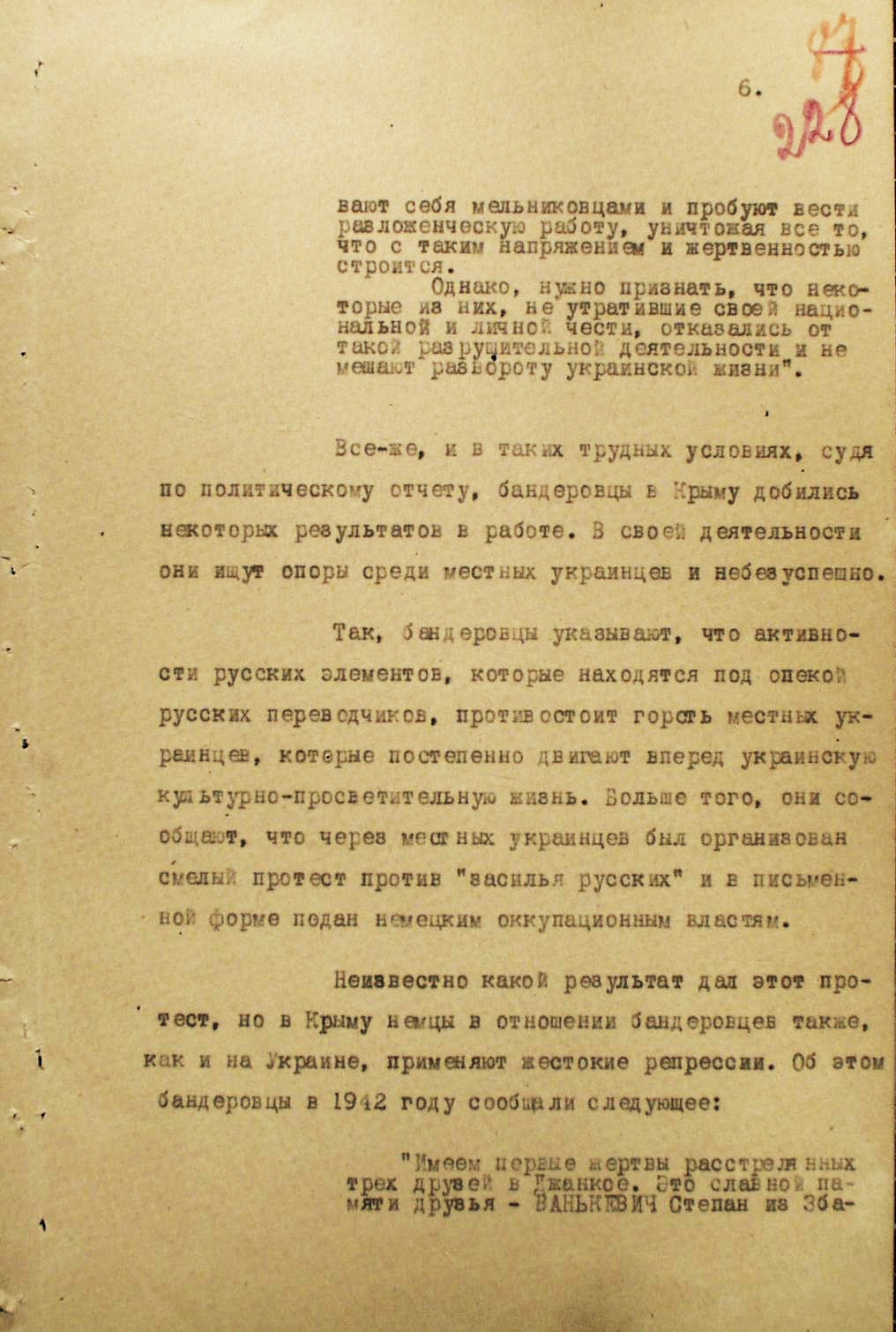
Further in the special message, citing the report, facts are presented regarding the persecution of Banderites by the Nazis for their activities. In the text, chekists themselves state the following: “…in Crimea, the Germans are using brutal repression against the Banderites, just as they do in Ukraine.”
Here is a quote regarding this from the OUN(b) report: “We have the first victims: three friends shot in Dzhankoy. These are our friends of glorious memory – Stepan Vankevich from Zbarazh, Mykhailo Liubak from Lviv, and Roman Bardakhivskyi from Sambir district. The fourth – Ivan Osadchuk – was arrested and taken to Lviv, where he died of typhus in a camp.”
Those arrests took place in 1942. In addition, the chekists reported that as early as late 1941, the Nazis had arrested a group of Banderites in Yevpatoria. “Along with other detainees,” the special message points out, “at the moment when our fleet unexpectedly landed troops there, the Germans were leading the banderites to a firing squad, but they ran away.”
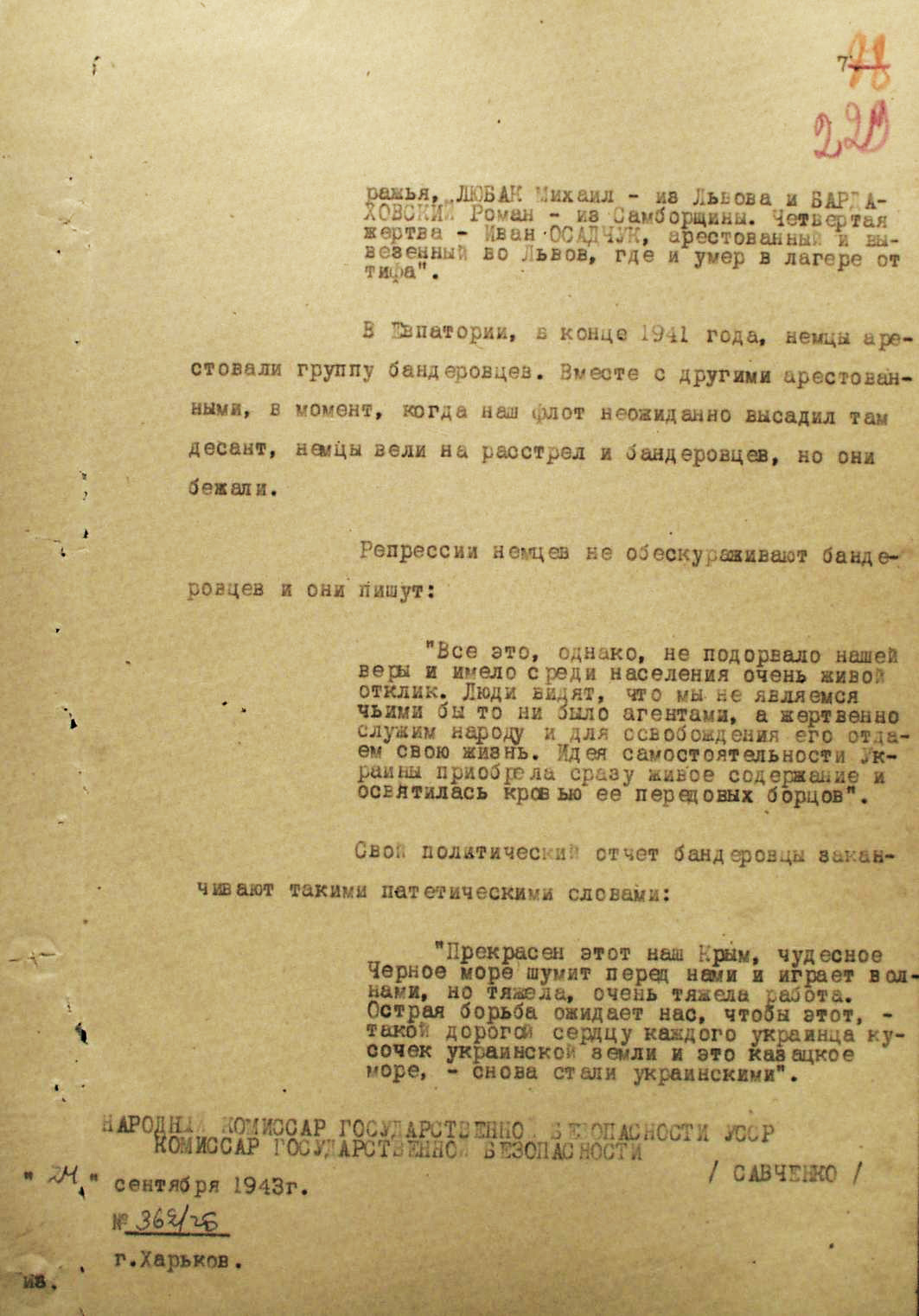
After citing these examples, the nkvd concluded that the repressions had not thrown off balance the Banderites. To confirm this, they quoted the following from the report: “This, however, did not undermine our faith and resonated strongly among the population. People see that we are not anyone’s agents, but selflessly serve the people and give our lives for their liberation. The idea of Ukraine’s independence immediately took on a living meaning and was sanctified by the blood of its vanguard fighters.”
The chekists also concluded their special message with a quote from the report, which they called pathetic. Here are those words: “Our Crimea is magnificent, the magnificent Black Sea roars before us and plays with its waves, but the work is hard, very hard. A fierce struggle awaits us for this piece of Ukrainian land – so dear to the heart of every Ukrainian – and this Cossack sea to become Ukrainian again.”
Thus, neither the OUN(b) report nor the text of the nkvd’s special message contains any mention of “close collaboration between Banderites and the fascist invaders” or the commission of “countless crimes against prisoners of war and civilians on the Peninsula,” as russian propaganda continues to repeat to this day, deliberately ignoring historical realities and distorting the facts. The document found in the archives provides further clear evidence of this.
(FISU. – F. 1. – Case 7092. Vol. 1. – P.P. 223–229).