Colonel Alfred Bizants. Notes from the Internal Prison of the mgb of the Ukrainian ssr
6/8/2026
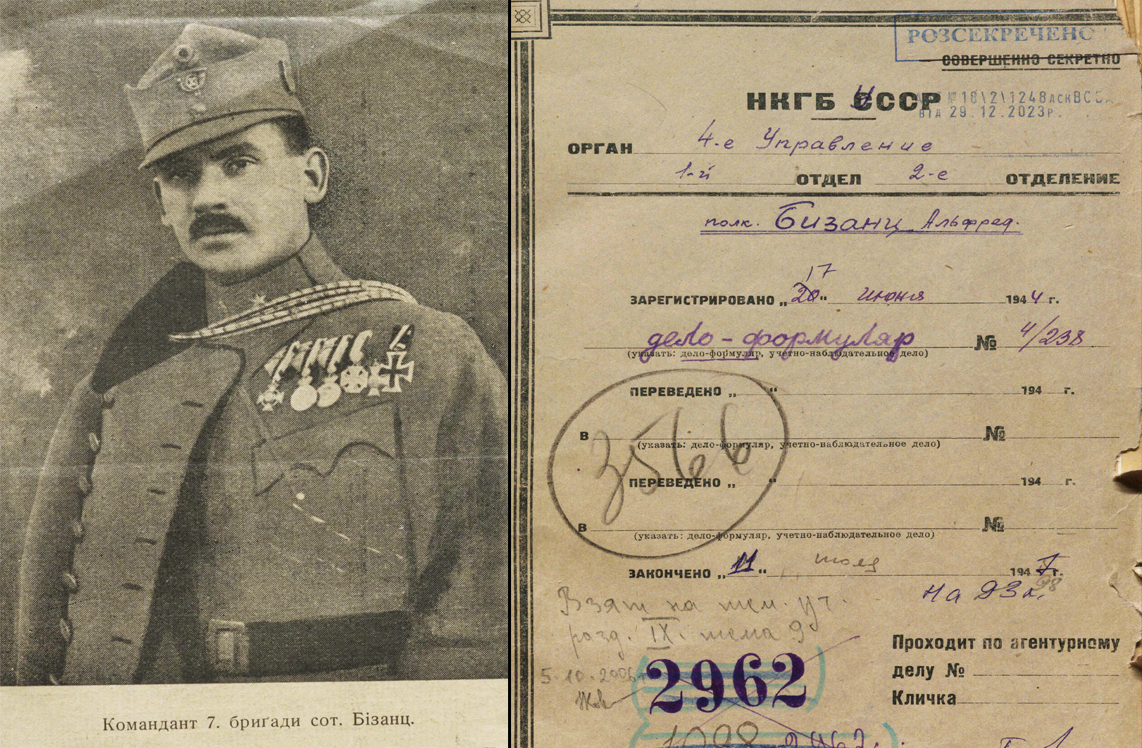
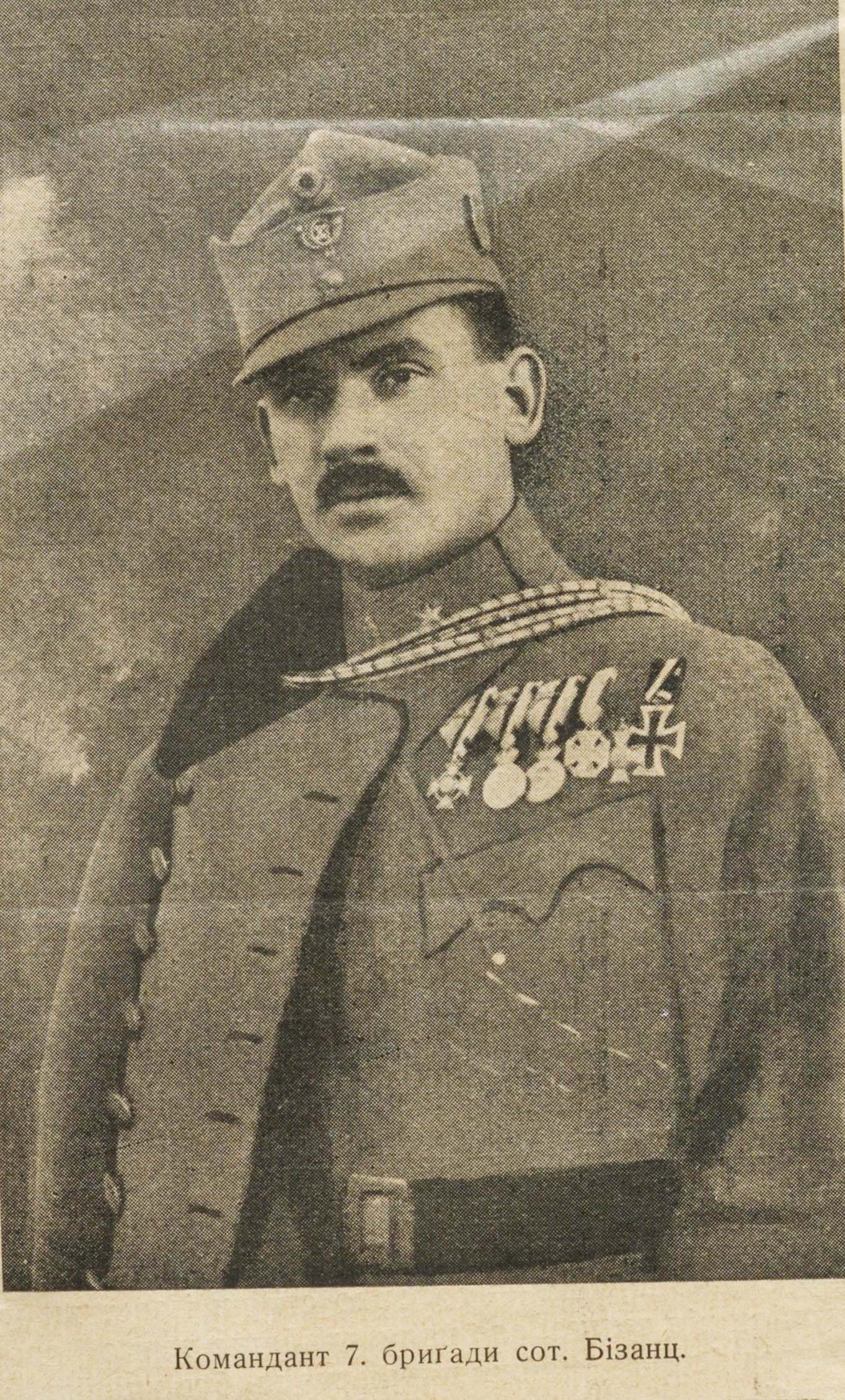
A case file has been discovered in the archives of the Foreign Intelligence Service of Ukraine that historians had been searching for unsuccessfully for a long time, concerning an active participant in the Ukrainian liberation struggle of 1918–1920, Colonel of the UGA and the Army of the Ukrainian People’s Republic, and one of the initiators and organizers of the formation of the “Halychyna” Division, Alfred Bizants. Actually, two case files. They shed light on some previously unknown circumstances of his arrest – in fact, his abduction by the soviet secret police in Vienna in 1945, his transfer, and his detention under investigation.
The fate of Alfred Bizants bears some resemblance to the story of the Austrian Archduke Wilhelm Franz von Habsburg-Lothringen, known as Vasyl Vyshyvanyi, who became a Colonel in the Legion of Ukrainian Sich Riflemen and played a prominent role in the Ukrainian national liberation movement. He, too, began a successful career in the Austro-Hungarian Army, then commanded various units within the Ukrainian Galician Army and the Army of the Ukrainian People’s Republic, was acquainted with prominent Ukrainian military and political figures, and throughout his life sought to serve the Ukrainian cause; and after the end of World War II, he was captured by SMERSH (an acronym derived from the initial letters of the slogan “Death to Spies!” [Russian: Смерть шпионам!], a counterintelligence unit of the people’s commissariat of defense (nko) of the ussr. It existed from April 1943 to March 1946 – Transl.) agents in Vienna, transported to Kyiv for investigation, and charged with collaborating with a number of foreign intelligence services. But despite many similarities, these are still different stories.
The name A. Bizants appears in numerous intelligence and operational case files, including those concerning Yevhen Konovalets, Andriy Melnyk, Stepan Bandera, Mykola Kapustianskyi, Volodymyr Kubiyovych, and other Ukrainian figures. Their paths crossed on numerous occasions. But a case was opened against him only in 1940. This is explained by the fact that after significant activity during the liberation struggle of 1918–1920, he actually withdrew from participation in public and political life for nearly two decades and began reappearing in the public sphere only with the start of World War II.
In March 1941, the nkvd authorities of the Ukrainian SSR received information that Colonel A. Bizants of the former Ukrainian Galician Army was leading a Ukrainian camp in Krakow and was engaged there in the military training of OUN personnel. One of the documents bears a resolution by state security lieutenant Ivan Kudria: “Gather all materials on Bizants and open a case”. It was not without I. Kudria’s involvement that a request was sent to moscow asking for a copy of agent “Bohun”’s report on A. Bizants. I. Kudria was directly involved in recruiting “Bohun” and it was from him that he first heard the surname.
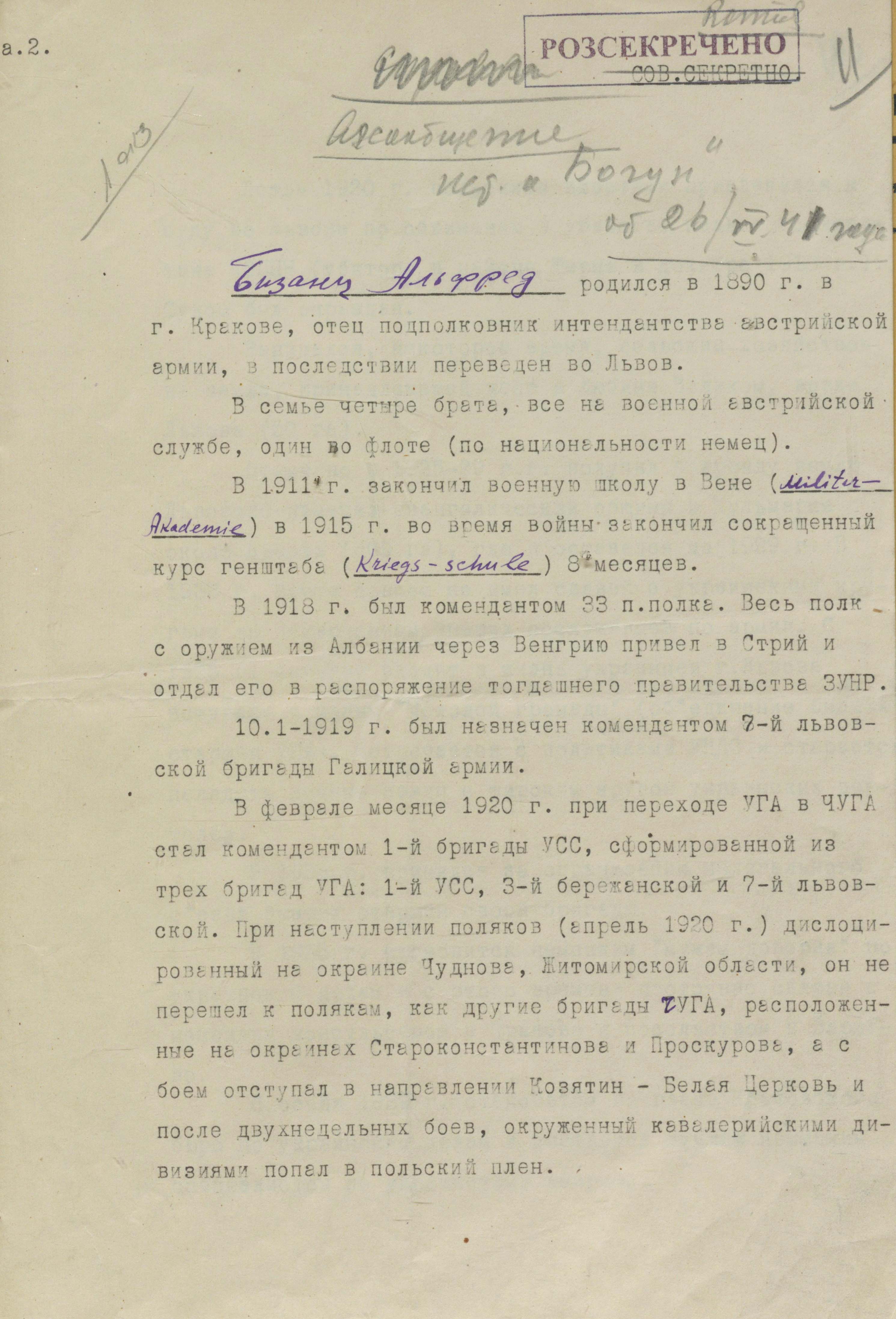
A reply signed by Pavel Sudoplatov arrived shortly thereafter. The document provided general information about A. Bizants, pointing out that he was born in 1890 and, during World War I, graduated in 1915 from the Austrian General Staff Academy after completing an accelerated course. In 1918, he brought the 33rd Infantry Regiment – in which he served and which consisted mainly of Galicians – from Albania through all of Hungary to Stryi and transferred it to the disposal of the ZUNR government. Shortly thereafter, he was appointed Commander of the 7th Lviv Brigade of the UGA. He participated in many battles and military operations. In particular, he took part in the Chortkiv Operation (June 8–28, 1919), which went down in the history of the Ukrainian Army as the Chortkiv Offensive and one of the UGA’s most brilliant operations. At that time, the government of the West Ukrainian People’s Republic ranked A. Bizants’s merits very high and promoted him to the rank of Colonel.
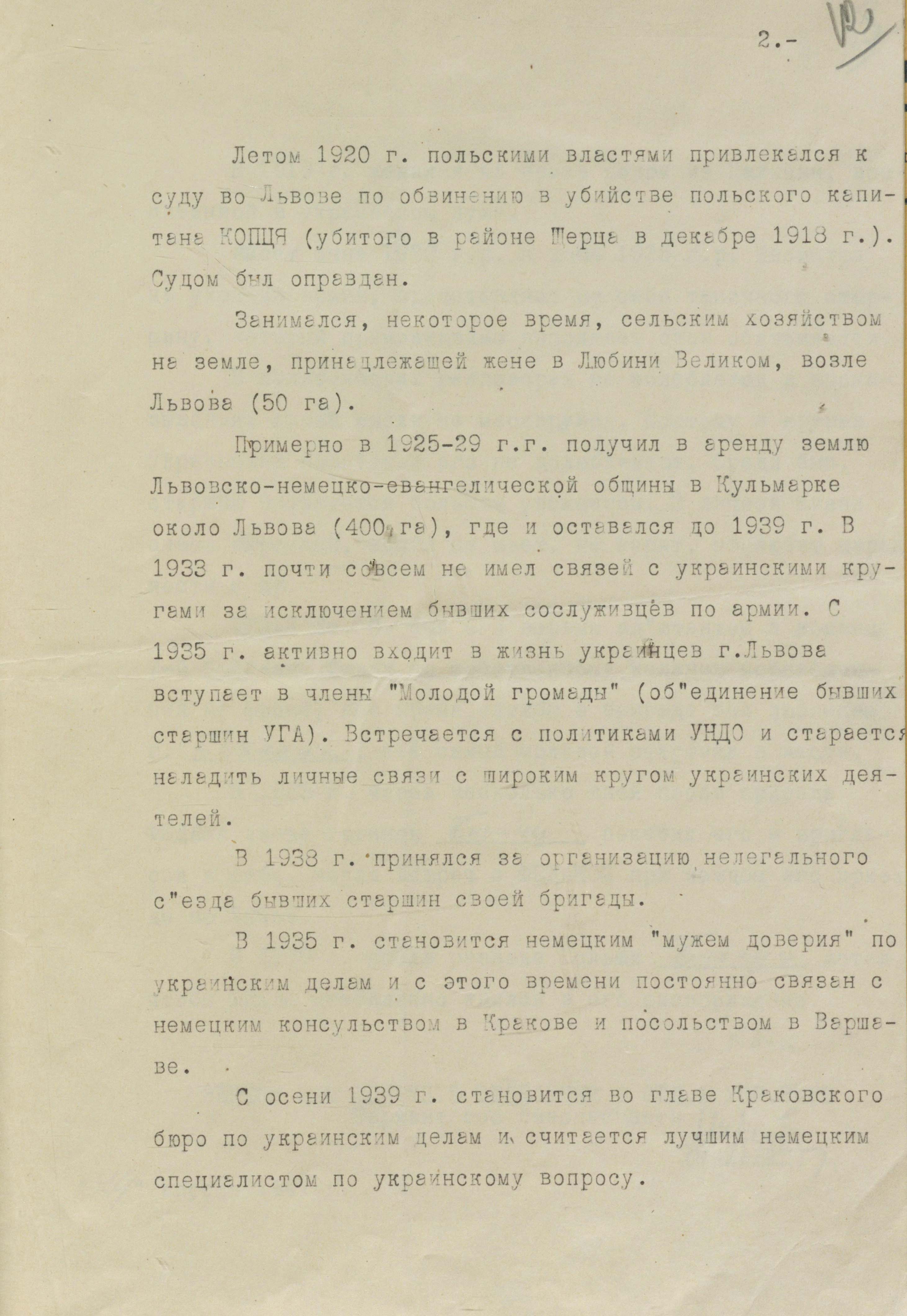
Later, A. Bizants served in the General Staff of the Army of the Ukrainian People’s Republic. In August 1919, his unit fought successfully during the united Ukrainian armies’ advance on Kyiv. Soon after, along with the remnants of the Ukrainian Army, he was sent to an internment camp in Poland. After the war ended and he was released from the camp, he returned to his native village in Lviv region, where he subsequently lived with his family and worked as a farmer.
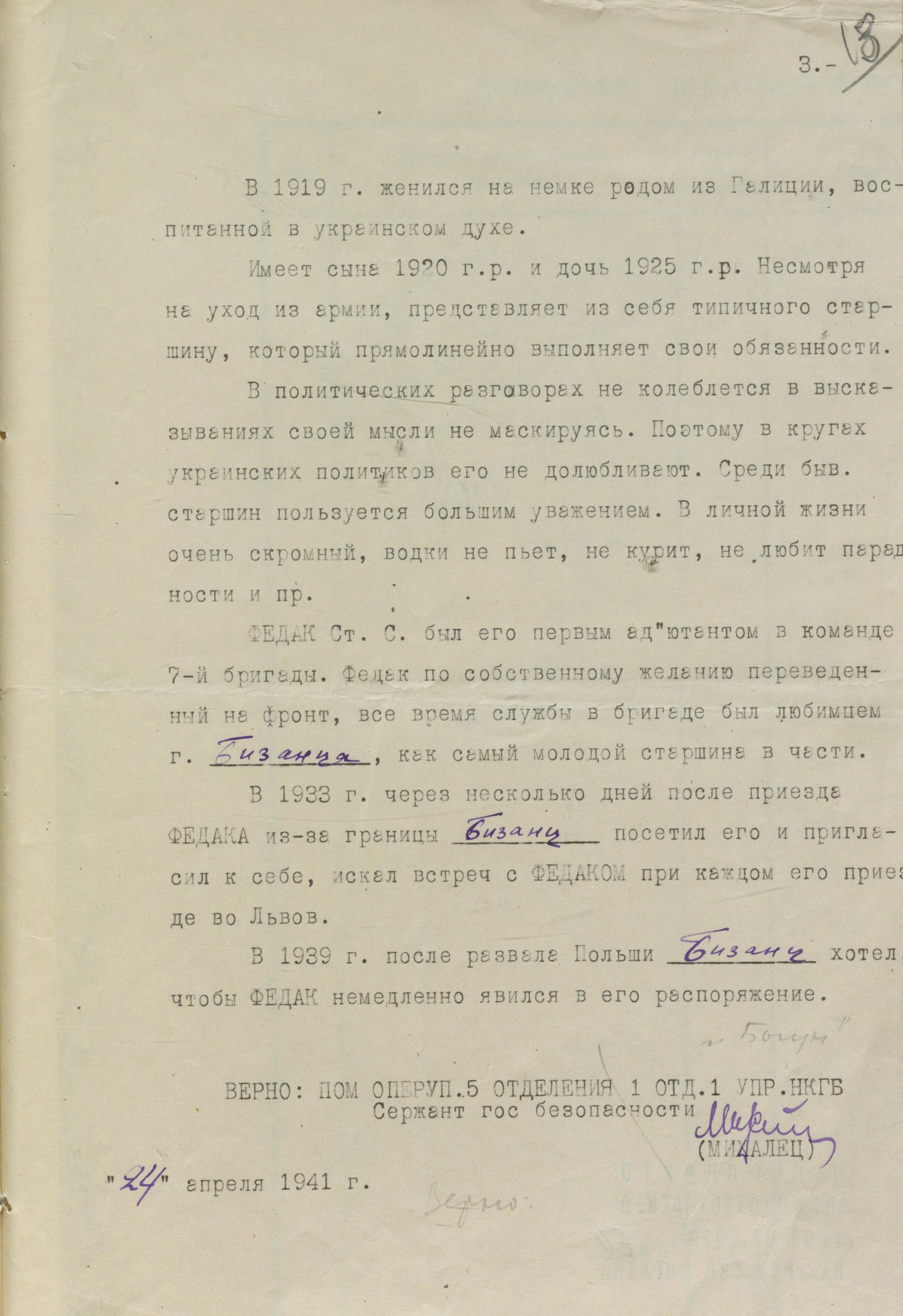
“Bohun” pointed out that A. Bizants “married a German woman originally from Halychyna who had been raised in the Ukrainian spirit. He had a son, born in 1920, and a daughter, born in 1925. Despite his discharge from the army, he has the appearance of a typical senior officer who straightforwardly fulfills his duties. In political conversations, he does not shy away from expressing his opinions. For this, he is disliked in Ukrainian political circles. Among former senior officers, he is held in high regard…” (FISU. – F. 1. – Case 7413. – P. 11–13).
Besides, “Bohun” reported that A. Bizants had maintained close contacts with German diplomatic representatives since the mid-1930s, and in the autumn of 1939 moved with his family to Krakow, where he volunteered for service in the administration of the General Government. At the same time, former UGA sotnyk Hans Koch, with whom they had served together, arrived in the city. He took up the position of advisor to Governor-General H. Frank on Ukrainian affairs and helped Alfred secure a position as an adviser on Ukrainian affairs. Soon after, H. Koch left for Lviv, and A. Bizants took his place.
All of this served as the basis for opening in April 1941 of a case file against A. Bizants, as a person engaged in counterrevolutionary activities against the ussr within the territory of the general government. However, further operational investigation was interrupted by the German-soviet War. A second case was opened in June 1944 based on information that, as an adviser on Ukrainian affairs, he was actively involved in the formation of the “Halychyna” Division and served as the head of the division’s military administration.
In neither case is A. Bizants’s correct place of birth ever mentioned. Przemyśl, Kraków, or Lviv are listed. In reality, he was born on November 15, 1890, in the German colony of Dornfeld (now the village of Ternopillia in Mykolaiv district, Lviv region) to the family of the wealthy colonist Karl Bizants. He attended a village school, then a gymnasium in Lviv, and the Imperial and Royal Cadet School in Lviv (now the Hetman Petro Sahaidachnyi Army Academy). He was fluent in Ukrainian and respected Ukrainian national traditions. Later, during World War II, he repeatedly helped free Ukrainians from Nazi prisons and concentration camps. This is mentioned in open sources.
But the chekists were interested in a completely different kind of information. In the documents of the nkvd, and later the mgb, he was listed as an agent of the Abwehr – German military intelligence. Therefore, they gathered evidence specifically regarding his collaboration with German intelligence agencies and other organs of the occupying authorities. Besides, they were interested in anything related to his involvement in the creation of the “Halychyna” Division.
In early 1946, the mgb received information from foreign agents that A. Bizants had appeared in Vienna, where his wife lived. Soon, a smersh operational group tracked him down and arrested him in March. A report compiled on the basis of the investigative file states that in May of that same year he was transferred to moscow, and until October 25, the investigation was conducted at the 3rd main directorate of the ussr mgb. He was held in Butyrka Prison. During his initial interrogations, he provided testimony only regarding his service in the Austrian Army, the UGA, and the Army of the Ukrainian People’s Republic, and also gave a general account of his activities during the occupation.
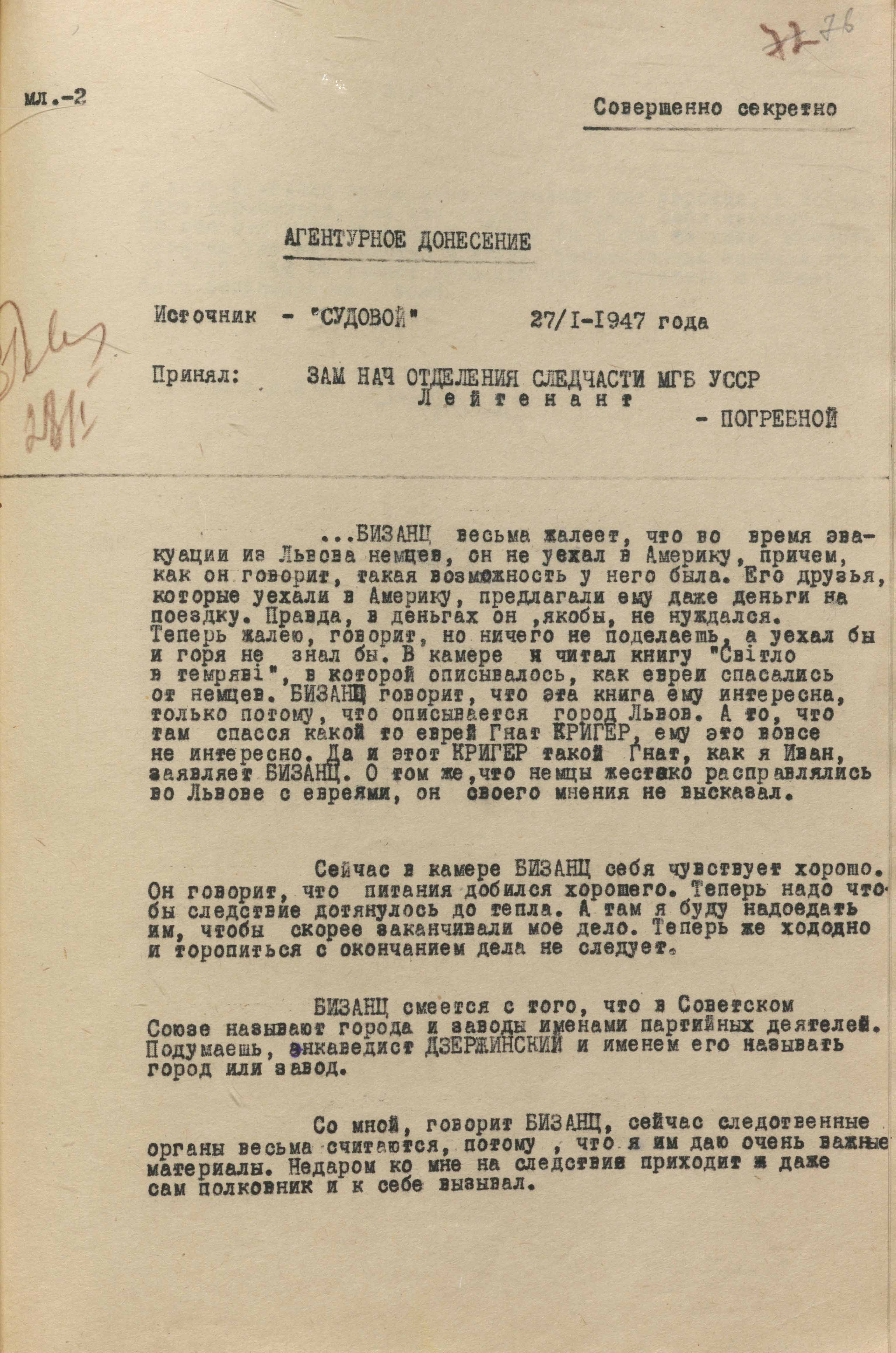
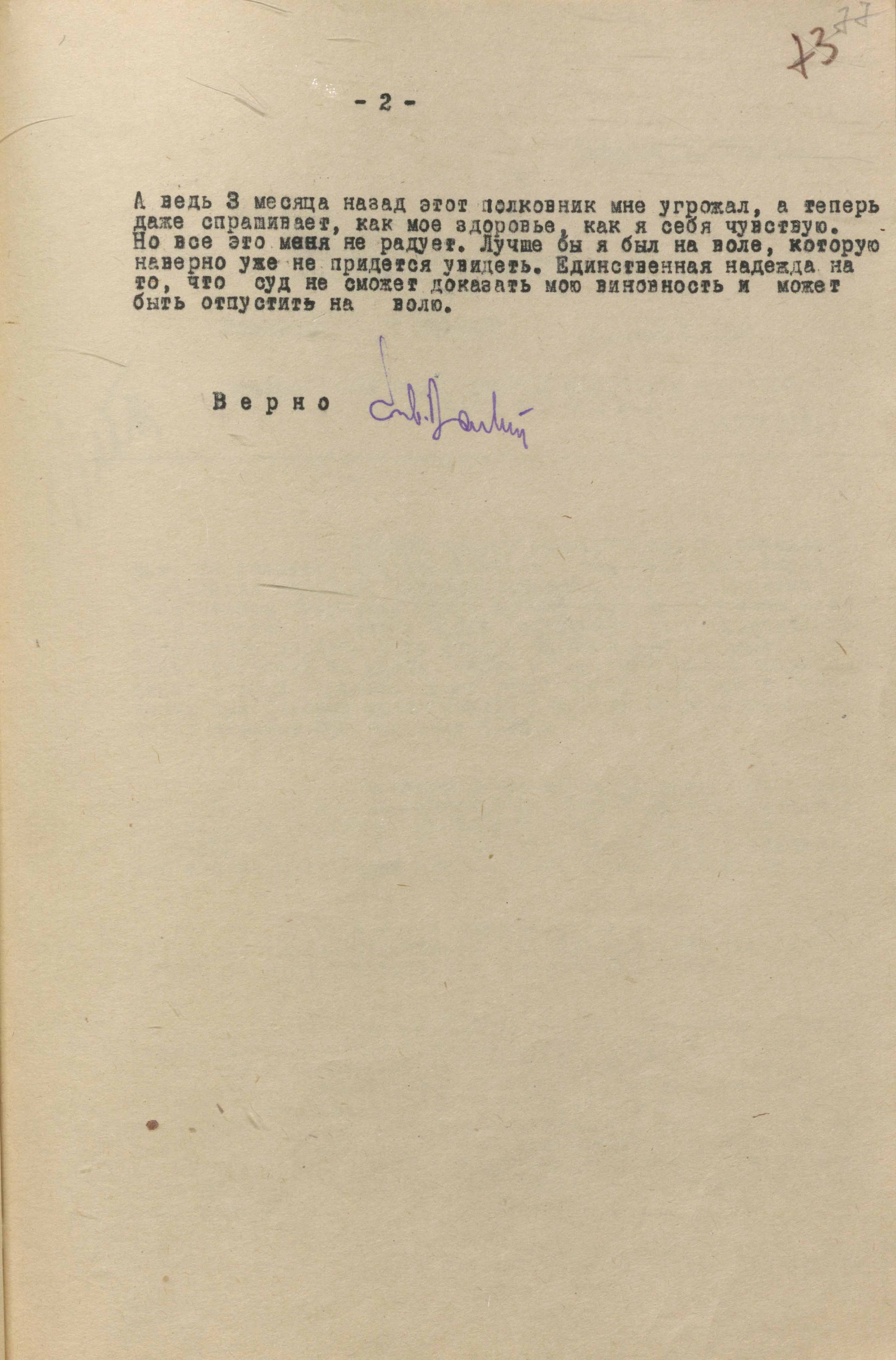
In late October 1946, A. Bizants was transferred to the investigative unit of the mgb of the Ukrainian ssr in Kyiv to continue the investigation and was placed in the mgb’s internal prison. It is the documents from that period that are unique and allow us to trace, at least in fragments, the course of events at that time. The case file contains a series of reports from agent “Sudovyi”, who was used to gather information from A. Bizants while he was in custody. He reported to the investigator everything he heard from A. Bizants in the cell or managed to find out as part of his assigned task.
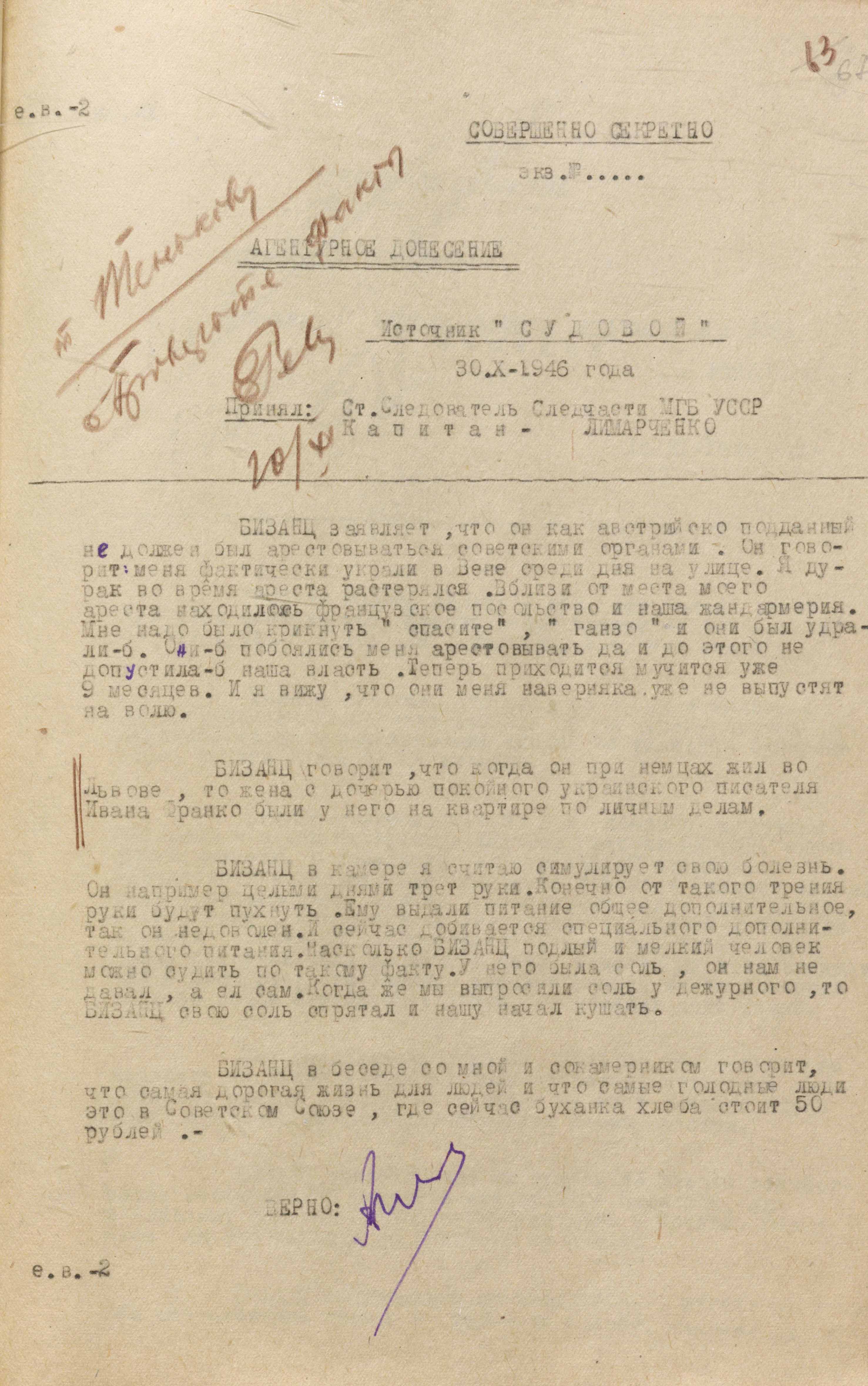
From agent “Sudovyi”’s report dated October 30, 1946:
“Bizants claims that, as an Austrian citizen, he should not have been arrested by soviet authorities. He says: ‘I was actually kidnapped in Vienna in broad daylight on the street. I, a fool, panicked during the arrest. The French embassy and our gendarmerie were located near the site of my arrest. I should have shouted ‘Help,’ and they would have fled. They would have been afraid to arrest me, and our authorities would not have allowed it anyway. Now I’ve been suffering for nine months. And I see that they certainly will never release me.”
(FISU. – F. 1. – Case 7413. – P. 63).
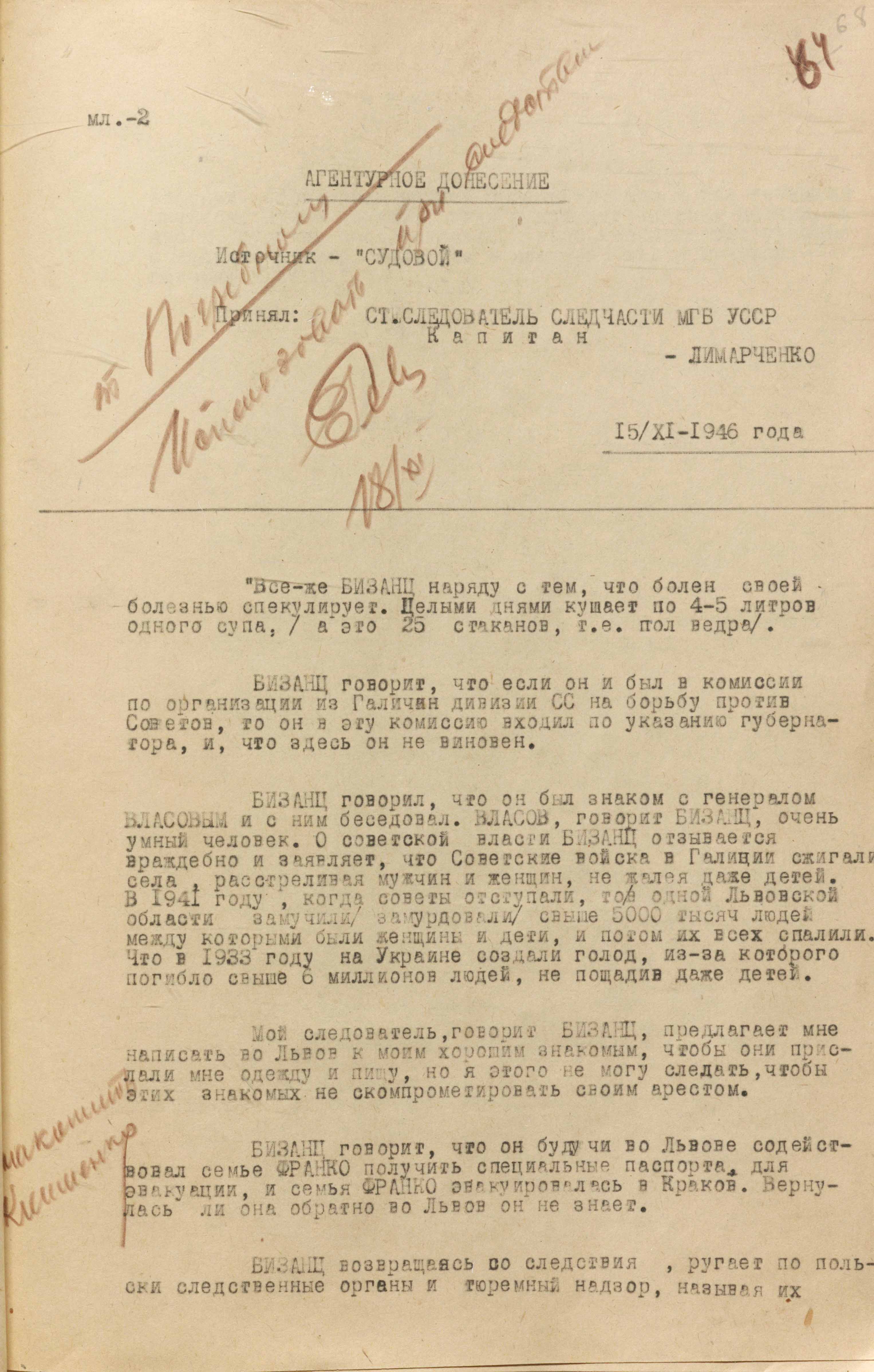
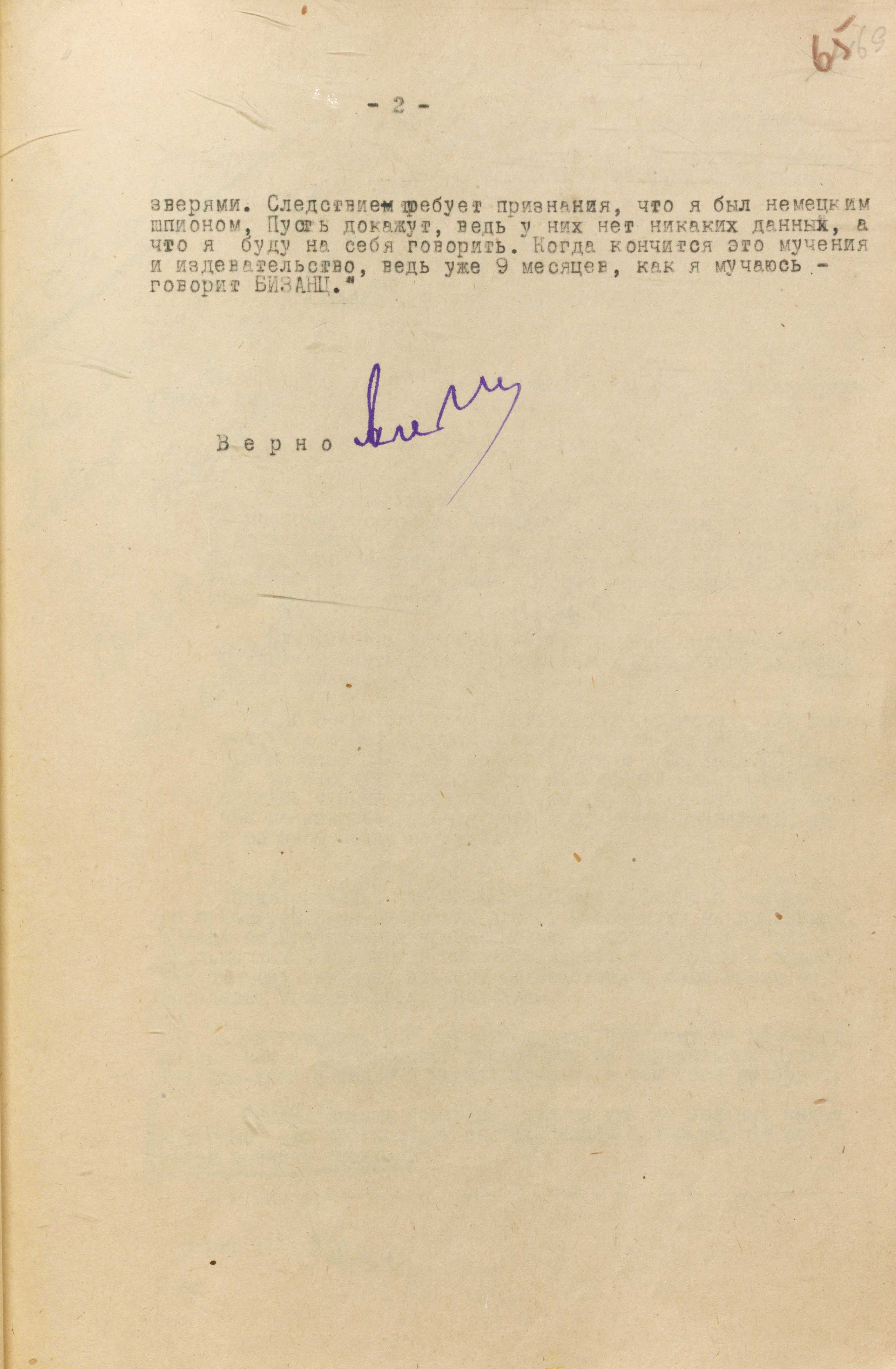
From a report by agent “Sudovyi” dated November 15, 1946:
“Bizants speaks hostilely of the soviet authorities and states that soviet troops in Halychyna burnt villages, shot men and women, and spared not even children. In 1941, when the soviets were retreating, in Lviv region alone they tortured (murdered) over 5,000 people, including women and children, and then burnt them all”
(FISU. – F. 1. – Case 7413. – P. 64).
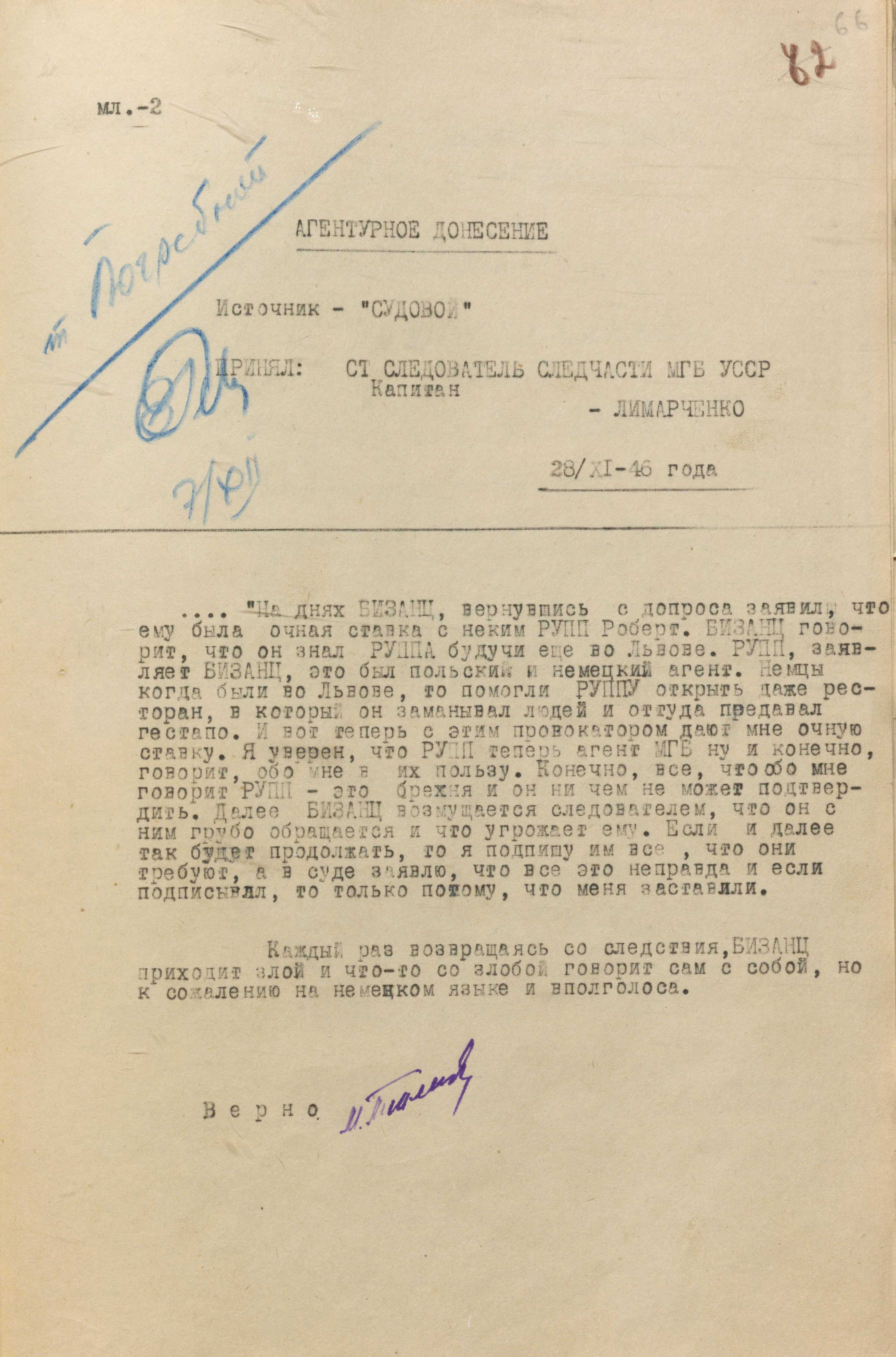
From a report by agent “Sudovyi” dated November 28, 1946:
“Bizants is indignant at the investigator, claiming that he is treating him rudely and threatening him. He says: ‘If this continues, I will sign whatever they demand, but in court I will claim that none of it is true, and that I signed only because I was forced to.’
Every time he returns from an interrogation, Bizants comes back angry and mutters something discontentedly to himself, but, unfortunately, in German and in a low voice”
(FISU. – F. 1. – Case 7413. – P. 62).
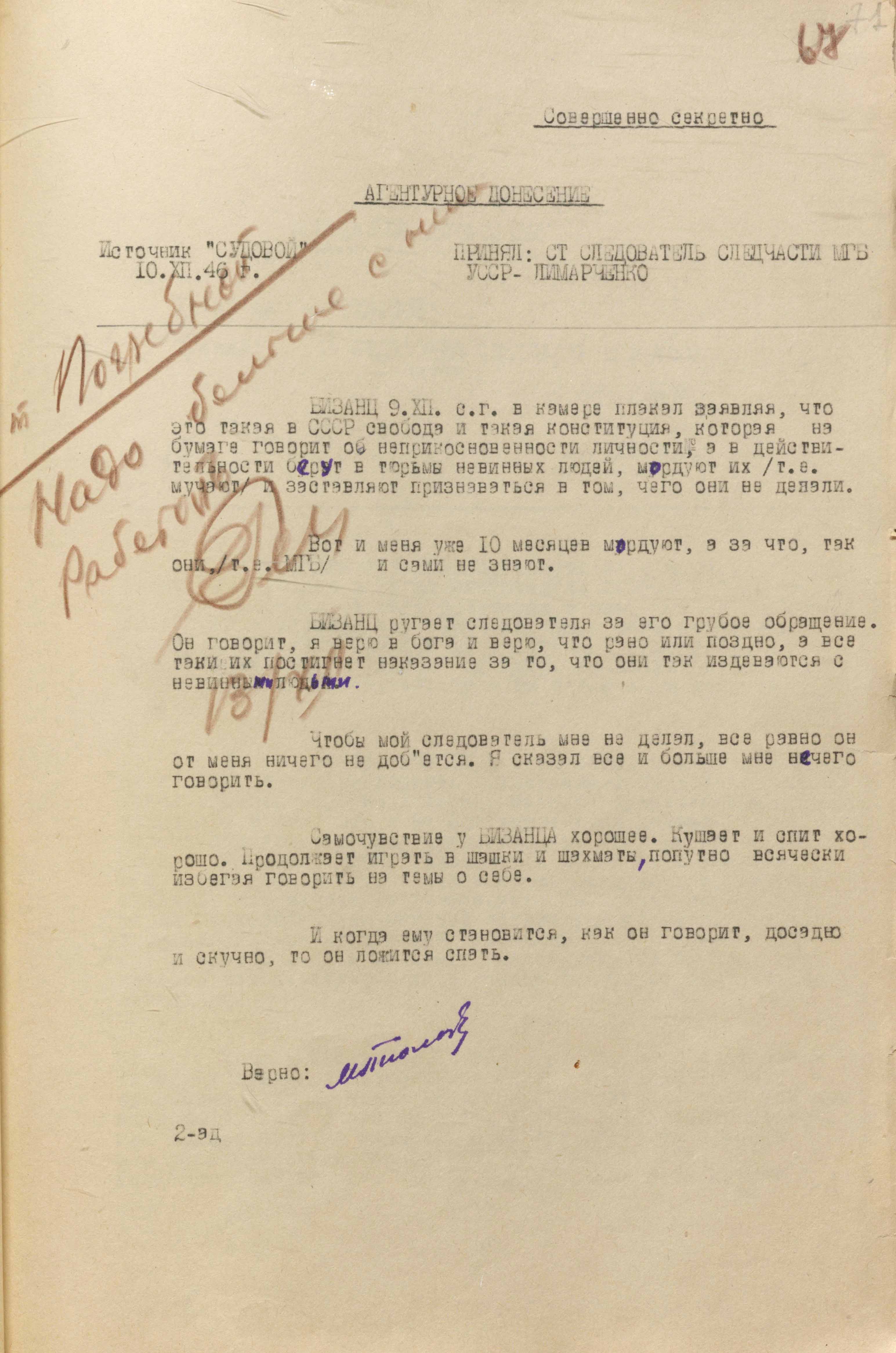
A. Bizants repeatedly complained about the investigators’ mistreatment. He called them and the prison guards beasts. He said that he believed in God and believed that sooner or later they would be punished for torturing innocent people in this way. He pointed out that they demanded, above all, that he confess to being a German spy. At this, he stated that the investigation had no evidence of this, and he would not incriminate himself. And when they threatened him with solitary confinement, he was prepared to go on a hunger strike.
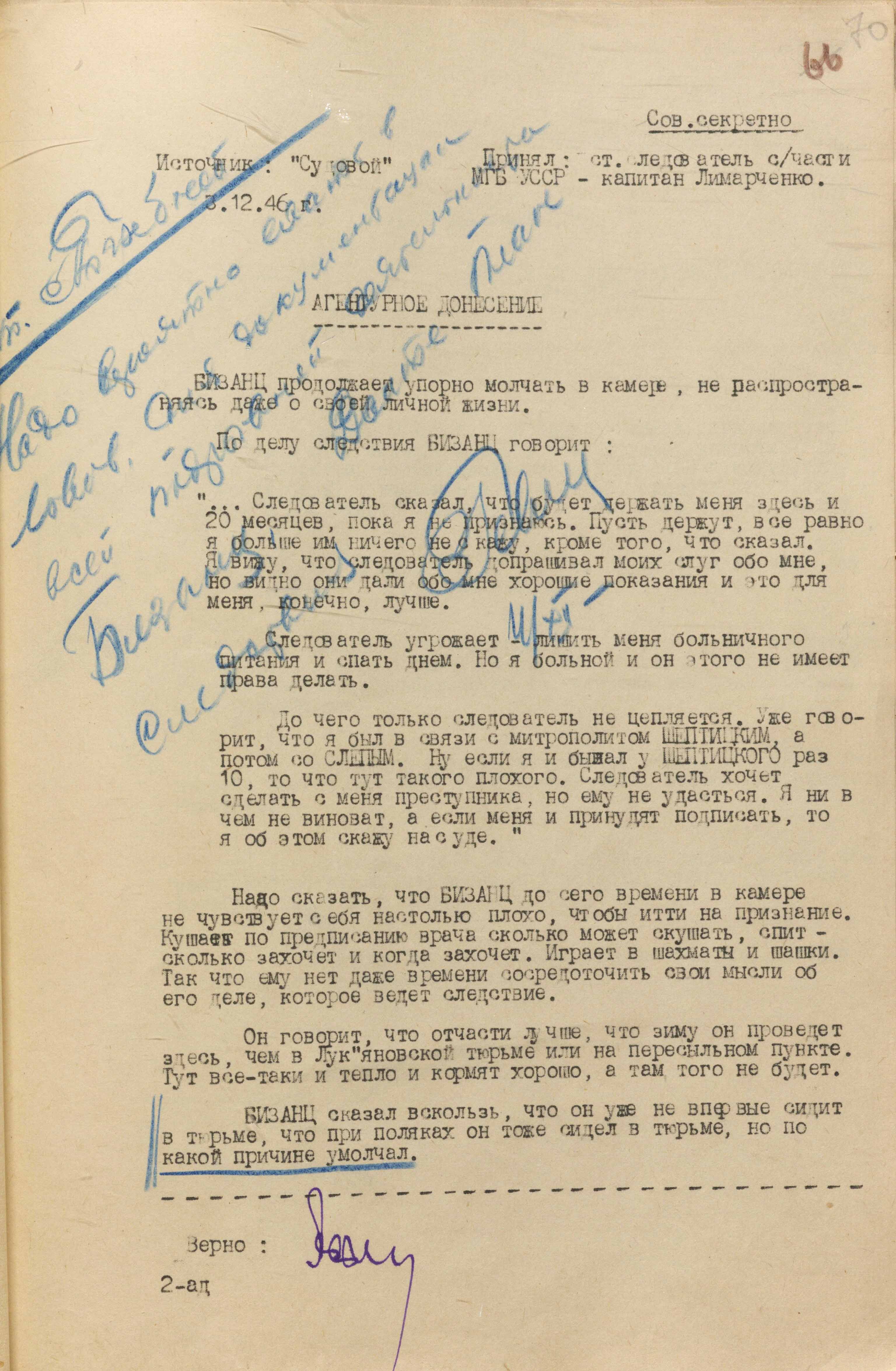
From a report by agent “Sudovyi” dated December 3, 1946:
“Regarding the interrogation, Bizants noted: ‘The investigator said he would keep me here for 20 months until I confess. Let them keep me; I won’t tell them anything anyway, except what I’ve already said…
The investigator is threatening to deprive me of hospital food and my daily nap. But I’m ill, and he has no right to do that.
There’s nothing the investigator won’t latch onto. He’s already saying that I was connected to Metropolitan Sheptytskyi, and then to Slipyi. Well, even if I visited Sheptytskyi about 10 times, what’s wrong with that?”
(FISU. – F. 1. – Case 7413. – P. 66).
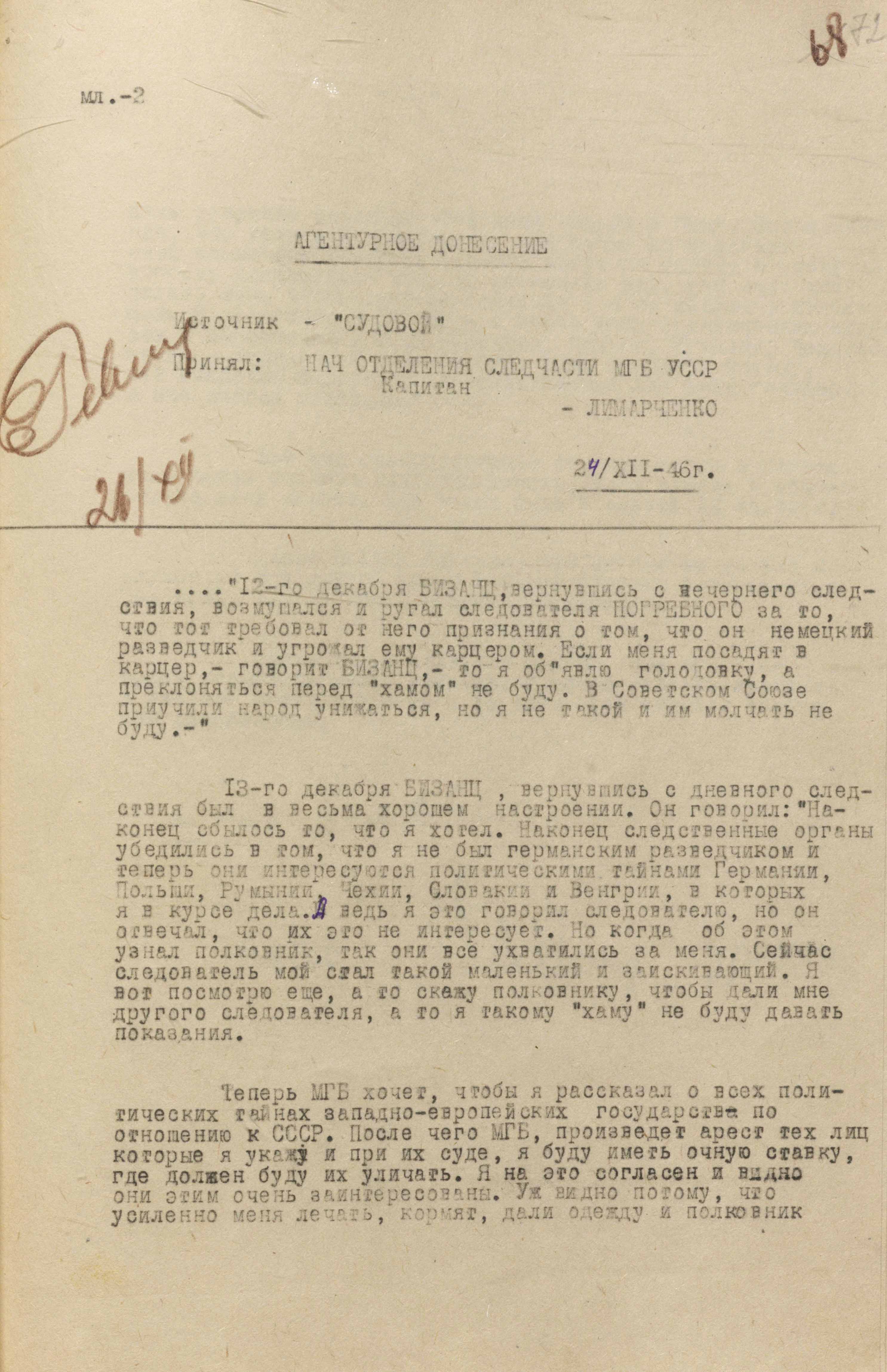
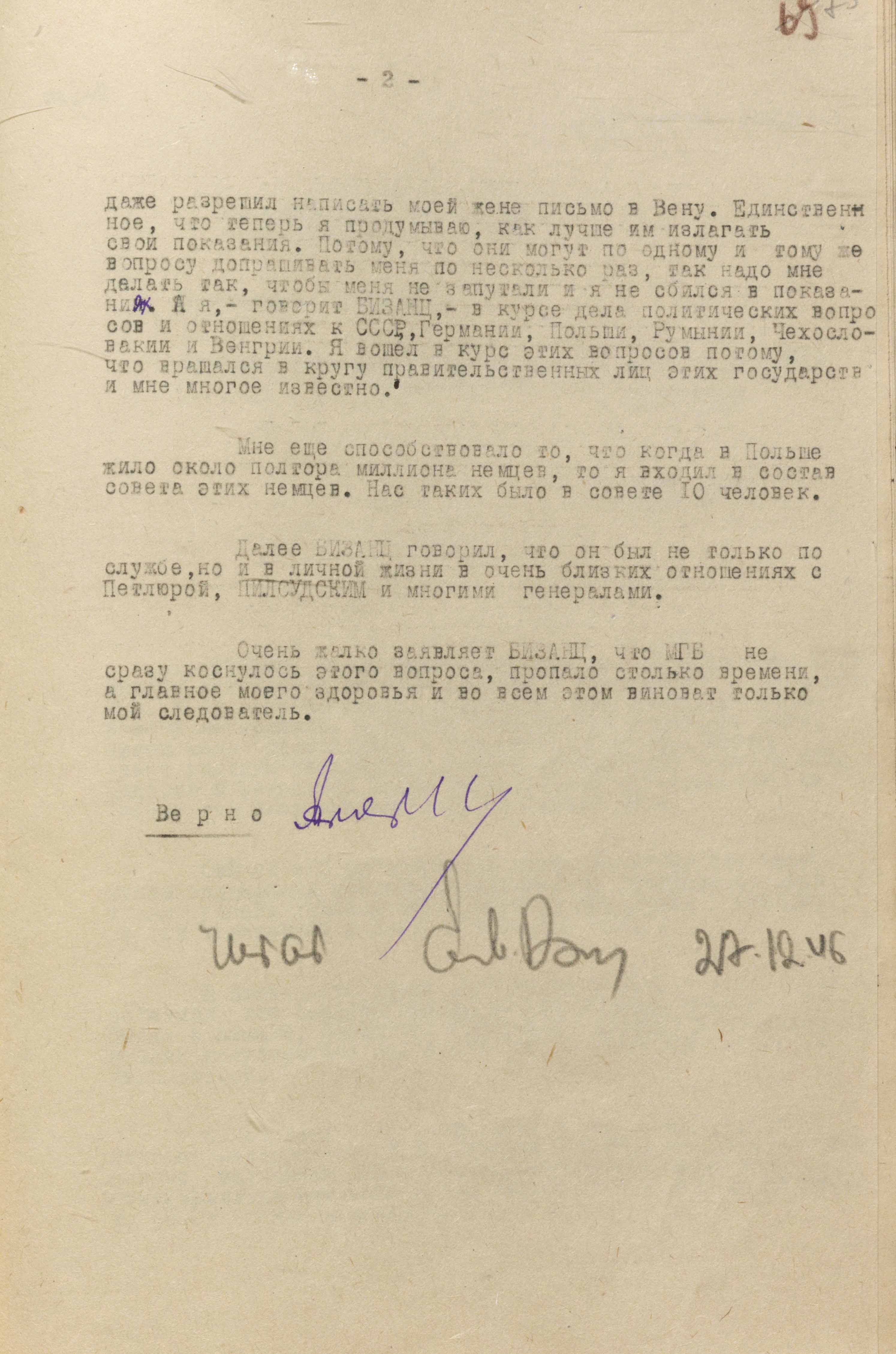
For a time, as reports from “Sudovyi” indicate, they stopped trying to extract a confession from A. Bizants that he was a German spy. Instead, they began to take an active interest in his connections in political circles in Germany, Poland, Romania, Czechoslovakia, Hungary, Sweden, France, Spain, and other countries, and wanted him to reveal the “political secrets of Western European states regarding the ussr” known to him. He allegedly did so willingly. At this, he pointed out that at one time “he had close personal and professional ties with Petliura, Piłsudski, and many generals”, and while living in Poland, he was a member of some council that dealt with German affairs. After that, during interrogations, the investigators allegedly began to treat him better and even allowed him to write a letter to his wife. But it didn't last long.
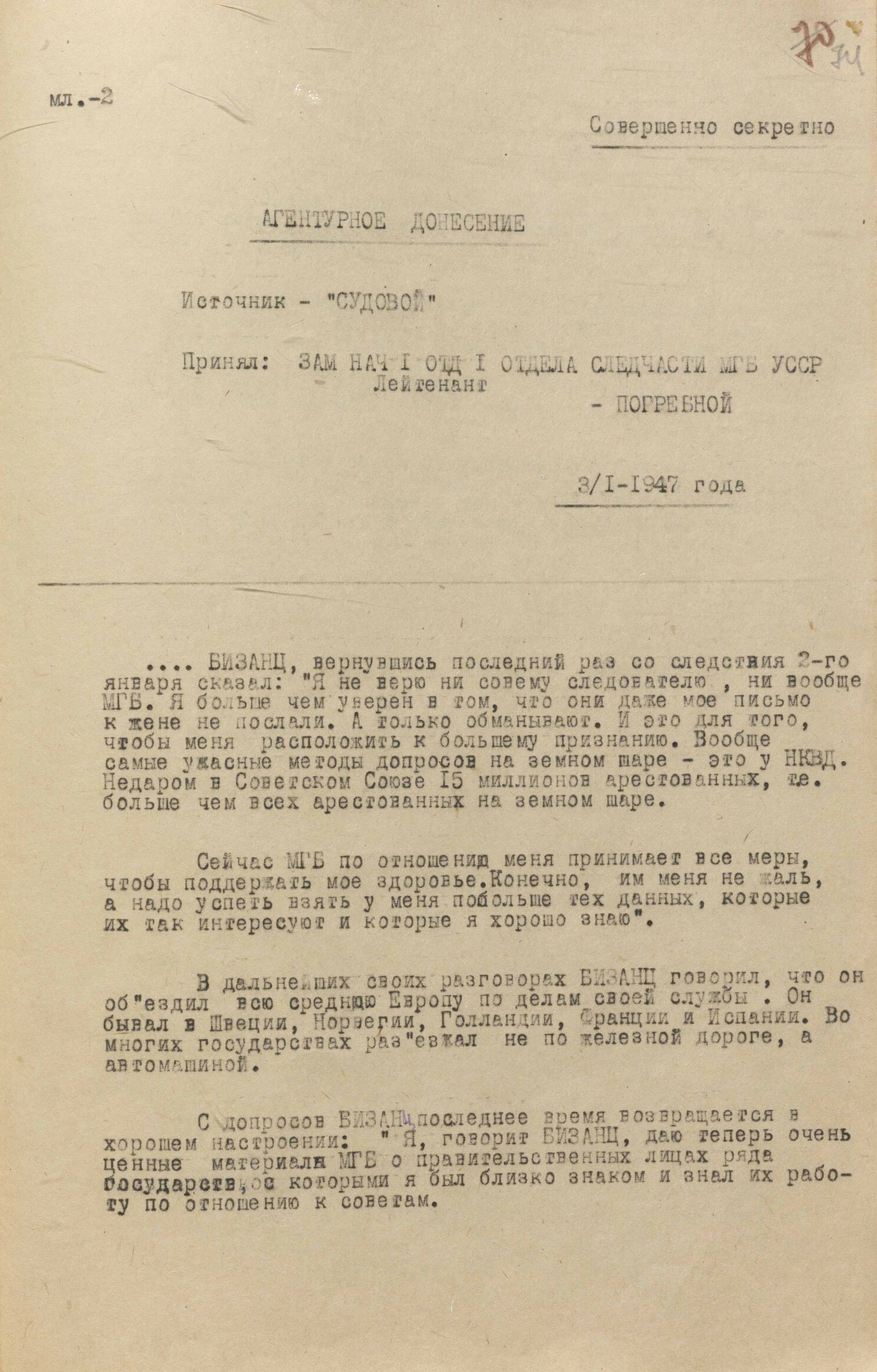
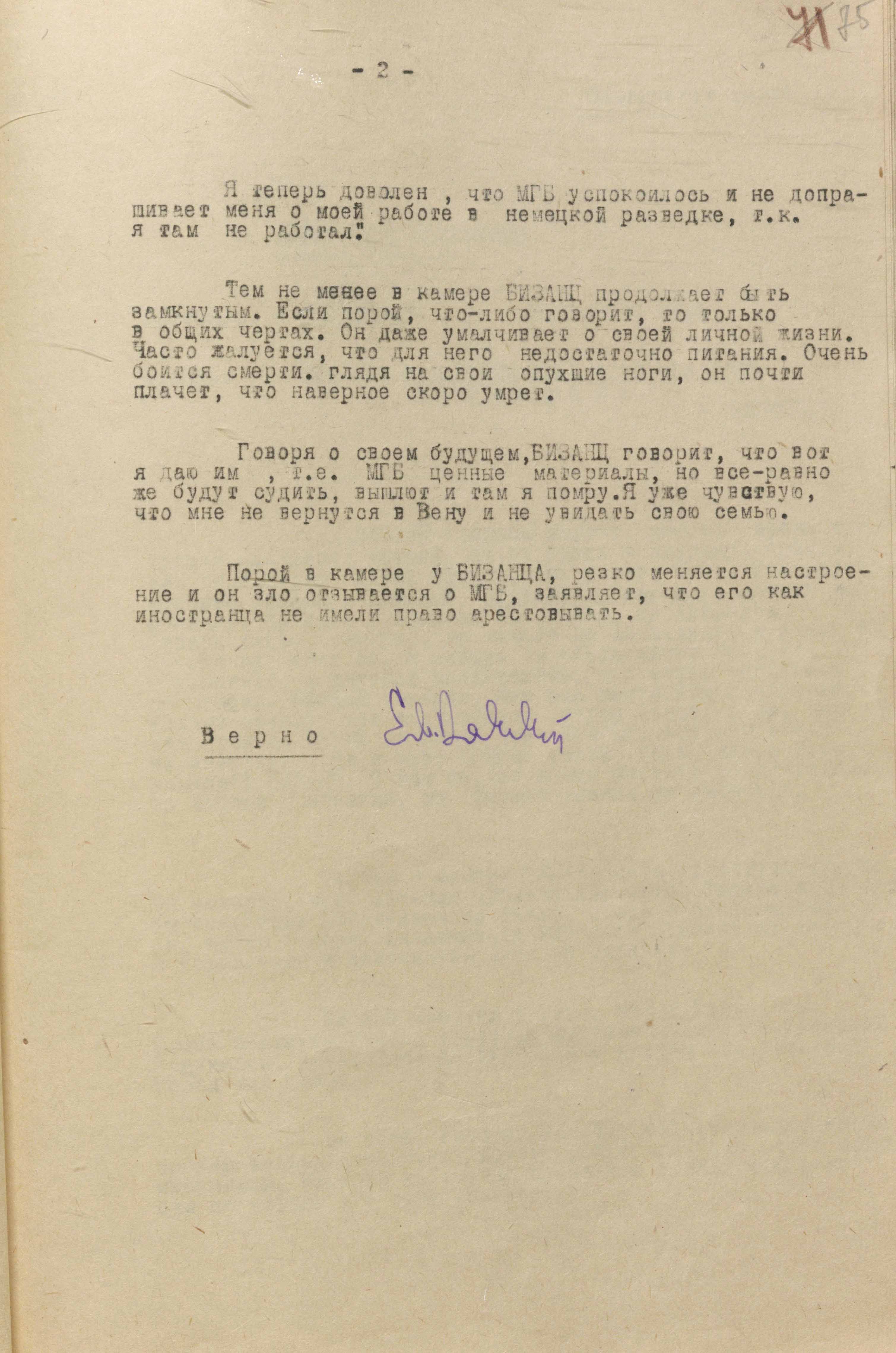
From agent “Sudovyi”’s report dated January 3, 1947:
“Bizants, upon returning from his final interrogation on January 2, said: ‘I don’t trust my investigator, nor the mgb in general. I am more than certain that they didn’t even send my letter to my wife. They’re just lying. And all of this is to coerce me into making further confessions.’ In general, the most horrific interrogation methods on the face of the earth are used by the mgb. No wonder there were 15 million people arrested in the soviet union – that is, more than all those arrested on earth combined”.
(FISU. – F. 1. – Case 7413. – P. 70).
Disappointment, despair, and the premonition that he would never be released and would die in prison grew stronger with each passing month. A report based on the investigation file points out that A. Bizants gradually began to reveal everything they wanted from him, including his connections with German intelligence. More precisely, he was forced to testify to this.
In early July 1947, the investigation was concluded and an indictment was prepared. On July 19, the military tribunal of the ministry of internal affairs of the Ukrainian ssr in Kyiv region sentenced A. Bizants to 25 years to be served in correctional labor camps. This is the last document attached to the case.
Documents found in other archives indicate that as of January 1949, A. Bizants was in Dubrovlag, and in May of that same year, he was in Special Camp No. 3. Accounts of his subsequent fate vary. Some sources state that he allegedly died in 1949 in the Mordovian camps in Potma, while others claim that he ended up in the vladimir central (A russian prison for particularly dangerous criminals in the city of vladimir – Transl.), where he was sentenced to death by a firing squad for sabotaging work and was executed in 1951.
The tragic fate of Alfred Bizants, like that of Vasyl Vyshyvanyi, is yet another testament to the brutality of the repressive system of the stalinist regime at that time. Both died in soviet prisons under circumstances that have not been fully clarified. Their burial sites remain unknown, and information about both was deliberately concealed by the kremlin authorities in order to erase even the memory of those who fought for the Ukrainian cause and opposed the totalitarian regime.