How the OUN Security Service Uncovered in Its Ranks a Valuable Agent of the mgb of the Ukrainian ssr
4/13/2026
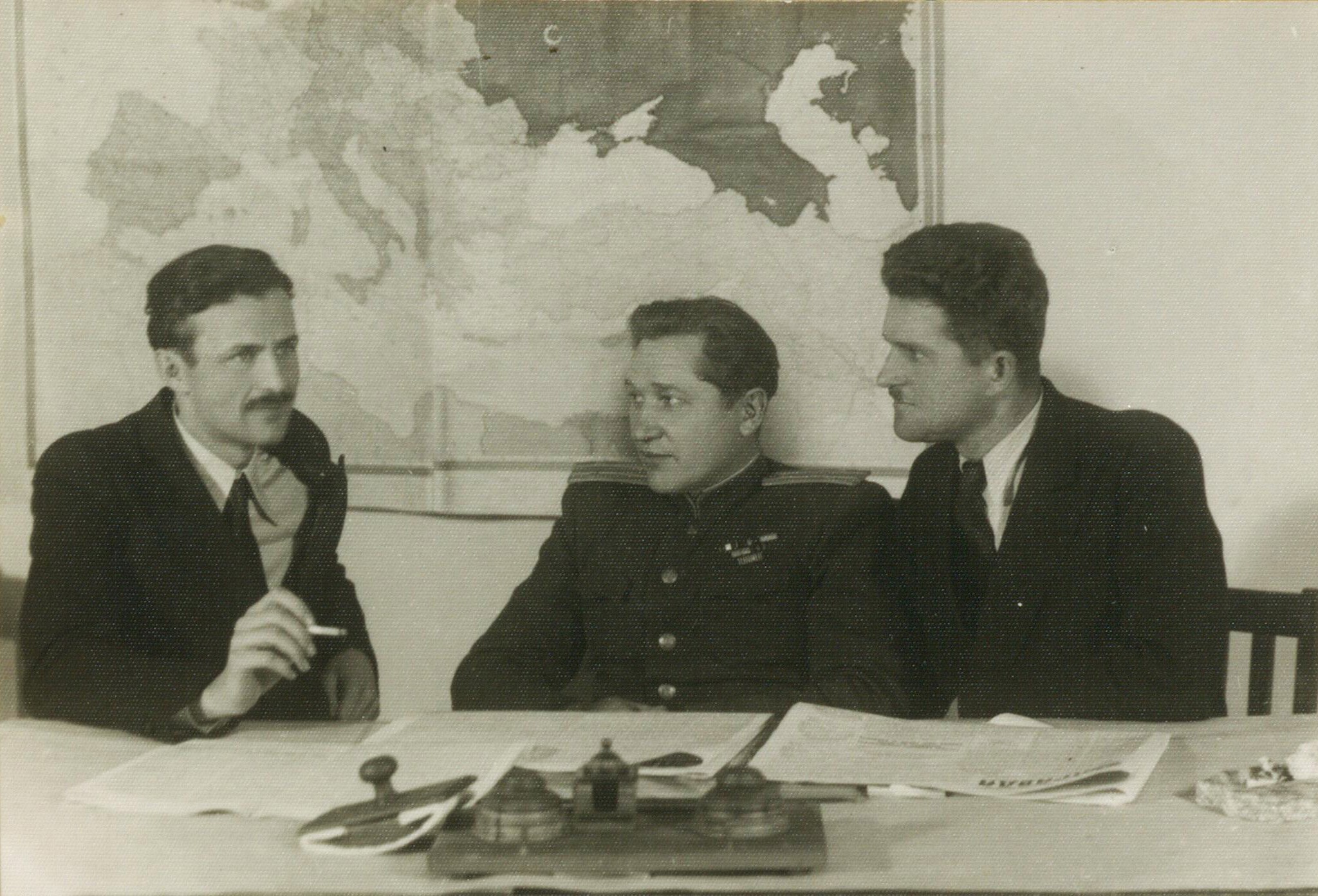
Among the documents in the archives of the Foreign Intelligence Service of Ukraine, a number of files have been found detailing how, at various times, the nkvd / mgb / kgb of the ussr made considerable efforts to infiltrate the most secretive structures of Ukrainian émigré organizations abroad, particularly the Security Service of the OUN’s Foreign Units. The new declassified part of history tells how this was done, what methods were used to coerce certain individuals into cooperation, and how representatives of the Ukrainian liberation movement managed to counteract the infiltration of enemy agents – and sometimes even expose “moles” within their ranks.
Ambush in the Village of Modrychi
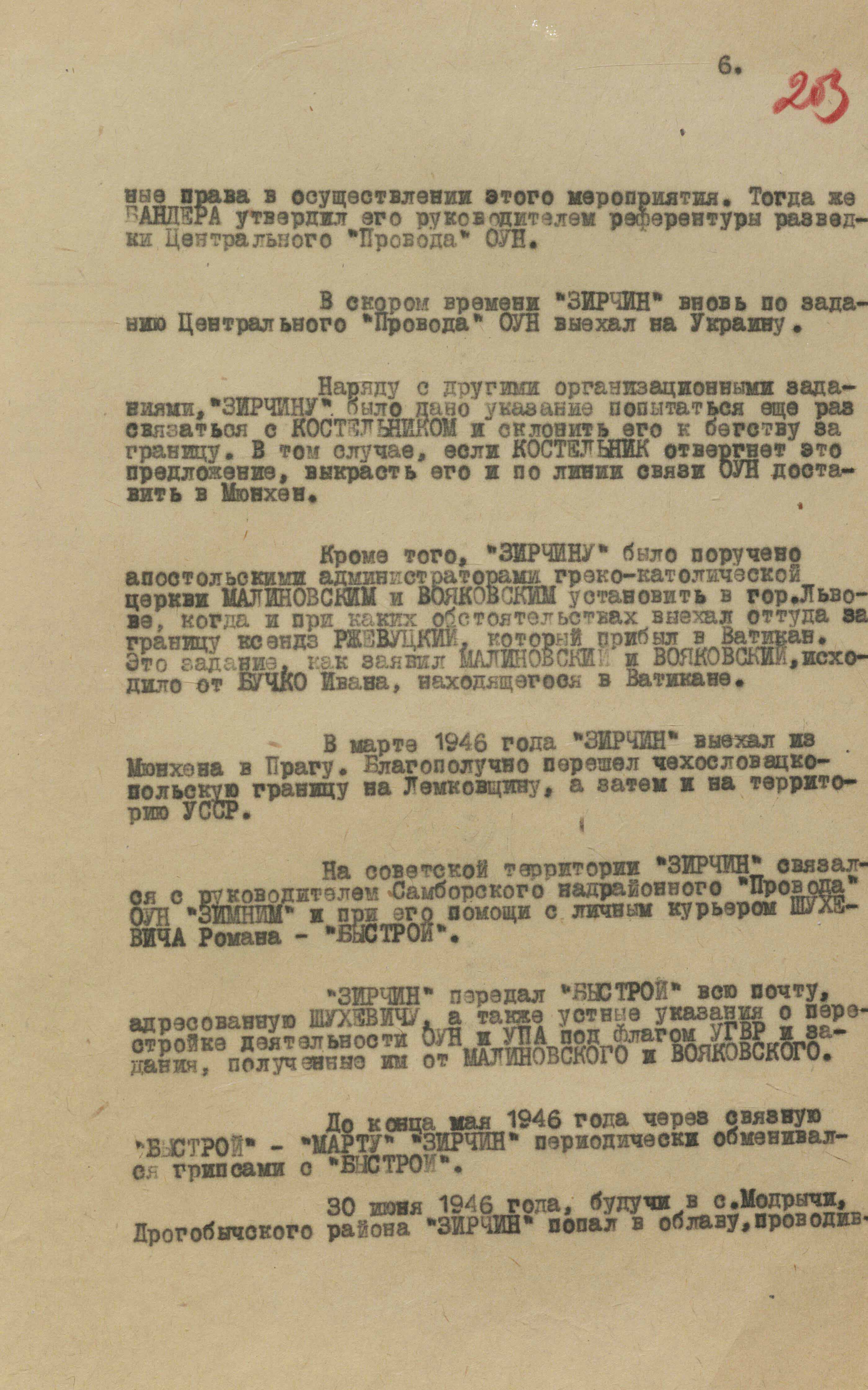
In March 1946, leader of the OUN in Czechoslovakia and concurrently head of the Intelligence Department of the Security Service of the OUN’s Foreign Units (ZCh), Yaroslav Moroz (OUN code names “Zymnyi”, “Dubovyi”, “Slavko”, “Slavek”, “Don”) received instructions from Stepan Bandera to cross the border, meet with UPA Commander-in-Chief Roman Shukhevych, and convey to him instructions regarding changes in the OUN’s activities, as well as the strategy and tactics of the liberation struggle. Soon he was given mail for R. Shukhevych. Besides, before his departure, he met with member of the OUN Central Provid Yevhen Stakhiv. He was to memorize everything that Stakhiv asked him to convey verbally.
To assist with the illegal crossing of the Polish-soviet border, a member of the OUN Security Service codenamed “Voron” – who had previously served in Yaroslav Stetsko’s personal security detail – was assigned, along with several individuals who knew the surrounding area perfectly well. They crossed the border near Przemyśl. On April 16, Ya. Moroz, through the leadership of the Drohobych Regional OUN Provid, contacted a member of the OUN Provincial Provid and R. Shukhevych’s liaison, “Bystra”. She stated that the UPA Commander-in-Chief was ill and could not receive him, so he asked her to pass on the mail he had brought and all instructions through her.
On May 30, Ya. Moroz accidentally wounded himself in the leg, which delayed his return abroad. While recovering, he contacted R. Shukhevych’s deputy “Kam” and deputy head of the OUN Regional Provid “Fedir”. From “Kam”, he received a note in which the latter asked him to prepare a route for the Chief of the Security Service of the Revolutionary OUN, “Mykhailo” (Mykola Arsenych-Berezovskyi), to cross the border. In mid-June, couriers from “Fedir” delivered a package addressed to Daria Rebet (“Orlyan”), a member of the OUN Central Provid. A week later, they were asked to return the package for inspection.
Soon after, “Bystra” arranged a meeting with Ya. Moroz for June 30 in the village of Modrychi, Drohobych district, where she was to hand him a letter and verbal instructions. He headed to the meeting place accompanied by “Voron” and four insurgents, who provided security and assisted with crossing the border. In the morning, the group was ambushed in the village and engaged in combat. The guards had been giving cover to the special representative from abroad to the very end, knowing of his high rank in the OUN and the value of the documents he carried. But the forces were unequal. Almost everyone was killed.
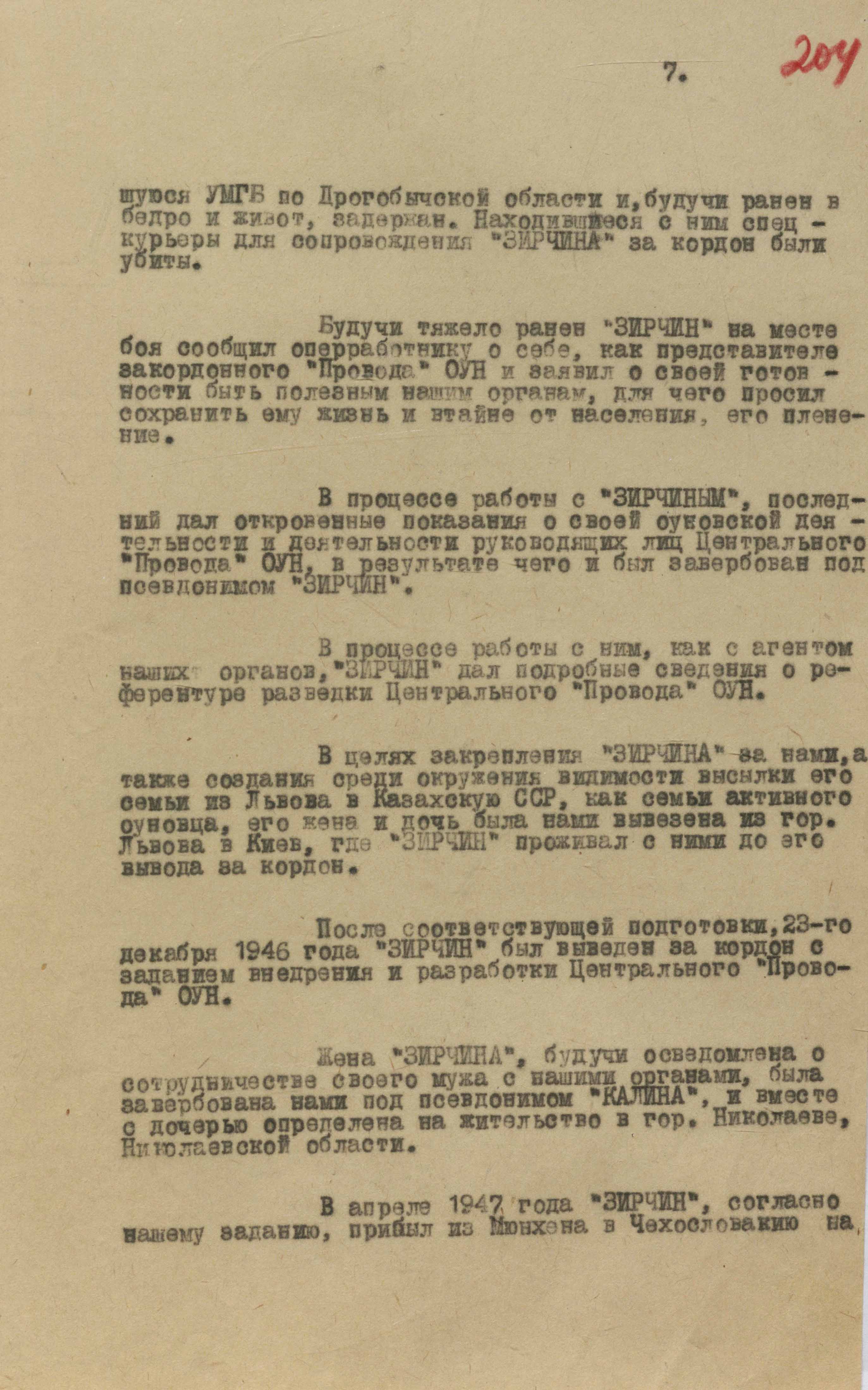
Ya. Moroz also fought back, sustaining severe wounds to his leg and abdomen, and was captured in that condition. He told an employee of the Drohobych mgb office, who was the first to reach him, that he was a representative of the OUN Central Provid, and asked that his life be spared and that the fact of his capture be kept secret from the local population. So, along with the others, he was transported – as if he were dead – to the internal prison of the directorate of the mgb, where he received the necessary medical care.
This is how the story is described in archival documents by mgb employees. In subsequent versions of the events of that day, as interpreted by Ya. Moroz himself, the account would change repeatedly depending on the development of operational plans and the simulation of various scenarios.
Testimony of the Rescued
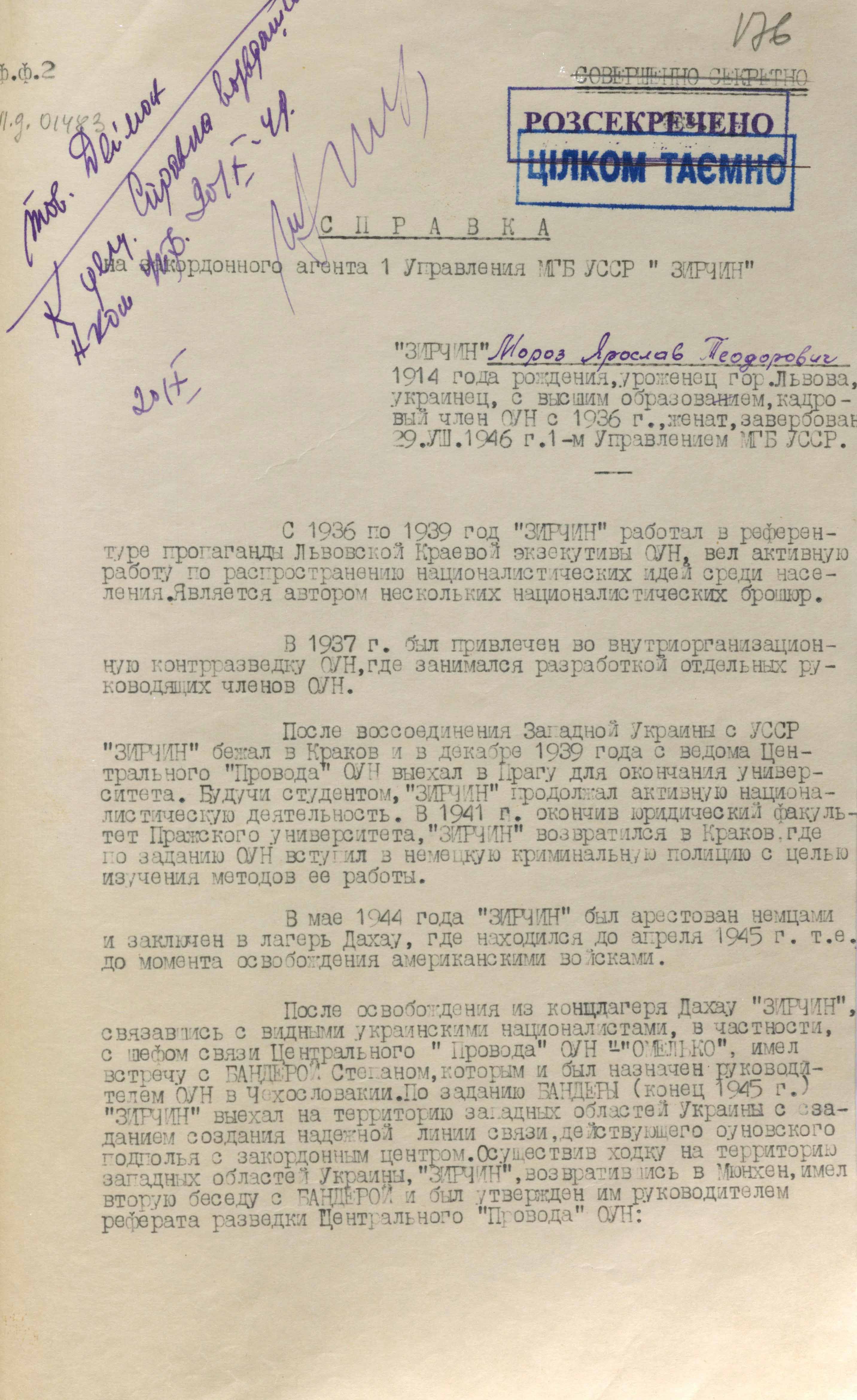
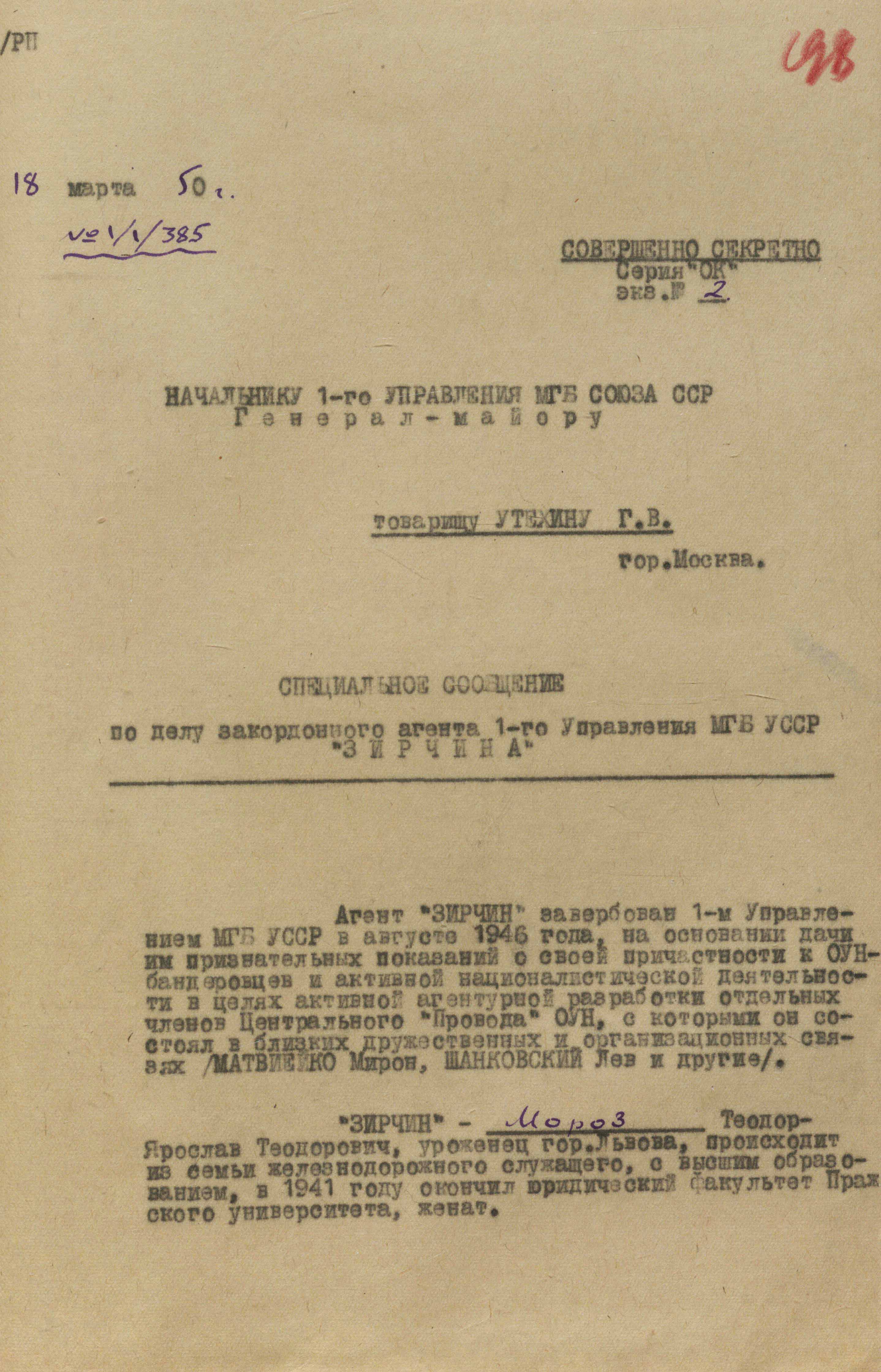
The archive file contains numerous transcripts of the interrogation of Ya. Moroz, an autobiography written in his own hand, as well as other documents and messages. Having analyzed all this, officials at the mgb of the Ukrainian ssr realized that they had indeed captured an exceptionally valuable member of the OUN. They immediately reported this to moscow. From there, they received instructions to treat the case as especially important, to conduct all operations with the utmost secrecy, and to limit the number of people privy to it. What, then, was the value of the arrested man?
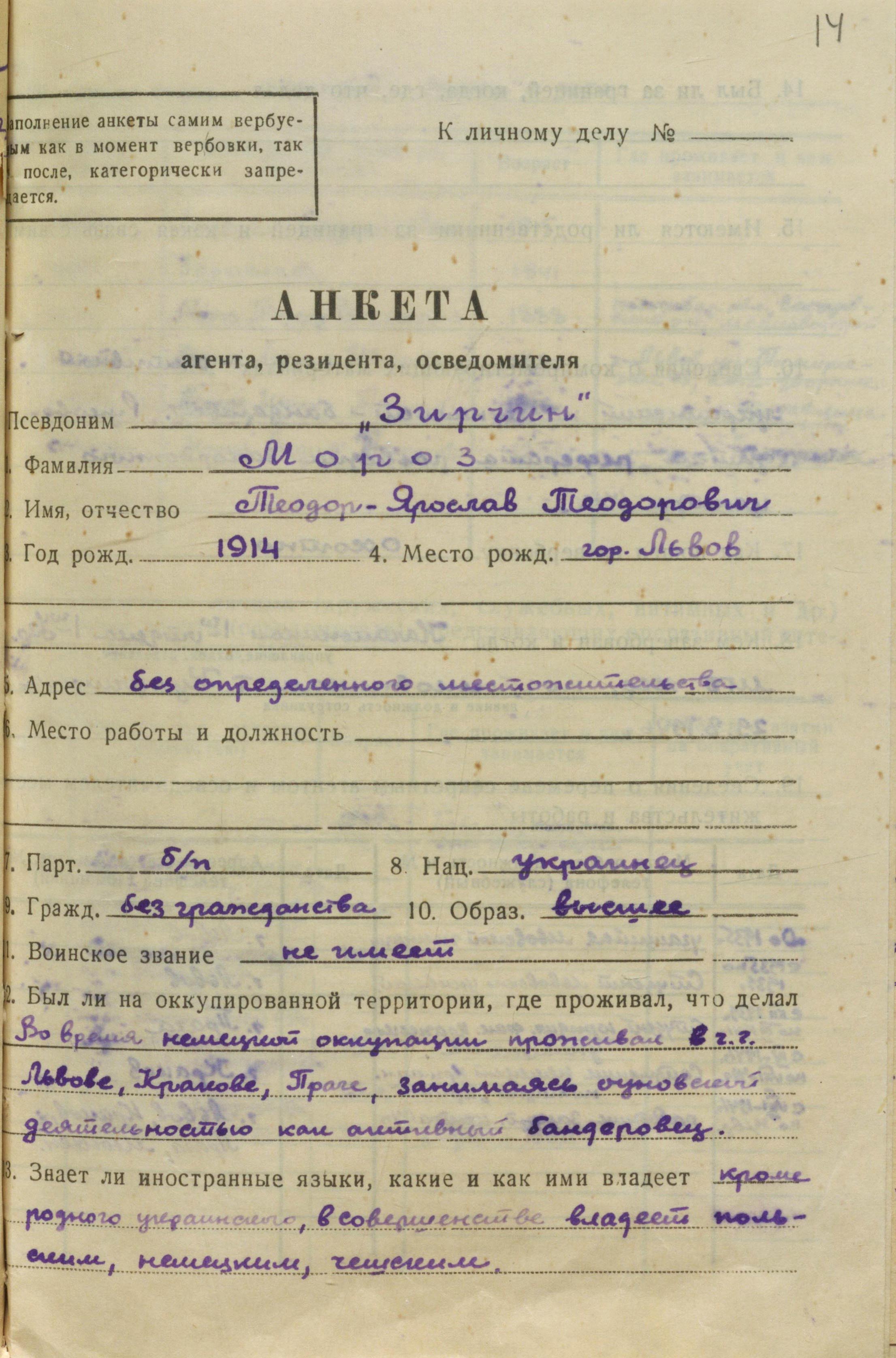
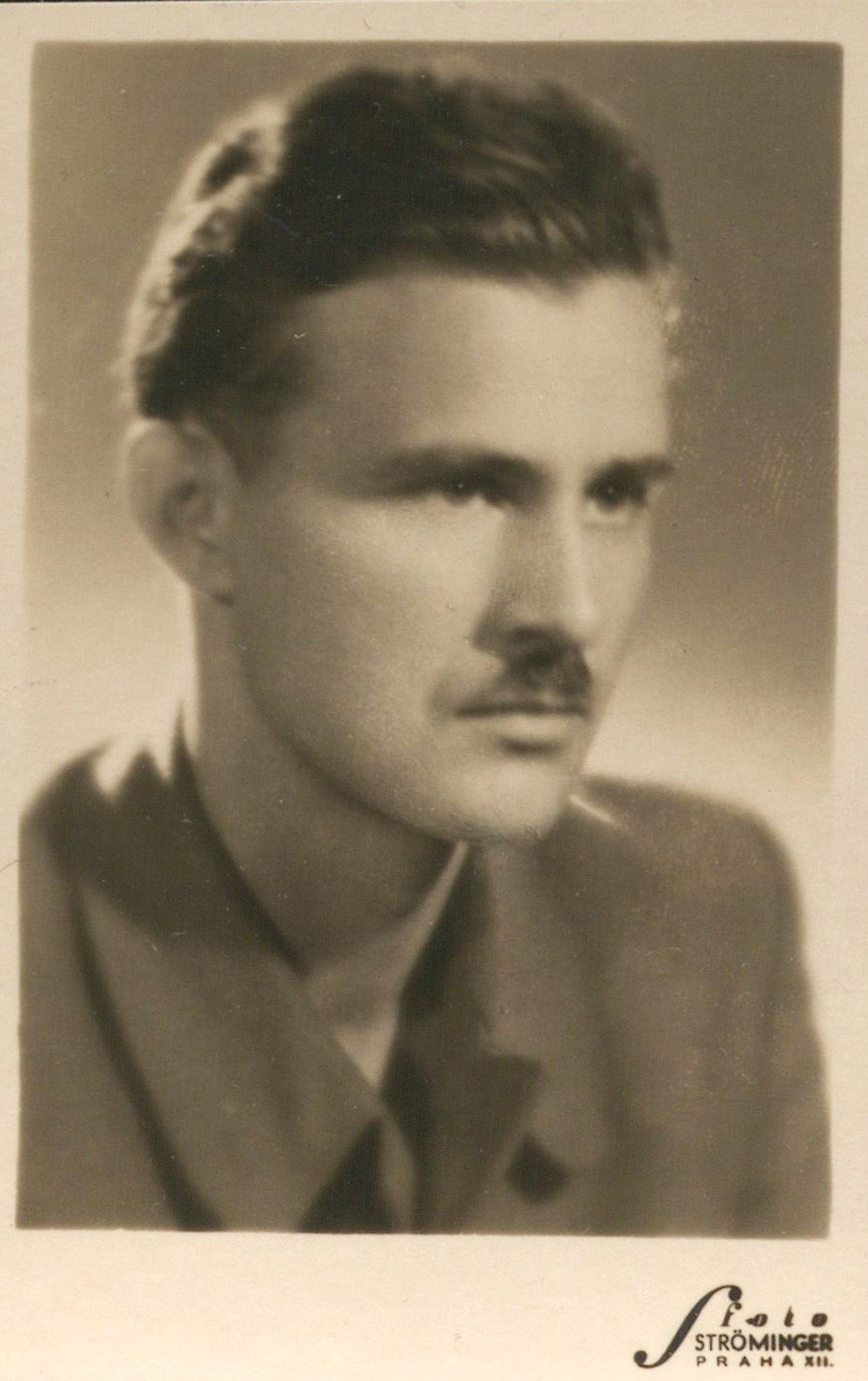
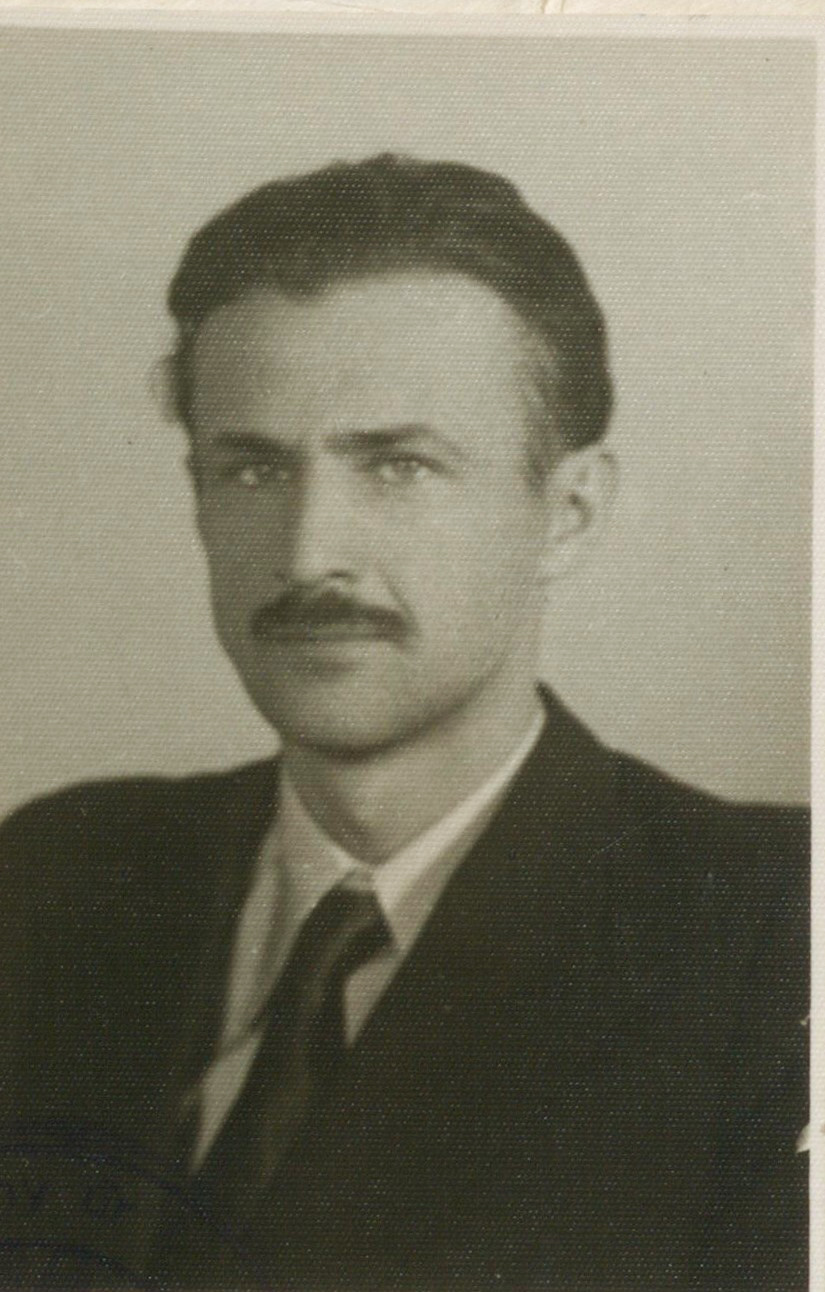
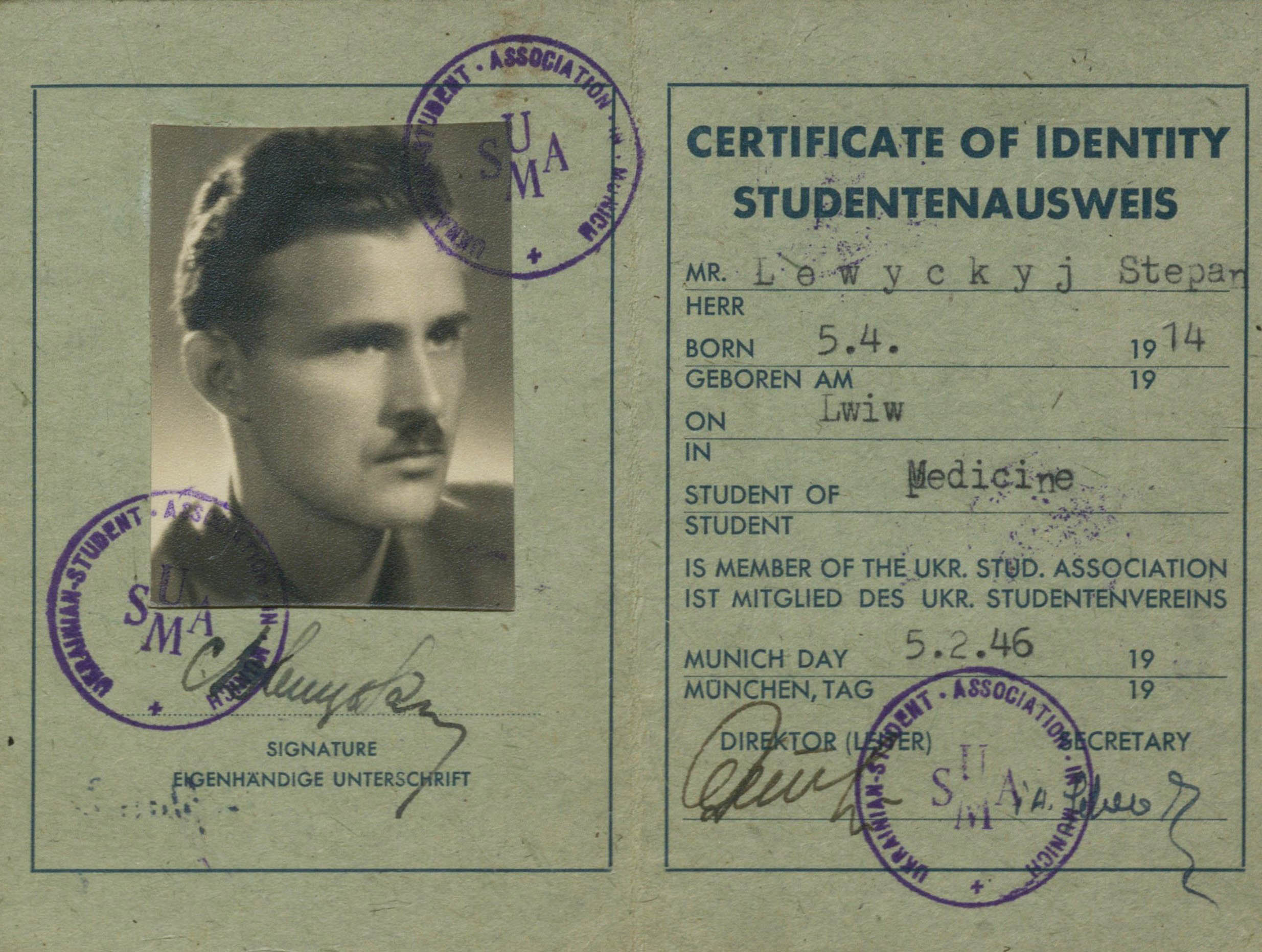
Teodor-Yaroslav Teodorovych Moroz was born on November 5, 1914, in Lviv to a family of a railway employee. At the time of his arrest, his wife and five-year-old daughter were living in Lviv. They were immediately placed under surveillance. His father was in exile in siberia.
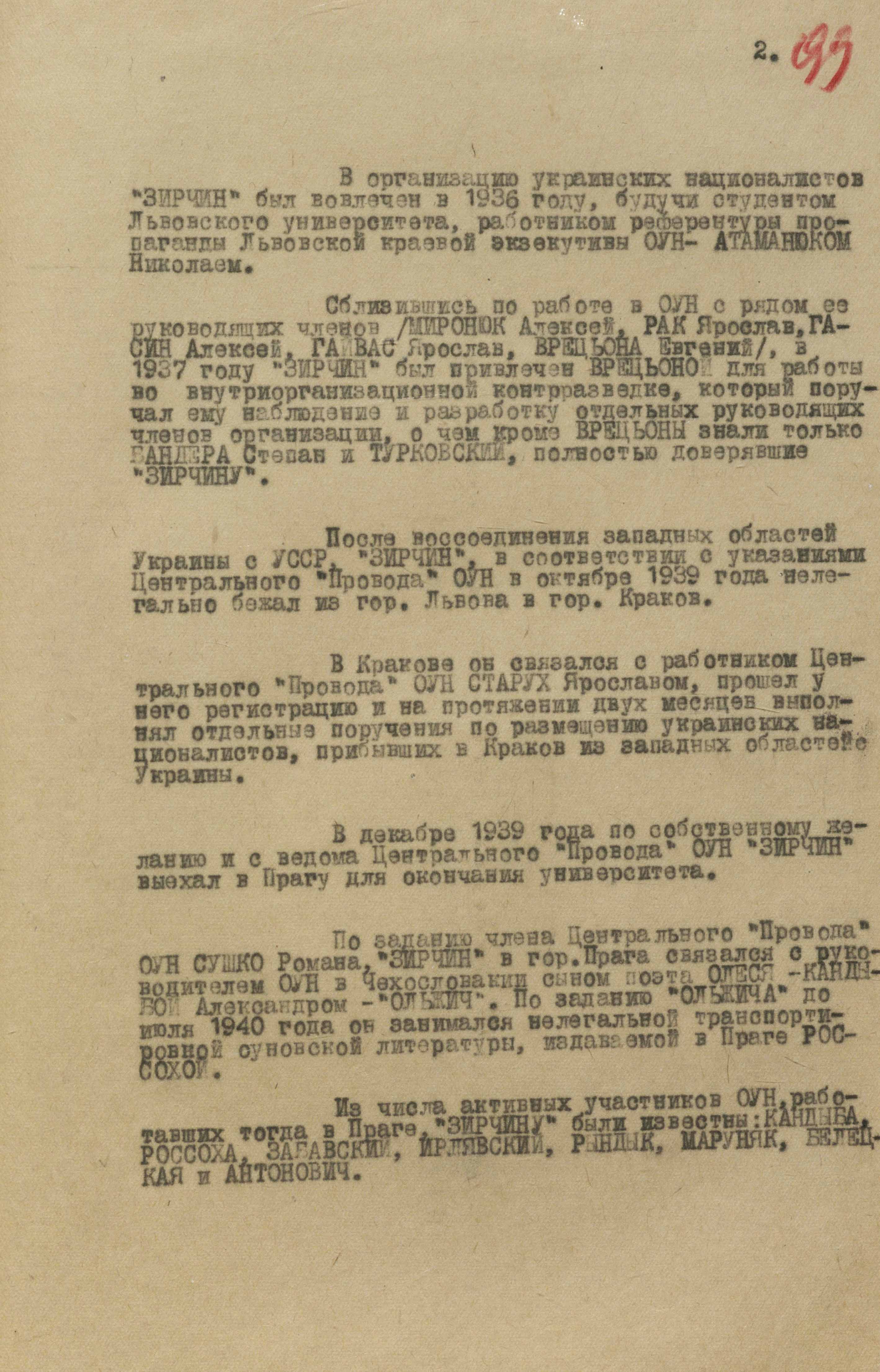
Yaroslav recounted that after graduating from high school, he enrolled in the law faculty at Lviv University. In 1936, he became a member of the OUN. He worked in the propaganda, intelligence, and organizational counterintelligence departments. During that period, he maintained contact with leading figures in the Organization, including Yaroslav Rak, Yaroslav Haivas, Yevhen Vretsiona, and others. In 1939, after the annexation of Western Ukrainian territories by the ussr, he illegally left for Krakow, where he continued his activities under the leadership of Yaroslav Starukh. He soon moved to Prague, where, after studying at the Prague University, he graduated with a diploma of a Doctor of Law.
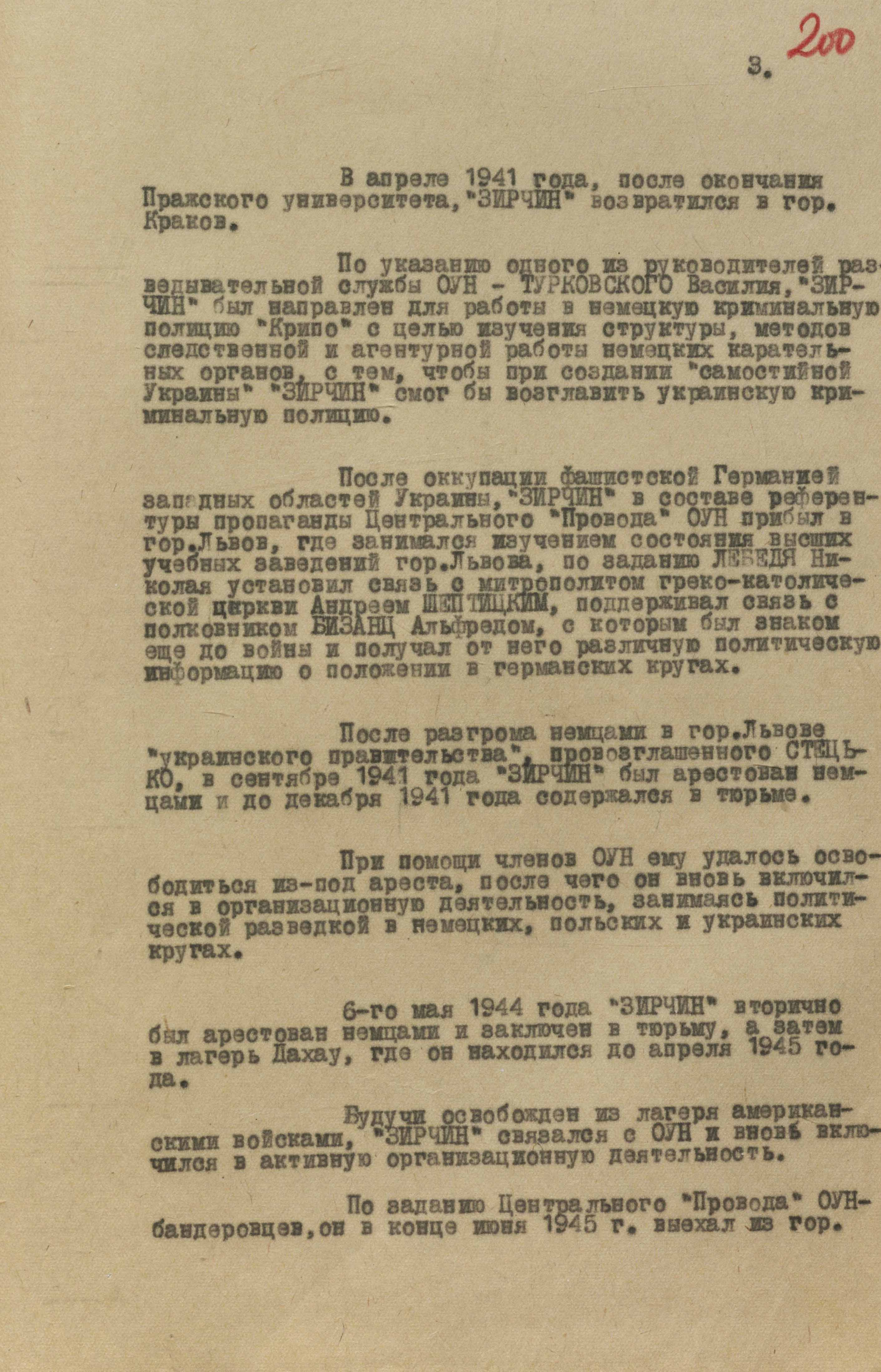
Before his leaving for Prague, Ya. Moroz met with member of the OUN Central Provid Roman Sushko who tasked him with contacting OUN leader in Czechoslovakia Oleksandr Kandyba (“Olzhych”) to continue organizational and propaganda work in his new location. This cooperation lasted until April 1941 – until he graduated from the university. Having received his diploma, Y. Moroz returned to Kraków and, on the orders of the leadership of the Intelligence Department, joined the German criminal police “KRIPO”. As noted in the documents, “with the aim of studying the structure, methods of investigative and intelligence work of the German punitive authorities so that, upon the creation of an independent Ukraine, he could head the Ukrainian criminal police” (FISU. – F. 1. – Case 33. – Vol. 2. – P. 3).
On June 30, 1941, the day the Act of Restoration of Independence of the Ukrainian State was proclaimed, Ya. Moroz was in Lviv. A month later, he resigned from “KRIPO” and continued his work within the OUN structures. He was responsible for maintaining contact with the heads of universities in Lviv and was also tasked with regularly communicating with Metropolitan of the Ukrainian Greek Catholic Church Andrey Sheptytskyi. Hence, he met with him weekly, reported on the OUN’s activities, and addressed a range of other matters.
After the Nazi occupying authorities refused to recognize the independent Ukrainian government and began arresting active members of the OUN, Ya. Moroz was also imprisoned. He remained in prison from September to December 1941. After contracting typhus, undergoing treatment, and thanks to the intercession of acquaintances, including A. Sheptytskyi and A. Bizants, he was released and continued to carry out the same tasks for the OUN, now operating underground. In May 1944, he was arrested a second time by the German police. He was held in the Dachau concentration camp and other camps until the end of April 1945.
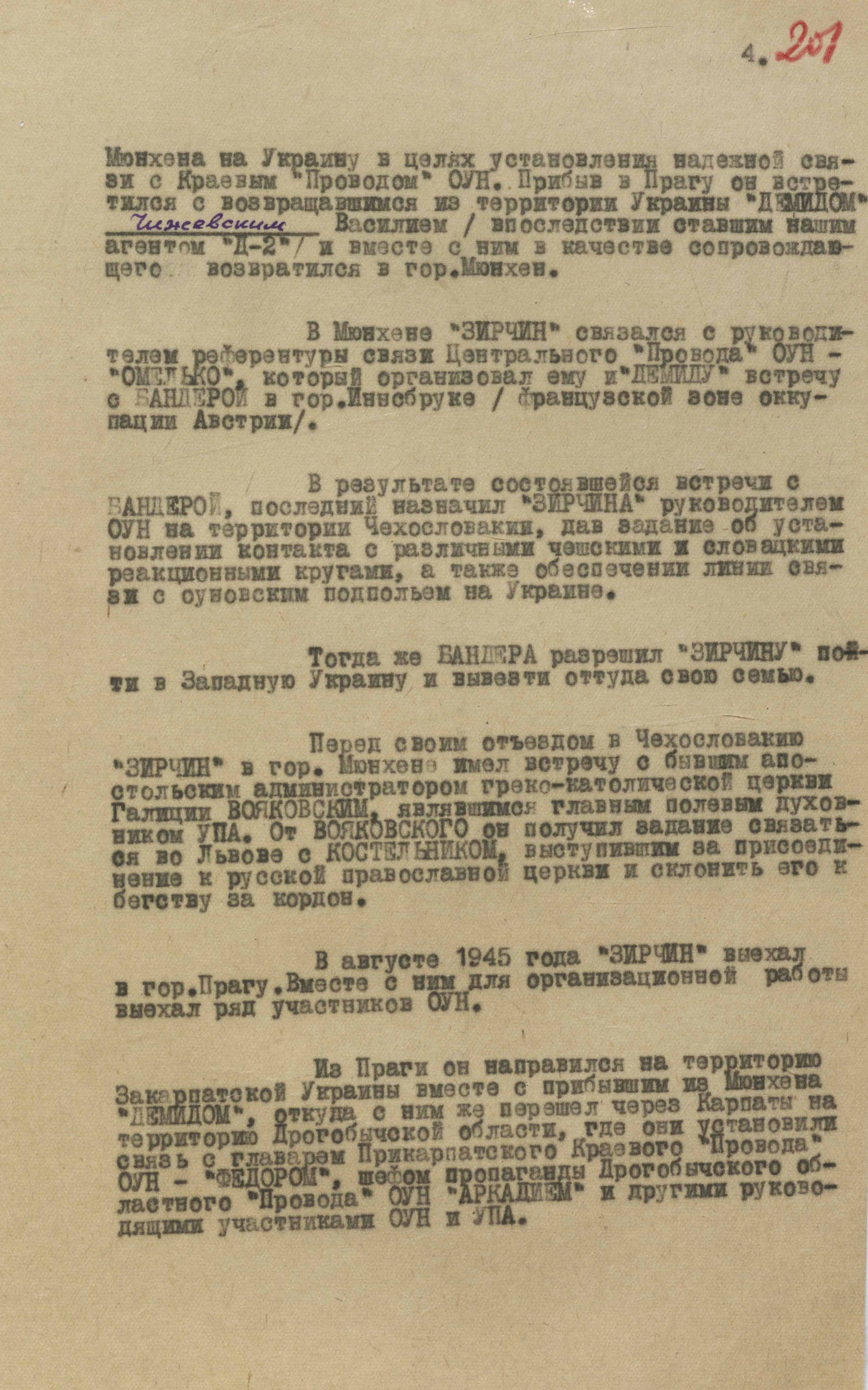
After his release, Ya. Moroz made his way to Prague and intended to enter Ukrainian territory illegally to search for his family. In the Czechoslovak capital, he met an old acquaintance, Vasyl Chyzhevskyi, codenamed “Demyd”. Chyzhevskyi said he was returning from Western Ukraine as a courier. He suggested they travel together to meet with S. Bandera, report everything to him, and then make further decisions. The meeting took place in late July 1945 in Innsbruck, Austria, at a safe house. The leader of the OUN offered Ya. Moroz the position of the head of the Organization in Czechoslovakia. He pointed out that that country served as the main link between the newly established OUN Foreign Center and the homeland. He therefore tasked Moroz with establishing reliable communication channels on the ground. In addition, he granted permission to cross the border and bring his family with him.
Before leaving the country, Y. Moroz had one more meeting – with former apostolic administrator of the Ukrainian Greek Catholic Church in Halychyna Voyakivskyi. At that time, as noted in archival documents, he was the Chief Field Chaplain of the UPA. Voyakivskyi knew that during the war, Ya. Moroz had been responsible for maintaining contact with the hierarchs of the Greek Catholic Church and was well-versed in this matter. Therefore, he asked to collect information on the situation of the UGCC in Western Ukraine and, in addition, to contact Dr. Havryil Kostelnyk, “to convince him of the wrongness of his position and to suggest that he flee abroad. If he agreed, to transport him to Munich via OUN communication channels”.
The report stated that in May 1945, the nkvd established a task group to reunite the Greek Catholic Church with the Orthodox Church. It included clergymen Havryil Kostelnyk, Mykhailo Melnyk, and Antonii Pelvetskyi, who, following instructions from the chekists, carried out the necessary work in their parishes and soon appealed to stalin with a request for reunification with the russian orthodox church. Theologian Father Kostelnyk agreed to serve as the group’s spokesperson. Thus, preparations were underway for the so-called Lviv pseudo-council.
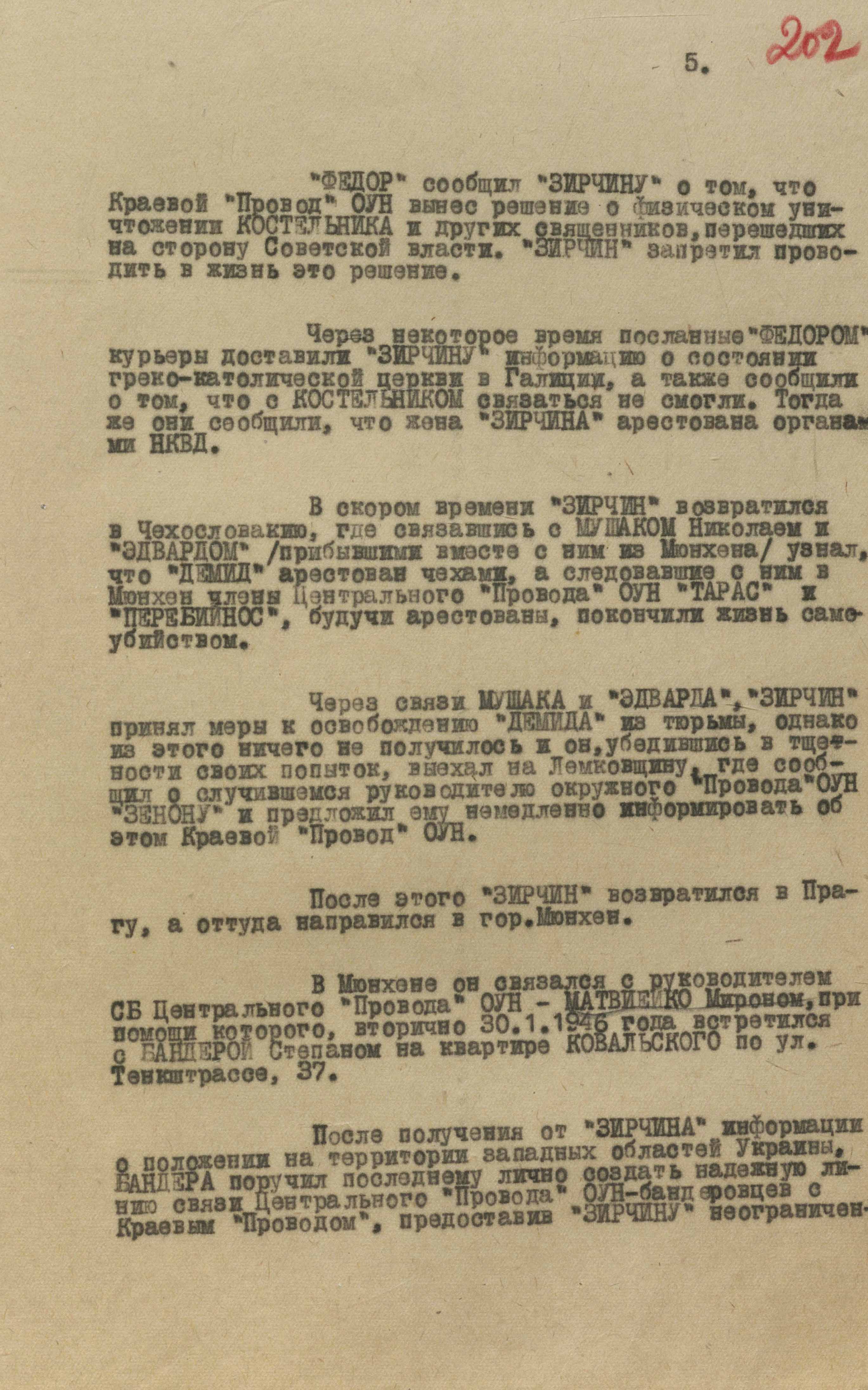
Ya. Moroz crossed the border together with “Demyd”. Once there, he contacted leaders of the OUN regional leadership, whom he asked to send couriers to H. Kostelnyk and to his wife in Lviv. Soon he received word that his wife had been arrested by the chekists, and he was unable to meet with H. Kostelnyk. With this disheartening news, he returned to Prague. There he learned that “Demyd”, along with other couriers, had been detained by Czechoslovak security forces while crossing the border into Germany. He tried to organize his escape from prison, but to no result. He reported all of this to S. Bandera in Munich on January 30, 1946. The latter tasked him with “personally establishing a secure line of communication between the overseas Center and the Regional Provid of the OUN, granting him unlimited authority to carry out this mission. At the same time, he appointed him head of the Intelligence Department of the OUN Central Provid” (FISU. – F. 1. – Case 33. – Vol. 2. – P. 7).
S. Bandera asked Ya. Moroz to wait in Munich for the conclusion of the next OUN conference and only then, with the necessary documents and verbal instructions, to travel abroad to R. Shukhevych. That mission ended on June 30, 1946, in the village of Modrychi with the capture of Ya. Moroz.
The “Legend” for His Return
“Thanks to the medical aid provided, we managed to rescue ‘45’, and his health is now out of danger”, read one of the reports from the mgb of the Ukrainian ssr. “The OUN underground is aware of this operation, but all OUN members who know about it believe that ‘45’ had been killed.
During the investigation, ‘45’ provided valuable testimony that largely corroborates all the materials we have regarding the activities of the OUN’s Foreign Center and the OUN-UPA underground on soviet territory.
‘45’s testimony is credible.
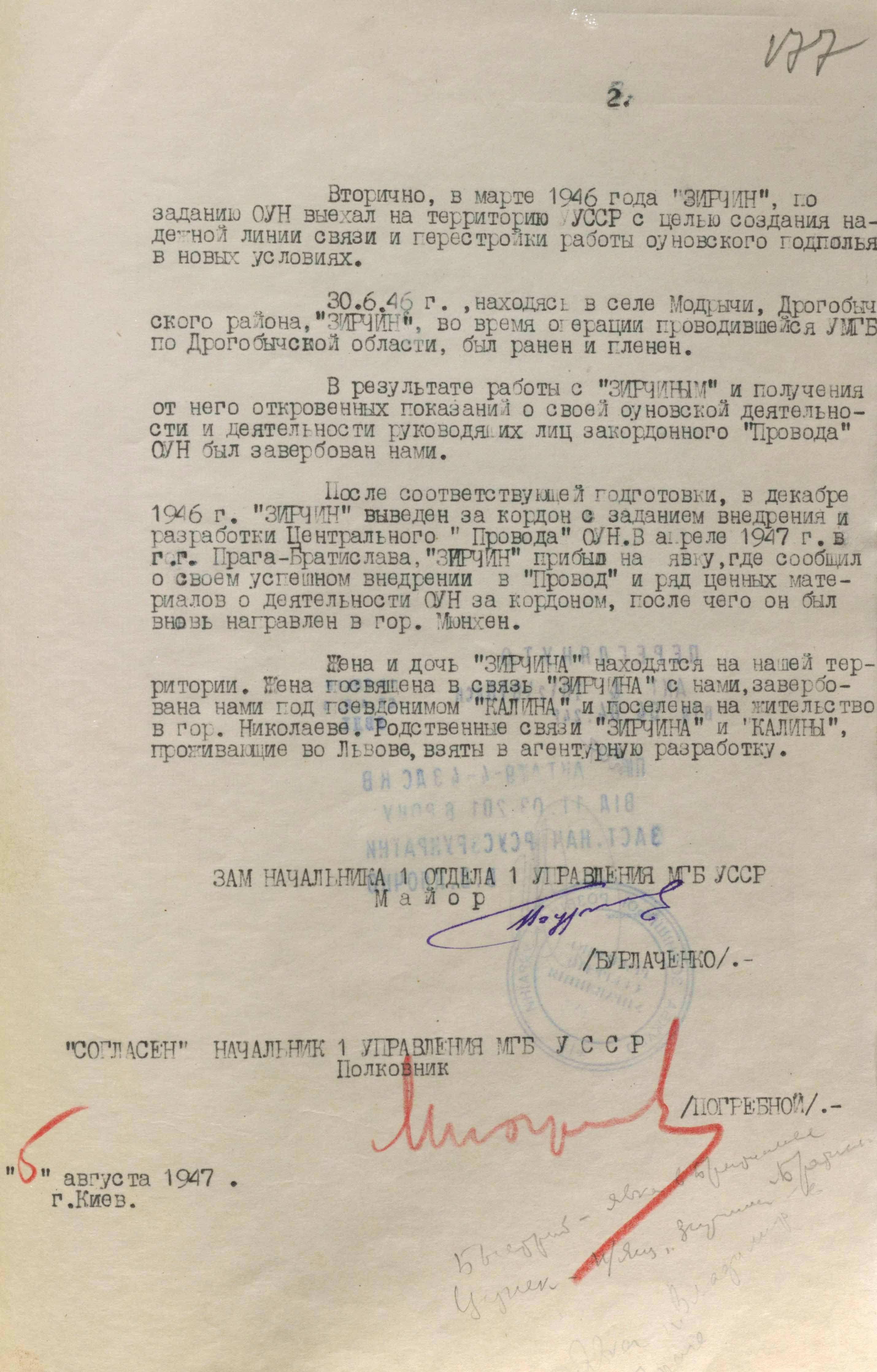
“In light of the above, given ‘45’s conduct during the investigation and his potential for infiltration into the OUN Central Provid and carrying out our tasks abroad, we recruited him in August 1946. ‘45’ agreed to be recruited willingly”
(FISU. – F. 1. – Case 33. – Vol. 1. – P. 122).
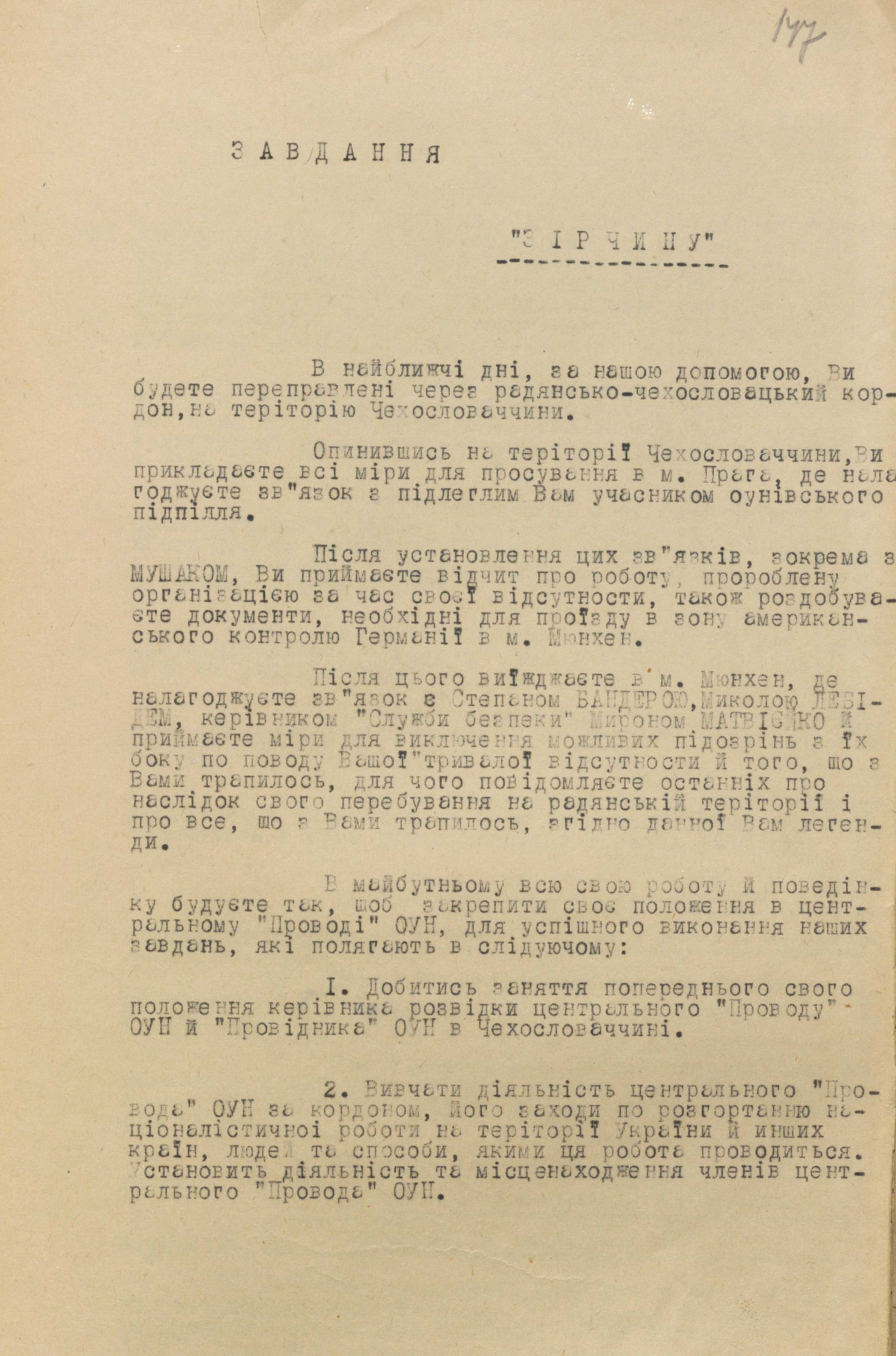
In his statement, Ya. Moroz indeed wrote of his voluntary and proactive desire to cooperate with soviet intelligence and pledged in this way to “atone for his guilt before the Ukrainian people”. For the sake of secrecy, he chose (or was offered by mgb officers) the code name “45”. There is no explanation in the case file as to why this particular pseudonym was chosen. Soon after, the code name was changed to “Zirchyn.”
He was held in prison until November 22, 1946. After they were certain that he would faithfully carry out whatever orders were given to him, and after taking the necessary measures to ensure this, they began to fabricate a “cover story” for his return abroad. One of the documents contains a kind of psychological profile of Ya. Moroz, compiled based on interrogations and other interactions with him. This assessment helps us understand what the security officers were trying to play on.
“In terms of his personal qualities,” the report pointed out, “‘Zirchyn’ is a literate, well-rounded, and resourceful man who loves money and a comfortable life. He is a braggart, verbose in conversation, and self-confident. He likes to express his own opinion on any issue, which he does not always do successfully. He quickly agrees with another’s opinion if it is logical and original. He loves books, and even more so beautiful things, paintings, and clothes… His family ties are weak, yet he is attached to his wife and daughter” (FISU. – F. 1. – Case 33. – Vol. 2. – P. 11–12).
They started with that attachment. A few days after his release from prison, the chekists arranged “Zirchyn”’s meeting with his wife and daughter in Kyiv.
They were accommodated in a room at the “Intourist” hotel using documents issued under different names, and were allowed to stay together for nearly three weeks. Of course, all of this took place under close supervision and control, including operational and technical surveillance. At the same time, he underwent special training for his transfer abroad. After it was completed, his wife and daughter were moved to another city, placed in a separate flat, and forbidden from telling anyone about their new place of residence. This information was also concealed from Ya. Moroz. Deliberately. To keep him on the hook in this way. Among acquaintances in Lviv, the word was spread that they had been arrested and sent to settle in Kazakhstan. The “arrest” itself was also carried out in a theatrical manner so that neighbors would be convinced of its authenticity.
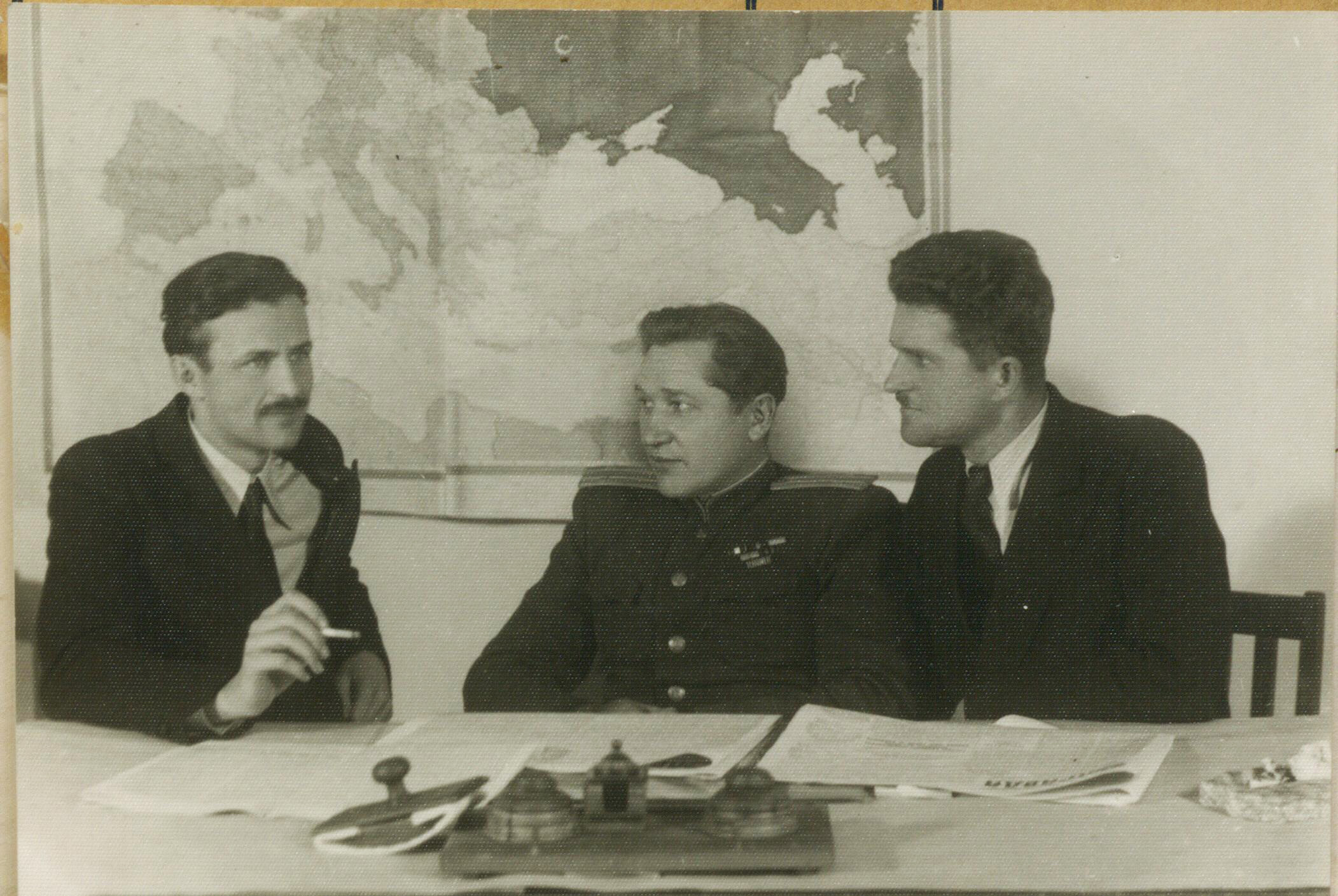
Besides, Ya. Moroz was photographed in the company of operatives from the mgb of the soviet Ukraine near the monuments to Volodymyr the Great and Bohdan Khmelnytskyi, against the background of the central entrance to the mgb building, and even in an office. All of this was prepared in case he refused to fulfill the assigned tasks, so that he could later be compromised.
And how did they plan to explain Ya. Moroz’s prolonged absence to the members of the Provid of the OUN? The answer to this question is provided by the “legend” set out in a separate document. This was standard practice in the mgb/kgb before sending an agent abroad. He was required to memorize this “legend” and strictly adhere to every detail. But things didn’t always go according to plan.
According to the “legend”, Ya. Moroz was to say that he had actually survived that battle. When a grenade explosion wounded him and threw him into the rye field, he supposedly gathered his strength and crawled away. Then, bleeding badly, he made his way to the nearest farmstead and knocked on the door of the first house on the outskirts. The owner of the house, who had been recruited by mgb agents in case the facts needed to be verified, agreed to shelter the wounded man and brought a doctor from Drohobych. The doctor had also been recruited so that he could confirm everything in the future. The doctor performed surgery, removed the fragments and bullets from the body, and visited the farmstead on several occasions. For this, Ya. Moroz allegedly thanked him with a gold watch, a diamond ring, and a camera.
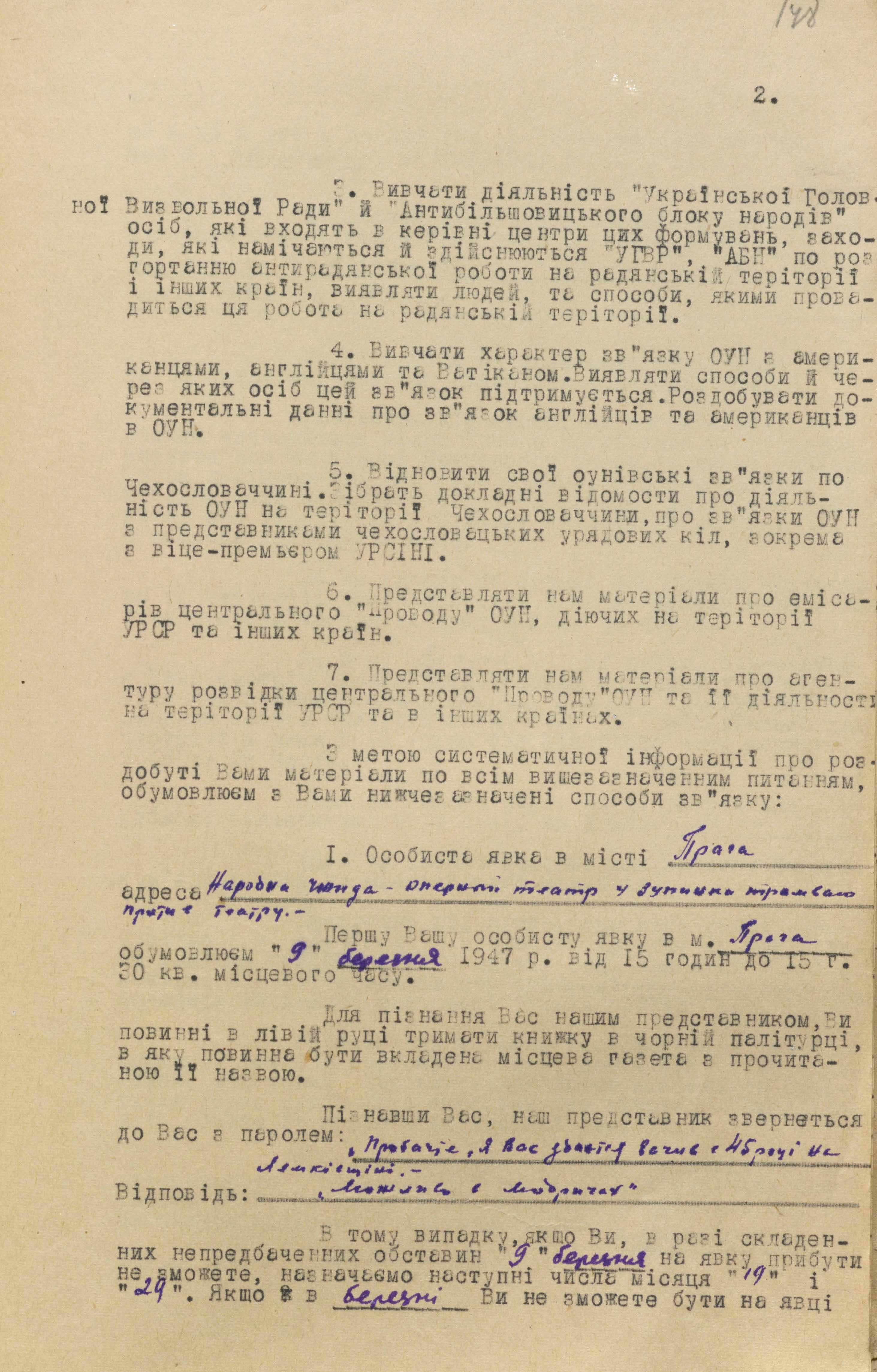
In turn, Ya. Moroz was assigned a whole series of tasks by the mgb: to reestablish contacts, collect information about the plans of the OUN’s foreign leadership, the Ukrainian Supreme Liberation Council, and the Anti-Bolshevik Bloc of Nations, as well as about key figures and agents sent to the ussr. A separate clause outlined yet another highly important task: “Provided this plan is successfully executed and ‘45’ behaves positively in working with us, he will be tasked with organizing…”. Further on in the text of this document, there was a blank space. The required phrase was usually handwritten in the original so that even the typists would not know what it referred to. And it referred to the liquidation of Stepan Bandera. Since Ya. Moroz had free access to the OUN leader, the mgb wanted to take advantage of this opportunity to kill Bandera. This is yet another unknown chapter in the series of assassination attempts on S. Bandera, which have come to light from declassified intelligence archives. Meanwhile, the situation took an unexpected turn. As a result of a joint military and security operation, materials from an investigation conducted by the Security Service of the Drohobych Regional OUN Provid into the circumstances of the battle in the village of Modrychi and the death of Ya. Moroz’s group were seized. Those documents indicated that OUN Security Service personnel had interrogated local residents, particularly those suspected of being involved with the mgb’s intelligence network. One such agent quoted the chekists’ account of Ya. Moroz’s death. Supposedly, he was blown apart by a grenade, so his body was left in the forest. Besides, the mgb feared that during a re-investigation by the OUN Security Service, the doctor from Drohobych and the peasant to whose farmstead the wounded Ya. Moroz had allegedly come would crack and confess everything.
So, they decided to change the “legend”. Ya. Moroz was to claim that he had been captured by the chekists while severely wounded and unconscious. He identified himself as “Kruk”, one of the bodyguards of the OUN’s foreign emissary. His face had been disfigured beyond recognition by the explosion. Hence, they claimed, Ya. Moroz had no choice but to agree to cooperate with the mgb. Consequently, he was tasked with crossing the border and infiltrating the security detail of the OUN district leader “Zenon”, who was operating in Poland.
While developing a new “legend”, mgb was persuading Ya. Moroz with the help of various methods that there were mgb agents within the inner circle of the OUN Foreign Units leadership and even within the Security Service. In particular, they made every effort to imply that both R. Shukhevych’s liaison “Bystra”, and head of the Security Service of the OUN Foreign Units M. Matviyeiko, were also linked to the mgb.
“In case that ‘45’, under the influence of some unforeseeable causes and circumstances,” the report to moscow said, “should take the path of betraying us – which we consider unlikely – then his suspicions regarding the alleged ‘collaboration’ with us by Matviyeiko and ‘Bystra’ will lead to their destruction or to their loss of trust on the part of the OUN Central Provid and to their removal from their current leadership positions in the OUN, which is also operationally advantageous for us” (FISU. – F. 1. – Case 33. – Vol. 2. – P. 31).
At this stage, the issue of S. Bandera’s assassination by “Zirchyn” was decided to be removed from the agenda. A document from moscow, signed by deputy minister of the mgb of the ussr P. Fedotov, emphasized that he must know nothing “about our intentions regarding the leaders of the Ukrainian nationalists”. First, he had to dispel all suspicions and secure his position as chief of intelligence of the Foreign Units of the OUN, which opened up enormous opportunities for the chekists to control the entire OUN agent network.
The fact that the mgb had high hopes for “Zirchyn” is evidenced by his being invited to a meeting with minister of the mgb of the Ukrainian ssr S. Savchenko. The minister inquired about his family and close associates, the “legend” of his leaving for abroad, and certain OUN figures, notably M. Matviyeiko and S. Bandera. After the meeting, “Zirchyn” made no secret to the operatives accompanying him that he was very pleased with such attention to his person and that he would justify the trust placed in him.
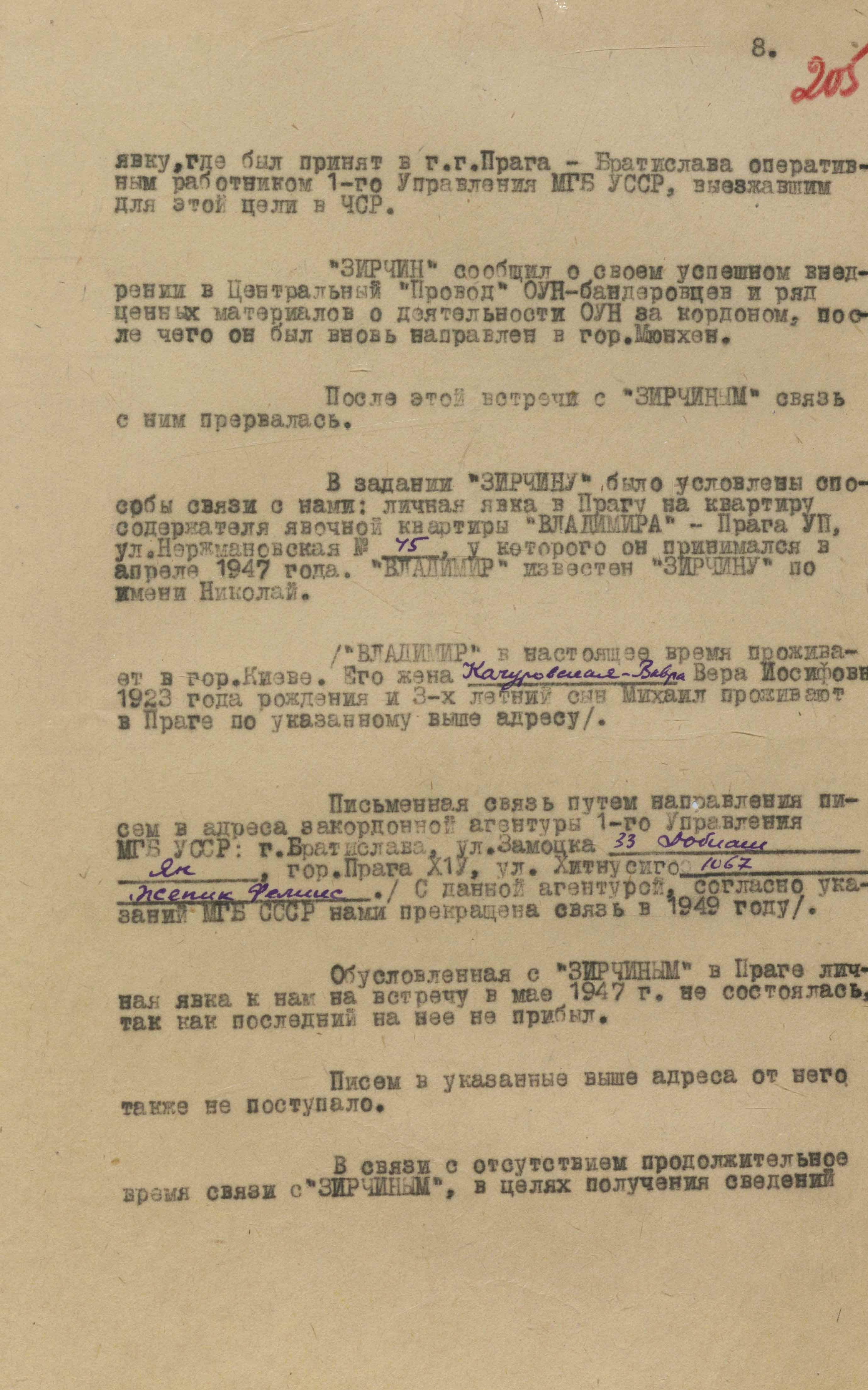
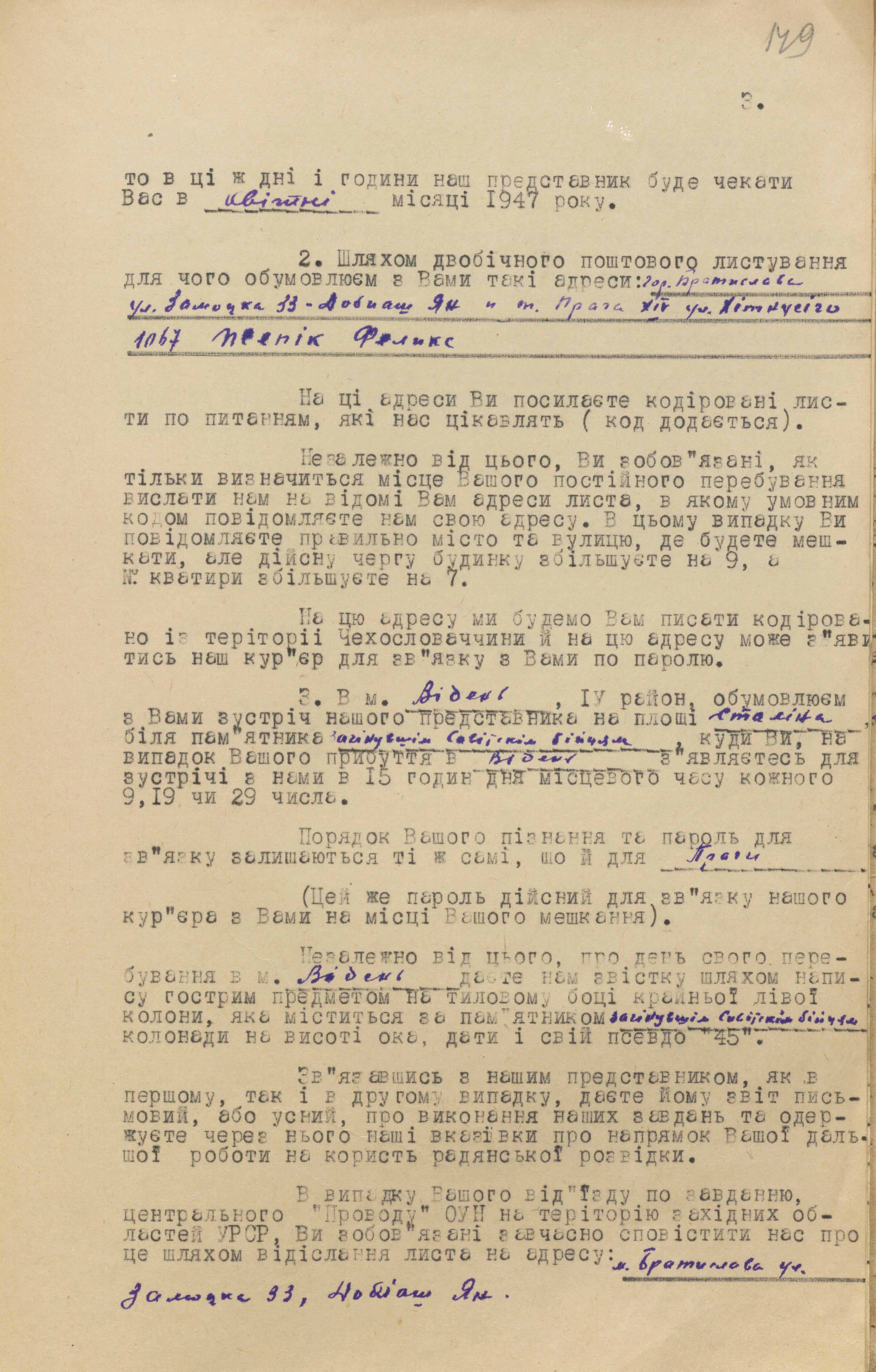
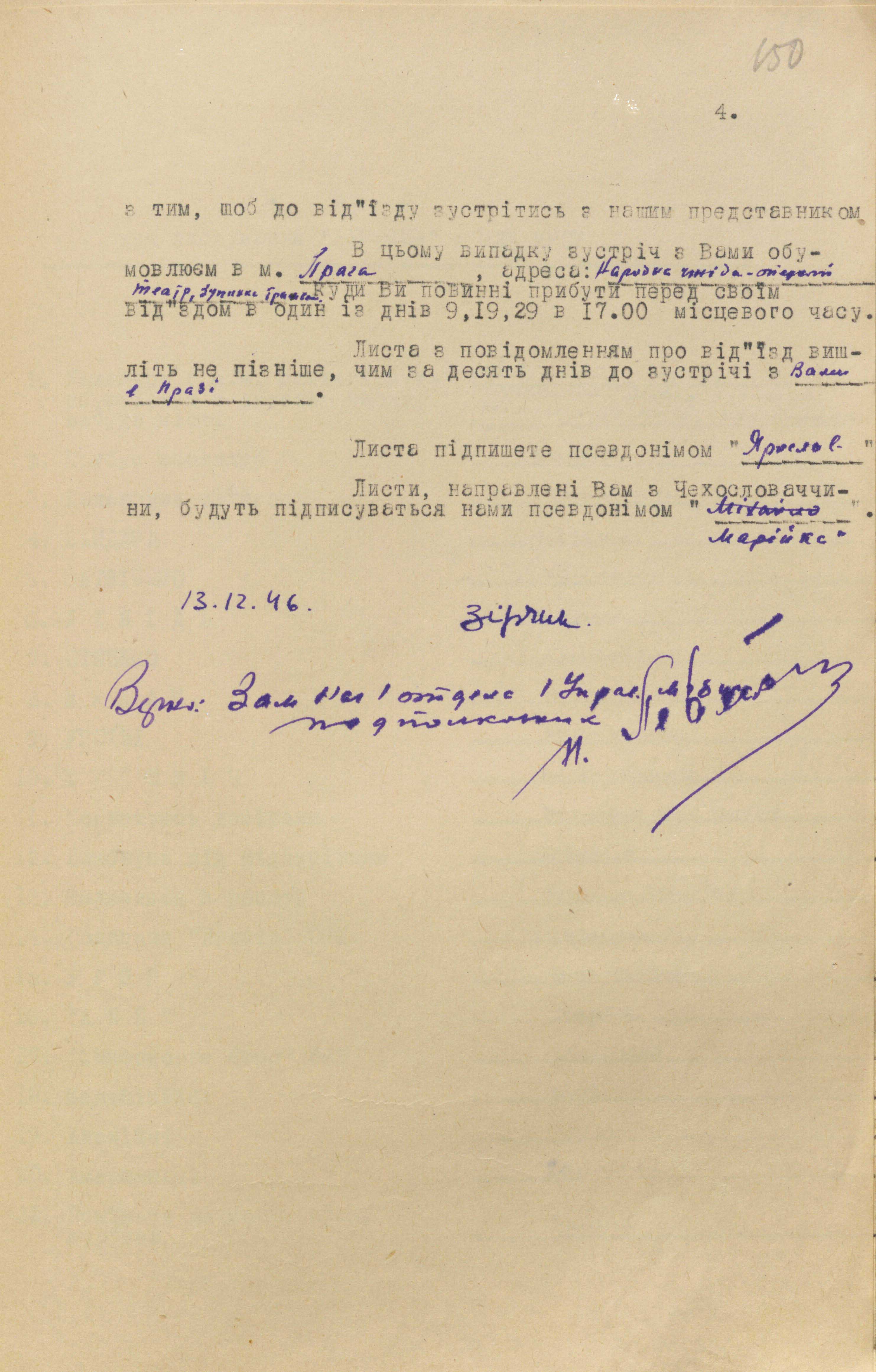
Before his transfer abroad, communication methods were discussed. He was given addresses of post office boxes for coded correspondence in Prague and Bratislava. It was planned that, after agreeing on the date, time, and place, agents from the mgb sub-residenturas of the Ukrainian ssr “Vuzol” and “Desna” would meet with him in Prague and Vienna, respectively. The first meeting was scheduled for March 9, 1947, in Prague.
Confession
“Zirchyn” did not show up for the scheduled meeting in Prague. Although he had previously reported in a letter that everything was going according to plan. He had successfully crossed the border, met with his overseer and immediate superior, M. Matviyeiko, in Munich, and was then awaiting a meeting with S. Bandera. He noticed that he was under suspicion but hoped to pass the check successfully. The mgb wanted to learn more details during a face-to-face meeting with him. That meeting took place on March 29. During the meeting, the agent described M. Matviyeiko’s reaction to the “legend” about his capture and recruitment by the chekists. “Matviyeiko ordered that no one speak of this,” the report on the meeting stated, “fearing that the opposition would use ‘Zirchyn’’s connection with us to compromise the Provid” (FISU. – F. 1. – Case 33. – Vol. 2. – P. 342). In addition to this, it was noted that M. Matviyeiko had sent S. Bandera the interrogation transcripts and his conclusions regarding the possibility of conducting an operational game with the mgb.
Shortly thereafter, an aide arrived from S. Bandera with written instructions to postpone the decision on launching such an operation until his arrival in Munich and a personal meeting with Ya. Moroz. Meanwhile, M. Matviyeiko instructed him to travel to Czechoslovakia, reestablish lost contacts on the ground, and carry out a series of other tasks. He assured him that within a month all issues concerning him would be resolved and he would once again head the Intelligence Department.
Inspired by this attitude to him on the part of the chief of the OUN Foreign Units’ Security Service, “Zirchyn” even asked during his next few meetings with mgb officials in Prague and Bratislava to arrange a trip for him to visit his family in the ussr on Easter. He claimed that everything was going well and there was no reason for undue concern. But the chekists did not grant permission for this. Meanwhile, they scheduled new meetings for him at safe houses and each time questioned him about the situation in the OUN Central Provid, which was rapidly changing. This was also demanded in directives from moscow. Then suddenly, “Zirchyn” did not show up for the next meeting in May 1947. Letters from him containing coded phrases also stopped arriving. All attempts to find out what had happened were in vain.
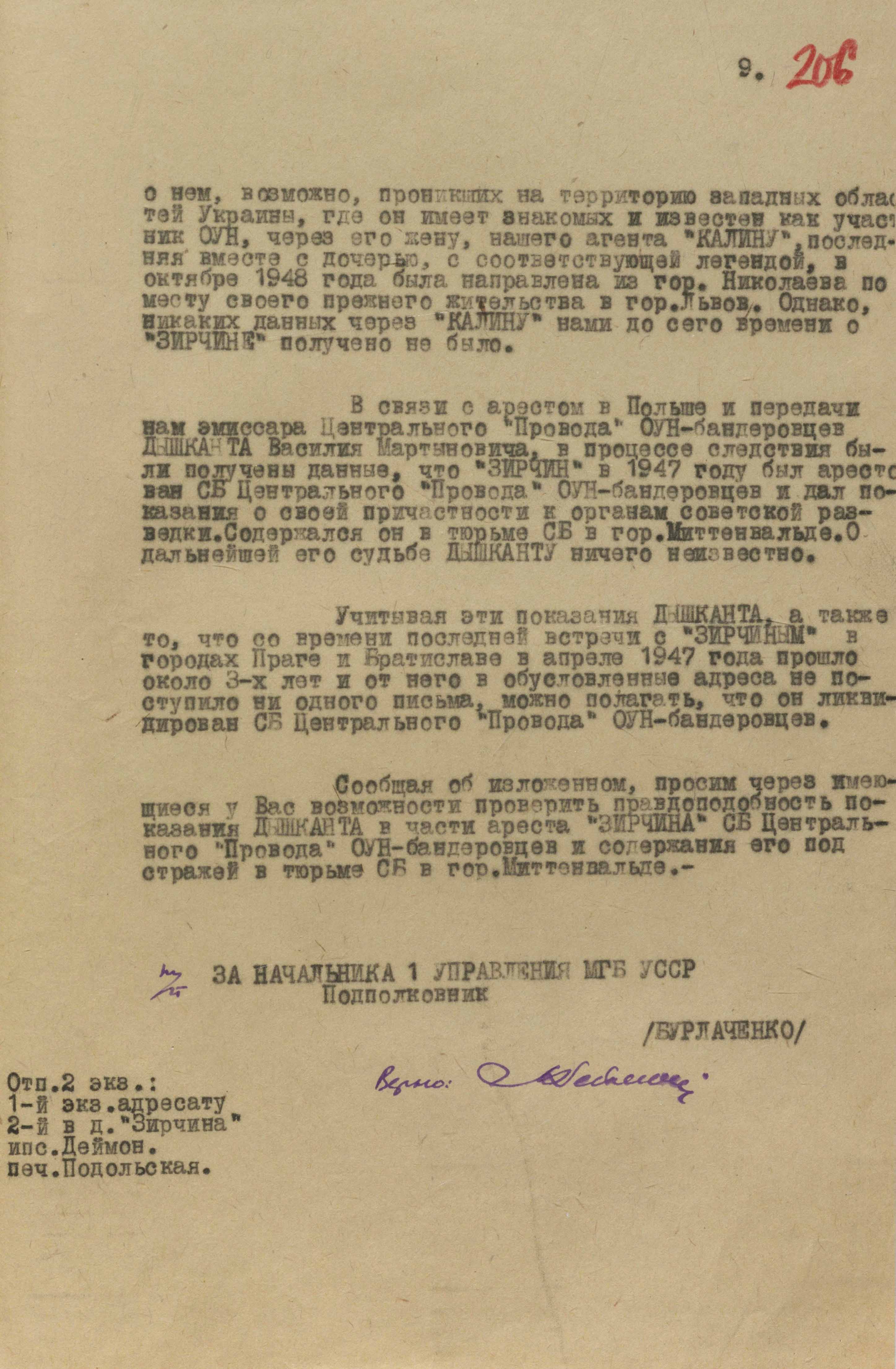
Only several months later, from arrested OUN emissaries and intercepted mail from M. Matviyeiko to underground leaders in Western Ukraine, did the chekists learn of “Zirchyn”’s arrest by representatives of the OUN’s Foreign Units’ Security Service. In their reports, the chekists themselves acknowledged the following: “…due to an inconspiratorial meeting with us, ‘Zirchyn’ was exposed by the OUN Security Service and subsequently liquidated” (FISU. – F. 1. – Case 33. – Vol. 3. – P. 222). It later became known that his trips to Prague and Bratislava had been monitored by agents of the Security Service of the Foreign Units of the OUN. They had tracked his secret meetings with soviet representatives, which Ya. Moroz had failed to report. They subsequently concluded that he was acting solely on the mgb’s orders.
As shown by declassified documents, during interrogations, Ya. Moroz confessed to everything. He described the true circumstances of his recruitment, the assignment he received to head the OUN’s intelligence, and to plan and carry out the assassinations of S. Bandera, Ya. Stetsko, D. Rebet, and I. Hryniuk. It was not until 1949 that the mgb of the Ukrainian ssr learned some details from reports by foreign agents, including that following the interrogations and confessions, he had been sentenced to death for treason. As a sign of contempt, his body was not even subjected to the customary burial procedure.
At the same time, the chekists received another interesting piece of information: R. Shukhevych had not met with Ya. Moroz in person not because he was ill. Among his close circle, he pointed out that he did not trust Ya. Moroz and did not want to have anything to do with him. He had instructed that Ya. Moroz be sent back and not sent to him again. Whether the UPA Commander-in-Chief knew something more, or had formed his own psychological profile and his intuition had proven correct, remains unknown.
This was the end of one of the mgb of the ussr’s numerous attempts to infiltrate their agents into the leadership of Ukrainian émigré organizations abroad in order to obtain necessary information, influence events, and even resort to extreme measures – such as the assassination of leading figures. In this situation, the Security Service units of the Foreign Units of the OUN stood in the way; although they acted quite harshly and sometimes crossed certain lines, they nevertheless ensured protection against enemy agents’ infiltration into their ranks.