Information Bureau of the General Staff of the Army of the Ukrainian People’s Republic. Milestones in the History of Ukrainian Intelligence
1/23/2026
During the period of the Directory of the Ukrainian People’s Republic, the demand for intelligence information among the state leadership increased significantly. This was due to the intensification of armed confrontation both within the Republic and on external fronts, which required a regular flow of intelligence data on the enemy, first of all of a military nature. Therefore, the emergence of another intelligence agency was quite natural. This agency was the Information Bureau (abbreviated as “INFIBRO”) within the General Staff of the Army of the Ukrainian People’s Republic.
The period of the Directory was the longest in the history of the Ukrainian national statehood formations of that time. At that time, the newly created, still insufficiently developed and strengthened special services had to operate in a rather tense military-political and operational situation. During 1919–1920, the territory of the Ukrainian People’s Republic became the arena of armed struggle against the intervention of soviet russia, together with the military units of the Ukrainian soviet republic, the “white” movement, and Poland, which was trying to seize part of Ukrainian lands, formed with its direct participation. All this was accompanied by foreign special services’ active subversive work and required the regular collecting of intelligence, primarily of a military nature.
The intelligence of the Directory period largely retained the directions, forms, and methods of obtaining secret information characteristic of the special services of the Hetmanate. At the same time, the potential of some of its varieties was higher.
The central body of military intelligence of the Armed Forces of the Ukrainian People’s Republic was the Rozvidochna Uprava (Intelligence Directorate – Transl.) of the General Staff. At that time, military intelligence had the following organizational structure: a central apparatus, regional bodies, relevant units of military formations (divisions, corps, brigades), field intelligence units, radio intelligence units, and others.
The main intelligence unit was the Agent Department. It was responsible for providing the head of the Intelligence Department of the General Staff with comprehensive information and analytical material prepared on the basis of reports from agents, field intelligence, radio interception, and press materials. The reports contained information on the deployment and general condition of the Red Army troops, the armed formations of the “white” general Wrangel, otaman Makhno, and others. The unit was also involved in conducting operations behind enemy lines.
In addition to the Intelligence Department, there was a Foreign Department which worked with Military Attachés. The positions of Military Attachés were introduced in the embassies of the UPR of the 1st and 2nd categories and in extraordinary diplomatic missions. The organizational and legal status and current activities of the Military Attaché of the UPR were established by a secret Instruction for military agents and their deputies. According to the Instruction, military agents or attachés and their assistants were subordinate to the Chief of the General Staff and were registered with the Foreign Department.
Apart from collecting intelligence on the state of foreign armed forces, military agents had to obtain information about all the most important legislative acts, military and railway budgets of the host country, cartographic publications, military-technical inventions, new models of combat equipment, and compile detailed descriptions of them.
Gradually, Military Intelligence and Military Attachés began to take on the functions of national political intelligence: obtaining, collecting, and studying information about the political situation in countries of interest, their military and economic potential, and creating positions of influence with the aim of finding allies in the cause of recognizing and guaranteeing the sovereignty of the Ukrainian state. This was most evident during the time of the Directory of the Ukrainian People’s Republic, when, along with Military Intelligence and Counterintelligence, National Intelligence and Counterintelligence began to operate.
These special agencies were created as part of the Political Department, which was structurally part of the Ministry of Internal Affairs of the Ukrainian People’s Republic. They were named the Internal Information Department and the Foreign Information Department. These units used methods and means of activity typical of special services, the main ones being agents, their covert use, and infiltration. For this purpose, instructions were developed for agents of “Political Intelligence and Counterintelligence”.
The Foreign Information Department had the status of a military-type organization. It carried out intelligence work on enemies actively operating against the UPR (the headquarters of the red and volunteer armies and Makhno’s insurgent army), as well as countries that were potential opponents of the Republic and possible allies. In fact, it was the first unit of the National Political Intelligence in Ukraine. It began operating on January 24, 1919, the day its temporary staff was approved.
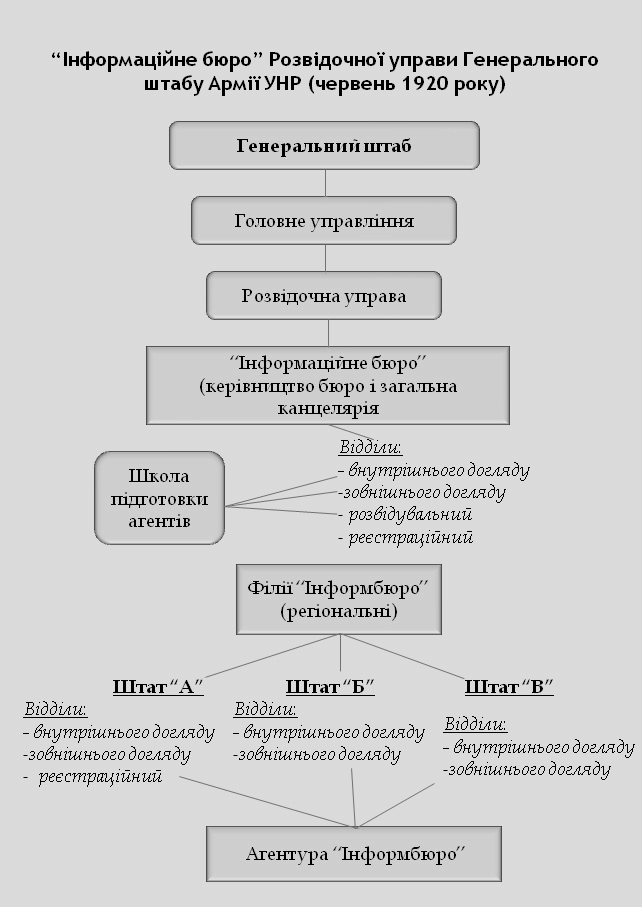
At the same time, in order to improve the structure of the central apparatus of the Military Intelligence and create regional bodies with a large-scale action plan, an Information Bureau was established under the General Staff in May 1920. Structurally, it was part of the Intelligence Department of the General Staff. However, it actually functioned as an independent main working body of Military Intelligence and Counterintelligence of the Armed Forces of the Republic and became, in fact, a separate special service, although this led to some duplication in the work of the Intelligence Directorate.
The current work plan for this institution was to be drawn up by the Minister of Defense or the Chief of INFIBRO, but with mandatory approval by the Minister. This work planning procedure was intended to ensure coordination between Ukraine’s overall defense efforts and the activities of the Republic’s Military Intelligence. Every day, the Chief of the Information Bureau personally reported to the Chief of the General Staff or the Head of the Military Department, which significantly increased his status.
Structurally, the Information Bureau consisted of a central body and branches. The central body included departments for internal and external surveillance, intelligence, and registration. This made it possible to autonomously perform a wide range of tasks related to the provision of intelligence information, its processing, maintaining the internal security of the Armed Forces, and personnel training.
The Intelligence Department was engaged in agent intelligence both within Ukraine, where fighting was constantly taking place, and outside its borders, and conducted agitation and propaganda work in the armies and among the population of the enemy states of the UPR, carried out counterintelligence activities abroad within its competence and capabilities, and organized various actions behind enemy lines.
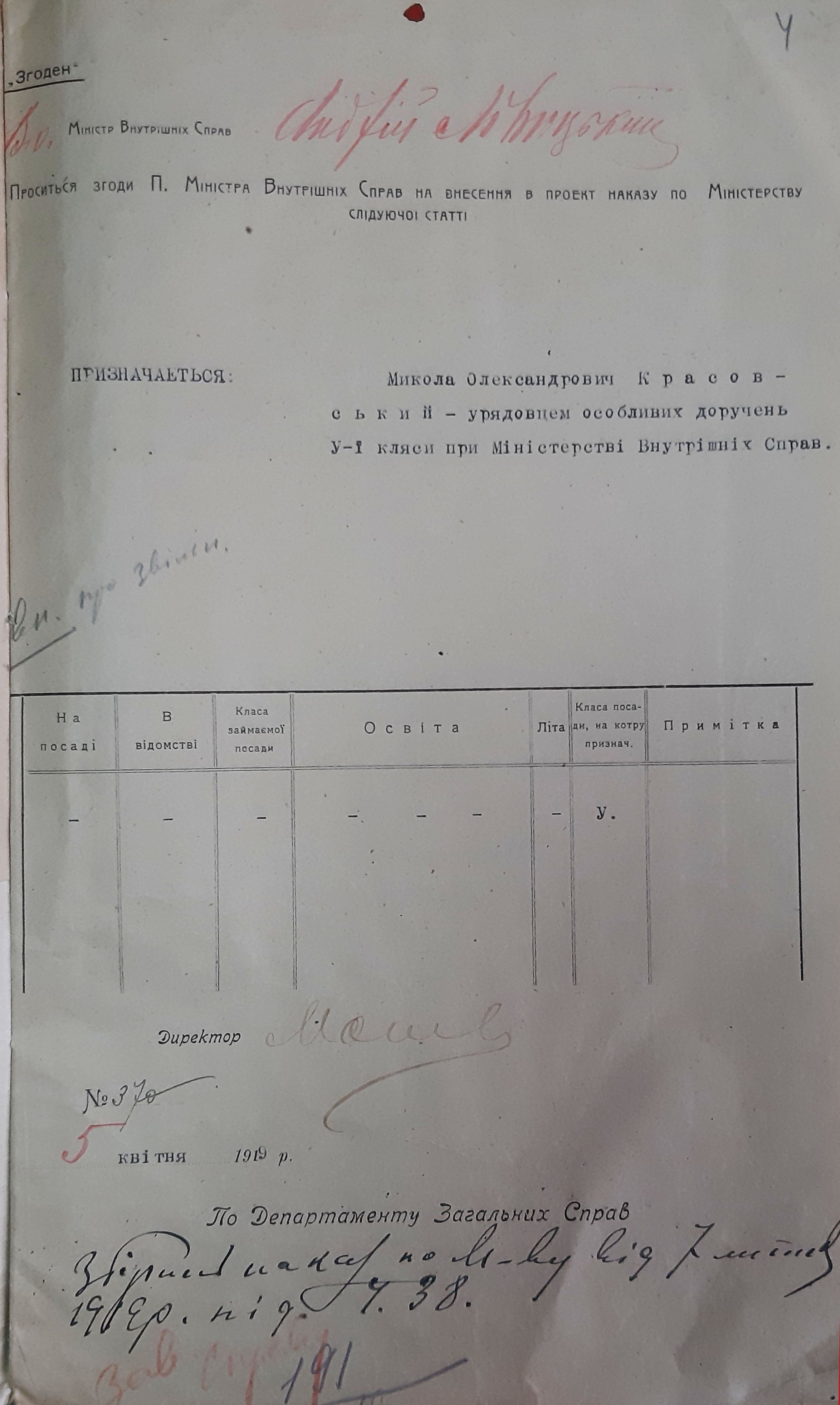
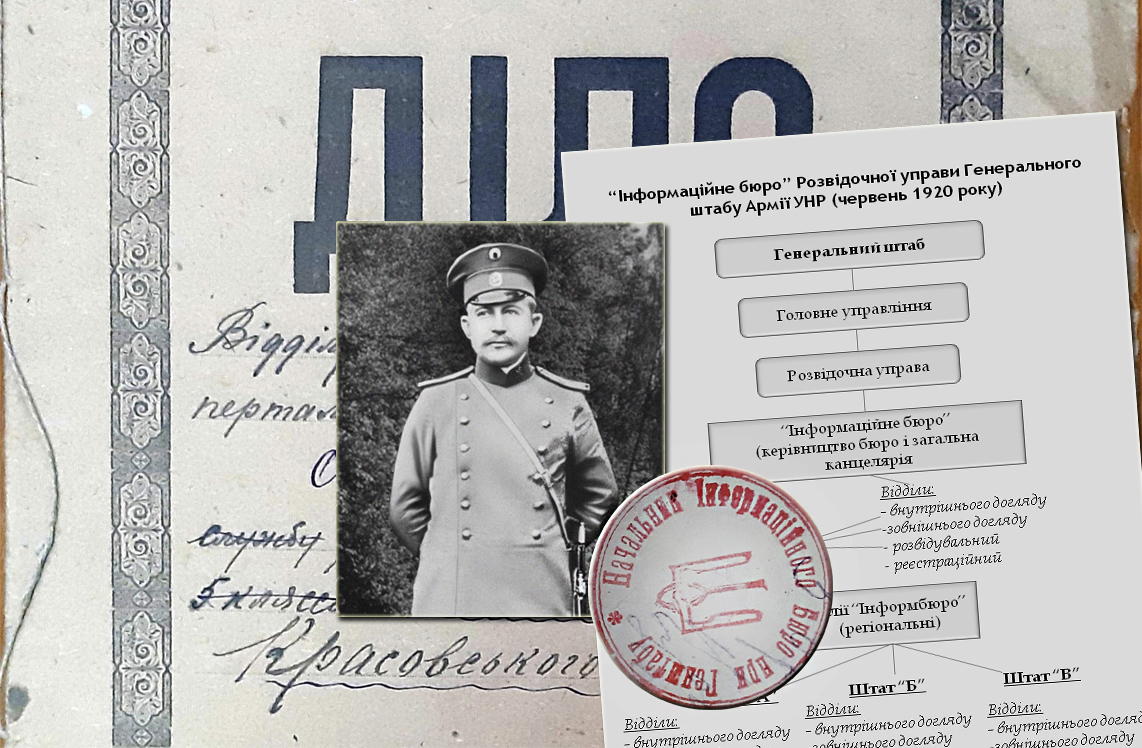
Given his great experience in previous operational and investigative work, Mykola Krasovskyi was appointed Head of the Information Bureau. Prior to this, during the period of the Central Rada, he had worked (since March 1917) as Chief of the Criminal Investigation Department in Kyiv. He headed the Kyiv CID until June 1918. Later, he was a member of an underground organization that was against the presence of the Austro-German troops stationed in Ukraine under the Brest Treaty, and was a member of the illegal Committee for the Salvation of Ukraine. He was later arrested and sentenced to two years in prison by a German military court martial.
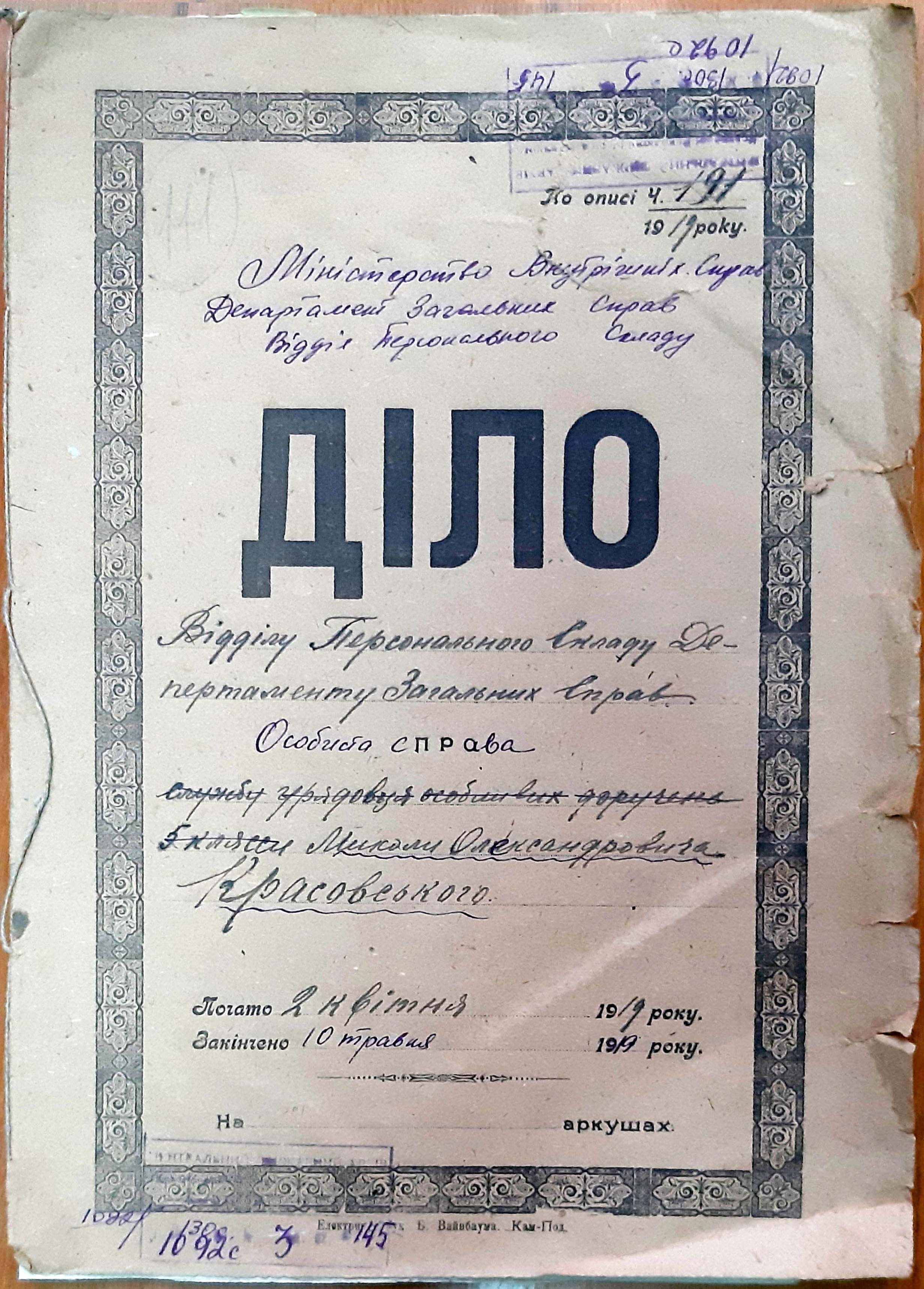
After Hetman P. Skoropadskyi abdicated, M. Krasovskyi was released from prison. He worked in the Ministry of Internal Affairs of the Ukrainian People’s Republic. The Central State Archives of Higher Authorities and Governance of Ukraine (TsDAVO of Ukraine) holds documents from that period that shed light on some episodes in the activities of the Information Bureau and its Head.
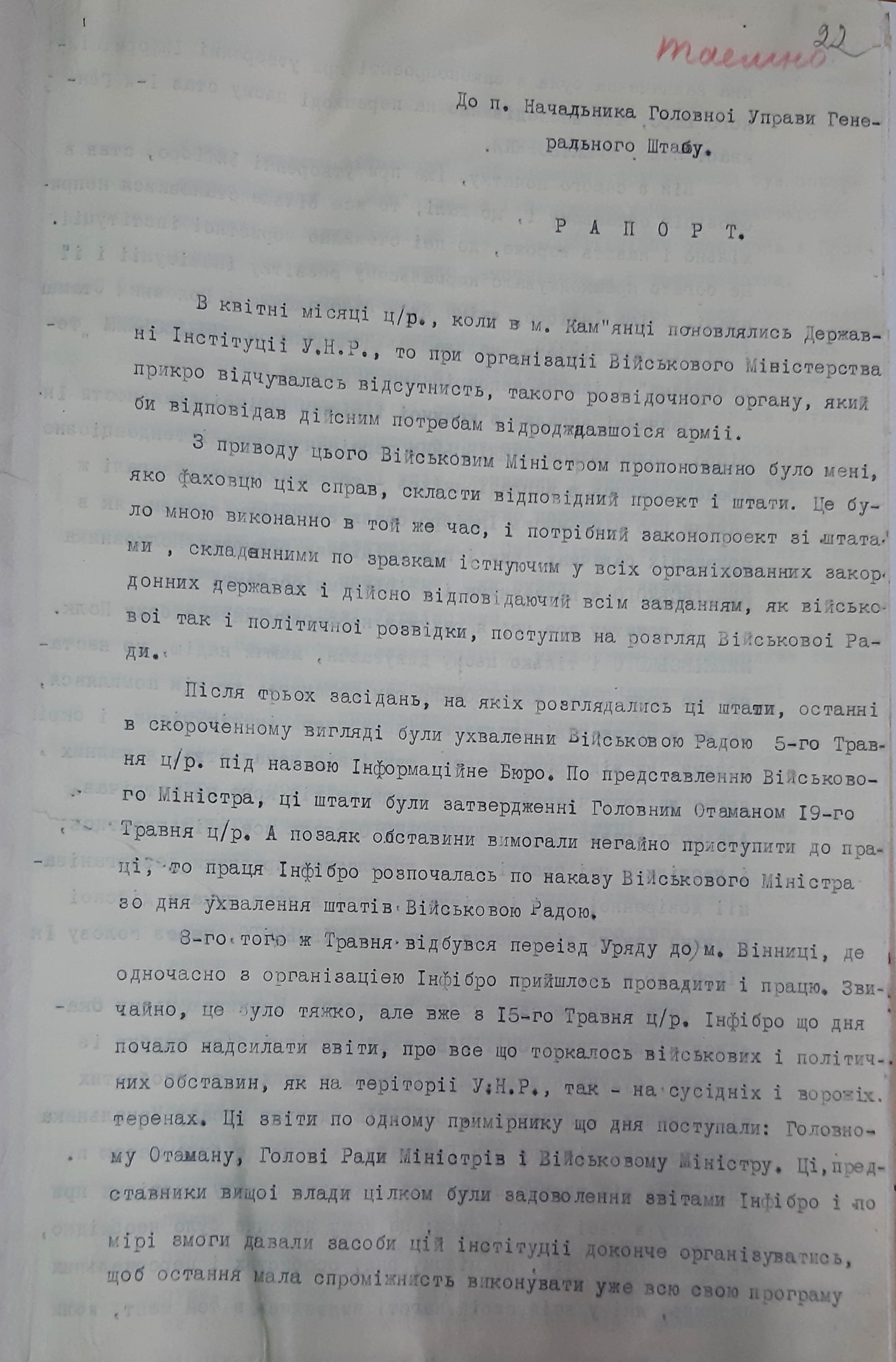
The archive contains his handwritten application for employment addressed to the Minister of Internal Affairs of the Ukrainian People’s Republic, dated April 2, 1919. Initially, as a government official with special assignments, he was involved in the formation and development of the Internal and Foreign Intelligence Departments. In April 1920, in Kamianets, where government institutions were located at that time, he received instructions from the Minister of Military Affairs to develop the structure and staff of a new intelligence agency. The prepared documents were approved on May 19 of the same year in Vinnytsia by Chief Otaman of the Army and Navy of the Ukrainian People’s Republic Symon Petliura.
In one of the reports stored in the TsDAVO, M. Krasovskyi pointed out: “Infibro began to send daily reports on everything related to military and political circumstances both in the territory of the Ukrainian People’s Republic and in neighboring and enemy territories. One copy of these reports was sent daily to the Chief Otaman, the Head of the Council of Ministers, and the Minister of Military Affairs. These representatives of the highest authorities were completely satisfied with Infibro’s reports and, as far as possible, provided this institution with the means to organize itself so that it could carry out its entire program, which was specified in the draft law on the establishment of the Information Bureau” (TsDAVO of Ukraine. – F. 1078. – Description 2. – Case 70. – P. 22).
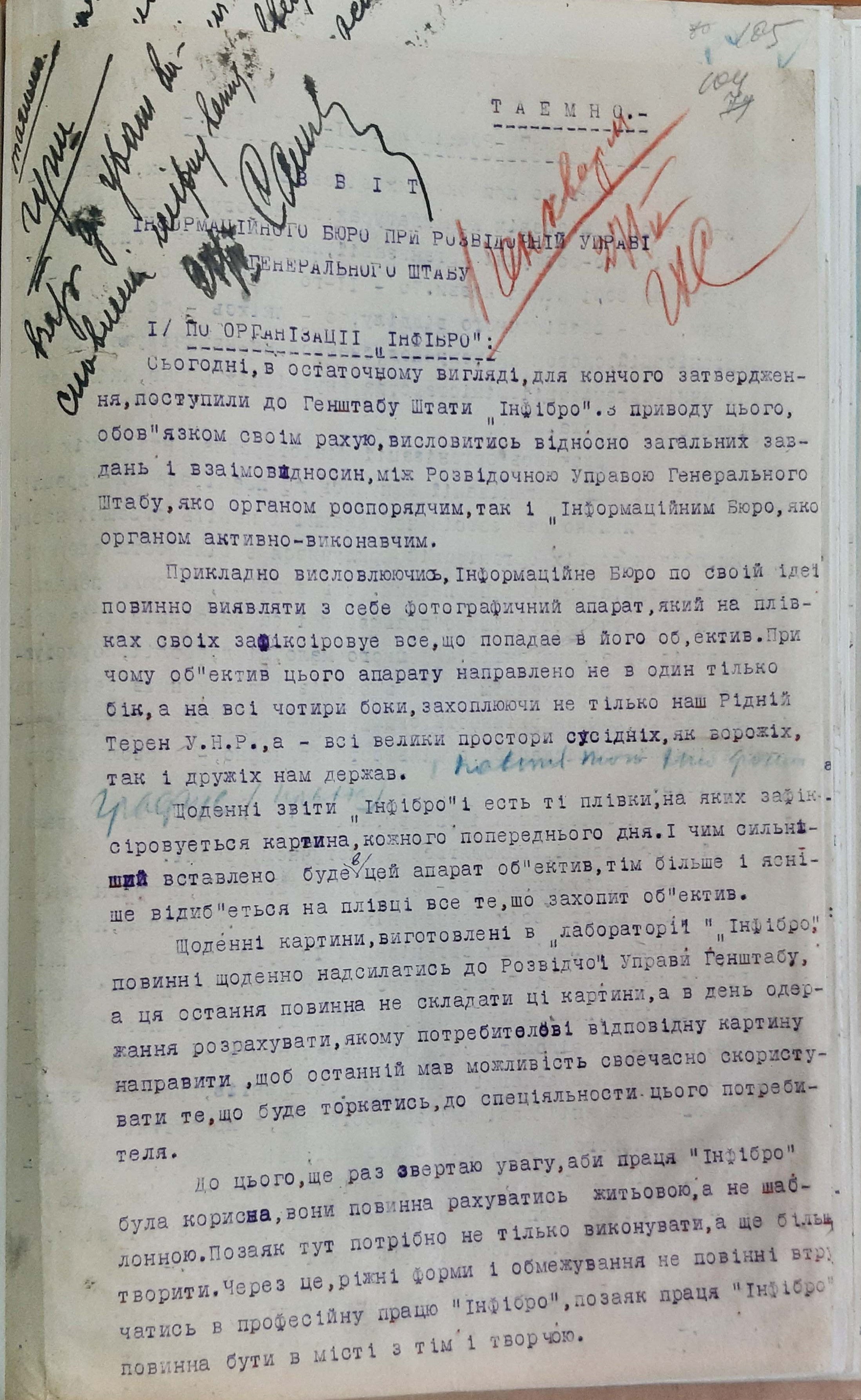
In another document, M. Krasovskyi attempted to explain the essence of the Information Bureau’s activities in an accessible form. He wrote as follows:
“To put it simply, the Information Bureau, according to its concept, should be like a camera that captures everything that comes into its lens. Moreover, the lens of this camera is not directed in only one direction, but in all four directions, capturing not only our native territory of the Ukrainian People'’s Republic, but also all the vast expanses of neighboring states, both hostile and friendly to us.
Infibro’s daily reports are films that record the events of each previous day. The stronger the lens inserted into this device, the more clearly everything captured by the lens will be reflected on the film.
The daily images produced in the Infibro “laboratory” must be sent to the Intelligence Directorate of the General Staff, which must not pile up these images, but on the day of receipt must decide which user should be sent the relevant image so that the latter has the opportunity to use what will be relevant to that user’s specialty”.
(TsDAVO of Ukraine. – F. 1078. – Description. 2. – Case 70. – Sheet 42).
The archival documents contain specific instructions on the conduct of intelligence activities. In particular, in June 1920, the task was set to prepare six agents to be sent to Odesa, Vinnytsia, Zhmerynka, Fastiv, Koziatyn, and Kyiv, as well as two resident agents with two couriers each to be infiltrated into Makhno and Wrangel’s armies. In addition, a school for agents was to be opened to immediately train six resident agents and six couriers.
M. Krasovskyi repeatedly demonstrated his principled position and determination in defending his own views on many issues. Because of this, he had conflicts with senior management, who were not very knowledgeable about sensitive operational issues. There were even cases when attempts were made to remove him from office, citing his many years of service under the tsarist regime. At this, they demanded that, when handing over his duties, he provide a report on all the people with whom he had maintained agent contacts while performing intelligence tasks. In particular, such an order was given to him by the newly appointed head of the Intelligence Directorate of the General Staff, Borys Snihiriv, whom M. Krasovskyi suspected of various abuses and even of collaborating with bolsheviks.
But Krasovskyi never complied and did not reveal the personal operational sources he had acquired over the years of service. Many of those individuals worked abroad and maintained contact with him for many years, trusting him completely.
In one of his reports to the General Staff, M. Krasovskyi openly wrote about his disagreement with how some military officials treated the intelligence agency he headed. At the same time, he spoke emotionally about his inability to compromise his conscience, honor, and duties. “My conscience in matters of intelligence and ideological struggle against all that is criminal and criminals, regardless of their position,” he declared, “will only hinder the dreams and desires that guide Mr. Snihiriv and thousands of foreigners like him, who for almost three years have been destroying and ruining everything that is useful in the Ukrainian Field” (TsDAVO of Ukraine – F. 1075. – Description. 2. – Case 89. – P. 23).
After the emigration of the Ukrainian government and military units, INFIBRO continued to operate in Poland for some time in 1920–1921. However, due to a lack of funds for its maintenance, the unit was eventually removed from the General Staff of the UPR Army. A number of its employees, including M. Krasovskyi, continued to serve in the Second Department of the General Staff of Poland, which dealt with intelligence and counterintelligence issues, by mutual agreement between the heads of the two allied military departments. In November 1921, after certain reorganizations, M. Krasovskyi was reinstated to his previous position in Ukrainian structures. He was given extraordinary powers to organize intelligence and counterintelligence activities, and his staff intensified their work, particularly in camps where Ukrainian soldiers were stationed in Poland.
Documents recently found in the Sectoral State Archive of the Foreign Intelligence Service of Ukraine supplement this information. In particular, the file entitled “Petliurists. 1922” contains a handwritten report, written in pencil on September 1, 1922, and signed “Kaminskyi”. It describes this person’s arrival in Lviv and his meeting with M. Krasovskyi, which took place on August 22. During the meeting, they discussed the transfer of insurgent groups to the territory of Ukraine.
Besides, the document pointed out that M. Krasovskyi was living in Rivne at the time, where there was a control (intelligence) point of the intelligence service of the UPR. No further information about his life and activities has been found in the archival documents.
In the context of large-scale military operations, the evacuation of the government from one city to another, a shortage of qualified personnel, and insufficient funds to finance the planned measures, it was very difficult to organize the full functioning of INFIBRO and the Foreign Information Department of the Political Department of the Ministry of Internal Affairs of the Ukrainian People’s Republic during that historical period. At the same time, those intelligence agencies still left a noticeable mark on the history of Ukrainian Intelligence. Their activity is evidenced by repeated references to them in the documents of the all-russian extraordinary commission and the significant sums of money that the chekists set as rewards for the elimination of their employees.