Symon Petliura: Two Years Before His Assassination
5/25/2026
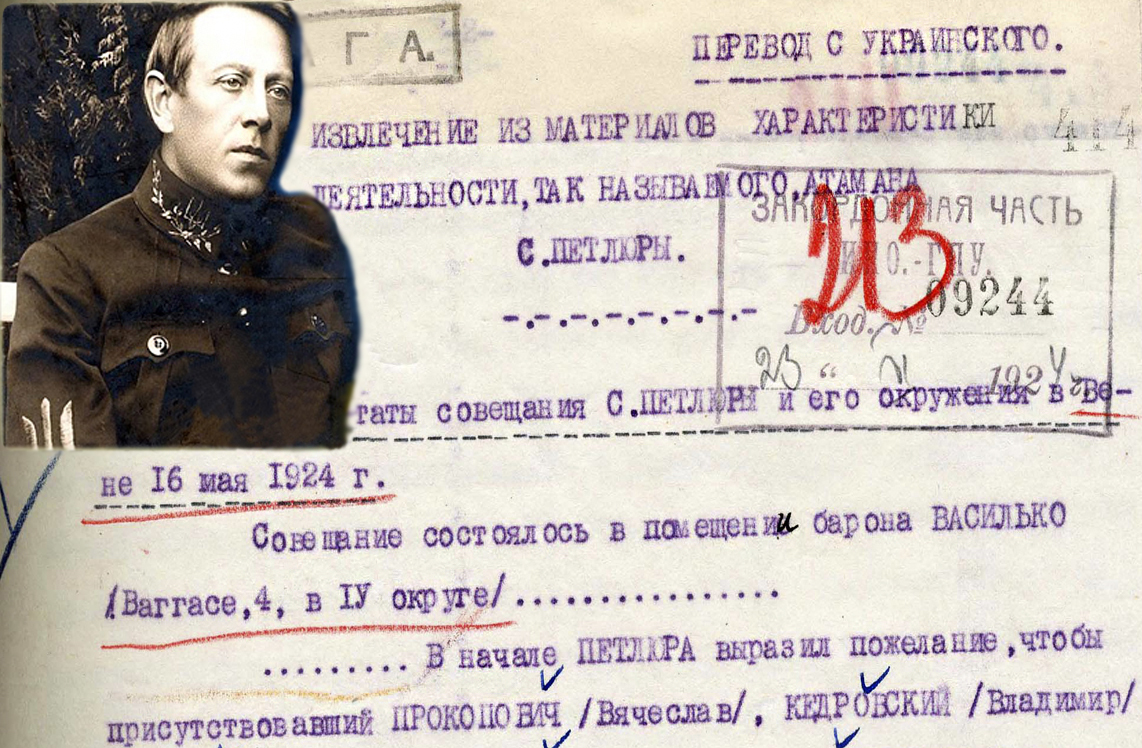
The archives of the Foreign Intelligence Service of Ukraine contain a number of documents relating to Symon Petliura’s time in exile from 1920 to 1926. These documents do not cover all of the activities undertaken by the Chief Otaman of the Army of the Ukrainian People’s Republic in organizing the work of the government-in-exile. At the same time, they demonstrate that S. Petliura remained the leader of the struggle for the Ukrainian cause, persistently seeking the support of other countries in this endeavor and consolidating pro-state emigration forces around him. Such activity did not go unnoticed by the ogpu of the ussr.
Until the foreign department of the gpu of the Ukrainian ssr began operations in the second half of the 1920s, surveillance of Ukrainian figures abroad was carried out primarily by moscow-based foreign intelligence residenturas. This explains the scarcity of documents regarding S. Petliura in the archives of the Foreign Intelligence Service of Ukraine and the limited number of files on his operational cultivation. All materials on the leader of the Ukrainian emigration and his environment were collected at the residenturas in Warsaw, Prague, Bucharest, Vienna, and Paris and sent to moscow. There, they were analyzed, decisions were made, plans were developed to counter “enemies of soviet power”, and instructions were subsequently sent to Kharkiv (the then capital of the Ukrainian ssr) to be taken into account in the work and to involve local agents in the cultivation of specific individuals.
A series of such documents, dated the first half of 1924, indicates that S. Petliura’s movements across Europe were under constant surveillance. The content of his individual meetings and negotiations became known to the chekists, while his calls to representatives of Poland and Romania, with France’s assistance, to “unite, before it is too late, in the struggle against imperial bolshevik russia” prompted the kremlin leadership to take measures against the very initiator of such actions.
On February 26, 1924, the ussr ogpu’s residentura in Prague reported as follows:
“Otaman Petliura left Poland legally. This trip was organized by Piłsudski, who remains a supporter of an independent Ukraine led by Otaman Petliura.
Petliura left Poland with the aim of seeking comprehensive support for his work in countries where the national movement is strongly developed and there is great hatred toward the bolsheviks. He intends to visit Hungary, Italy, Switzerland, Spain, and Czechoslovakia.
Another issue is the attempt to once again try to unite the following Ukrainian parties for joint work: Social Democrats, Socialists-Federalists, the “Ukrainian Union of Agrarians-Statists”, the “Democratic Farmers”, and some prominent individual figures…
In Budapest, Otaman Petliura held a conference with the Minister of Foreign Affairs. He reportedly achieved great success…
Petliura is to visit Prague in the near future”
(FISU. – F. 1. – Case 10102. – Vol. 4. – P. 115).
Another document details the activities of S. Petliura and his associates between May 15 and August 1, 1924. It concerns the activities of the UPR missions in Poland, Romania, the Vatican, and France. Additionally, it is noted that during his stay in Paris, S. Petliura met with a number of influential figures and submitted a memorandum to the Ministry of Foreign Affairs in which “he emphasized the unwavering sympathy and interest of Ukrainian circles in France’s participation in the revival of Ukraine and Ukraine’s readiness not only to return property that belonged to French entrepreneurs but also to grant favorable concessions.” It is further noted that he was received by Italian Prime Minister B. Mussolini and “had a lengthy audience with him”, during which they discussed support for the Ukrainian cause and further political and economic cooperation in case of the restoration of Ukrainian statehood.
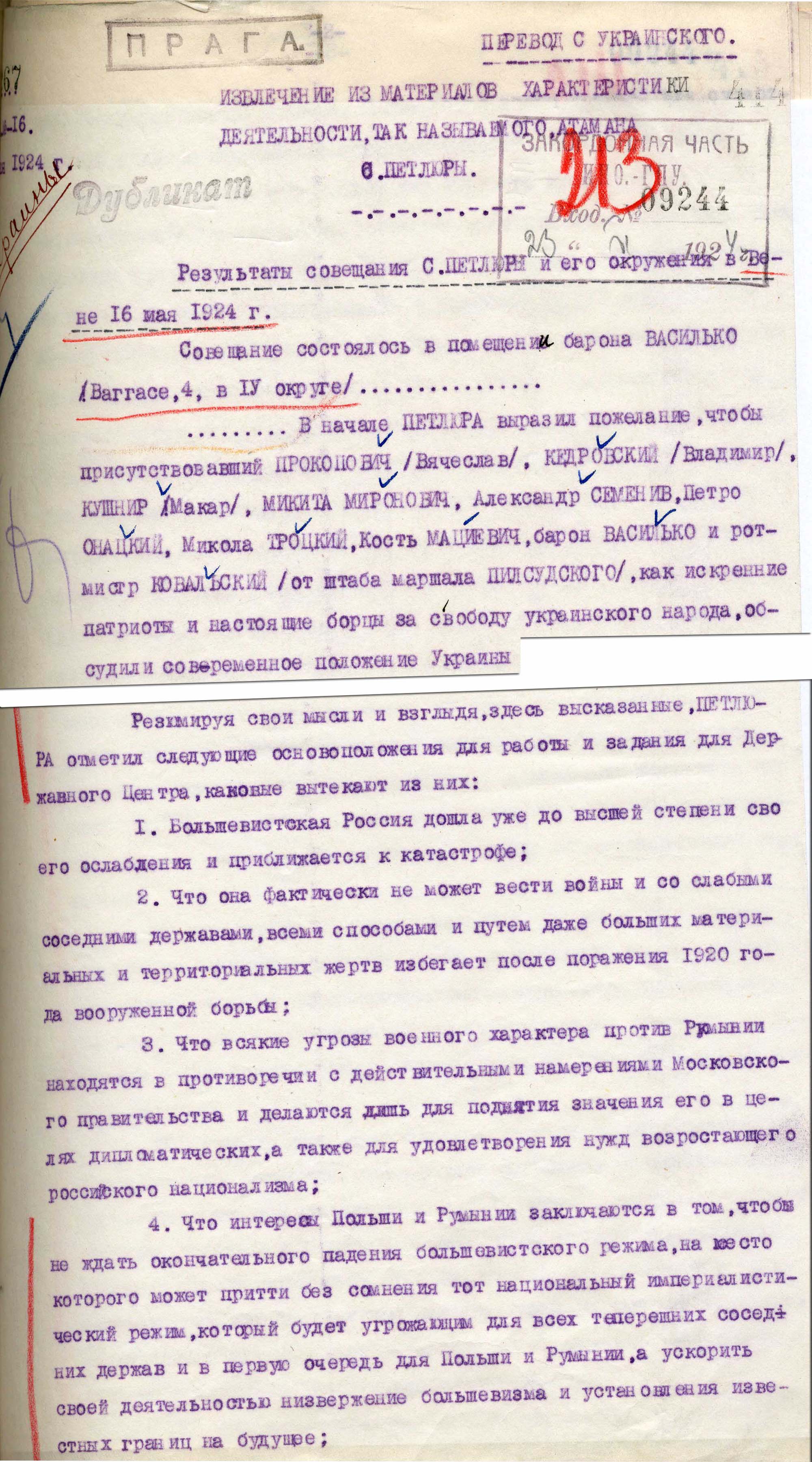
In May 1924, the ussr ogpu’s Prague residentura reported that S. Petliura had traveled to Chernivtsi and Kolomyia under the name S. Ivanov, from where he returned via Budapest and Prague to Vienna, where some important meeting was to take place. A separate report is devoted to that meeting. It stated that the meeting took place on May 16 at the residence of the Ukrainian diplomat Baron Vasylko. At the meeting, S. Petliura spoke about negotiations with Romanian and Polish government officials and representatives of military staffs, during which the possibility of a joint armed campaign against bolshevik russia was raised. Expanding on the topic of forming a coalition to support Ukrainian national forces, he spoke of the need to pursue such efforts more actively in Italy, France, Belgium, and England.
“Summarizing his thoughts and views,” the document points out, “Petliura determined the following key principles for the work of the State Center and the tasks arising from them:
1. bolshevik russia has already reached the peak of its weakness and is approaching catastrophe.
2. That it is, in fact, no longer capable of waging war against its weaker neighboring states and, by all means and even at the cost of significant material and territorial sacrifices, has been avoiding armed conflict since its defeat in 1920.
3. That all manner of military threats against Romania are at odds with the true intentions of the moscow government and are made solely to bolster its standing for diplomatic purposes, as well as to satisfy the needs of russian nationalism, which is on the rise.
4. That the interests of Poland and Romania lie in not waiting for the final collapse of the bolshevik regime, which will undoubtedly be replaced by a national imperialist regime that will pose a threat to all current neighboring states, first and foremost to Poland and Romania, but rather in speeding up, through their actions, the overthrow of bolshevism and establishing recognized borders for the future.
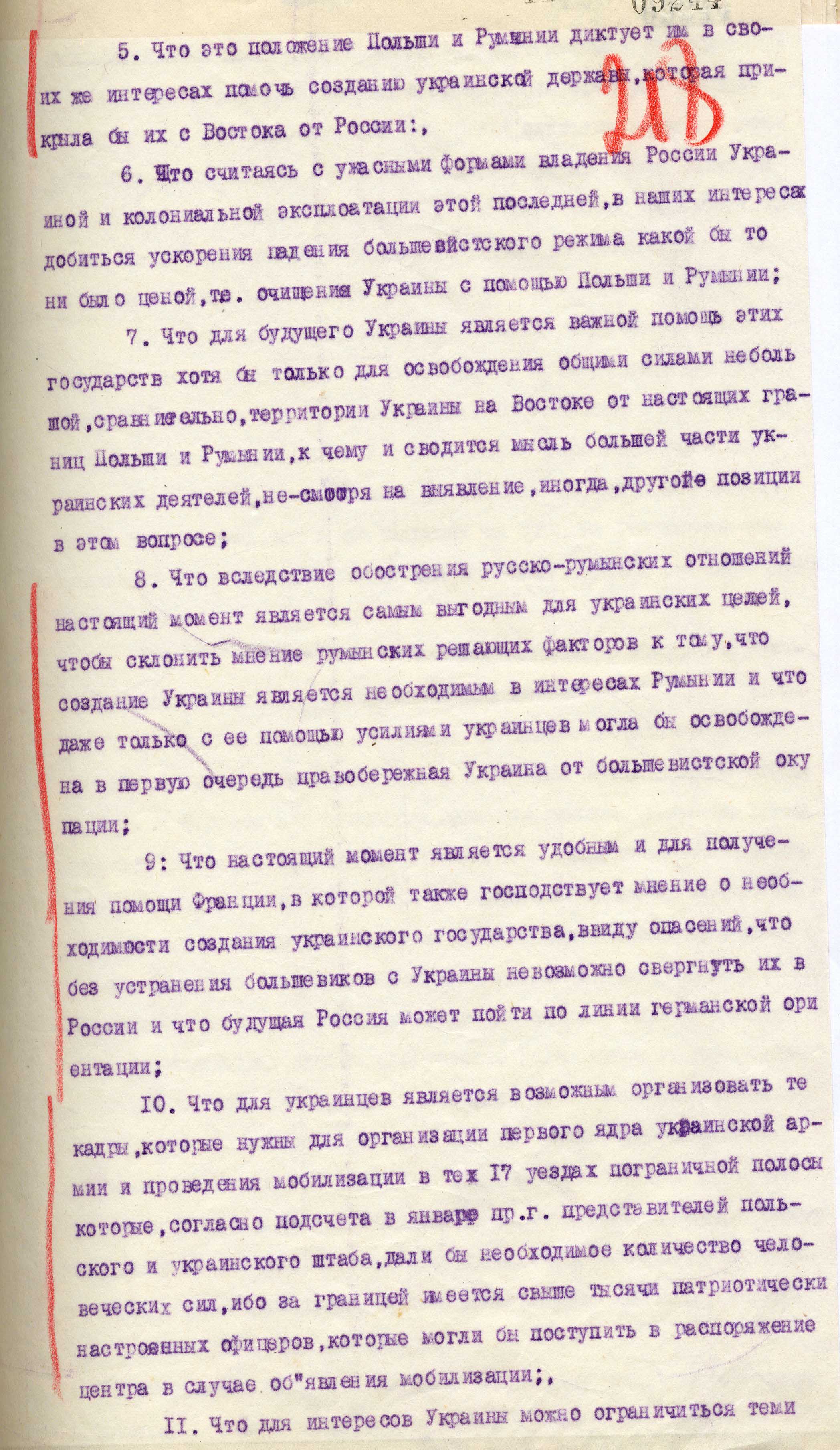
5. Given the current situation in Poland and Romania, it is in their own best interests to assist in the creation of a Ukrainian state that would serve as a buffer against russia to the east.
6. That, given russia’s horrific rule over Ukraine and its colonial exploitation, it is in our interest to speed up the fall of the bolshevik regime at any cost, that is, to liberate Ukraine with the help of Poland and Romania.
7. That for Ukraine’s future, the assistance of these states is crucial, even if only to liberate, through joint forces, a relatively small territory to the east of the current borders of Poland and Romania – a view shared by the majority of Ukrainian leaders, despite the occasional emergence of a different position on this matter…»
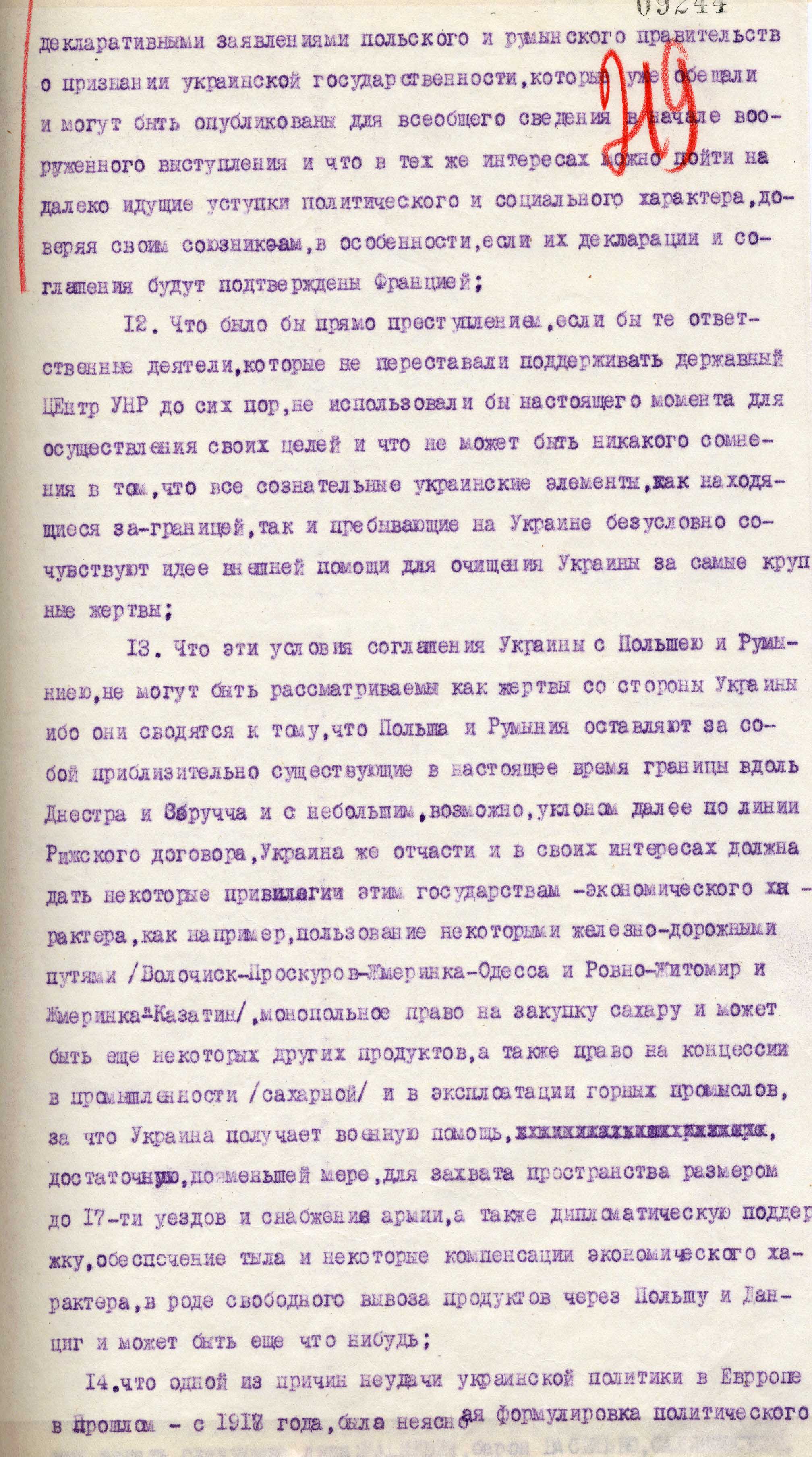
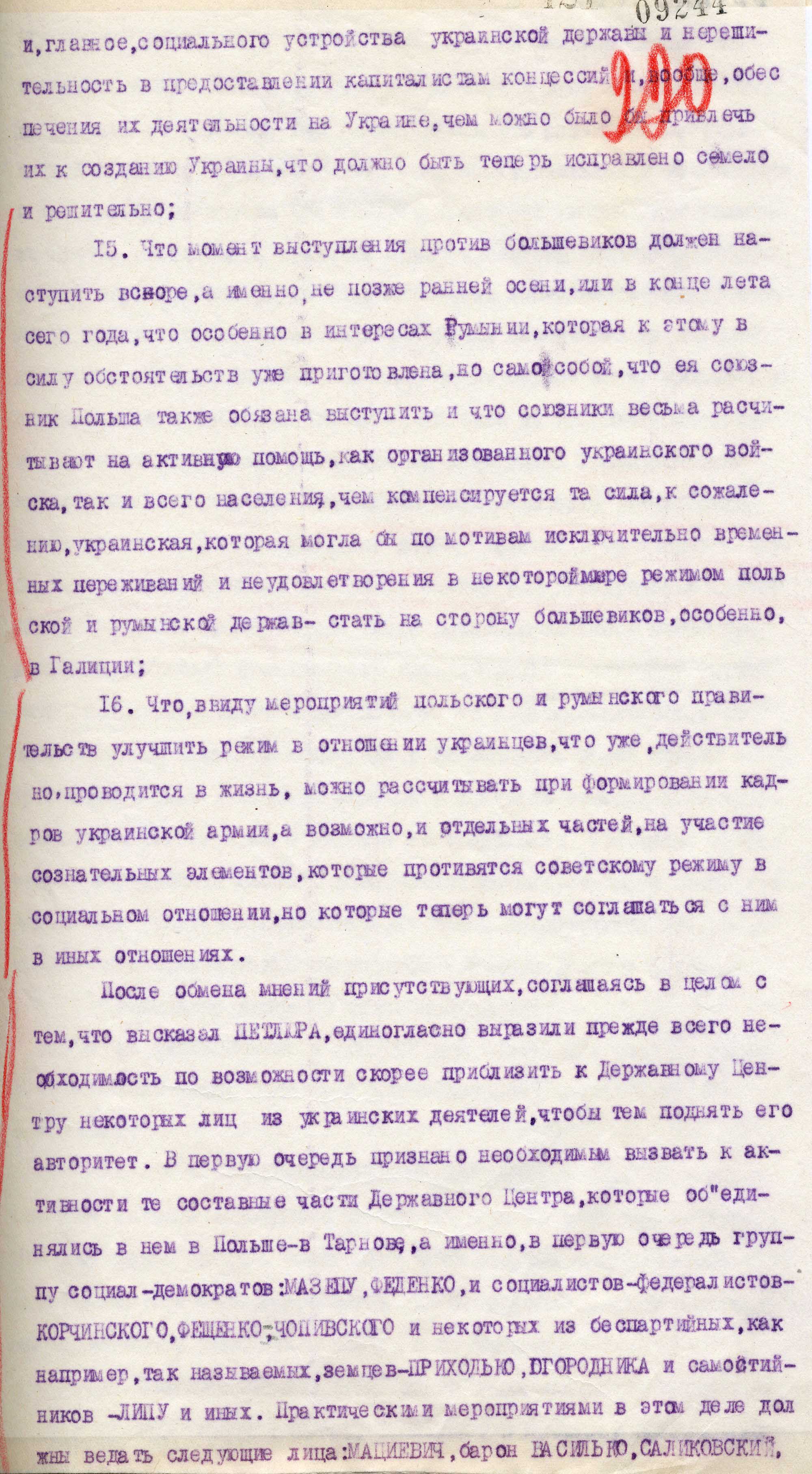
(FISU. – F. 1. – Case 10102. – Vol. 4. – P. 217–220).
In total, the document lists 16 main points from S. Petliura’s speech at the meeting, in which he repeatedly emphasized that a favorable situation had arisen for a joint offensive against the bolsheviks and that it would be a crime not to take advantage of external assistance to liberate Ukraine, even at the cost of great sacrifices.
It is not surprising that such information compelled the bolshevik leadership to make ever-greater efforts to monitor S. Petliura, his movements, and his lifestyle; to infiltrate agents into his inner circle; to uncover his plans; and to find the right moment to settle the score with him, as well as the individuals who could carry this out.
The bolsheviks viewed S. Petliura’s very existence as a serious political and ideological threat. For many Ukrainian émigrés, former soldiers of the UPR Army, and a segment of the population of soviet Ukraine, he remained a symbol of Ukrainian statehood and the armed struggle for the restoration of independence. moscow feared that in case of an international conflict or the weakening of the ussr, an anti-bolshevik center might form around him.
Meanwhile, the kremlin was eager to prove to the world that the Ukrainian question had been definitively resolved within the ussr, while S. Petliura and the UPR government in exile constantly reminded the world of their existence. Thus, the struggle against S. Petliura and the Petliurists did not cease even after the assassination of the Chief Otaman of the UPR Army. Throughout all historical periods, the gpu/nkvd/kgb attempted to discredit him and erase all memory of him, as evidenced by other declassified documents from the archives of the Foreign Intelligence Service of Ukraine.