The Mystery of Stepan Fedak Jr.’s Disappearance
5/1/2026
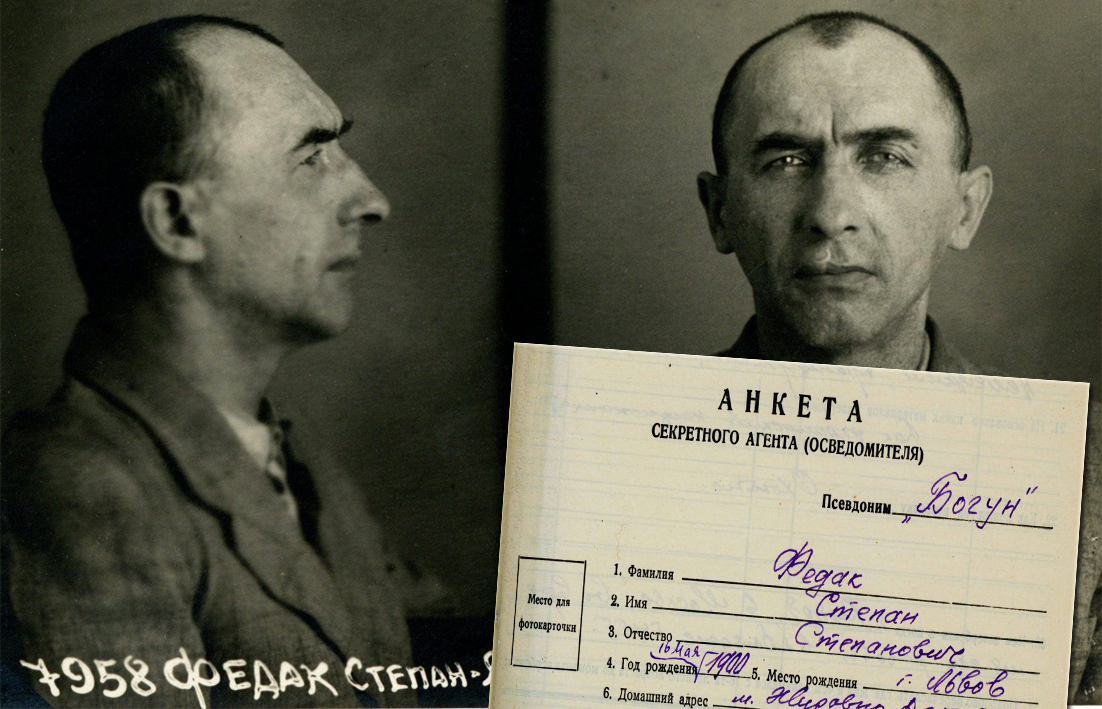
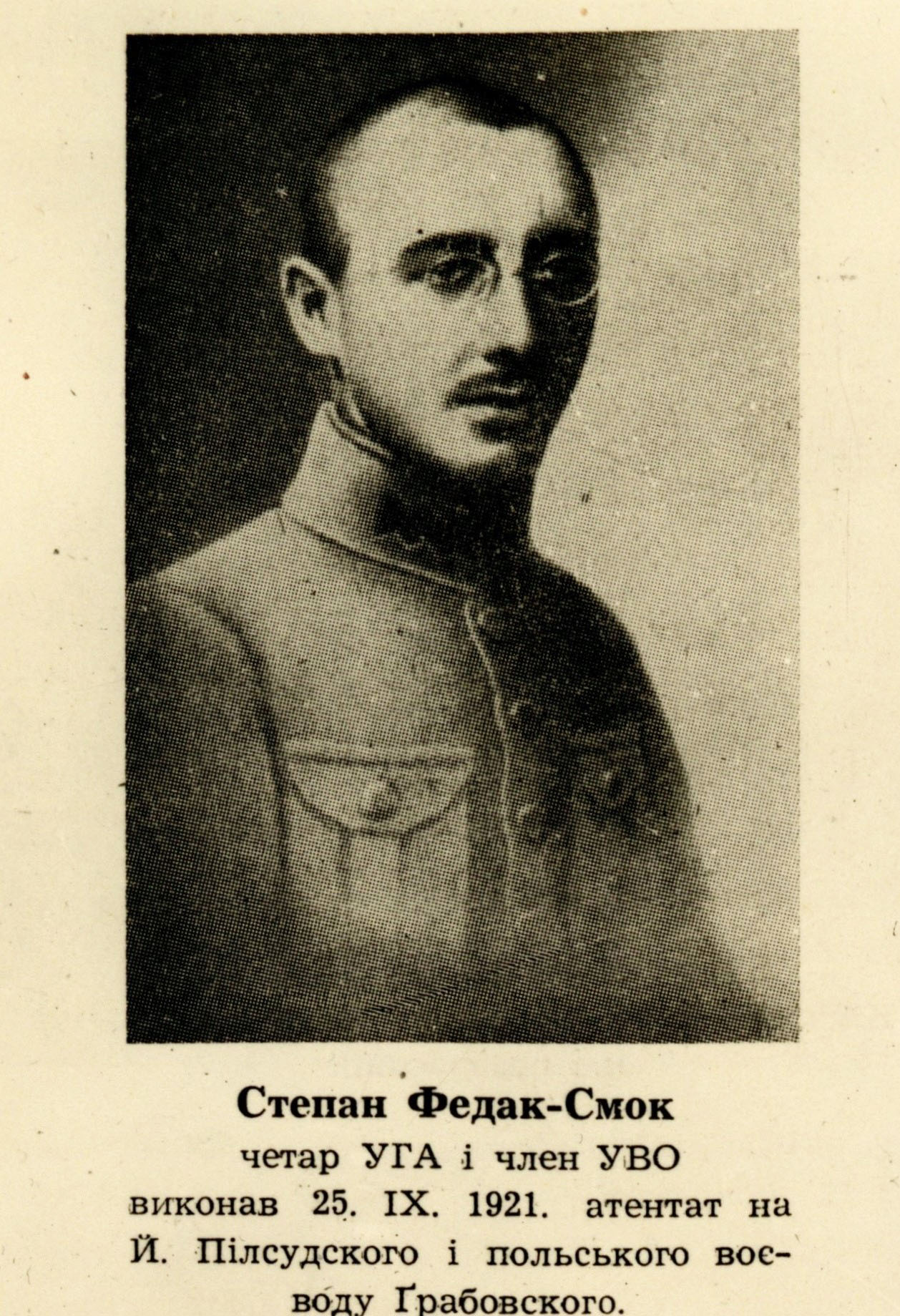
The fate of Stepan Fedak, whose sisters were married to Yevhen Konovalets and Andriy Melnyk, is full of mysteries and blank spots. It was believed that he disappeared without a trace around 1945, at the end of World War II. But the mgb, and later the kgb of the ussr, did not believe this and persistently kept searching the world for him. They needed him in order to complete a special operation that had been so unexpectedly interrupted by the outbreak of war. The operation is a striking example of how moscow resorted to such a rather specific method as “gentle” recruitment, solely to infiltrate the inner circle of leaders of the Ukrainian liberation movement.
Arrest in Zhuravne
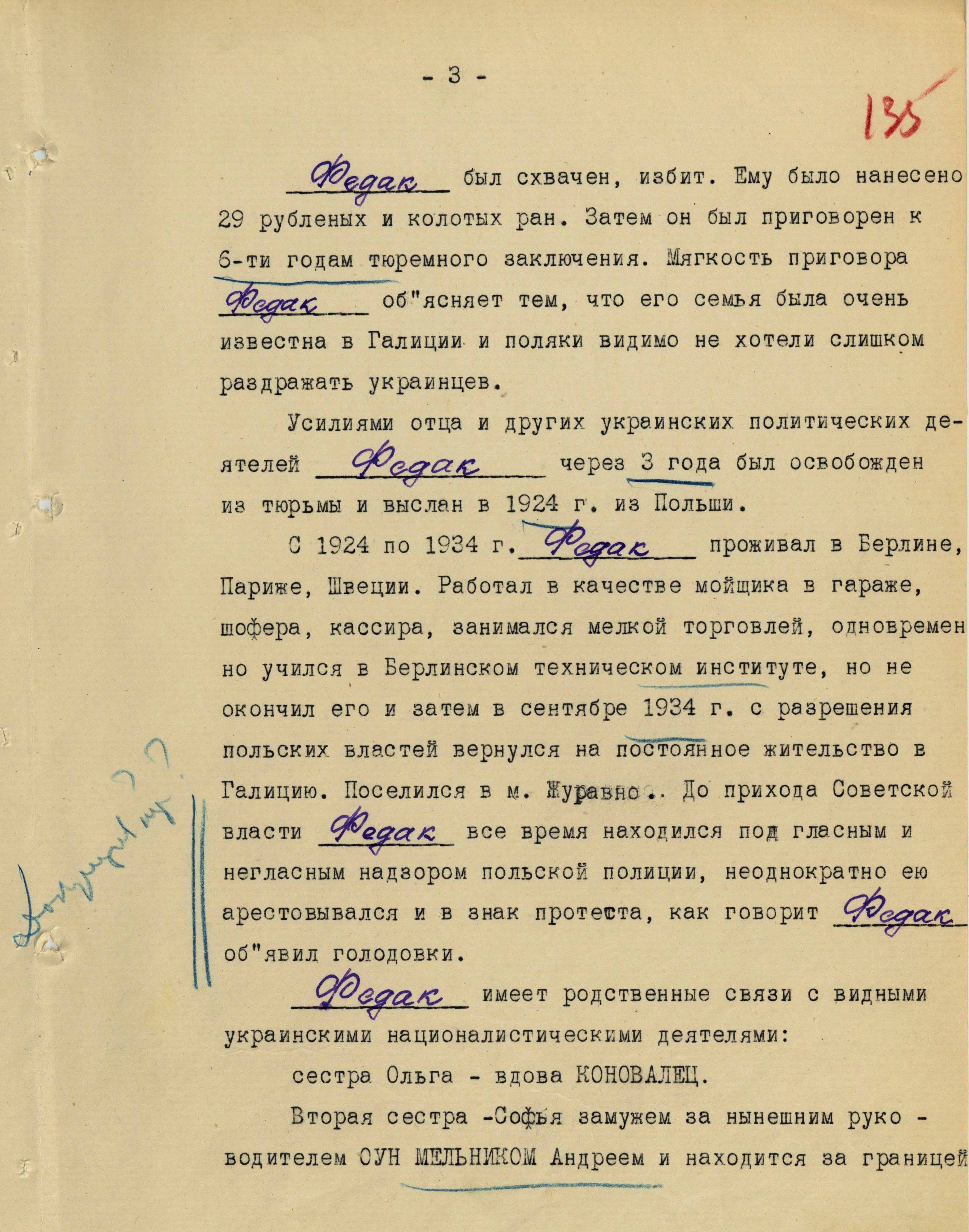
After the red army’s arrival in Western Ukraine in 1939 and the establishment of soviet rule, the village of Zhuravne soon became the center of Zhuravne district of Drohobych region (now Stryi district of Lviv region). Immediately, a district department of the nkvd was established with the task of searching for, investigating, and arresting those who were hostile to the new regime, active members of the OUN, and their close relatives. Among the suspects was Stepan Fedak, the son of Stepan Ivanovych Fedak, a well-known lawyer and public and political figure of Western Ukraine.
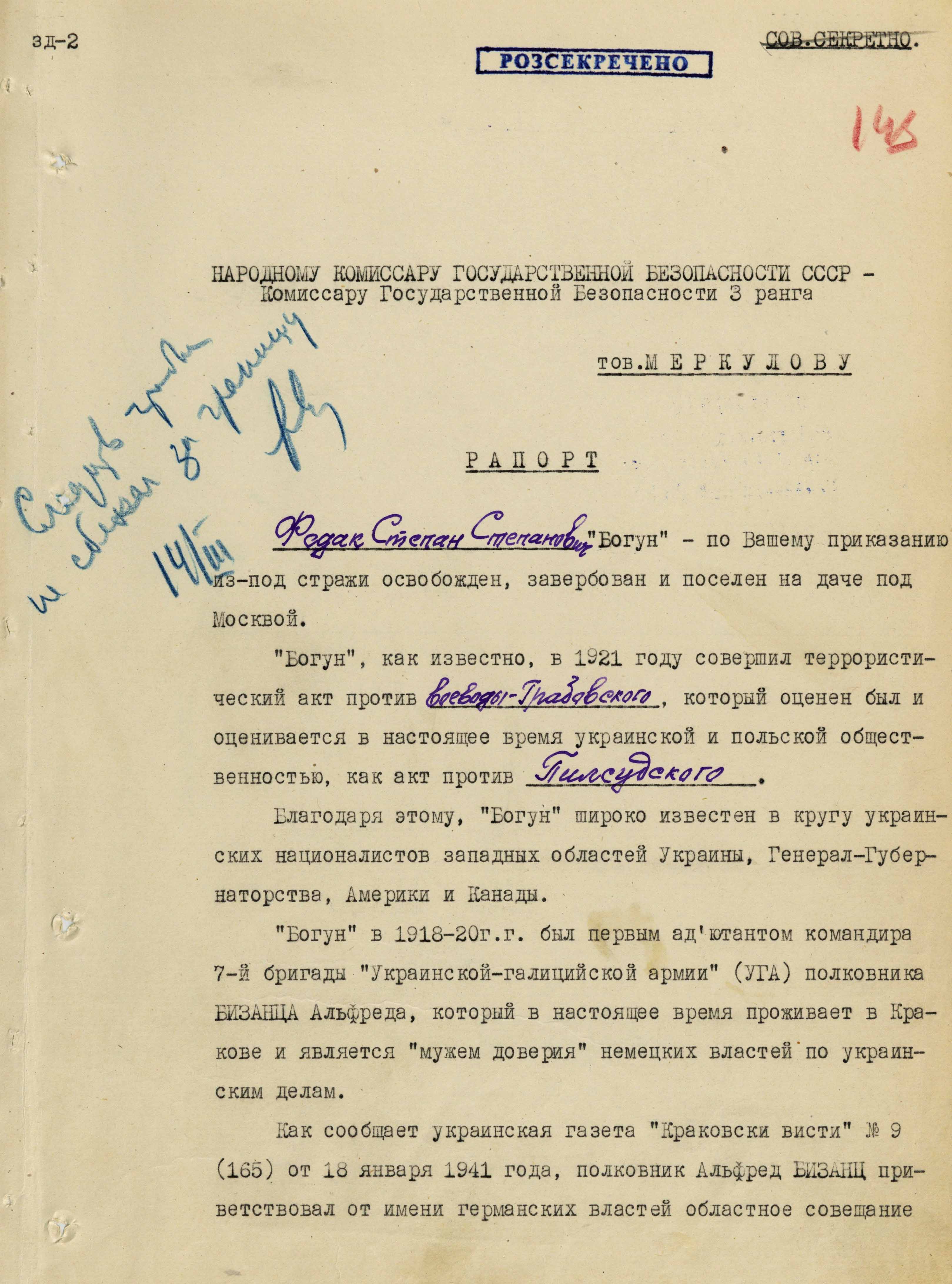
Stepan Fedak Jr. worked as the director of a local butter mill; he was not involved in political activities at that time and therefore had no intention of emigrating anywhere. But this did not save him from repression, the plans for which were traditionally drawn up by the nkvd. To the chekists, he was a highly suspicious individual, if only because, in an act of revenge for the closure of the Ukrainian University, he had once fired at Lviv Governor Kazimierz Grabowski, who was accompanying Head of State of Poland Józef Piłsudski in Lviv. Hence,the chekists considered him a potential terrorist who could commit a similar act against soviet officials.
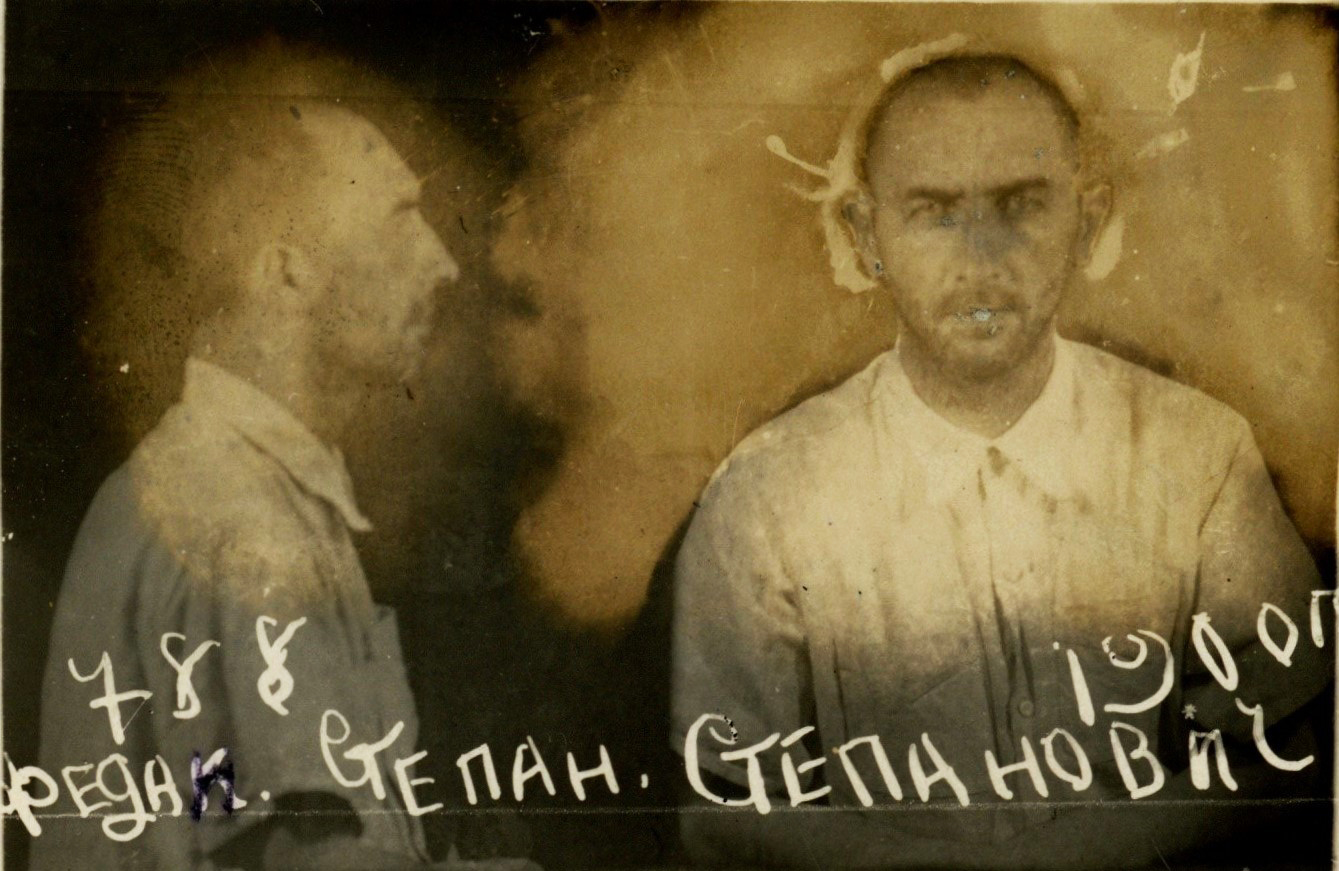
According to declassified documents, S. Fedak was not arrested immediately, but on March 22, 1940. Evidently, they had been observing him and gathering information for several months. He was charged with having fought against the red army as a senior officer of the Ukrainian Galician Army in 1919, having been a member of the Ukrainian Military Organization from 1920 to 1928, and subsequently having been a member of the OUN. “At meetings held by Ukrainian nationalists,” one document pointed out, “he delivered counterrevolutionary, slanderous speeches against the soviet union.” Evidently, he never made such speeches, but witnesses were found to testify to that.
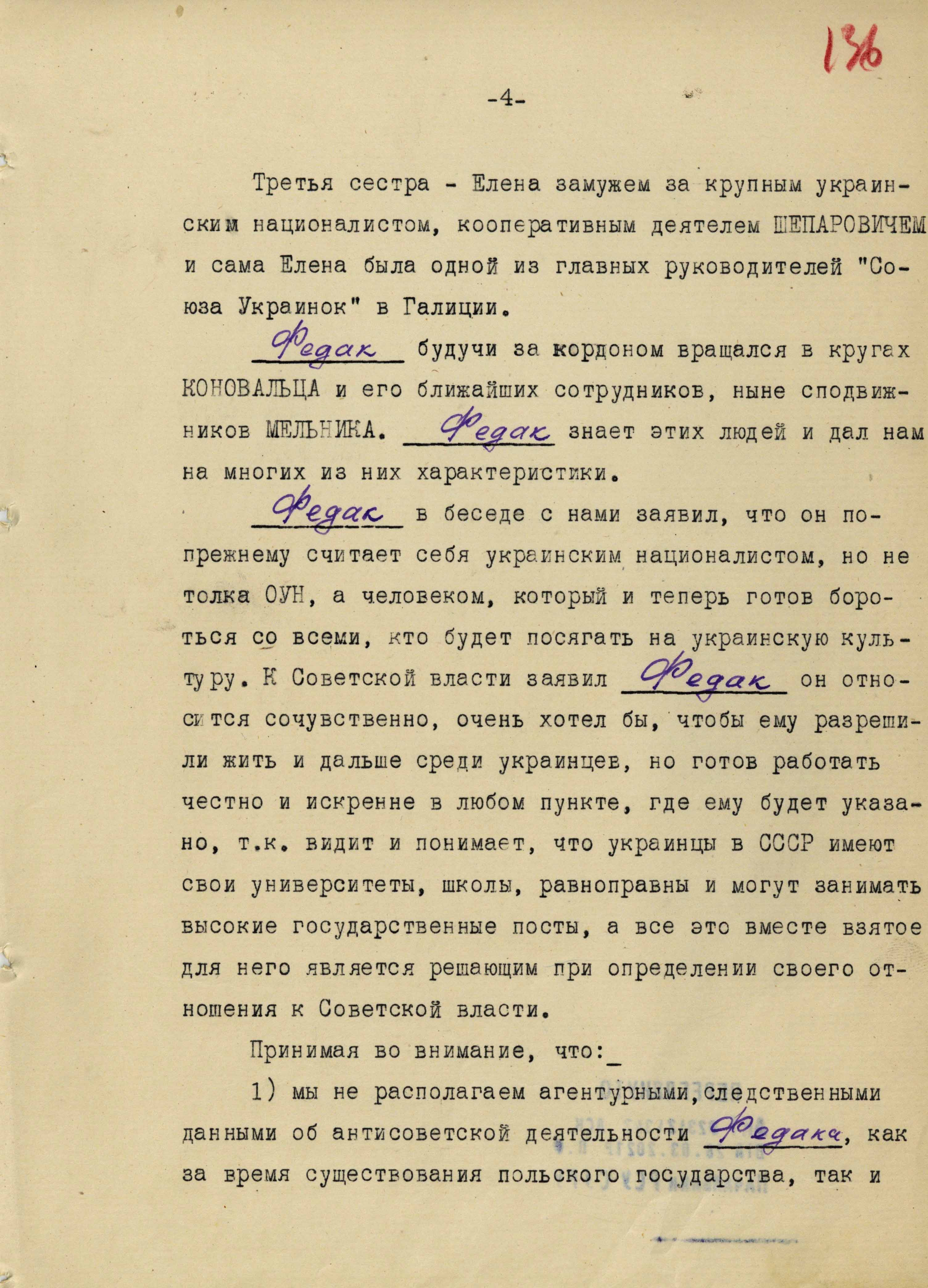
Based on such compromising materials, a plan to recruit S. Fedak took shape at the district department. The relevant proposals were sent to Kyiv for approval, as the arrested man was a rather prominent figure. But the nkvd of the Ukrainian ssr issued a negative assessment. They pointed out that recruiting S. Fedak as an agent within the OUN held little promise. They argued that after the failed assassination attempt on K. Grabowski in 1921 and serving his sentence in a Polish prison, he had withdrawn from political activity and had no organizational ties to the OUN. His contacts with Ye. Konovalets and A. Melnyk were allegedly of a purely family nature.
In the document, the nkvd leadership of the Ukrainian ssr warned that S. Fedak might try to deceive them, attempting to gain their trust in order to be released from custody and then flee abroad. Besides, they pointed out that those around him would undoubtedly view his release with suspicion and that “the OUN leadership is not so naive as to believe in the reasons for his release from custody based on fabricated motives”. Therefore, they concluded that the investigation had dragged on, so it was necessary to conclude it and transfer the materials to the court.
Based on hastily collected testimony, criminal intelligence investigator of the Drohobych Directorate of the nkvd moskaliov drafted and signed an indictment, which was already being prepared for submission to a special meeting of the nkvd of the ussr. But unexpectedly, an administrative directive arrived from moscow to the Lviv diractorate of the nkvd of the Ukrainian ssr, which changed all plans. It instructed that all close relatives of Fedak Sr. be located, in particular his son Stepan, who was known to be living in Zhuravne.
“We attach great importance to the cultivation of Fedak,” the document stated. “Stepan Fedak and all his relatives must be identified and placed under active cultivation. It is necessary to thoroughly study him through our agents and find out whether he can be recruited to cooperate with us. Please, coordinate all your operational measures with us” (FISU. – F. 1. – Case 5. – Vol. 2. – P. 48).
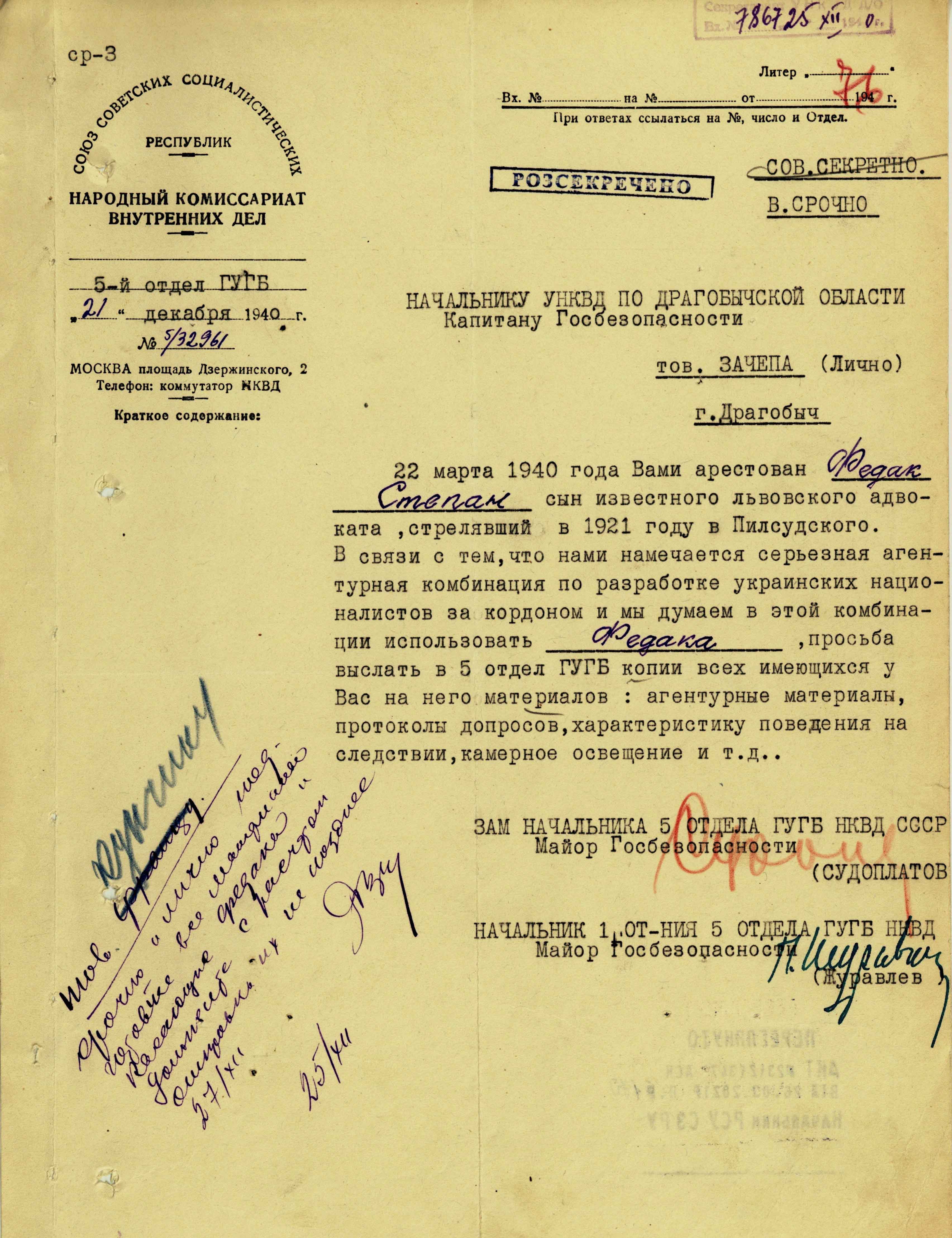
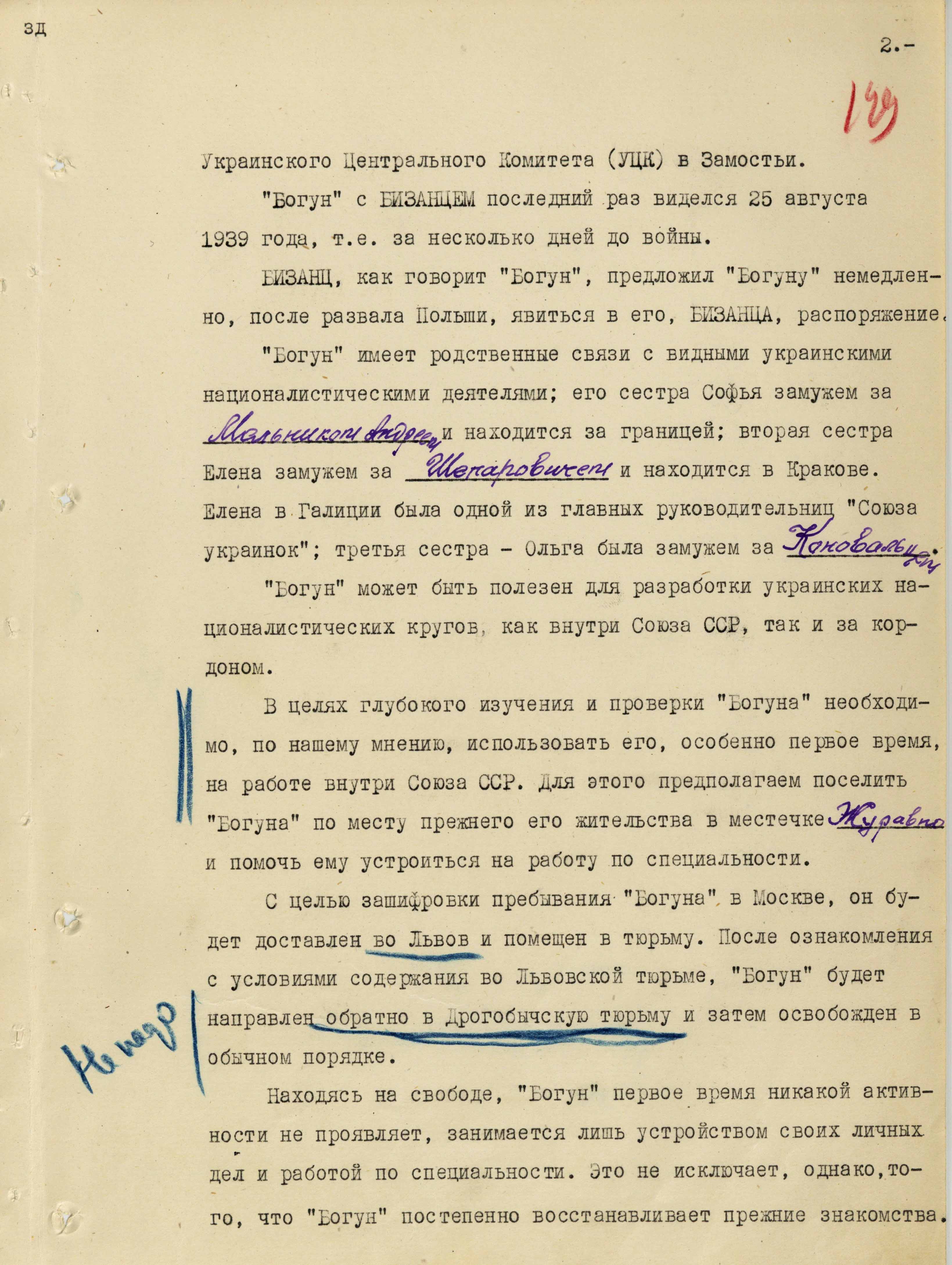
Soon another document arrived from moscow, the contents of which made clear the reason for such persistent interest in S. Fedak. It stated that it was also necessary to immediately locate all close relatives of Andriy Melnyk, a native of the village of Volia Yakubova in Drohobych district, who had become the head of the OUN following the assassination of Ye. Konovalets. They explained that they intended to use S. Fedak, whose sister was A. Melnyk’s wife, to infiltrate the OUN leadership. Thus, the circle was closed.
After moscow had learned that S. Fedak had been arrested and was being held in the nkvd prison in Drohobych, they ordered that no further independent actions be taken against him and that all collected materials be sent immediately. The relevant document, dated December 21, 1940, was signed by Pavel Sudoplatov. All the materials were immediately sent to moscow, where they were added to the case that Lieutenant Ivan Kudria had been handling against S. Fedak at the nkvd central office for over two years by that time.
“Put Him in a Dacha Near moscow”
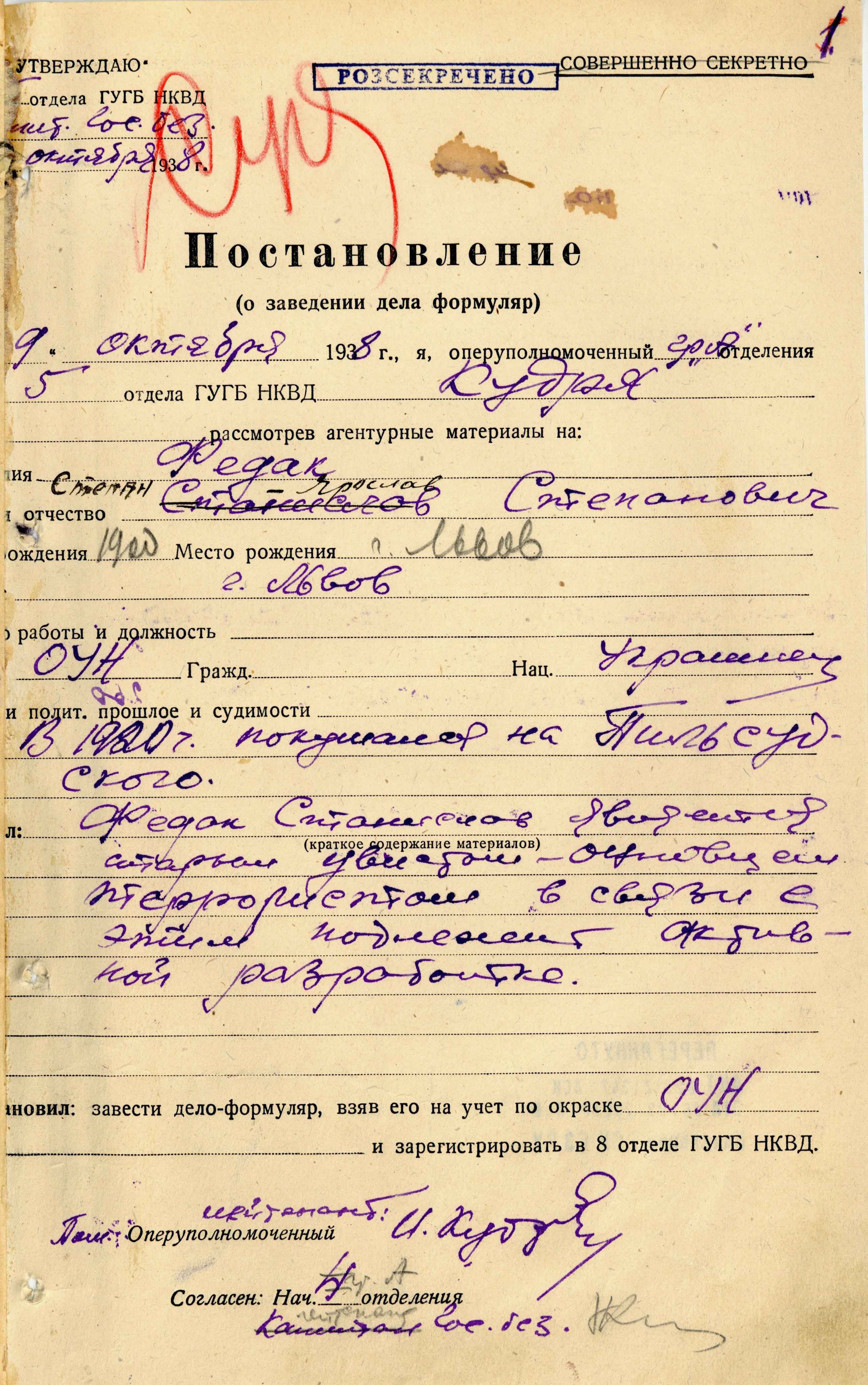
A resolution to open a case, dated October 9, 1938, signed by I. Kudria and approved by P. Sudoplatov, was found in the archives of the Foreign Intelligence Service of Ukraine. In other words, the operational investigation was carried out with the direct involvement of the man who, a few months earlier, had killed Y. Konovalets and subsequently focused on developing measures against the new OUN leader, A. Melnyk.
Under the supervision of P. Sudoplatov, as shown by archival documents, separate cases were soon opened on A. Melnyk under the code names “Sprut” (February 1941) and “Engineer” (May 1944). The latter outlined operational measures to liquidate the OUN leader in Berlin, but the attempt failed.
Meanwhile, they were looking for individuals through whom they could gain A. Melnyk’s trust. The nkvd operated according to a scheme already tested in Operation “Stavka” regarding the assassination of Ye. Konovalets. At that time, one of the key figures was the Colonel’s comrade-in-arms, former Sich Rifleman Vasyl Khomyak (agent “Lebed”). Under the new circumstances, S. Fedak was considered for this role.
Even before I. Kudria issued the order to open the case, information on S. Fedak was already being collected from the ussr nkvd’s foreign residenturas. A number of documents dating from the early 1930s mention his residing in Berlin and Paris, as well as his meetings with Ye. Konovalets, M. Stsiborskyi, O. Boikiv, Y. Petrushevych, D. Skoropadskyi, and other Ukrainian figures. There are mentions of his arrest by the Polish police in 1937 as part of a group of OUN representatives and charges of nationalist activity.
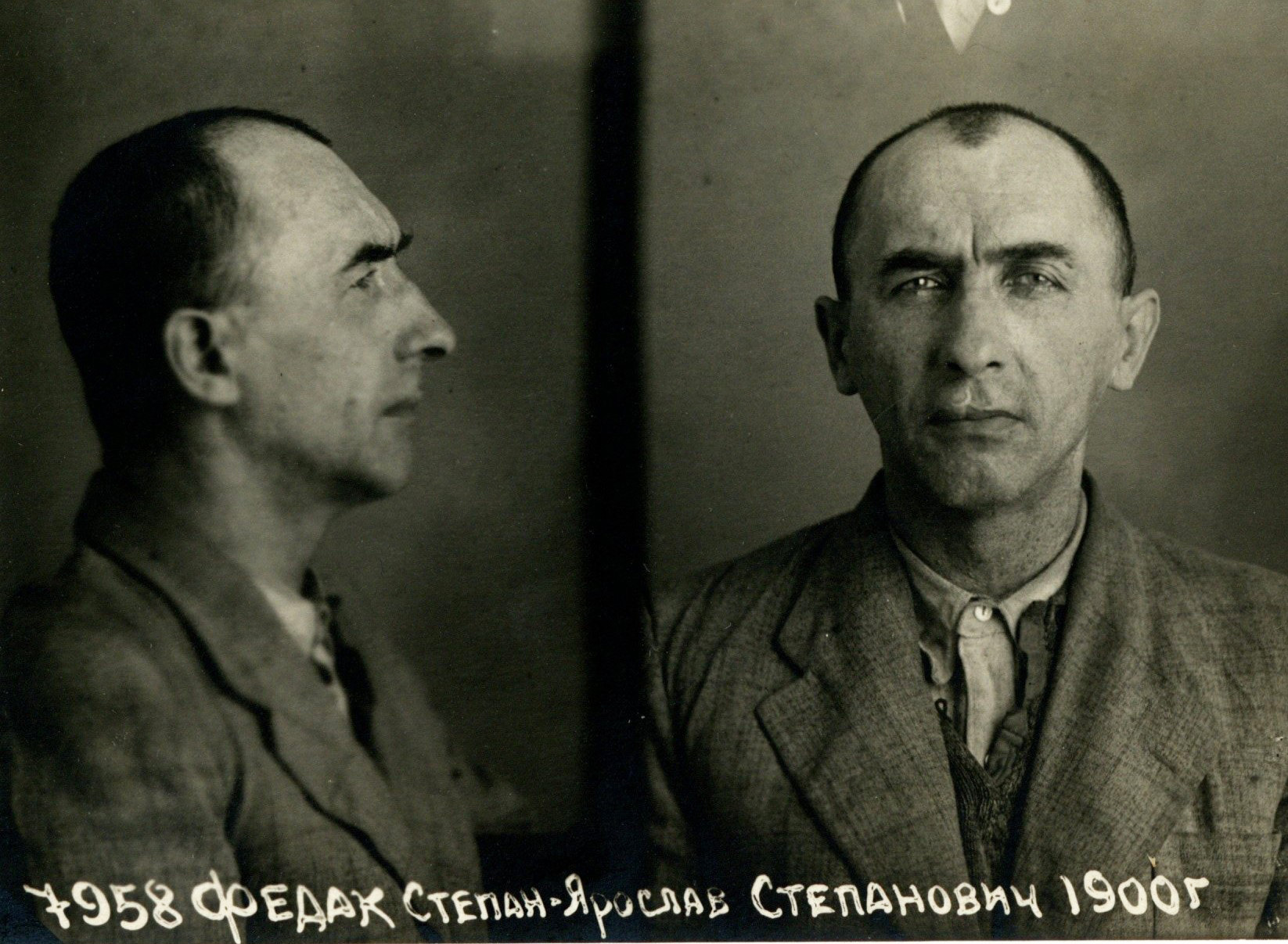
Thus, the chekists kept their eye on S. Fedak, but only as a target for monitoring. After he ended up in an nkvd prison, the plans took on clearer contours. On January 18, 1941, a telegram signed by chief of the nkvd Lavrentiy Beria arrived in Kyiv with an order to immediately send S. Fedak, accompanied by the investigator handling the case, to moscow. At first, he was placed in the nkvd’s internal prison. Then, in February, I. Kudria, an operative of the 5th Department of the nkvd’s main directorate of state security of the ussr, issued a ruling to close the case and release the detainee from custody. The ruling was approved at the highest level – by the chief of the nkvd and the ussr prosecutor general. The text stated that “the investigation had not established any hostile activity on his part against the soviet government.”
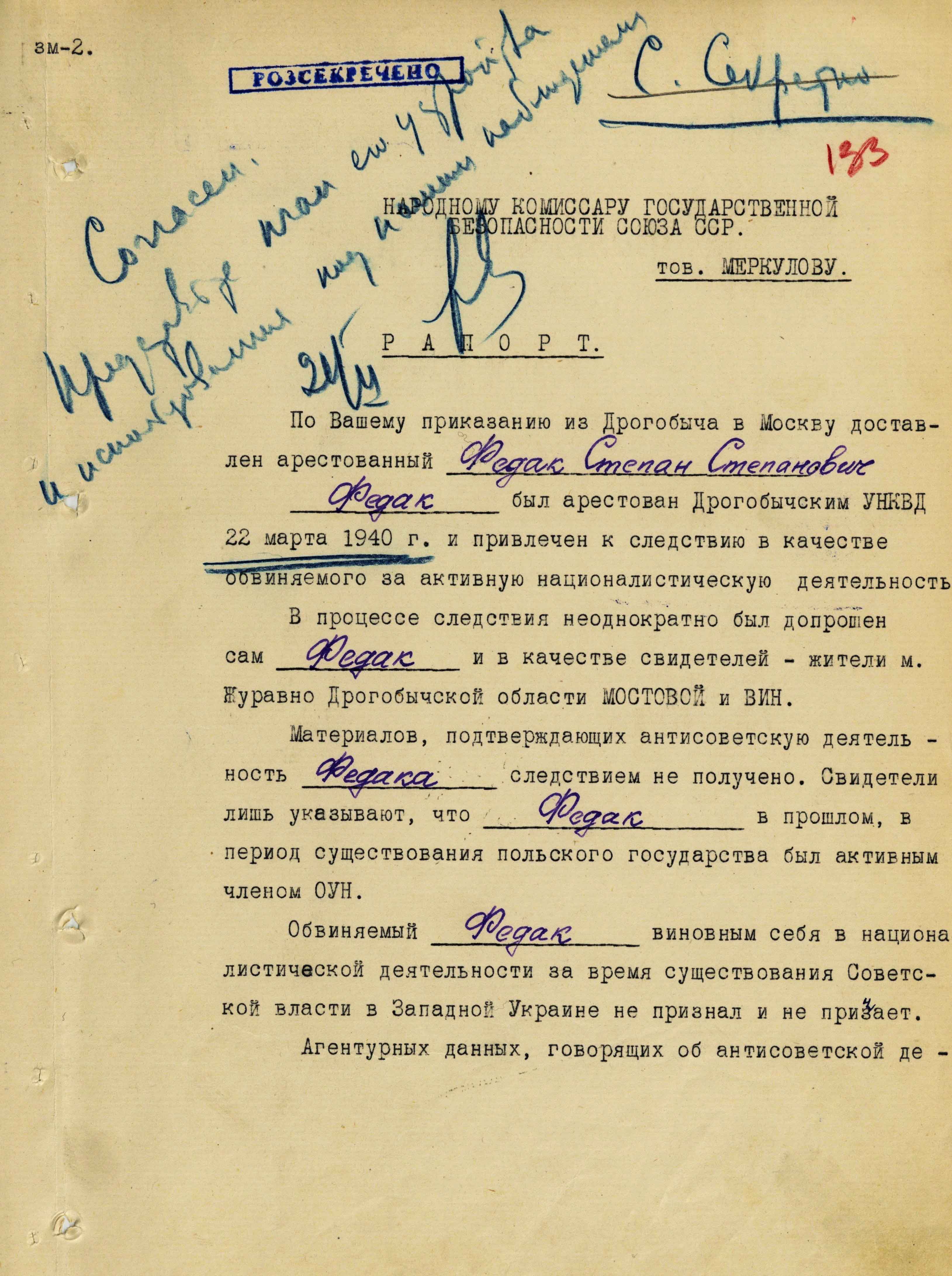
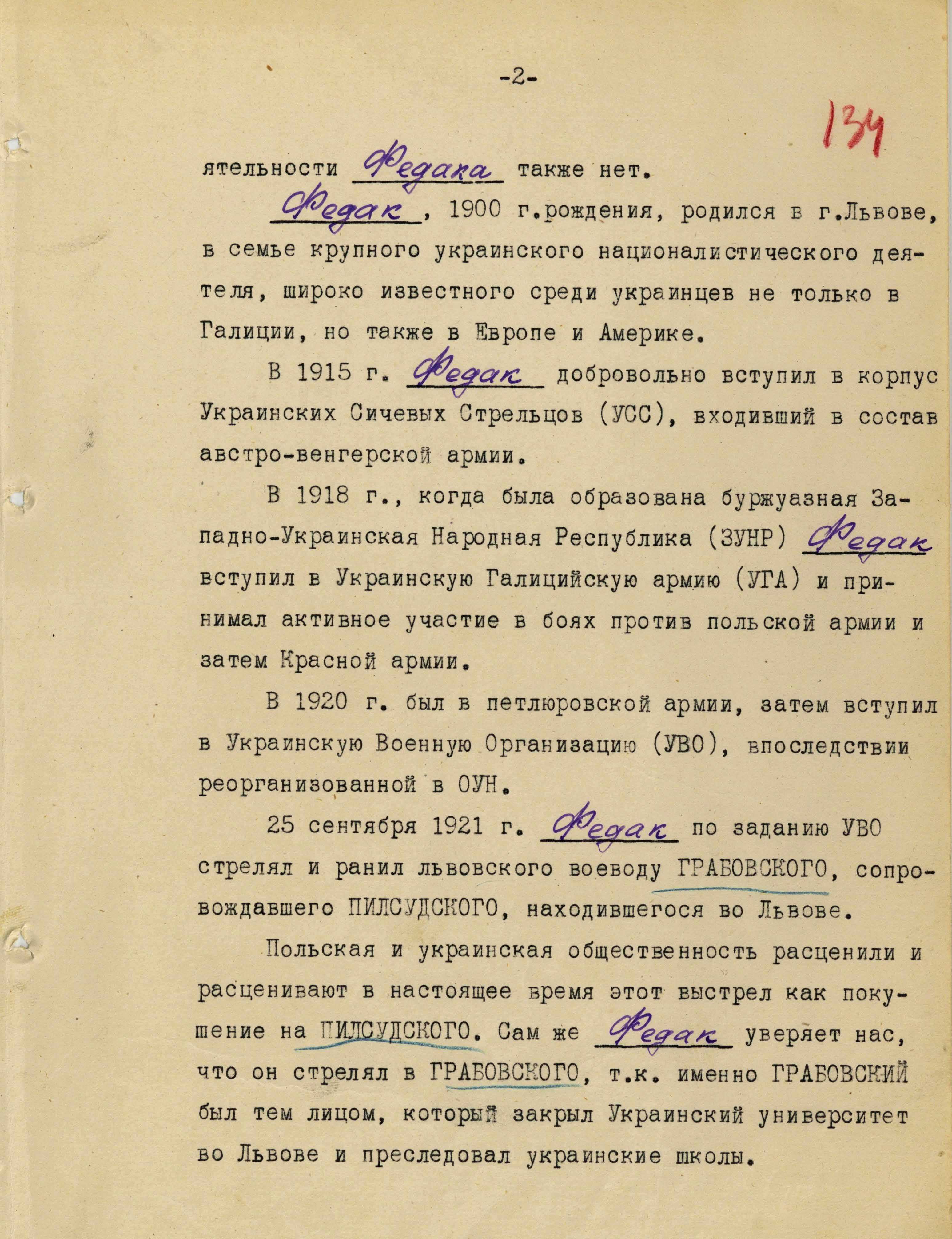
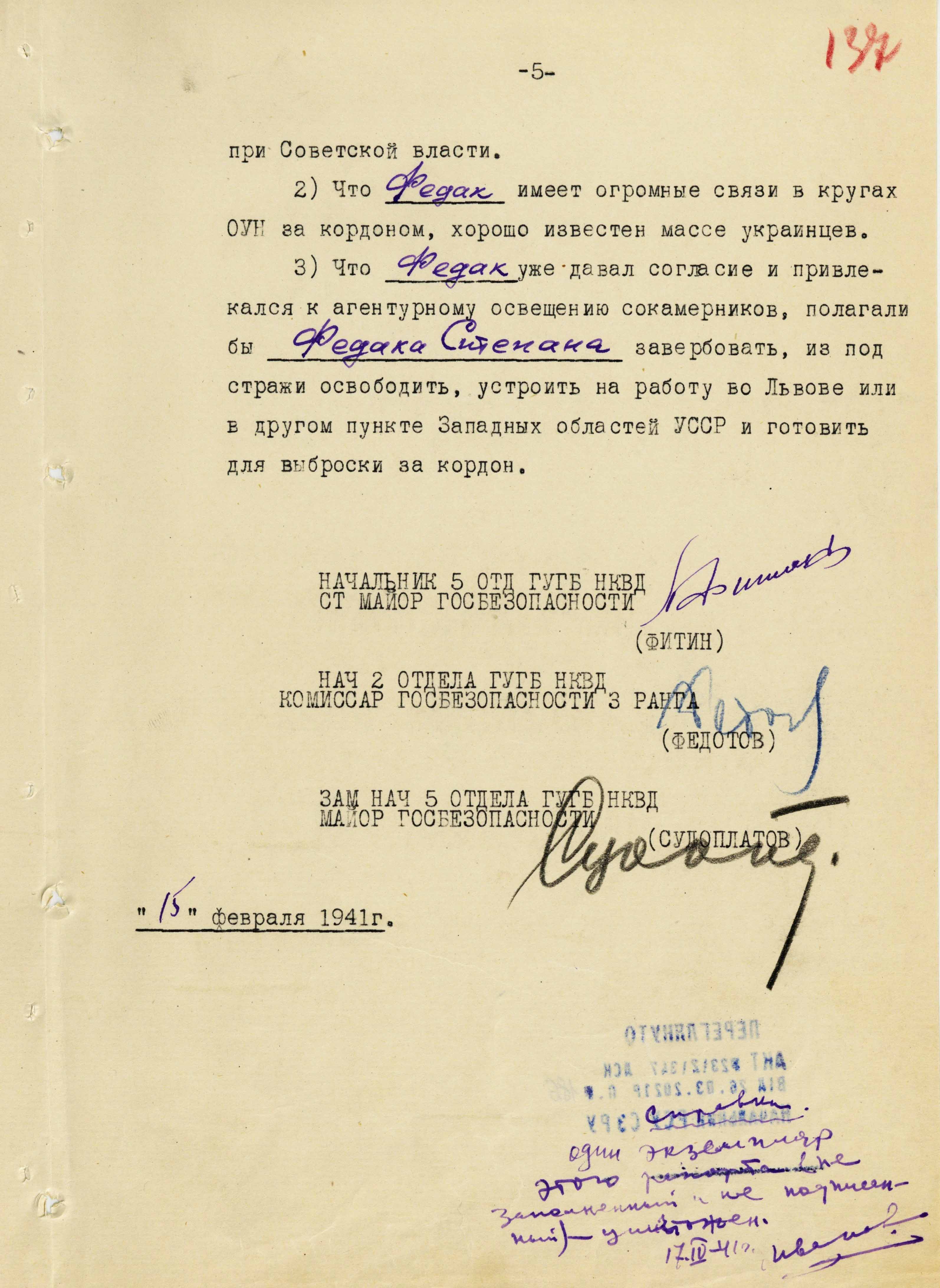
So what happened during that month? The answer to this question is provided by a report signed by P. Sudoplatov and other nkvd leaders. It contains the following telling statement: “Taking into consideration that… Fedak has extensive connections within OUN circles abroad, is well-known among Ukrainians, …we would consider recruiting Stepan Fedak, releasing him from custody, placing him in a job in Lviv or some other location in the western regions of the Ukrainian ssr, and preparing him for transfer abroad” (FISU. – F. 1. – Case 5. – Vol. 2. – P. 133–137).
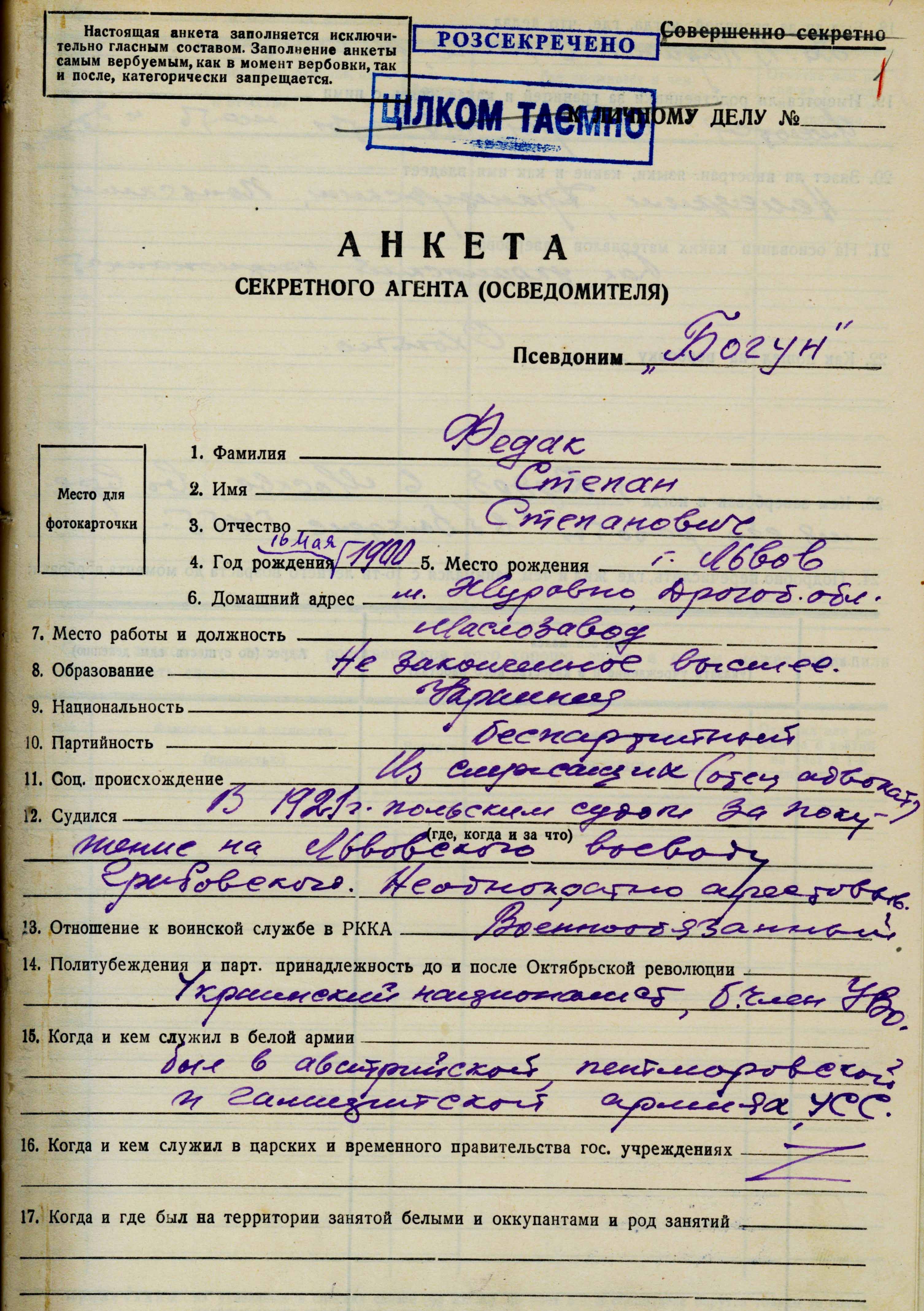
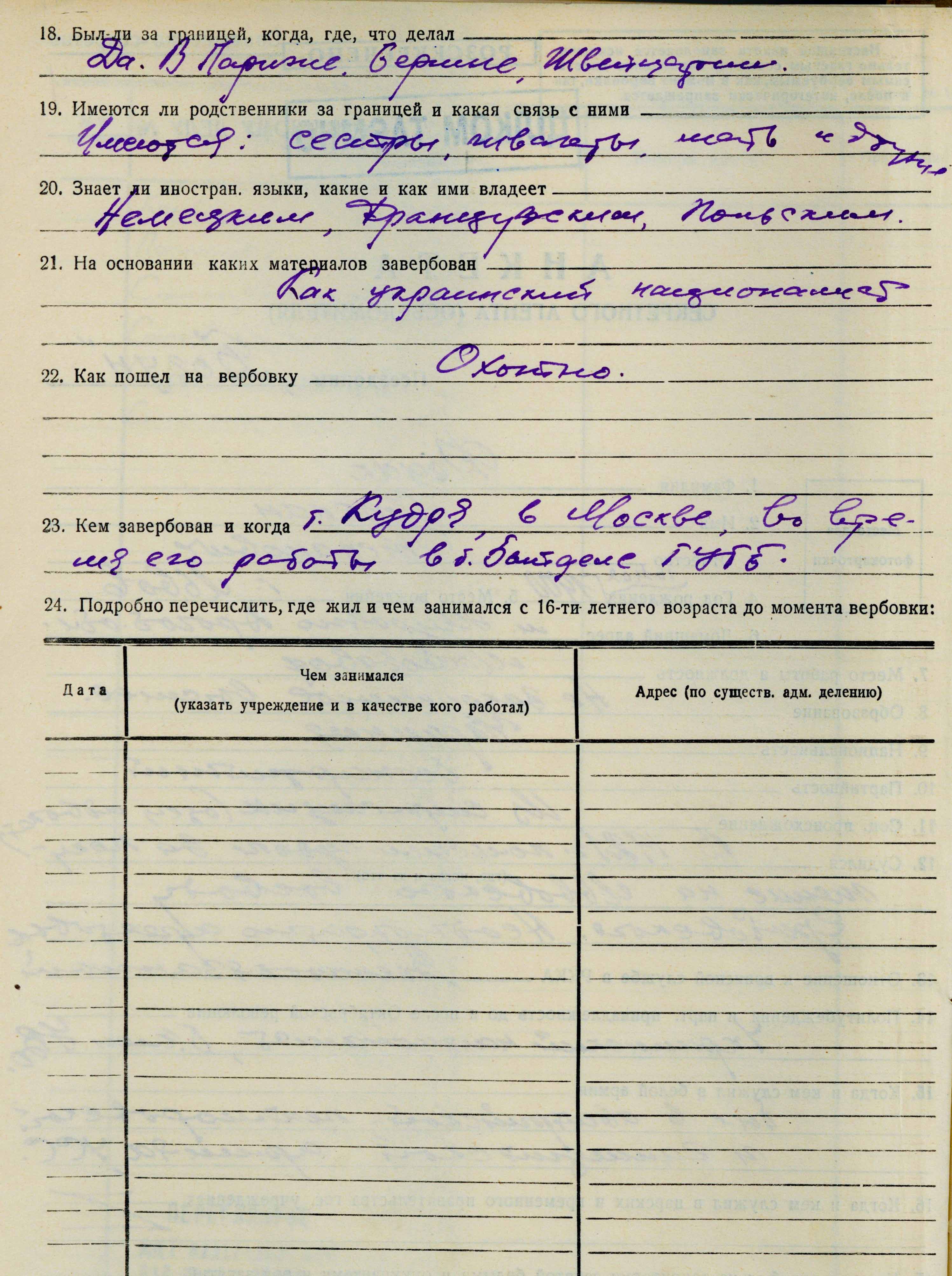
Another report points out that S. Fedak was released from custody, recruited, and settled at a dacha near moscow. In the document, he already appears under the code name “Bohun”, which he chose when signing an agreement to cooperate with the nkvd. Of particular interest is the resolution on the report by the people’s commissar of state security of the ussr Vsevolod Merkulov: “Ensure he does not flee abroad.” In other words, they did not trust him at all. However, as shown by declassified documents, no such suspicious intentions on the part of S. Fedak were detected. On the contrary, he ceased to be withdrawn and allegedly willingly made contact. The following documents make it clear what caused such changes in his behavior.
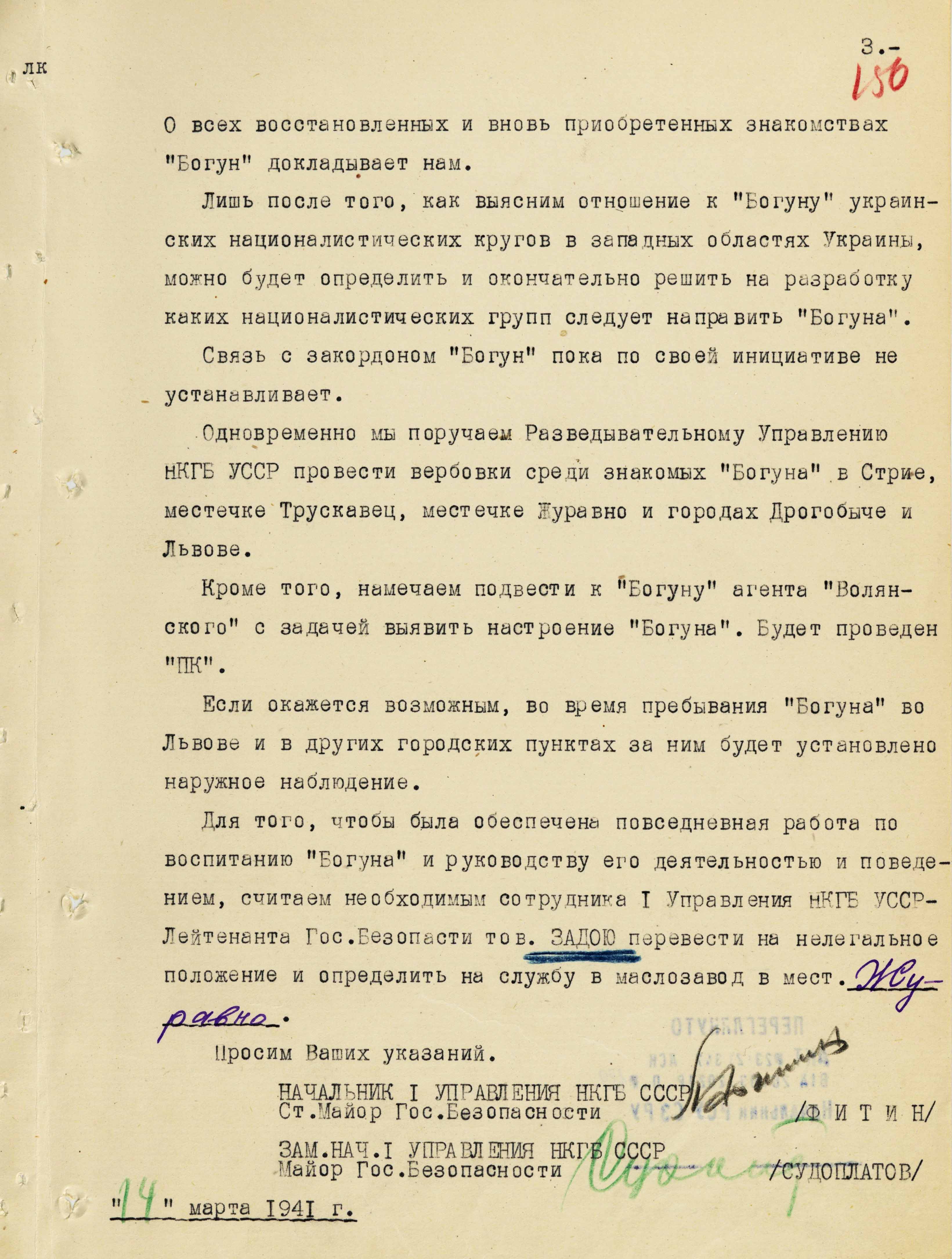
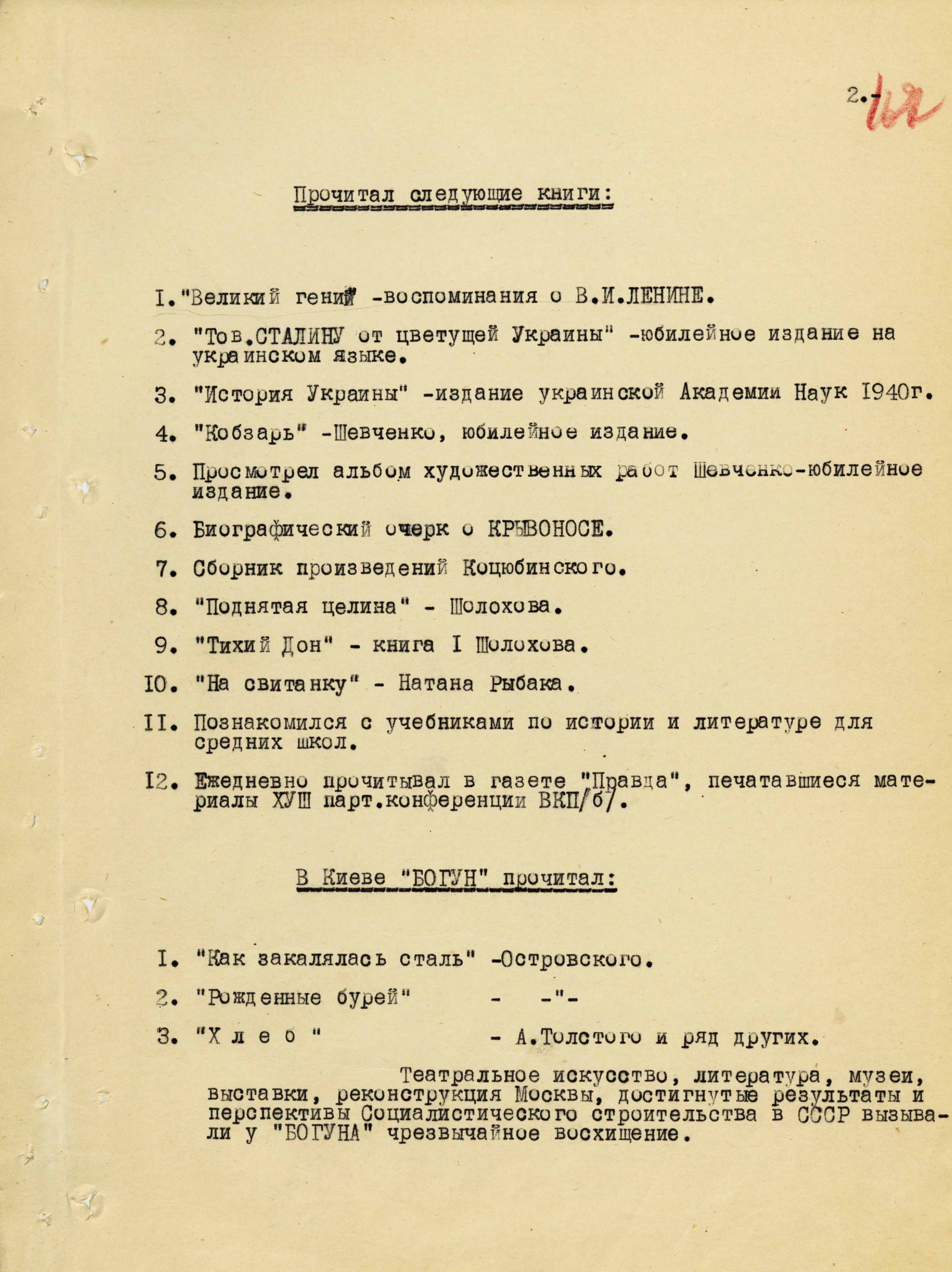
Even before his recruitment, S. Fedak had met on multiple occasions with P. Sudoplatov, I. Kudria, and Ukrainian ssr nkvd officer Zadoya, who had been specifically assigned to the detainee. There were hours-long discussions about the achievements of the soviet regime and how well and happily people supposedly lived in the ussr; they argued that the policy of Ukrainian nationalist centers abroad was wrong, the centres themselves were misguided, claiming that they were unaware of the true state of affairs and were continuing their struggle for Ukraine’s independence in vain. They gave him books to read about Ukraine, including works by T. Shevchenko, Yu. Kotsiubynskyi, and N. Rybak, the Academy of Sciences of the Ukrainian SSR’s publication “History of Ukraine”, as well as M. Sholokhov’s “Quiet Don” and “Virgin Soil Upturned”, “How the Steel Was Tempered” and “Born of the Storm” by M. Ostrovskyi, and books about the “great geniuses” lenin and stalin. In addition, he was given the newspaper “Pravda” to read every day, which at that time was publishing materials from the 18th party conference of the all-union communist party (bolshevik), and he read them thoroughly.
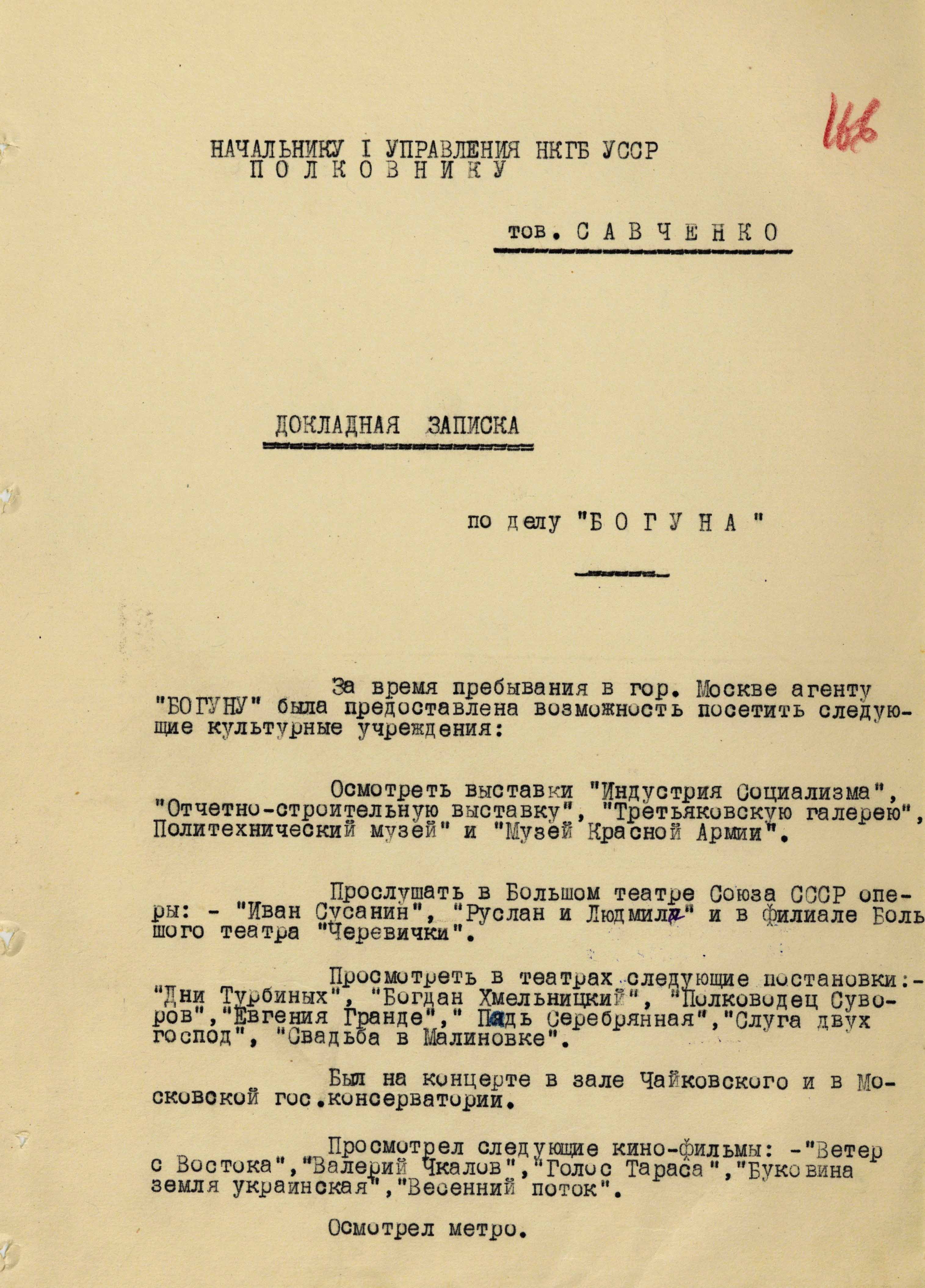
While staying at a dacha near moscow, in a so-called nkvd safe house, he was issued new clothes. For this purpose, the nkvd special department provided him with a winter coat, a suit, two shirts, and two pairs of socks. Dressed in this attire and accompanied by his curators, he was shown the city’s landmarks, metro stations, the Tretyakov Gallery, the Polytechnic Museum, the “Industry of Socialism” exhibition, and others. He was taken to the Bolshoi Theatre to see the operas “Ivan Susanin” and “Ruslan and Lyudmila”, and to various drama theaters to see the plays “The Days of the Turbins”, “Bohdan Khmelnytskyi”, “Warlord Suvorov”, “The Wedding in Malynivka”, “Eugénie Grandet”, and others; to cinemas to see the films “The Voice of Taras”, “Valeriy Chkalov”, “Bukovyna – Ukrainian Land”, “Wind from the East”, and others; and they also organized visits to the conservatory for classical music concerts.
As the memos indicate, the materials for showing and the repertoire were thoroughly selected to make an impression. All of this was accompanied by appropriate explanations and commentary. Consequently, they succeeded in convincing S. Fedak that everything was fine in the ussr, that soviet authorities cared about national policy, and that there was allegedly no oppression of Ukrainians.
In March 1941, he was brought to Kyiv. As Lieutenant Zadoya wrote in his report, “on the way from moscow to Kyiv, ‘Bohun’ repeatedly expressed his gratitude to Serhii Petrovych (Deputy Chief the 1st Directorate of the nkvd of the ussr Sudoplatov) for the attention paid to him, stating: ‘I face a difficult task – to justify the trust placed in me, but I am confident in my abilities…’” (FISU. – F. 1. – Case 5. – Vol. 2. – P. 171).
In Kyiv, he was shown the monuments to T. Shevchenko, B. Khmelnytskyi, and Prince Volodymyr, St. Sophia’s Cathedral, the Kyiv-Pechersk Lavra, the University, the I. Franko Theater, the remains of the Golden Gate, and government buildings. Near the monument to the fallen participants of the January bolshevik armed uprising against the Central Rada and the Ukrainian People’s Republic, the chekists deliberately emphasized that Yevhen Konovalets and other Ukrainian figures known to Serhiy Fedak had allegedly personally executed them. In this way, they attempted to influence his worldview and assessment of the events of contemporary history.
In general, as the case files show, both during recruitment and during discussions of further plans to infiltrate the OUN’s overseas centers, the chekists stated that they were interested only in general information about the state of affairs and the mood among the Ukrainian émigré community, and that his task would be to try to persuade the acquaintances to cease the struggle, arguing that they were mistaken in their intentions. At the same time, he was viewed as someone who had already attempted an assassination once and would therefore be capable of doing so again, but this time specifically targeting whoever they designated.
The “Legend” of Release from Prison
“Pursuant to the order of the people’s commissar of state security, comrade Merkulov, ‘Bohun’ has been released from custody. After completing work with him in moscow, he will be transported to Lviv and placed in Lviv Prison No. 2.”
“Bohun” kept his stays in moscow and Kyiv a secret from those around him. He explained his month-long absence from Drohobych by saying he had been transferred to the Lviv prison. He was held in solitary confinement…
“Bohun” is released from the Lviv prison on the grounds that the charges of nationalist activity under soviet rule, as well as anti-soviet activity prior to the establishment of soviet rule in Western Ukraine, could not be proven…
After his release from prison, “Bohun” settled permanently in the town of Zhuravno…”
(FISU. – F. 1. – Case 5. – Vol. 1. – P. 10–12).
This is an excerpt from the “legend” for the release of agent “Bohun”, developed under P. Sudoplatov’s direction. To carry it out, after familiarizing the agent with landmarks in moscow and Kyiv, he was taken to Lviv accompanied by I. Kudria. It was I. Kudria who had directly carried out the recruitment in moscow. Throughout the journey, in their conversations, he tried to reassure himself once again that S. Fedak was not playing games but was ready to cooperate. At the same time, he continued to praise life in the ussr and convince his interlocutor that the nkvd authorities would do their best to ensure that he, too, lived well and lacked for nothing.
In line with the “legend” and earlier directives from the highest levels to “ensure he does not flee abroad”, the nkvd authorities carried out a series of other measures. I. Kudria was transferred from moscow to Kyiv and appointed chief of a department within the 1st directorate of the nkvd of the Ukrainian ssr. He was to oversee all subsequent operations on the ground as the person who had managed to gain S. Fedak’s trust. Another operative, Lieutenant Zadoya, who had been with the agent in moscow, was to be placed in an underground position and, under a code name, appointed director of the butter plant in Zhuravne. S. Fedak was also to be employed there. In this way, they planned to maintain constant contact that would not arouse anyone’s suspicion. Additionally, I. Kudria was to travel from Kyiv to Lviv on a business trip for control meetings.
According to the “legend”, after two months of living in Zhuravne, S. Fedak was to come to Lviv, restore old ties, find out where A. Melnyk and other leading OUN figures were, and try to get in touch with them. But things immediately went off track. As it turned out, the butter plant had been closed, and there were no other enterprises where Lieutenant Zadoya could be placed in a managerial position. S. Fedak was also unable to find a job anywhere. Moreover, according to him, local residents suspected that his release had been in exchange for agreeing to become the nkvd’s agent.
Hence, in May 1940, he was tasked with traveling to Lviv and attempting to find employment there with the assistance of influential acquaintances, in particular Professor K. Studynskyi – a deputy of the supreme soviet of the ussr and a close friend of his father. At the same time, the chekists spread rumors that the nkvd was blocking his employment because he was allegedly an unreliable and staunch enemy of soviet power who had concealed evidence of his counterrevolutionary activities from the investigation.
According to archival documents, he did not see K. Studynskyi. The latter was away on a trip. Meanwhile, S. Fedak, due to his unemployment and financial difficulties, began to get nervous and express all sorts of discontent. Instead, I. Kudria tried to calm him down in letters, praising his willpower and admiring how he had managed to get out of difficult situations in the past. All of this was part of a plan to gradually win the agent over to their side and prepare him for missions abroad. But the German-soviet War stood in the way of these plans.
Meeting with I. Kudria in Kyiv
“…On the third day after the Germans arrived in Kyiv, Kudria met a man from Lviv named Stepan on the street. When our troops liberated Western Ukraine, this Stepan was arrested as a nationalist.
…Then he switched sides and started working for us… I was with Kudria when we met Stepan. When Kudria saw Stepan wearing a Gestapo armband, his whole expression changed, and I immediately realized that something incredible had happened…
Ivan Danylovych told me, “Go home”. I was very nervous because Ivan Danylovych had been gone for about an hour and a half. Then he returned and began telling me about this Stepan…”
(FISU. – F. 1. – Case 5. – Vol. 2. – P. 319–320).
This is an excerpt from the transcript of a report by Maria Hruzdieva, who was a member of the nkvd’s underground residentura in Kyiv during World War II. The chief of the residentura was “Maksym” – I. Kudria. Upon his return, I. Kudria told her that it was S. Fedak, whom he had interrogated on multiple occasions before the war and whose case he had been handling. Now, however, he had allegedly secured a job as “a translator for the chief of the field Gestapo”.
The report quotes M. Hruzdieva: “Stepan told him, ‘I could expose you right now, but I won’t do it and I don’t intend to. I work for the Germans, but not for their benefit, but for the benefit of our cause’.” It was not specified whether that was for the benefit of the OUN or the soviet power. At the same time, S. Fedak offered I. Kudria money if he needed it and promised to provide important information regarding the Gestapo’s operations. He allegedly provided such information later during clandestine meetings with I. Kudria and M. Hruzdieva herself.
“Because of his work, Stepan had to move around with the front all the time,” noted M. Hruzdieva. “We received word that he had moved to Kharkiv, and we’ve lost contact with him ever since.” (FISU. – F. 1. – Case 5. – Vol. 2. – P. 320).
In the summer of 1942, I. Kudria was arrested and later executed by the Nazis as the head of an underground soviet intelligence network in Kyiv. But S. Fedak, as shown by archival documents, had nothing to do with that.
“Wanted: A Rather Valuable Agent, ‘Bohun’”
After the liberation of the Ukrainian ssr from Nazi forces, a document was sent from Kyiv to the Lviv directorate of the nkvd of the Ukrainian ssr, demanding that the whereabouts of pre-war agents be found out. A list was attached. It included the name of S. Fedak. Taking into account M. Hruzdieva’s report, one of the points suggested checking him against the operational records of the nkvd of the ussr, SMERSH, the intelligence directorate, and the central staff of the partisan movement. In other words, there were certain expectations that at some stage he might have been recruited by those special services. But the checks yielded no positive results.
Subsequently, the 1st (intelligence) directorate of the mgb of the Ukrainian ssr opened a separate investigation case on S. Fedak. The phrase “Wanted: a rather valuable pre-war agent ‘Bohun’” appears repeatedly in it. In other words, the chekists decided to return to the plan which they could not fulfill on the eve of the war. But to do so, they needed to find S. Fedak and understand his current position.
Soon, through their informants, they received information that he had allegedly been in Zhytomyr, Kyiv, Kharkiv, and other cities working as a translator for the German occupation authorities. In 1942, he returned to Lviv and left the service. The reason for this was supposedly his disappointment with Nazi Germany’s policy regarding the Ukrainian question. In Lviv, he moved in with his uncle, Kostiantyn Pankivskyi, a prominent figure in the Ukrainian central committee. Using his ties, knowledge, and past experience in the dairy industry, he secured a position as an inspector for “Maslosoyuz.”
“During the formation of the ‘Halychyna’ Division,” reads one of the archival documents, “he voluntarily joined the Division in 1943, holding the rank of Captain. He was close to the leadership circle of the combat administration, but it was impossible to find out what official position he held. During the final period of the German occupation, “Bohun” married a young woman (surname unknown), whom he immediately evacuated. He himself, at the very last moment of the Germans’ retreat from Lviv in 1944, left for the West in a passenger car together with Pankivskyi” (FISU. – F. 1. – Case 5. – Vol. 1. – P. 178–179).
The document also pointed out that his environment described S. Fedak as vain, self-absorbed, not very serious, and boastful. At this, it was mentioned that he allegedly “opened up” to his close acquaintances. In particular, among his friends, he spoke about his arrest by the nkvd in 1940, claiming that “in moscow, he lived in a separate luxury apartment, had a car at his disposal, moved freely around the city, attended theaters, cinemas, and other establishments, was well-provided for, and socialized with prominent figures.”
This information somewhat complicated further plans regarding the use of S. Fedak in case he is found. However, the search for him continued. During that period, the mgb had intensified its cultivation of A. Melnyk and his supporters. S. Fedak may have played a certain role in that matter. His contacts with I. Kudria during the war and his service in the “Halychyna” Division could have been used both to pressure him and to blackmail and discredit him. So, all efforts were directed toward tracking him down.
In December 1946, the mgb received information that S. Fedak was allegedly in Munich. To find out his whereabouts, it was decided to enlist the help of his first cousin Bohdan Pankivskyi, information on whom had been collected in advance. It was found out that he was struggling, unable to find a good job and feed his family. His relatives even were starving. Chekists decided to play on this. During one of their meetings, they offered to help find a job and money in exchange for a trip abroad to meet S. Fedak. At this, the documents stated that he would not go anywhere or reveal their plan, because he had been warned that his wife and children would be held hostage.
At the same time, Bohdan did his best to avoid the persistent visitors and the task they set. In the end, nothing came of it. Instead, documents were found in the case files indicating that “Bogdan-Teodor Kostiantynovych Pankivskyi, born in 1901, a native of Lviv, was sentenced by a special meeting at the ussr mgb and exiled to a special settlement at the station zima in irkutsk region”, and that he died in the special settlement. Such was the terrible price for disloyalty to the mgb.
Meanwhile, no confirmation was found that S. Fedak lived in Munich. A year later, agent “Chaban” reported that he had allegedly left for the United States back in 1945. On October 10, 1948, the Ukrainian émigré newspaper “Novyi Shliakh”, published in Canada, published a report on the wedding of Kazimir Tsybrinskyi and Vira Zoldak, who lived in the Canadian city of Crowlenz. The publication mentioned that S. Fedak was among the guests. Consequently, the search for him continued in Canada, but to no avail.
Soon after, in the Ukrainian magazine “Surma,” Issue 10 of July 15, 1949, published by the Provid of the OUN’s Foreign Units in Munich, the name of Stepan Fedak, who had donated 20 Belgian francs, was found on the list of donors supporting the publication of materials on the struggle in the homeland (Ukraine). This became the basis for a search for him in Belgium. But it was just as fruitless.
In June 1950, reports from moscow indicated that Yaroslav Fedak (under this name he also appeared in various materials) had allegedly left Germany for England with documents in the name of Illia Fedak and was working there at the “Ukrainian Bureau” as a close assistant to the Bureau’s head, Sotnyk Panchuk.
In 1954, the New York office of the ussr mgb received a telegram from moscow stating that new information had been obtained regarding S. Fedak. It stated that as early as 1950 (according to other reports, in October 1949), he had traveled to the United States on the steamship “General Howze” with his uncle K. Pankivskyi. K. Pankivskyi was a well-known figure to the residentura. He had participated in the creation of the so-called Coordination Center for “Understanding of Political Groups in the United States”. They decided to use this as a starting point and continue their search.
In January 1955, the kgb under the council of ministers of the ussr received information from foreign agent “Valet” that S. Fedak had allegedly appeared in Luxembourg, where A. Melnyk lived, and that they were in close contact. To verify this, a kgb officer was immediately sent to Luxembourg, but he found no confirmation. So, the search resumed in the United States.
Those searches dragged on for several years. Eventually, K. Pankivskyi’s whereabouts in the United States were established. At the same time, one of the kgb agents, who knew both men well from their joint activities in Lviv, was tasked with passing a note to them. It contained the following phrase: “What is Smok doing? Give him my regards”. “Smok” was S. Fedak’s code name, by which he was known among the leaders of the UVO and OUN. Some time later, a letter arrived from the USA, from K. Pankivskyi. Among other things, he wrote that they were living in Philadelphia and that everything was fine with them. This was in 1961.
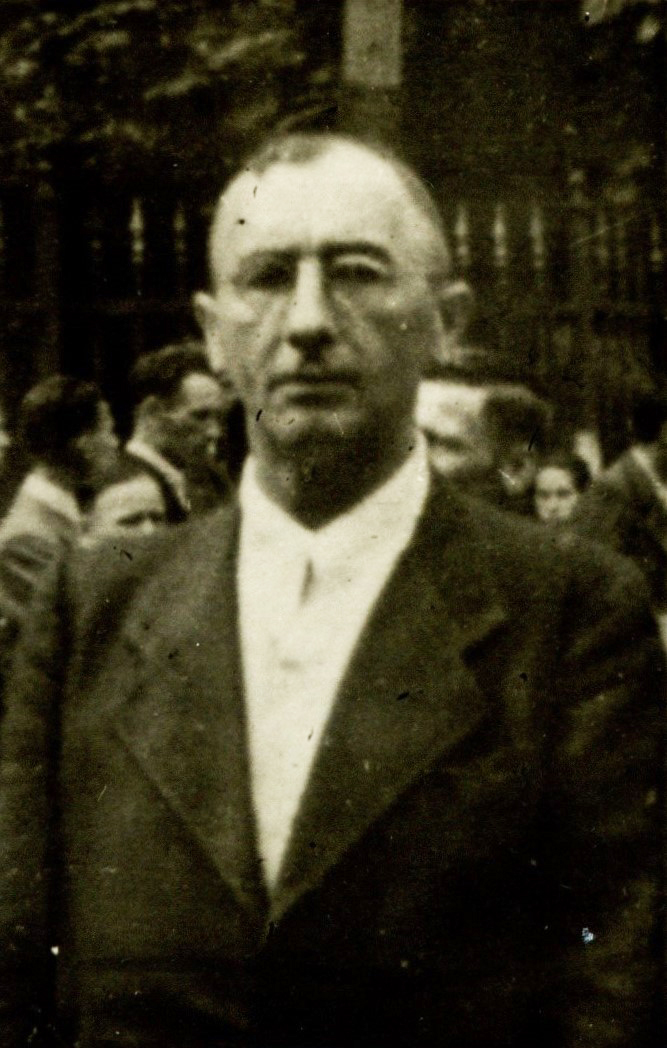
In August 1964, through one of their foreign agents, the kgb received confirmation that S. Fedak was indeed living in Philadelphia, was approximately 60 years old, and was a supporter of the Melnyk faction of the OUN, though he was not actively involved in politics. Given the new circumstances, the kgb at the council of ministers of the Ukrainian ssr nevertheless decided to try to reestablish contact with him. To this end, they had already begun searching for a courier. However, they were unable to find out his address. Soon, on November 1, 1964, news arrived of the death of A. Melnyk, into whose inner circle the kgb had so persistently sought to infiltrate S. Fedak.
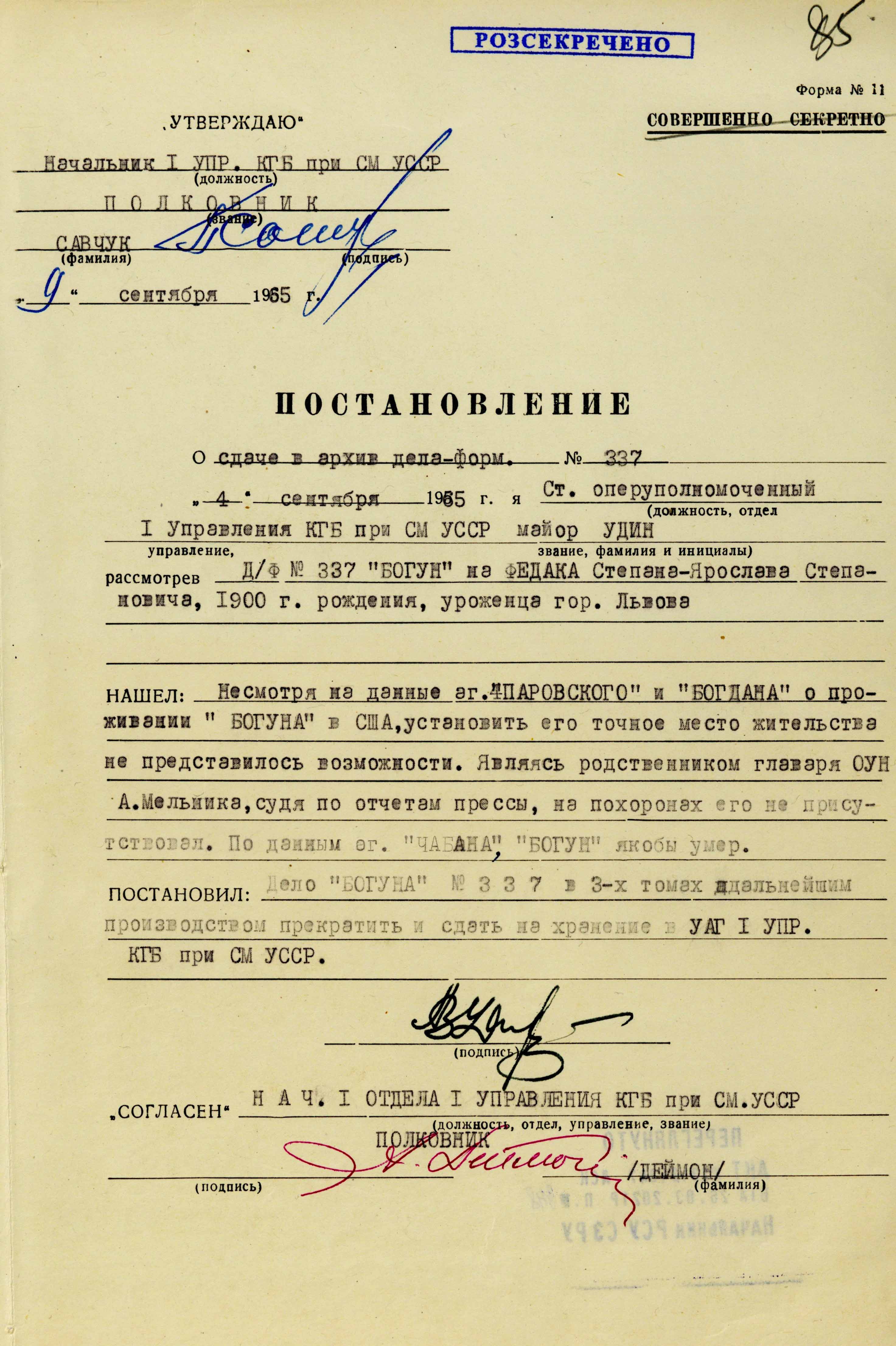
According to archival documents, in September 1965, the kgb at the council of ministers of the Ukrainian ssr decided to close the case on S. Fedak. The resolution states that “they were unable to establish his actual place of residence. As a relative of OUN leader A. Melnyk, according to press reports, he was not present at his funeral. According to information from agent ‘Chaban”, ‘Bohun’ allegedly died” (FISU. – F. 1. – Case 5. – Vol. 3. – P. 85).
Thus, thanks to declassified documents from the archives of the Foreign Intelligence Service of Ukraine, it has been possible to uncover yet another mysterious story about a long-running operation by the nkvd/mgb/kgb against the leaders of the Ukrainian national liberation movement – a story of how moscow stopped at nothing, spared neither money nor time, just to attract close relatives to cooperation and force them to act against their former brothers in the liberation struggle, how psychologically they played on weaknesses, ambitions, certain character traits and other factors. This tactic has been used repeatedly. Knowledge of these insidious methods is important for understanding the aggressive activities of the kremlin leadership aimed at obstructing the struggle of Ukrainians for independence in all periods of history.