
Ukrainian Insurgent Army. Intelligence Service (1943–1945)
9/21/2022
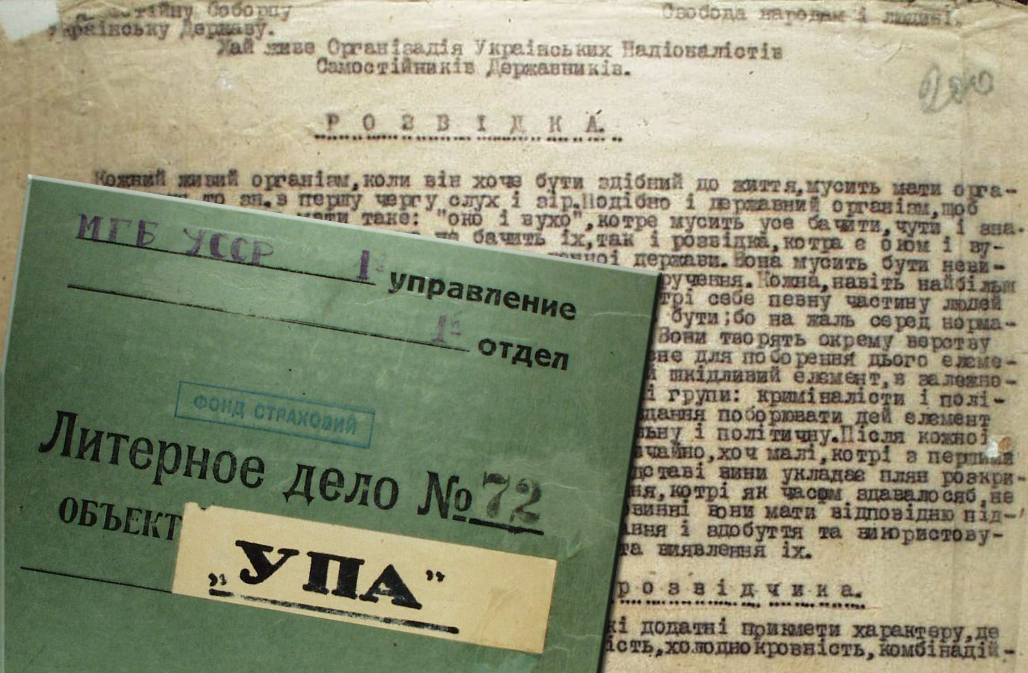
A separate page in the twentieth century history of the intelligence service and of special services in general was written by the intelligence units of the Ukrainian Insurgent Army, which had to act in specific conditions and obtain the necessary information in confrontation simultaneously with the Hitler occupiers, regular units of the red army, soviet partisan units and structures of the NKGB. Their experience became the object of study by many special services of the world.
In the instructional documents of the UPA, which are kept in the Branch State Archive of the Foreign Intelligence Service of Ukraine, intelligence was interpreted as “the ears and eyes of the organization”, “a prerequisite for the success of partisan tactics”, “the basis of maneuver, struggle and security of own department”.
In particular, this is mentioned in the “Intelligence” section of one of the documents, which describes the essence of intelligence work, forms and methods, ways of obtaining information, traits that should be in a person who is taken to the intelligence department. It states: “Every living organism, when it wants to be capable of life, must have organs of cognition, primarily hearing and eye-sight. Similarly, a state body, in order to exist, must have the following: “eyes and ears”, which must see, hear and know everything. Just like the owner of the eyes and ears does not see them, so intelligence, which is the eyes and ears of the state,...must be invisible in order to be able to act successfully where its intervention is needed” (BSA of the SZR of Ukraine. - F. 1. Case 7088. – V. 2. – P. 200).
Archival documents, memories of participants of those events and memoirs make it possible to reproduce the organizational structure of UPA intelligence. For example, in November 1943, the Military Staff of the Military Referentura of the Main Directorate of the OUN(b) became the Main Military Staff of the UPA. In its composition, the II (Intelligence) department was created.
In general, the Intelligence of the UPA Main Military Staff had the following structure:
- intelligence units of UPA groups;
- intelligence departments of staffs of UPA military units;
- intelligence centers of kurins (battalions- Transl.);
- Intelligence of sotnyas (hundreds- Transl.)
Structurally insurgent intelligence had a link to the linear structure of the UPA, based on the use of staff and not-on-the-staff intelligence units. The intelligence department of the staff of the UPA group consisted of several sub-departments, the general management was carried out by the chief, who had a deputy and a secretary. The organizational structure of the intelligence network from the UPA group and below was established. At the staff of the group, an intelligence department was created, consisting of its chief, deputy chief, secretary, head of communications and agents (that is, intelligence officers). Agents and other staff members of the intelligence department were the so-called “special agents” and were assigned to perform the most serious intelligence tasks, replenish the intelligence network if necessary, lead intelligence and sabotage groups, etc.
The department had the following basic functions: organization of the intelligence network, management of the lower intelligence units of UPA, interrogation of prisoners of war, preparation and sending to fulfill the tasks of intelligence and diversion groups, preparation of intelligence reports.
The scheme of agent intelligence of the military district included the following elements: the head of the intelligence department, the povit informants (each of them had a secretary and 5 messengers), district informants (each had 3 messengers and relied on a network of intelligence persons in settlements (“stanytsyas”) – stanytsya informants.
Regional, district and village leaders of the underground had to divide the area of responsibility for intelligence so that all the territories were covered by it. Informants from among the population collected information on the deployment of the enemy in cities and villages, on railways and other important sites, moving and other preparations.
In this regard, the order which is mentioned in the archival documents of the Foreign Intelligence Service of Ukraine, states: “There should not be a single place where our intelligence does not operate”... The intelligence and information department, with the help of its intelligence informants, monitors every movement and event on the territory. The intelligence and information department of the referentura sends information from places once a week, and on important cases – immediately after receiving such information. Provide information briefly, but clearly, answering five main questions in each message: When? Where? Who? What? How?” (BSA of the SZR of Ukraine. – F. 1. Case 7088. – V. 2. – P. 190).
This order also provides a list of questions that the intelligence and information department had to collect intelligence on. Among them:
- the enemy’s force in the territory and its weapons.
- this force’s actions against the Ukrainian population.
- the tactics of the force in the suppression of the Ukrainian insurgent movement.
- the moral and combat state of the force.
- the permanent location of the force.
- the replacement of documents and travel passes.
- the traffic on the railway and the motorway.
- the ways of propaganda by the German government among the population.
- the enemy’s intelligence on the territory that serves both the enemy’s underground organizations and German police.
- informants and the enemy’s servants (provide detailed lists of informants).
- arrests and executions of Ukrainians by German police.
- the mood of the population.
- the influence of the UPA among the population.
- the faults in our work.
- the reasons for these faults.
- unstable persons who got to the UPA ranks”
(BSA of the SZR of Ukraine. - F. 1. Case. 7088. - V. 2. - P. 190-191).
Equally important was the selection and training of personnel for intelligence units. As shown in the documents, “apart from knowledge, the intelligence officer must have special features of character, such as: observation, courage, duty, composure, combinational talent, endurance... To know the rules of good behavior, but also to have own way of nature and behavior with people of different professions and strata of the society. Accordingly, disguised, able to squeeze in among intellectuals, peasants, batyars (from Hungarian betyar- a man prone to make rash actions- Transl.), merchants, cab drivers, shoemakers, thieves, depending on what information and from whom was needed. The intelligence officer also must conduct a conversation accordingly and adapt to the pronunciation of the speaker and, first of all, touch upon topics interesting for him... The intelligence officer must develop the ability to quickly remember a suspicious or traced person. This is possible as a result of a long intelligence work and practice”(BSA of the SZR of Ukraine. – F. 1. Case 7088. – V. 2. - P. 200).
Intelligence schools and courses were created, where, depending on the training program of “foot scouts of sotnyas”, 10 hours were devoted to explaining the general concepts of organization of intelligence among the population, 10 – to organizing agents’ work among the population, 30 – to studying the actions of a riy (squad) and chota (platoon) in intelligence.
Future senior officers were trained for 14 hours to master special subjects. Of these, 4 hours – for foreign intelligence, 4 – for counterintelligence, 4 –for methods of vigilance and conspiracy, encryption, etc., 1 hour – for a military-field gendarmerie and 1 hour – for courts. In addition, they studied the experience of Soviet, Polish, German special services and methods of counteraction.
In studies they used some normative documents of the national liberation struggle of 1917-1921 and the military special service of the State Center of the UPR in exile. At the same time, taking into consideration the new realities and the accumulated experience of intelligence, they created their own instructional documents, which concentrated on the idea of the functions and organization of intelligence structures in the UPA. One of these thorough documents was the “Instruction of the Intelligence and Counterintelligence Service”. The introduction to the Instruction stated that UPA, despite the superiority of the enemy, does not give up the offensive tactics, so victory in the struggle is conditioned not only by the armed force, but to a great extent by the secret kind of war.
According to the Instruction, the intelligence officers were divided into chiefs in the rank of UPA officers, agents (full -time employees, UPA servicemen) and “co-workers”. The first two categories were to work under the appropriate prompt cover. Candidates for “co-workers” (unofficial assistants of special service staff or their operational sources) could be persons of the ordinary and command staff of the UPA, employees of its rear structures, civilians who lived legally and met the requirements.
The main directions of intelligence were: the study of the Red Army, bodies and troops of the NKVD/NKGB, fighter battalions and other law enforcement agencies of the enemy, the armed forces of “enslaved peoples, who are fighting against Stalin invaders next to the Ukrainian people”, but only for the sake of collecting intelligence.
As for the ways of work, intelligence was divided by the Instruction into personal (carried out by military personnel and military units in clashes with the enemy) and agent (carried out by the intelligence service for the study of the armed force of the enemy in Ukraine, other territories occupied by the enemy, its deep rear).
The intelligence and counterintelligence departments of staffs of the UPA detachments were called “agent stanytsyas”(stations). The instruction paid special attention to the organization of communication, considering it one of the most important elements in intelligence. The intelligence information had to be well-timed, reliable, safe, and the intelligence collected had to be handed over exclusively by reliable communication channels, using ciphers and codes.
Among the archival documents there is the code confiscated by the operation group 4 of the NKDB of the USSR in the territory of Rivne region, which has 203 code words. Among them there are the following correspondences: “OUN - Marusya, UPA - Love, Leader - Gray, Insurgent - Bridegroom, Messenger - Greek, Weapons – Bill, Cannon - Baba, Plane- Whistle, Ukraine - Sister, Moscow - Aunt, Meeting - Date, Congress- Supper, Riy - Monday, Chota - Tuesday, hundred - Wednesday, Kurin - Thursday, Regiment - Friday, Brigade - Saturday, Division - Sunday, Army - Week, Spy - Artist, Agent - Actor, Provocateur – Musician” (BSA of the SZR of Ukraine. - F. 1. Case 7088. - V. 2. - P. 399-404).
The Instruction included virtually all components of operational work, including record keeping. In particular, even the scheme of the agent message (“agent ad”) was established. It required to mention the operative employee who received it, the operational source, the conclusions according to the information, a plan of further agent operational measures. The method of conducting agent case, which contained certain thematic information was also determined.
Caring for personnel and observance of system in the work created the necessary conditions for full and effective conducting intelligence at all levels – from the intelligence department of the UPA group staff to the agent station – and became one of the main factors of the duration of the combat activity of Ukrainian insurgents.