Ukrainian ssr mgb Agent “D-2”. Failed the Screening by the OUN Security Service
4/23/2026
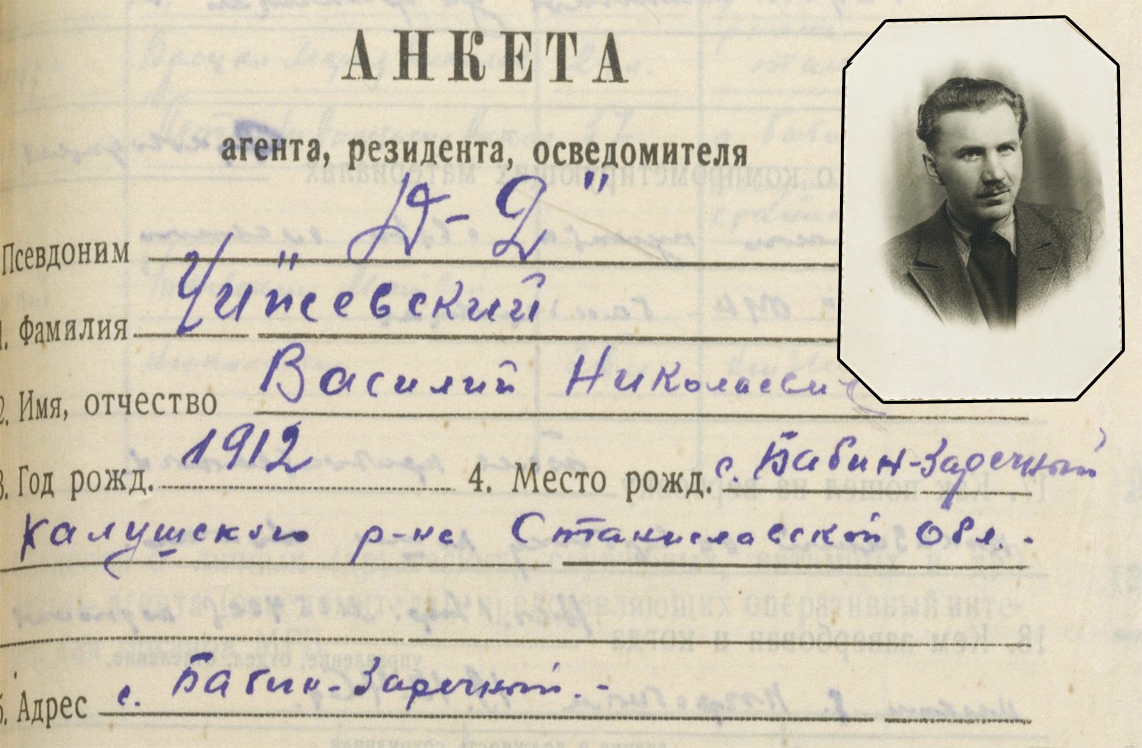
Throughout its history, the OUN Security Service made considerable efforts to prevent bolshevik agents from infiltrating the ranks of the Organization. To this end, a whole system of measures, screenings, and investigations – often quite harsh – was established. The сhekists were well aware of this. Therefore, when preparing to infiltrate another agent into the OUN’s leadership structures, they tried to carefully craft a “legend” for him. Declassified documents from the archives of the Foreign Intelligence Service of Ukraine reveal how the former did that and what countermeasures were taken by the latter.
In a Prague Prison
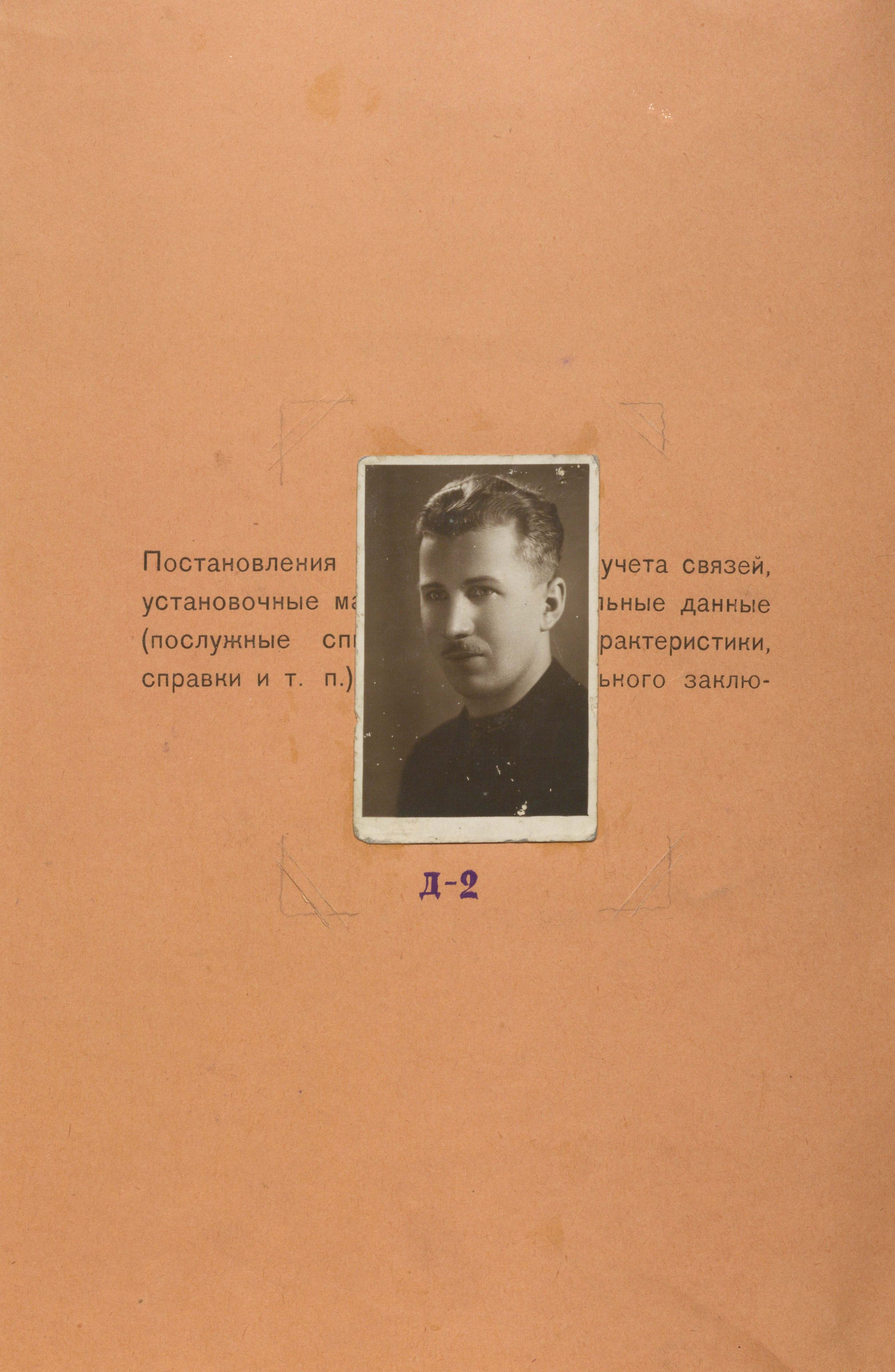
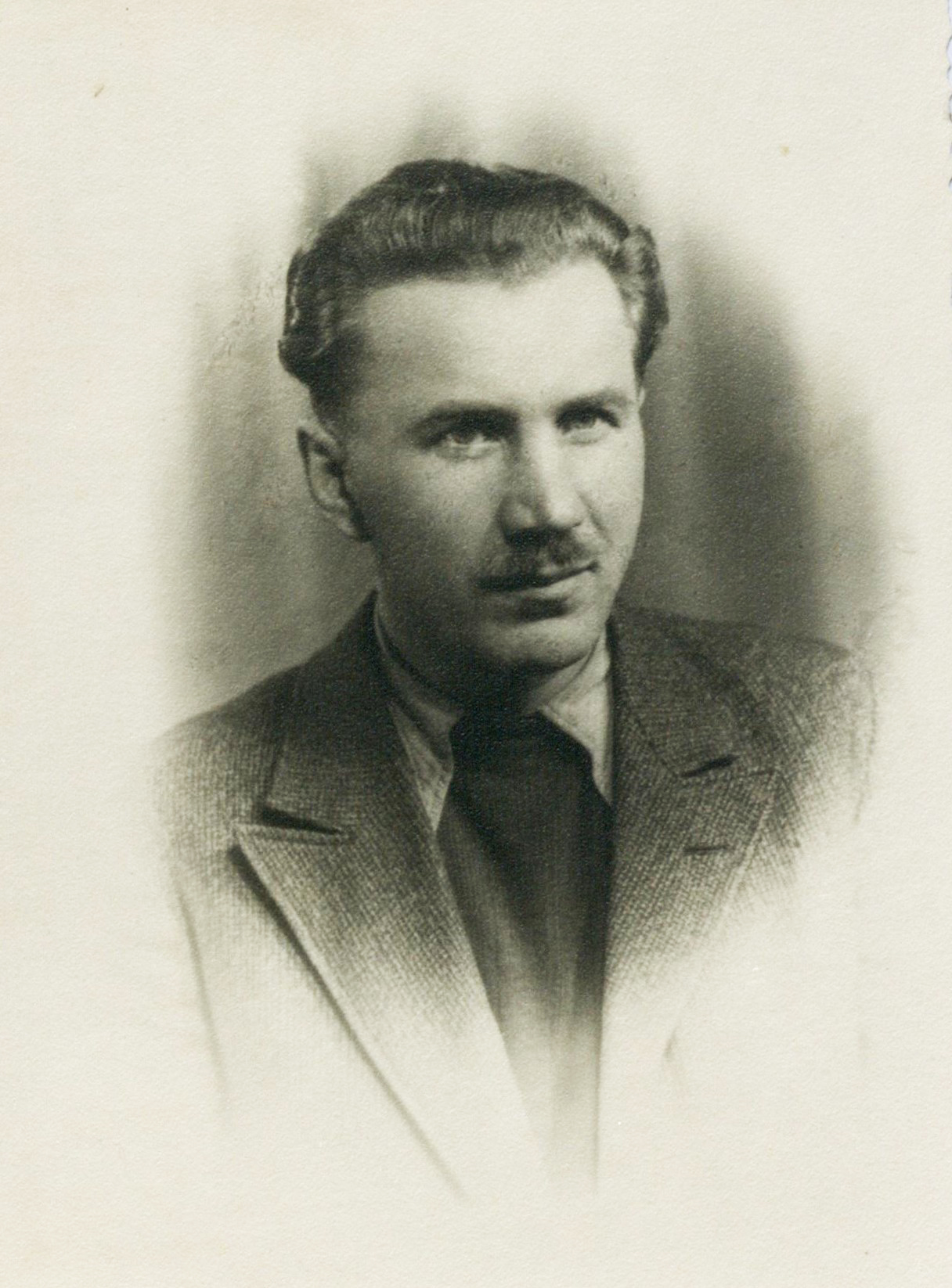
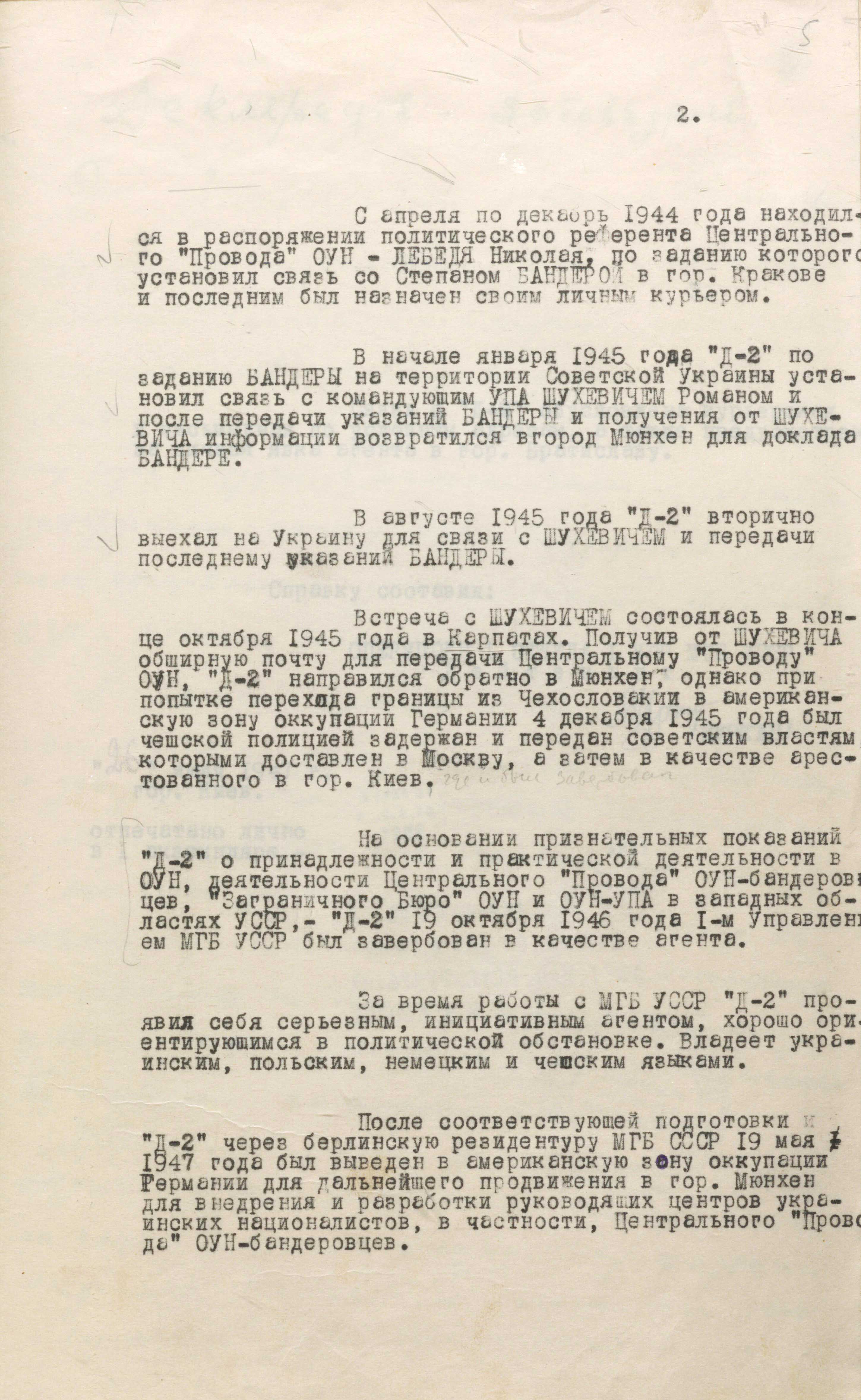
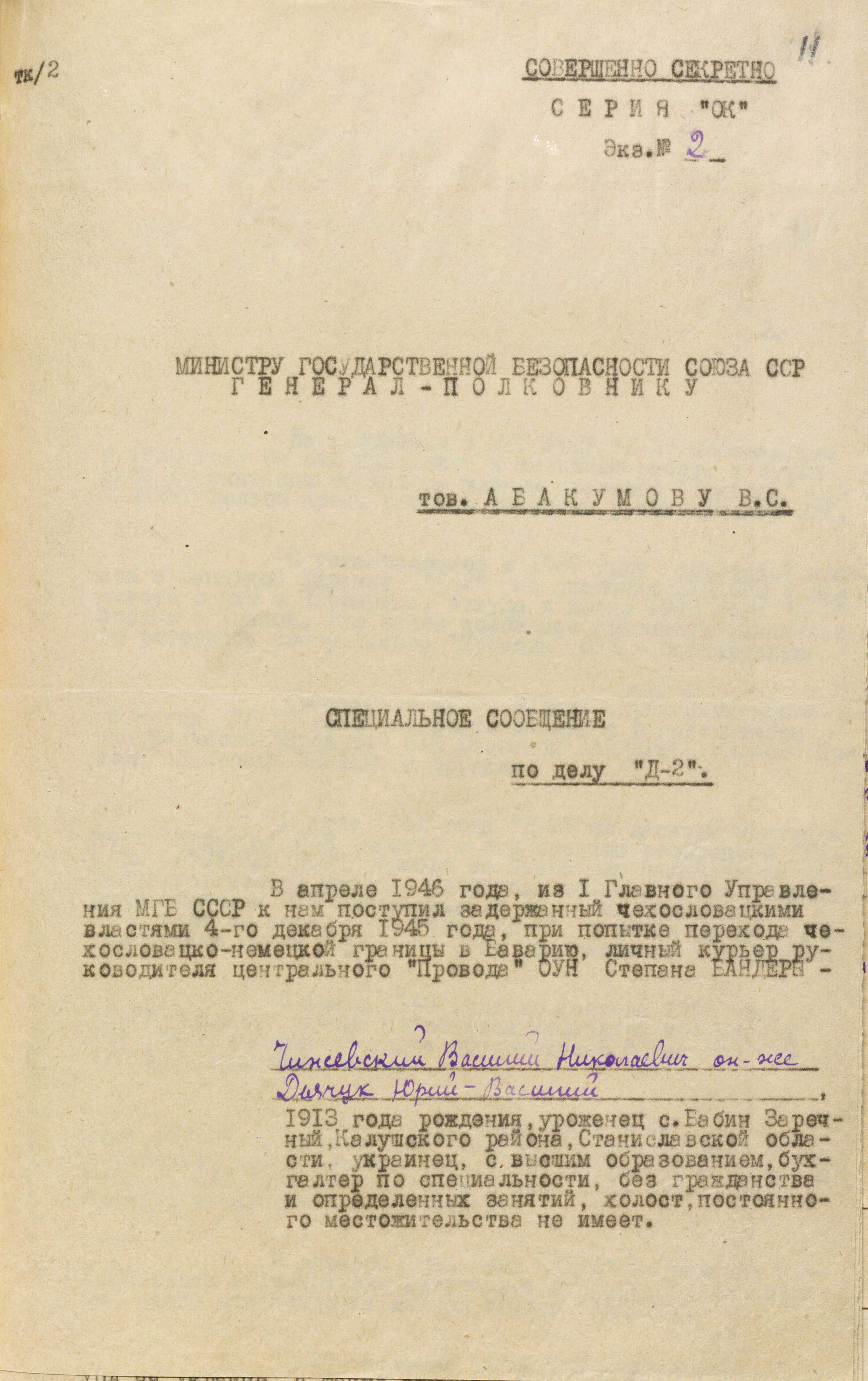
In mid-July 1945, a tall, slender, thin man in his thirties with a small mustache and hair combed upward entered the Ukrainian Greek Catholic Church in Prague to pray. He was still hoping to meet some of his fellow countrymen and acquaintances to ask for help in obtaining documents to cross the German border and get to Munich. It was Vasyl Chyzhevskyi, Stepan Bandera’s courier. He was returning from Western Ukraine, where, back in January, on a mission from the head of the OUN’s Foreign Center, he had tracked down UPA Commander-in-Chief Roman Shukhevych, delivered mail to him, and conveyed the necessary verbal directives.
At the church, he ran into an old acquaintance from his time in the OUN, Yaroslav Moroz. The latter said he was planning to go to Lviv to find his family and carry out certain tasks assigned by the OUN leadership. In particular, among other things, he was to find a courier codenamed “Demyd”, whom S. Bandera had sent on a mission six months earlier and from whom there had been no word since. V. Chyzhevskyi admitted that that was his pseudonym and that it was indeed him. Then Ya. Moroz gave him a note addressed to him. The text stated that he was to return to Munich immediately.
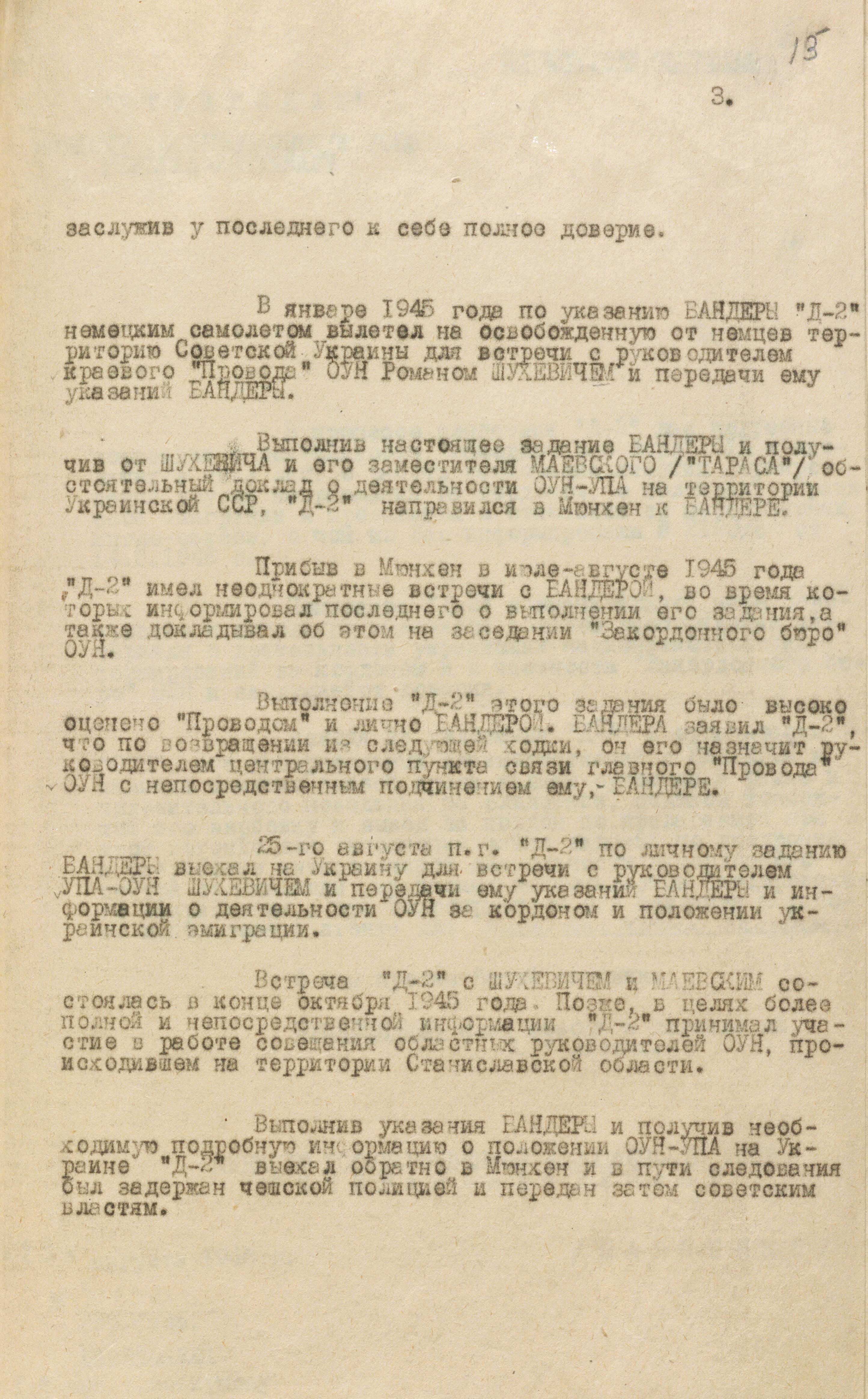
Ya. Moroz helped his comrade obtain the documents. After that, they decided to first travel together to meet with S. Bandera, report everything, and only then make further decisions. Such a meeting took place in late July 1945 in Innsbruck, Austria. At the meeting, each received a new assignment in the western Ukrainian territories. As noted in declassified archival documents, S. Bandera stated that V. Chyzhevskyi “would serve as a liaison between him – Bandera – and the OUN leadership in Western Ukraine, and after he established this connection, Bandera intended to appoint him as the head of communications for the OUN Central Provid” (FISU. – F. 1. – Case 30. – Vol. 2. – P. 247).
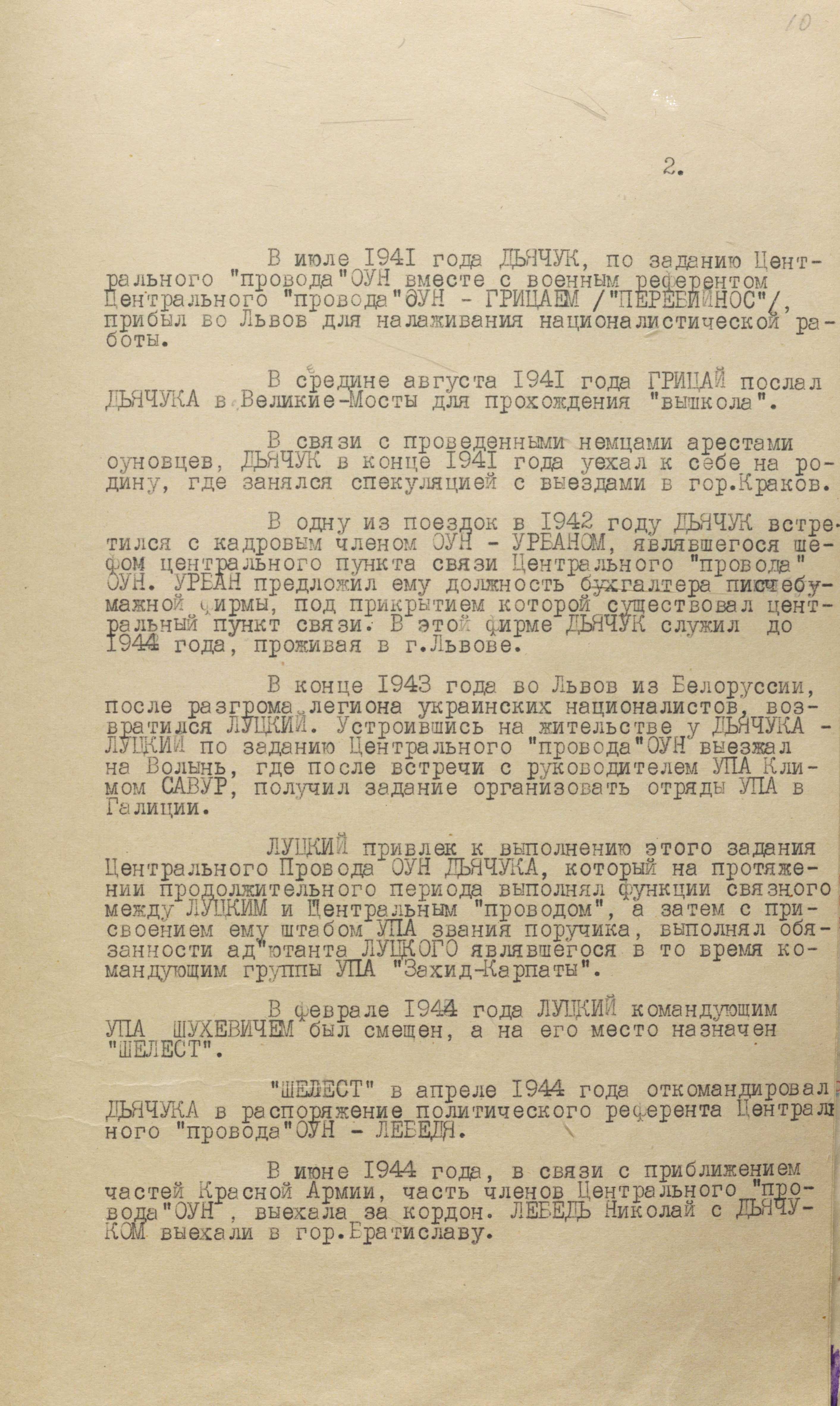
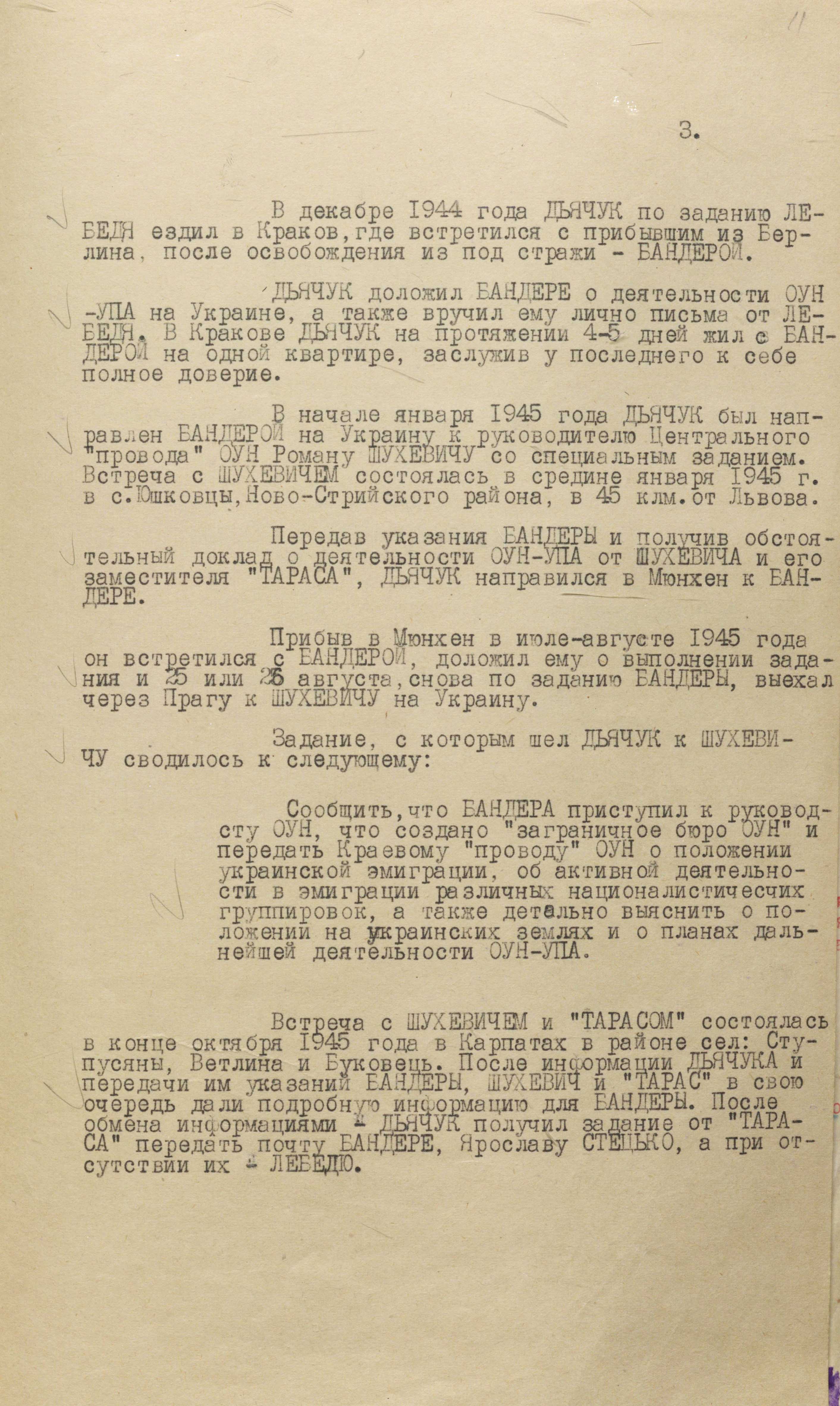
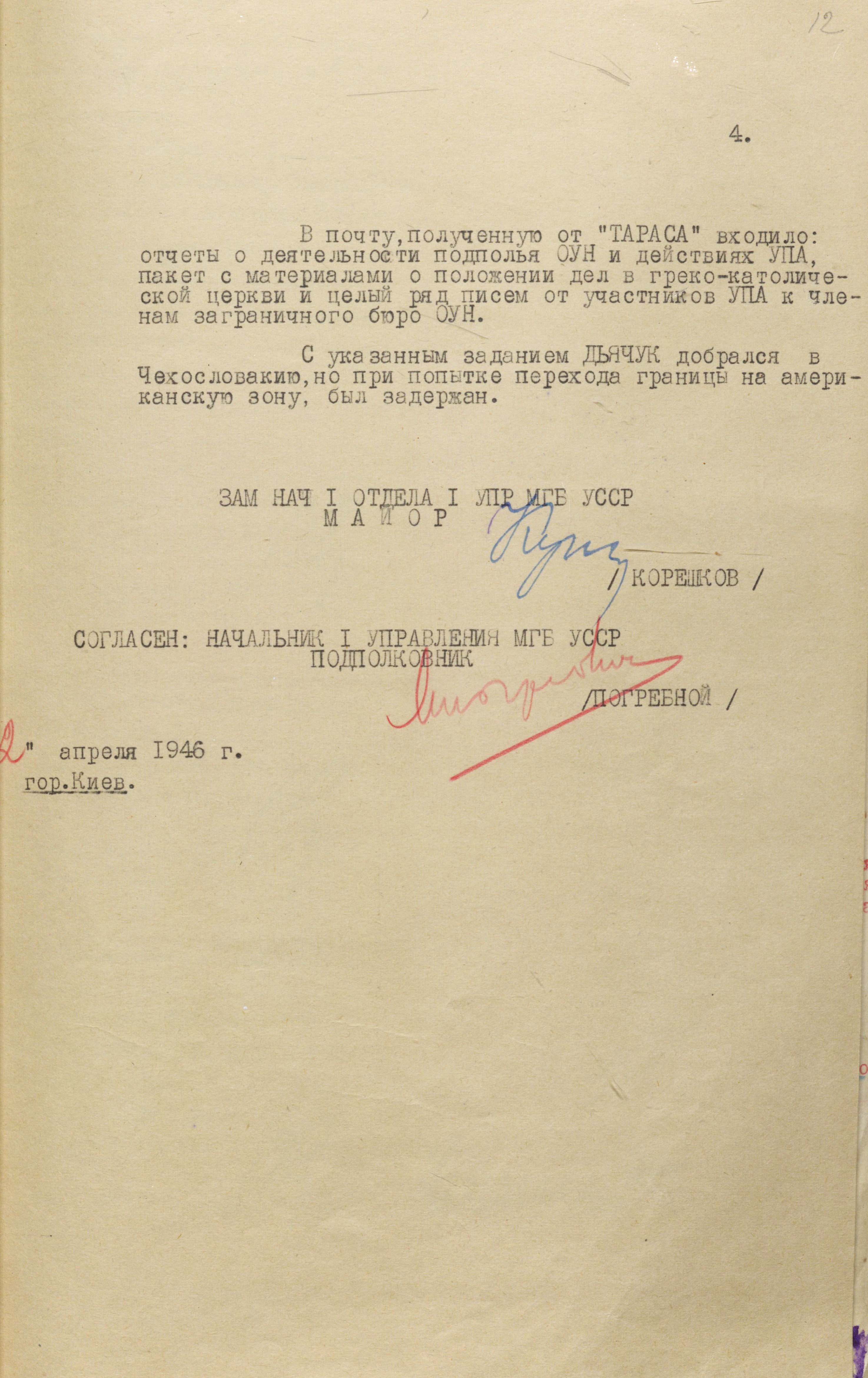
There and then, they decided to cross the border illegally together in Transcarpathia, and from there, each would follow his own plan. V. Chyzhevskyi met again with R. Shukhevych. He returned from that meeting with written reports on the activities of the OUN and the UPA, the state of affairs in the Greek Catholic Church, and other documents. But his attempt to cross the Czechoslovak-German border ended in failure. According to archival documents, he arrived in Prague in early December 1945. There he was to wait for the arrival of leading figures of the Ukrainian underground: Dmytro Maiivskyi – a member of the OUN(b) Provid Bureau and UPA General–Political Educator under the code name “Taras” – and Dmytro Hrytsai – Khorunzhyi General, Chief of the General Military Staff of the UPA, code name “Perebyinis”. He had been in contact with them while staying with R. Shukhevych and had then conveyed to them S. Bandera’s instruction to come to Munich to discuss plans for further work.
In Prague, V. Chyzhevskyi arranged for their temporary accommodation in safe houses. Besides, he was to provide them with the necessary documents for travel within the American occupation zone of Germany and organize a safe border crossing for them. First, however, he had to go to Munich to obtain the documents and then return for “Taras” and “Perebyinis”. But he was captured by Czechoslovak border guards and taken to a Prague prison.
As V. Chyzhevskyi never returned, high-ranking OUN representatives from Ukraine decided two weeks later to cross the border on their own and were also detained. At this, D. Maiivskyi shot himself so that no confessions could be got out of him during interrogations in prison. D. Hrytsai soon took his own life in his prison cell. Nothing was learned from him either. Another man, “Dorko” (Teodor Reketchuk), who had accompanied them and was responsible at that time within the OUN for courier communications between Prague and Munich, managed to escape from prison. As for V. Chyzhevskyi, his was a completely different story.
Having learnt of his comrade’s arrest, Ya. Moroz tried to use his ties to organize an escape for him. But nothing came of it. He then went to S. Bandera to consult on how to proceed. He reported that moscow wanted to take the detainee back as soon as possible. He warned that this posed a grave threat to the entire Organization, arguing that the chekists would beat a full confession out of V. Chyzhevskyi during interrogations. As archival documents show, it was decided in Munich to make another attempt to organize his escape, and if that proved impossible, to smuggle poison into his cell. But nothing came of it. On January 11, 1946, the detainee was transported to Berlin, from there to moscow, and shortly thereafter– to Kyiv, where he was placed in the internal prison of the mgb of the Ukrainian ssr.
Meanwhile, Ya. Moroz received a new assignment from S. Bandera – to go in person, instead of V. Chyzhevskyi, to a meeting with R. Shukhevych. That trip to Western Ukraine ended in the courier’s arrest and recruitment, with the chekists assigning him the code name “Zirchyn”. In the spring of 1947, the Security Service of the OUN’s Foreign Units exposed “Zirchyn,” having caught him in covert contact with soviet representatives abroad. After interrogations and confessions, he was sentenced to death for treason.
In the Internal Prison of the mgb of the Ukrainian ssr in Kyiv
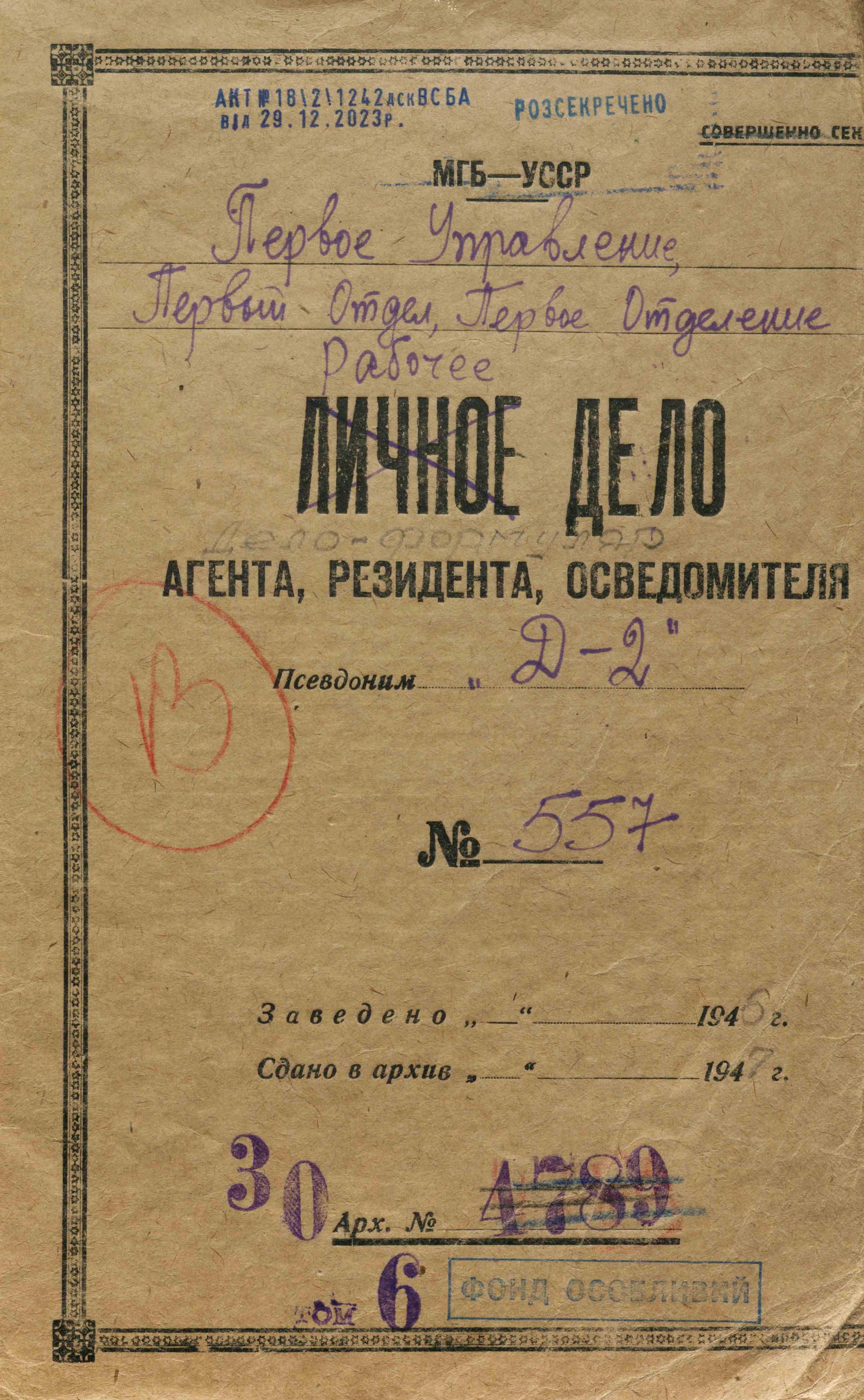
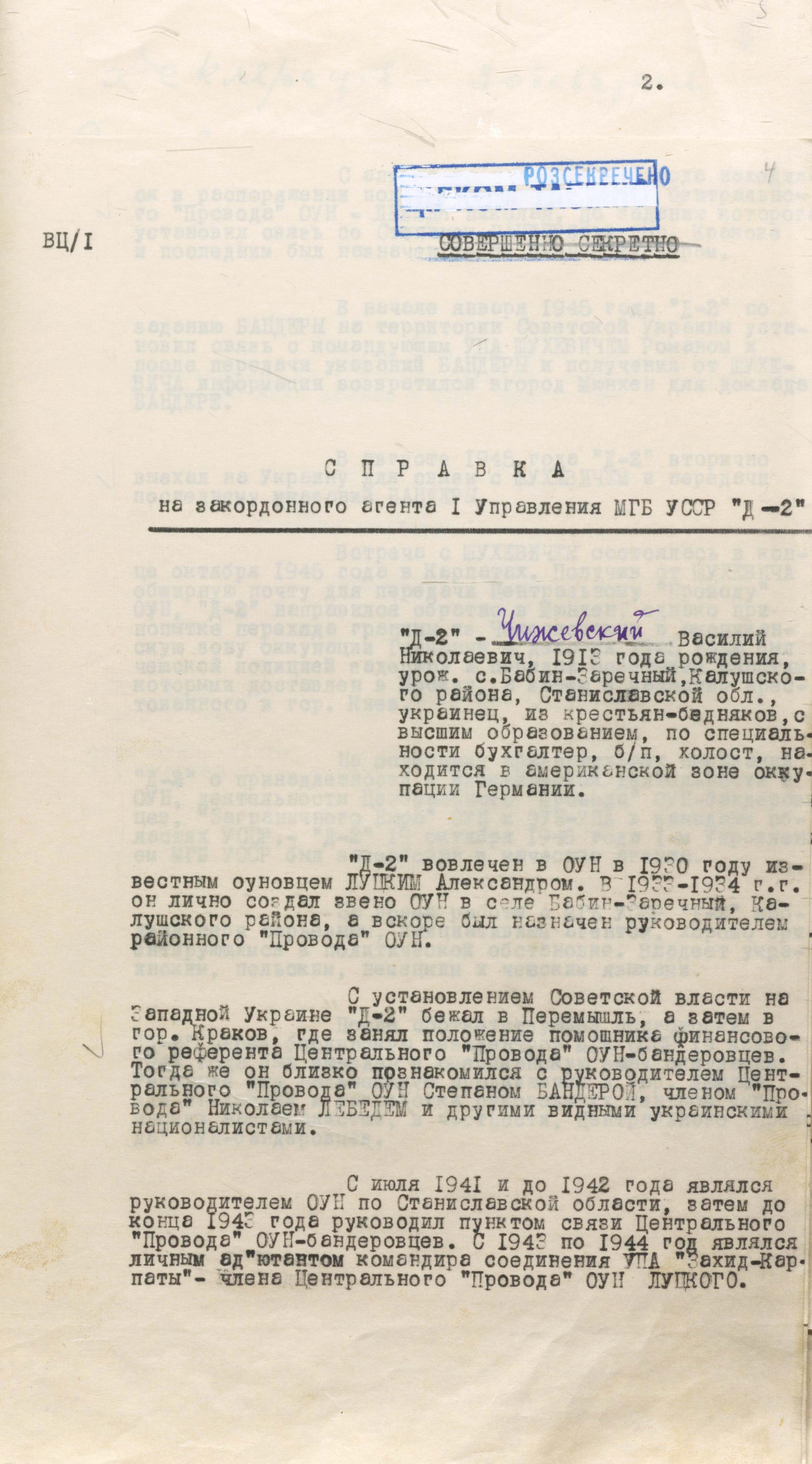
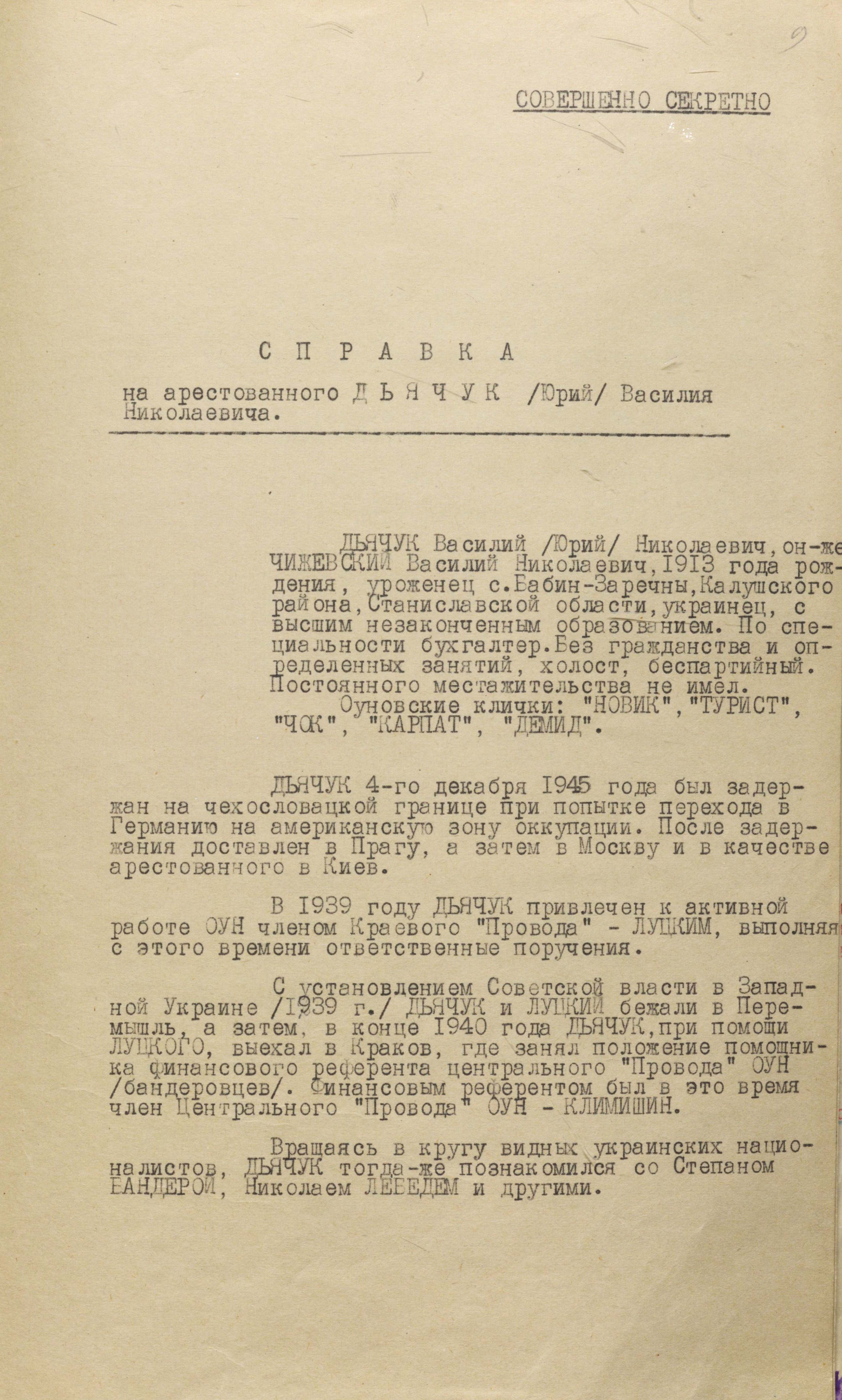
While Ya. Moroz was just about to go to a meeting with R. Shukhevych, V. Chyzhevskyi was already being interrogated in the internal prison of the mgb of the Ukrainian ssr in Kyiv. The case was given special importance. It was codenamed “D-2”. The main suspect was also identified by this code name. A review of operational records revealed that he had been arrested by the nkvd of the Ukrainian ssr as early as October 1939, following the establishment of soviet power in Western Ukraine. At that time, he was suspected of involvement in OUN activities, but he vehemently denied it. Eventually he was released from custody. At the same time, they talked him into cooperation; he was assigned the agent code name “Lys”, and he signed a pledge to provide information about OUN and UNDO figures with whom he had contact. According to the materials from that old case, V. Chyzhevskyi allegedly promised to do so, but in reality, he refused to cooperate and disappeared. He allegedly never told anyone about any of this.
Under the new circumstances, his past “sins” were brought up, and he was warned not to try to be cunning in the future. The physical evidence seized from the courier already confirmed his anti-soviet activities and contacts with the OUN underground. He was therefore advised to confess to everything voluntarily; otherwise, he was threatened that they would make him do so by other means. V. Chyzhevskyi chose the former option. The multi-page interrogation transcripts, handwritten confessions, and character assessments of leading OUN figures indicate that he revealed everything he was involved in. From those confessions, the chekists compiled a complete biography and psychological profile of the arrested man.
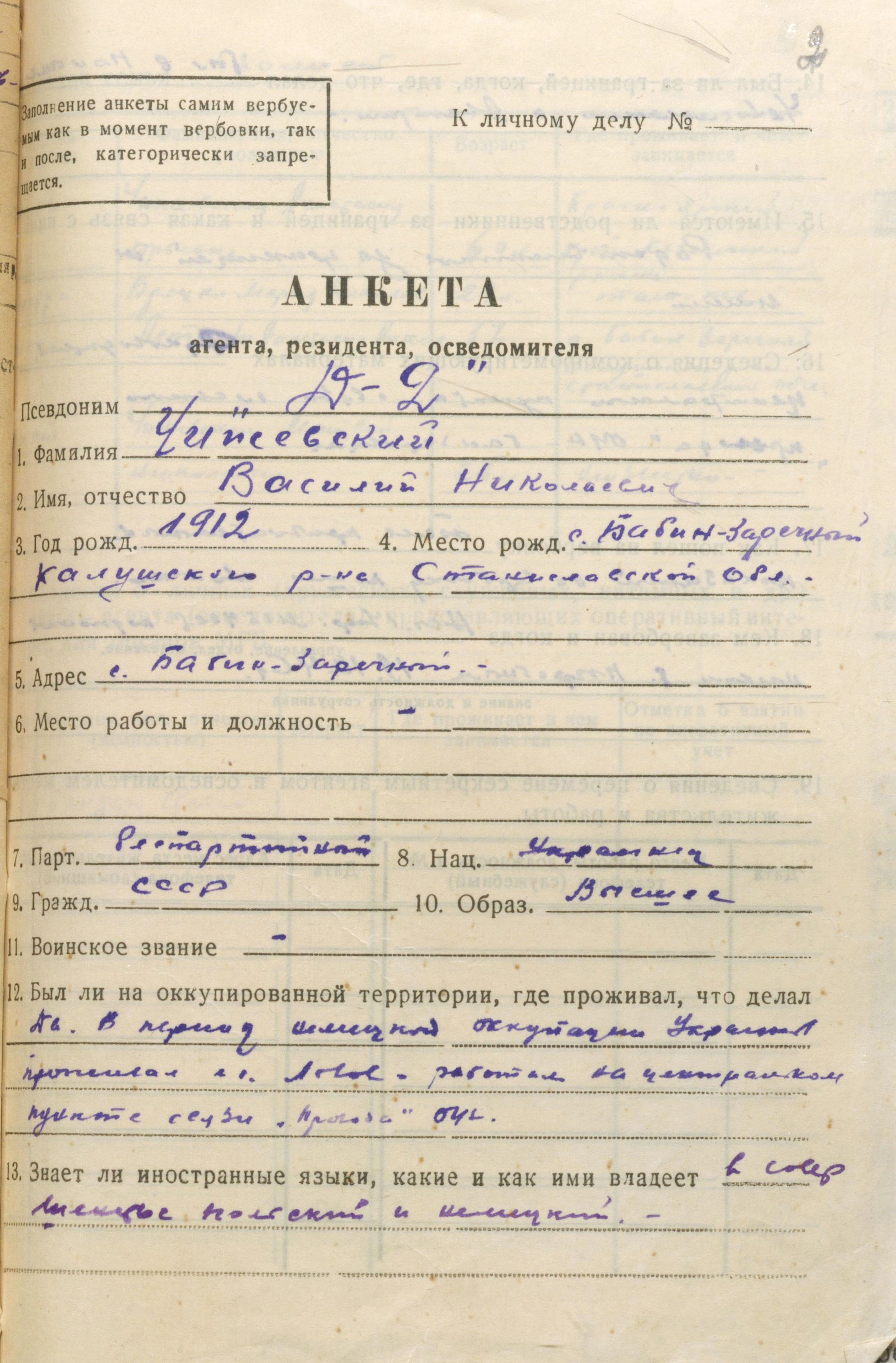
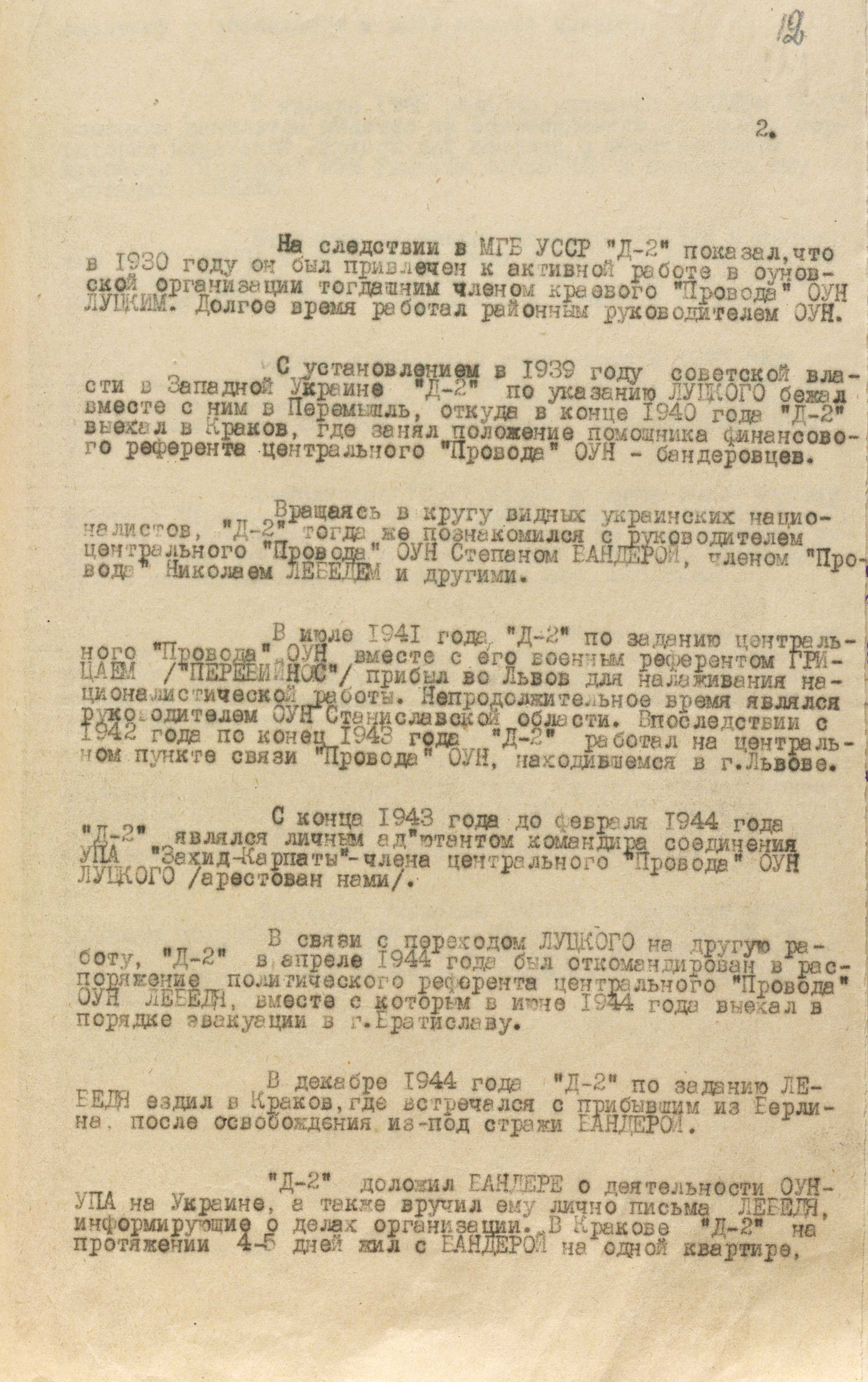
According to these documents, Vasyl Mykolayovych Chyzhevskyi was born in 1913 in the village of Babyn-Zarichnyi, Kalush district (now Ivano-Frankivsk region). He was recruited into the OUN in 1930 by his classmate Oleksandr Lutskyi while attending gymnasium. At different times, his pseudonyms in the OUN were “Artym”, “Denys”, “Diachuk”, and “Demyd”. He was repeatedly arrested by the Polish police for underground nationalist activities. In 1939, after the establishment of soviet rule in Western Ukraine, he fled to Krakow. He worked at the Ukrainian Relief Committee and simultaneously served as an assistant to the financial officer of the OUN Central Provid. He studied at a senior officers’ school. It was then that he met S. Bandera, M. Lebid, and other leading figures.
From 1941 to 1942, V. Chyzhevskyi served as the head of the OUN in Stanislav region. He participated in the Second Grand Assembly of the OUN in Krakow (1941). During World War II, he headed the Communications Center of the OUN Central Provid for a time. In 1943–1944, he served as an aide to O. Lutskyi, Commander of the UPA-West. In late 1944, he became S. Bandera’s personal courier. He met with S. Bandera on December 20, 1944, in Krakow. He told about this in detail during interrogation – how he had stayed with him in the same apartment for several days, and the task he had received to establish contact with the underground in Western Ukraine. Shortly thereafter, in Munich, he received specific instructions regarding the search for R. Shukhevych and communication with him.
After the chekists had documented all the information they needed regarding the OUN’s activities, they once again threw V. Chyzhevskyi into a dilemma: either trial, conviction, and exile, or freedom and work for the mgb abroad. He chose the latter. At this, he was warned that if he proved insincere, the fact of his collaboration with the foreign intelligence services would be revealed to the OUN leadership, and this would be a death sentence for him. He understood this very well himself. But he did not change his decision.
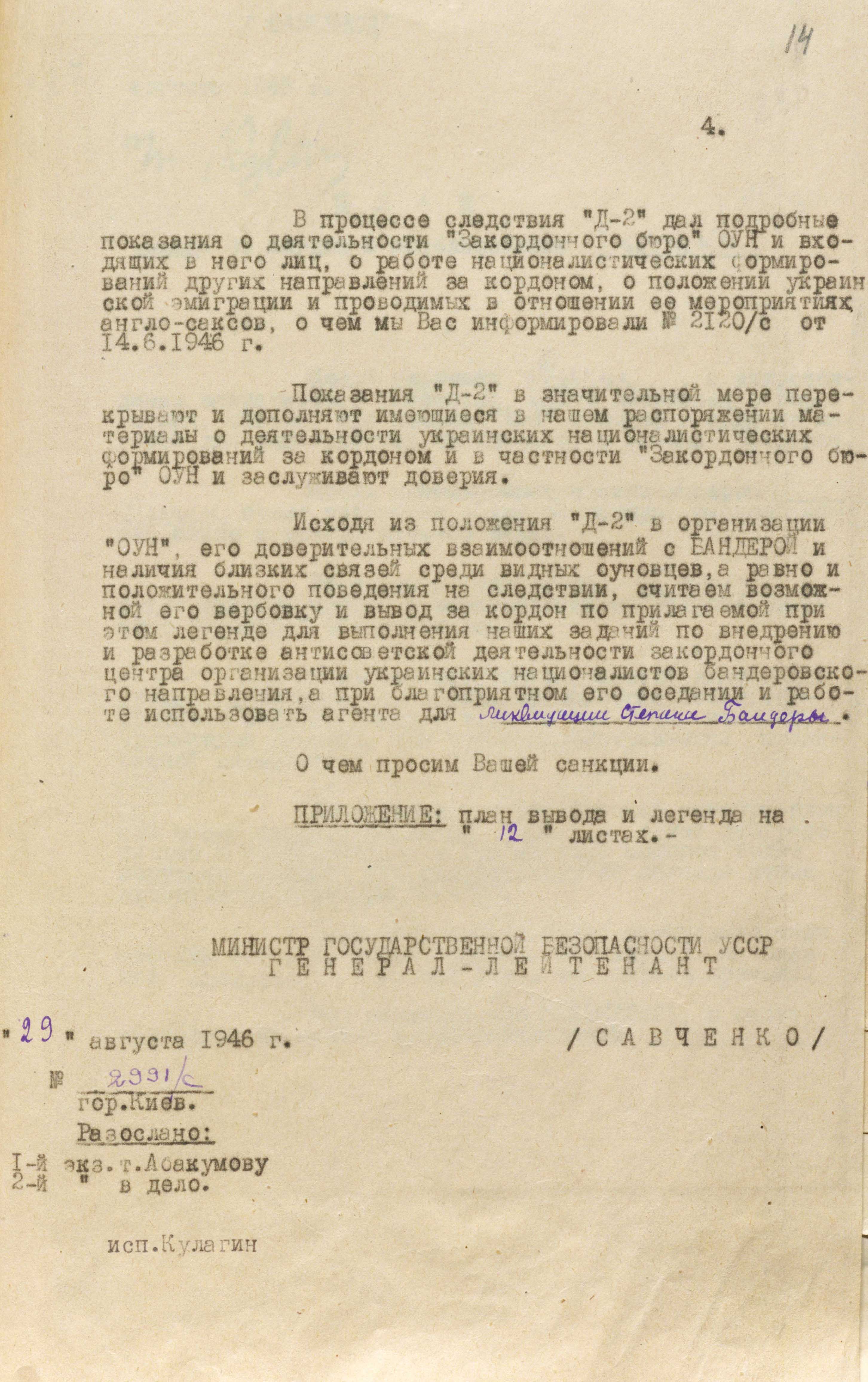
On August 29, 1946, a special report was sent from Kyiv to moscow addressed to minister of state security V. Abakumov, which stated the following: “Taking into account the position of ‘D-2’ within the OUN organization, his trusting relationship with Bandera, and his close ties with prominent OUN members, as well as his positive behavior during the investigation, we consider it possible to recruit him and send him abroad under the ‘legend’(attached) to carry out our tasks of infiltrating the OUN’s Foreign Center of Ukrainian Nationalists of the Bandera faction and cultivation of their anti-soviet activities, and, if he settles in and works successfully, to use the agent to liquidate Stepan Bandera” (FISU. – F. 1. – Case 30. – Vol. 4. – P. 14).
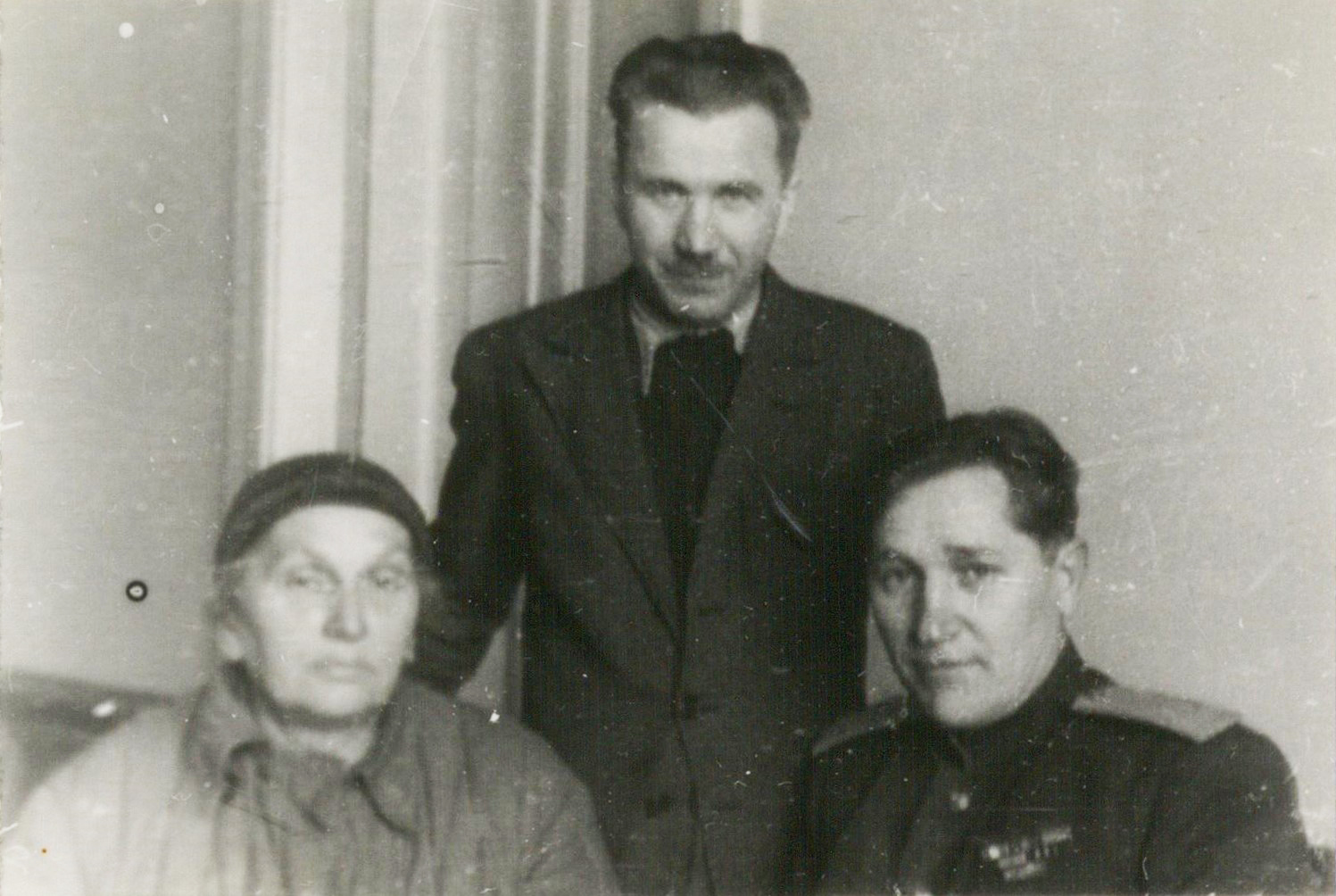
After receiving approval from moscow, the recruitment was formalized in writing, a pledge was written, the agent’s code name “D-2” was chosen based on the case file name, and a “commemorative” photo was taken of the agent in the company of operational staff. Just as they had done in the case of “Zirchyn” and other agents. Soon he was settled in a safe flat in Kyiv and preparations began for sending him abroad and infiltration into the leadership of the OUN.
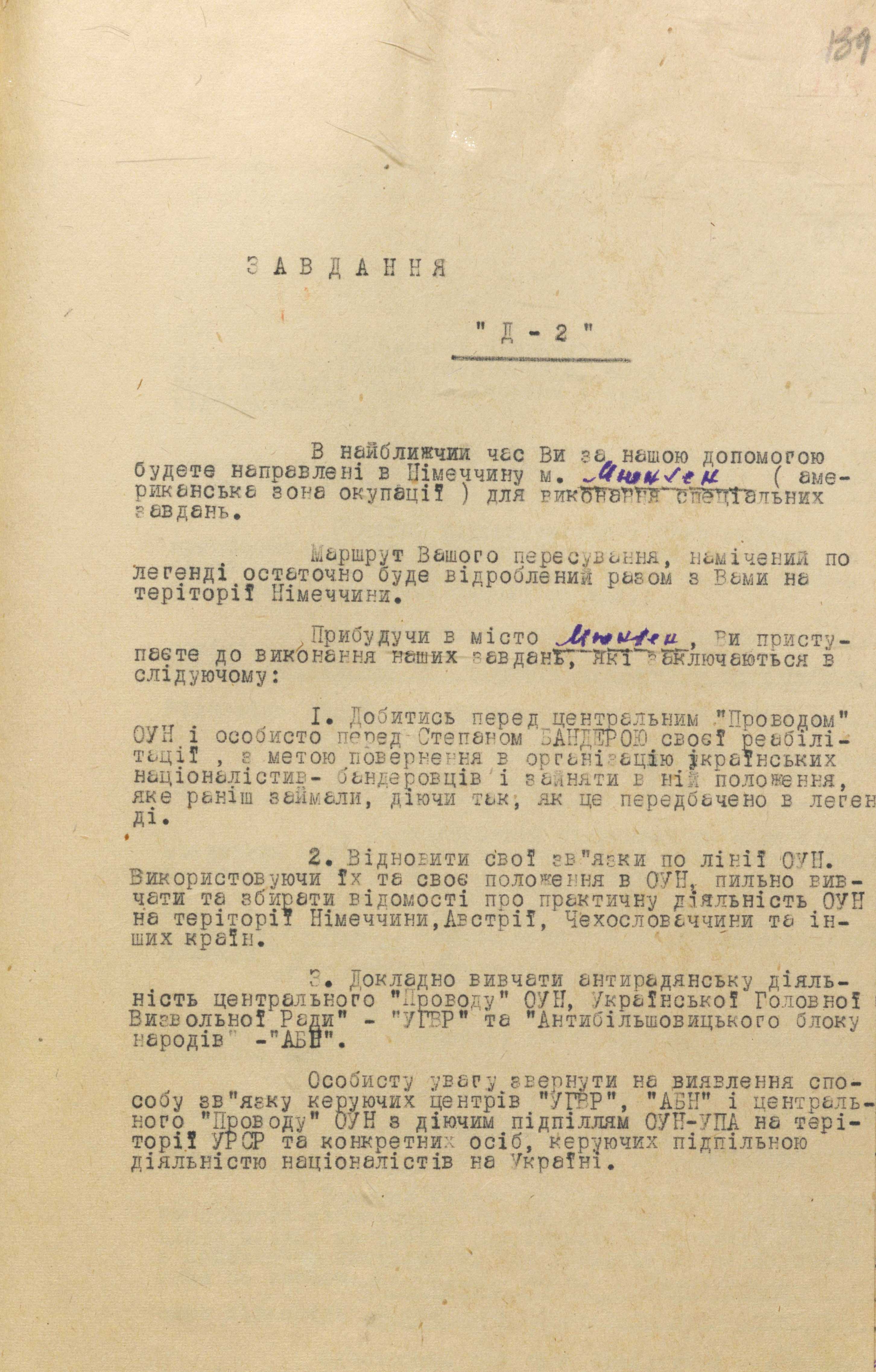
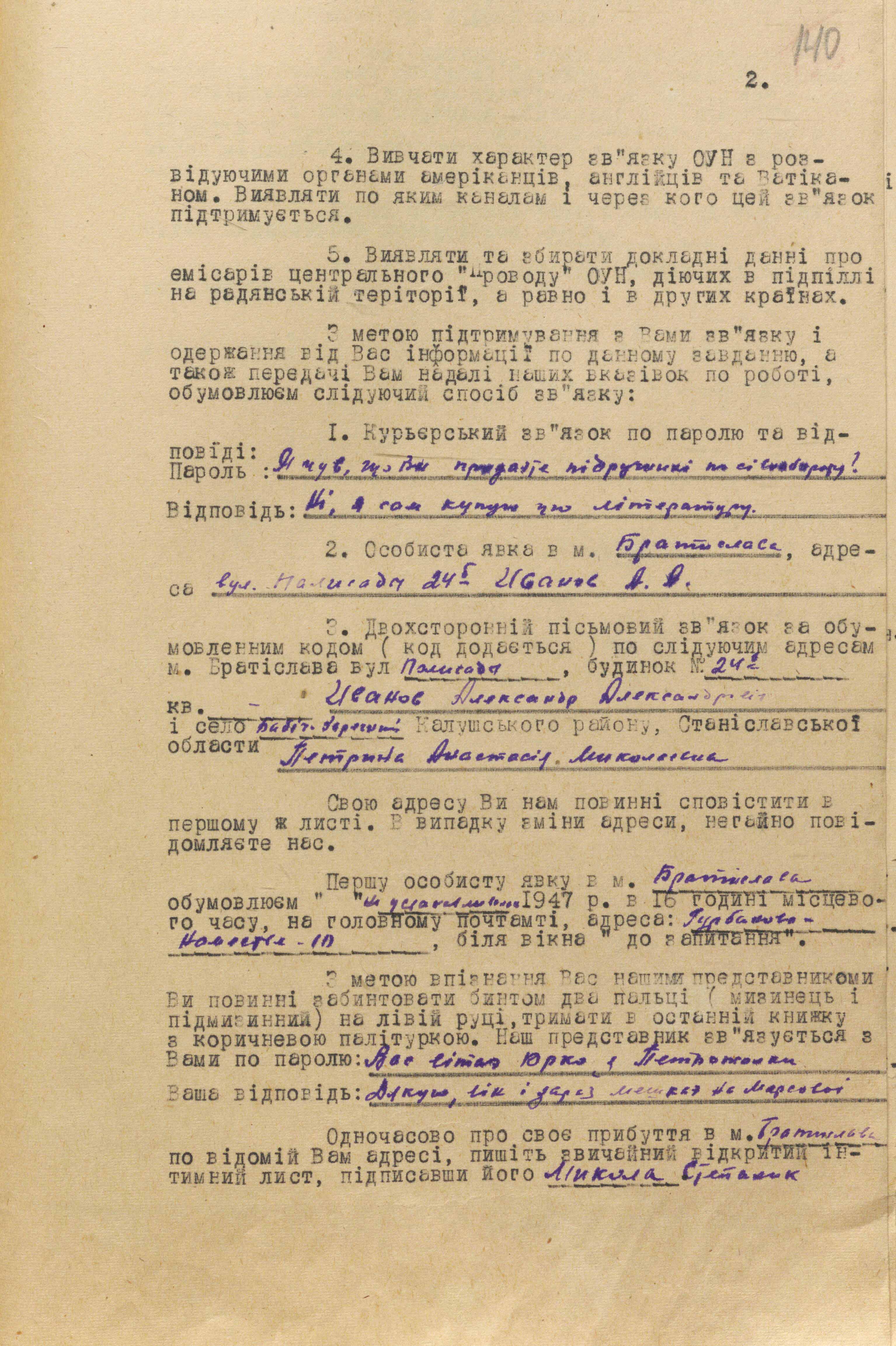
The mgb made several revisions to the “legend” for “D-2”. Correspondence on this matter between Kyiv and moscow indicated that, upon his return, the Security Service of Foreign Units of the OUN would thoroughly verify his account and every explanation, and would seek out witnesses and eyewitnesses to confirm his statements. In the final version, he was to recount that after being detained by Czech border guards, he explained to investigators in a Prague prison that he had allegedly been held in the Nazi concentration camp “Mauthausen” at the end of the war and had been liberated by American troops. In fact, that was exactly what happened. Afterward, he set out to search for his family in Transcarpathian Ukraine, where he claimed to be from. There, he learned that his relatives had been taken to Germany for forced labor. So, he decided to go there to look for them. Investigators supposedly believed the story, released him from prison, and transferred him to a soviet repatriation camp. He was then transferred to the Buchenwald camp. There, not wanting to return to the ussr, he persuaded two Germans to escape, and in this way found himself free and made his way to Munich.
With this “legend”, “D-2” was sent to moscow. From there, he was sent to the Berlin residentura of the ussr mgb, whose agents, through their own channels, smuggled him into West Germany on May 19, 1947.
In the Prison of the Security Service of the OUN Foreign Units
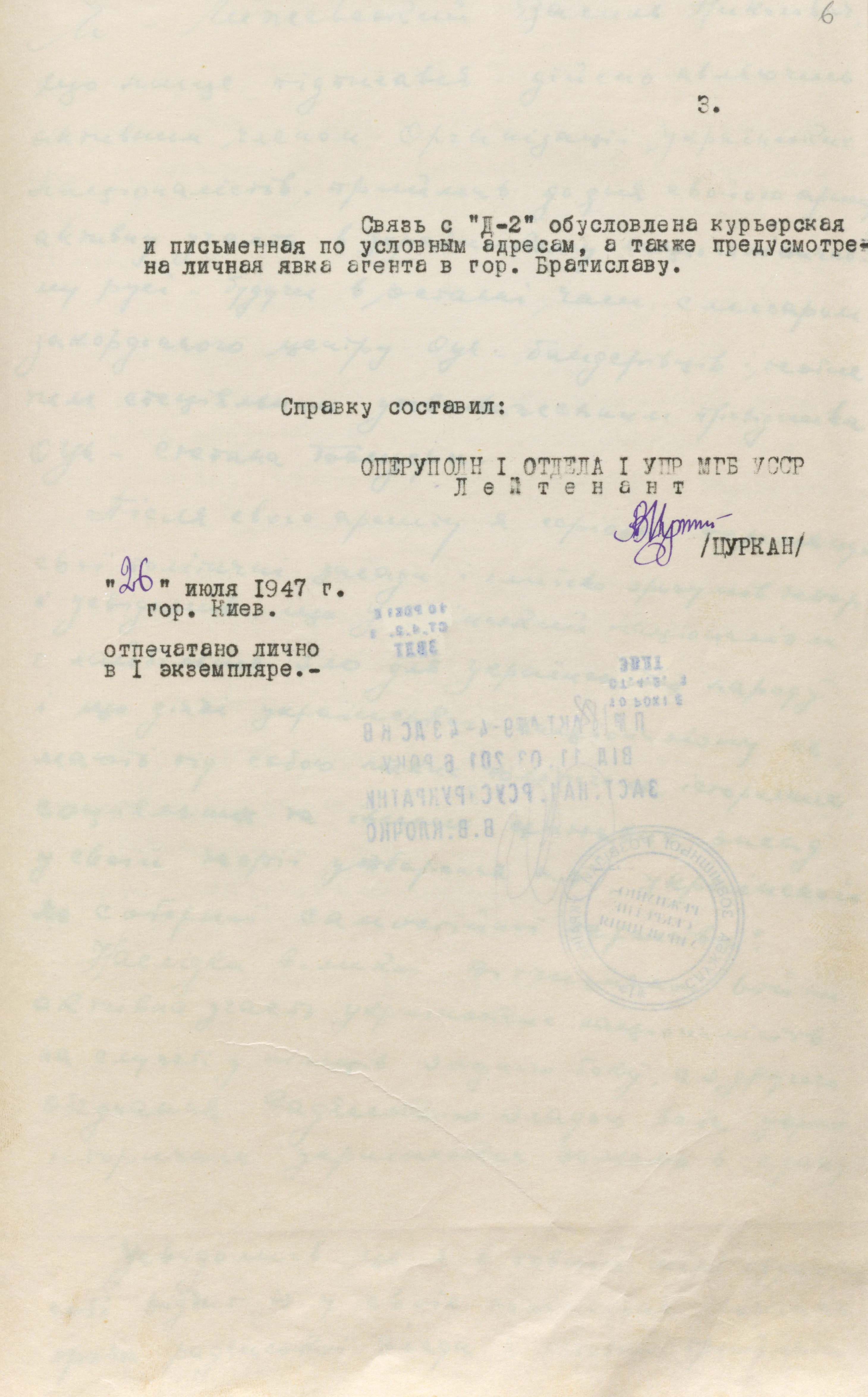
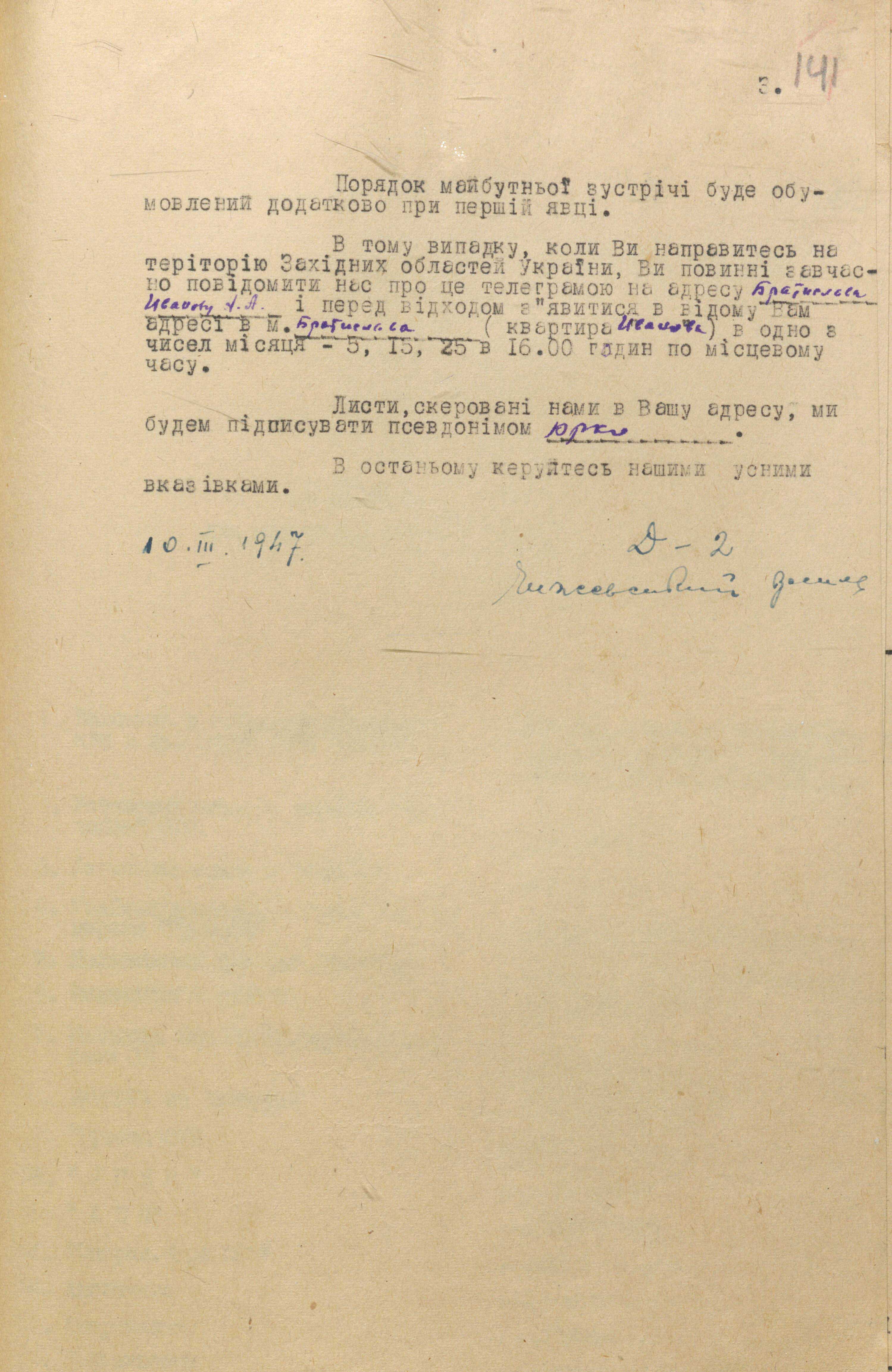
Before he was sent abroad, he had to master the main and backup communication methods, passwords, and coded phrases, and was provided with the addresses to which he was to send letters and where to go for meetings. Meanwhile, month after month passed, and there was no word. It was not until August 1948 that, from intercepted mail intended for R. Shukhevych, the chekists learned that shortly after V. Chyzhevskyi arrived in Munich, he was arrested by the Security Service of the OUN Foreign Units and placed, as noted in archival documents, in the OUN(b) prison in the city of Mittenwald. It was a specially equipped facility in a DP camp for temporarily displaced persons, where those suspected of collaborating with soviet special services and committing other negative acts were held. Verification of the “legend” he had provided and interrogations lasted over a year. Ultimately, the “legend” did not hold up.
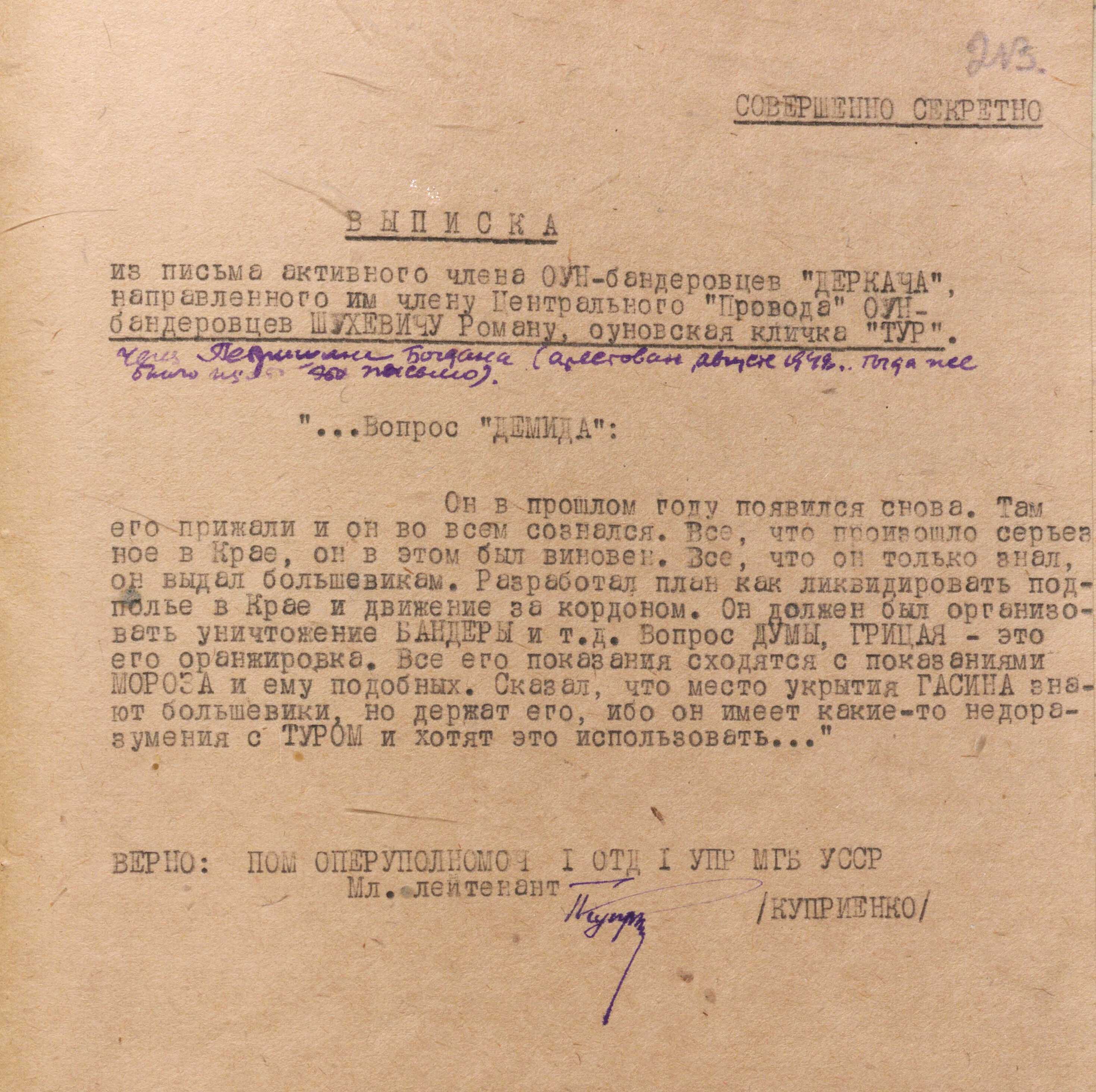
“…They pressed him there,” read a letter from “Derkach” to R. Shukhevych, “and he confessed to everything. He was to blame for everything significant that happened in the Homeland. He revealed everything he knew to the bolsheviks. He devised a plan to liquidate the underground in the Homeland and the movement abroad. He was supposed to organize the assassination of Bandera, etc.” (FISU. – F. 1. – Case 30. – Vol. 4. – P. 213).
Obviously, the mgb underestimated the OUN Security Service. This is documented in a report to minister of state security of the Ukrainian ssr M. Kovalchuk. It pointed out:
“As was later established, the main reason for the failure and exposure of ‘D-2’ as our agent was the failure of the former 1st main directorate of the mgb of the ussr to carry out a series of fairly serious measures to confirm “D-2”’s legend, according to which he was allegedly held in the “Buchenwald” camp, from which he escaped with a number of persons of German nationality. In reality, however, “D-2” had not been placed in that camp, as established by the Security Service during the verification of the agent’s testimony”.
(FISU. – F. 1. – Case 30. – Vol. 4. – P. 271).
That is, employees of the Berlin residentura of the kgb were supposed to place V. Chyzhevskyi in that concentration camp for a certain period of time; after World War II, the camp was still used for some time by the soviet military administration to hold former prisoners of war and other individuals. Such a plan existed, but it was not carried out. Meanwhile, employees of the Security Service of the OUN Foreign Units collected the necessary information about the location of the barracks, the territory, the conditions of detention, and other details through Ukrainians who had gone through that death camp. When V. Chyzhevskyi was asked to describe in detail exactly where and with whom he had been in the camp, he began to get confused in his testimony and was unable to describe everything correctly. He also became confused in other testimonies. After that, he was forced to confess to everything.
According to emissary of the Central Provid of the OUN(b) Vasyl Dyshkant, who had been detained by the chekists, V. Chyzhevskyi allegedly also confessed that “he had tried to give away Roman Shukhevych to the soviet authorities, and only by chance Shukhevych did not fall into an ambush, and instead Head of the Security Bureau of the OUN Provid in Ukraine Mykola Arsenych (“Mykhailo”) and his wife were killed”. At the same time, after analyzing V. Dyshkant’s testimony and other sources, the mgb concluded that ‘“D-2’, while under arrest by the Security Service, was subjected to intense interrogations involving the use of physical coercion, since under other circumstances he would hardly have given such contradictory testimony, moreover, confessing to things he did not actually do (denouncing the gang leaders “Taras” and “Perebyinis”, attempting to give away Shukhevych to soviet authorities)” (FISU. – F. 1. – Case 30. – Vol. 4. – P. 241–242).
Eventually, following the results of an internal investigation, V. Chyzhevskyi was sentenced to death for treason. Neither his past merits in the Organization nor his proximity to leading figures of the OUN stood in the way of this. Betrayal of the cause, principles, and comrades in the liberation struggle was unforgivable. This was a harsh but principled stance, and there was the political will to enforce it.
In contrast to V. Chyzhevskyi, the names of D. Maiivsky and D. Hrytsai – who were also detained at the Czechoslovak-German border and made the difficult decision to take their own lives rather than reveal secrets of the Organization under torture – have been shrouded in an aura of martyrdom throughout history. Today, they are honored as unbreakable heroes.