Yurii Boiko-Blokhin and His Full of Trials Path to the Statehood of the Ukrainian Nation
7/15/2026
Documents on the operational cultivation of prominent Ukrainian scholar, public and political figure, theorist of Ukrainian nationalism, Yurii Boiko-Blokhin abroad, shed light on why the kgb / mgb of the ussr paid such close attention specifically to scientists – historians, linguists, literary scholars, and archaeologists. Their research into the origins of the Ukrainian nation, statehood, language, and culture significantly hindered the imperial plans of the kremlin leadership, which was rewriting history to suit its own agenda. War was declared on those who stood in the way of this and did not fit into the concept approved at the highest levels in moscow.
“’Kursant’” Refuses to Cooperate”
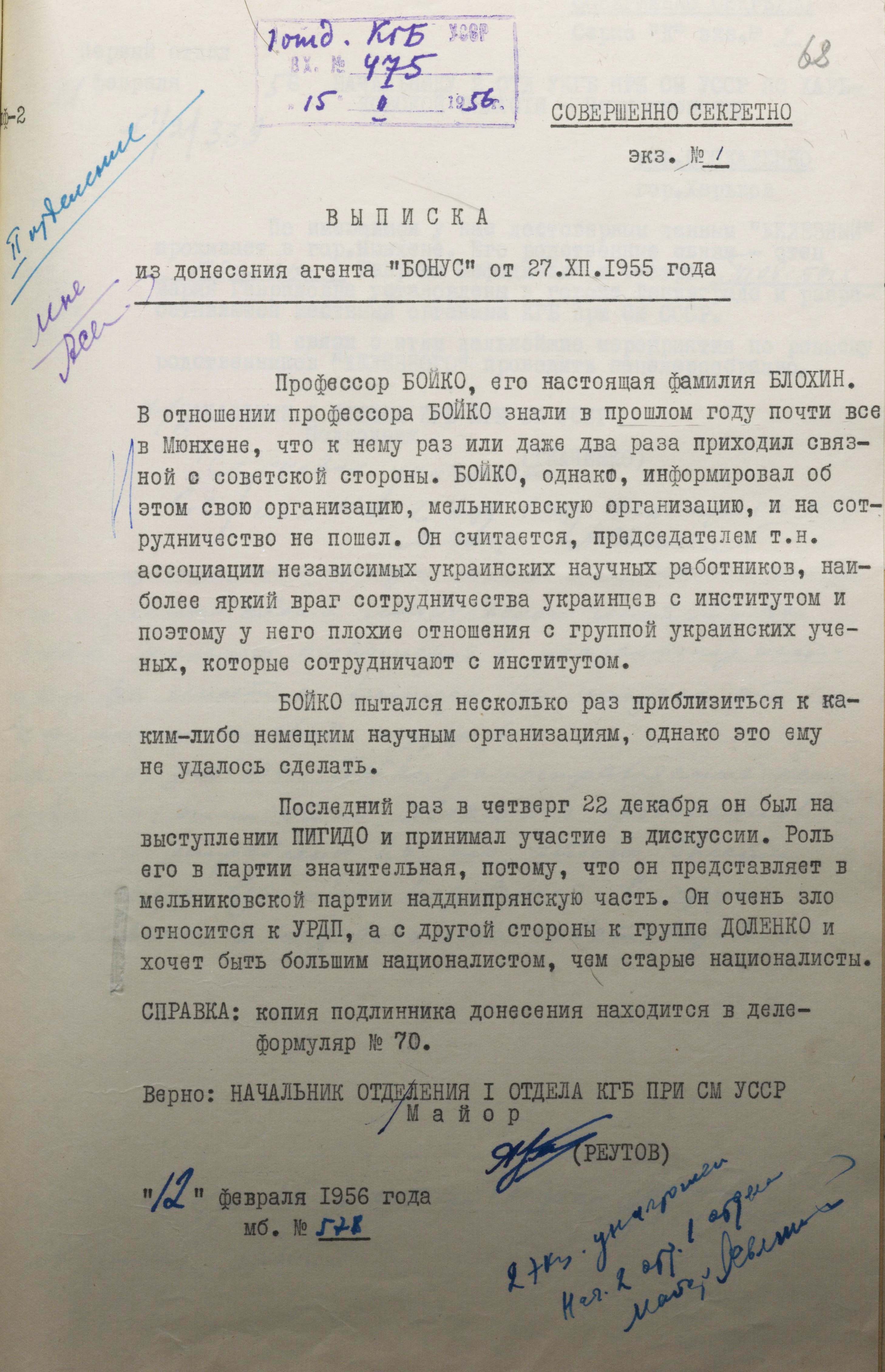
Yurii Blokhin came to the attention of the chekists immediately after the end of World War II. Among the Ukrainian figures who had settled in Munich, he stood out for his remarkable academic, civic, and political activism; he spoke at academic conferences, wrote articles and books, and was a member of various societies and associations. But most importantly, he was a member of the Provid of the Melnyk wing of Ukrainian Nationalists and headed the propaganda department. It was precisely this that served as the basis for the ussr mgb’s representative office in the German Democratic Republic to place him under operational cultivation.
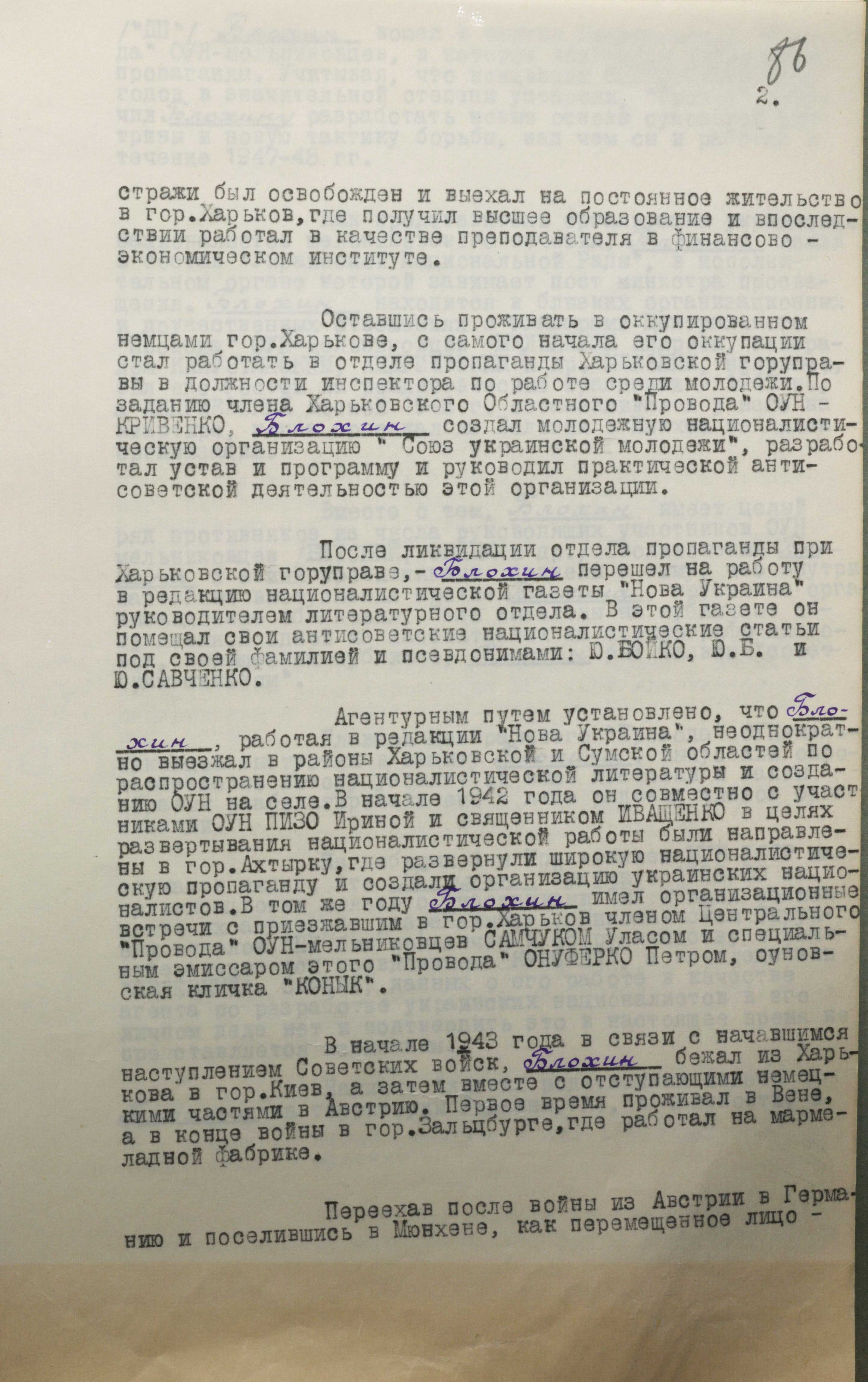
The compilation of a dossier on Yu. Blokhin began when a request was sent from Berlin to Kyiv asking for information about his activities during the Nazi occupation, as well as to verify whether he had previously been part of the intelligence of the nkvd of the Ukrainian ssr. The response stated that he had spent most of his time in Kharkiv, was a member of the city council, participated in the work of “Prosvita”, was responsible for youth affairs, published anti-soviet articles in newspapers under the pseudonyms Yu. Boiko and Yu. Savchenko, and joined the OUN-M in 1941. As German troops retreated, he evacuated to Kyiv and Lviv and eventually ended up in Munich, where he lived under the surname Karbyk (later becoming better known in academic circles as Boiko-Blokhin). Besides, it was reported that Yurii Blokhin and his wife, Oleksandra Sulyma, were not part of the mgb’s intelligence network.
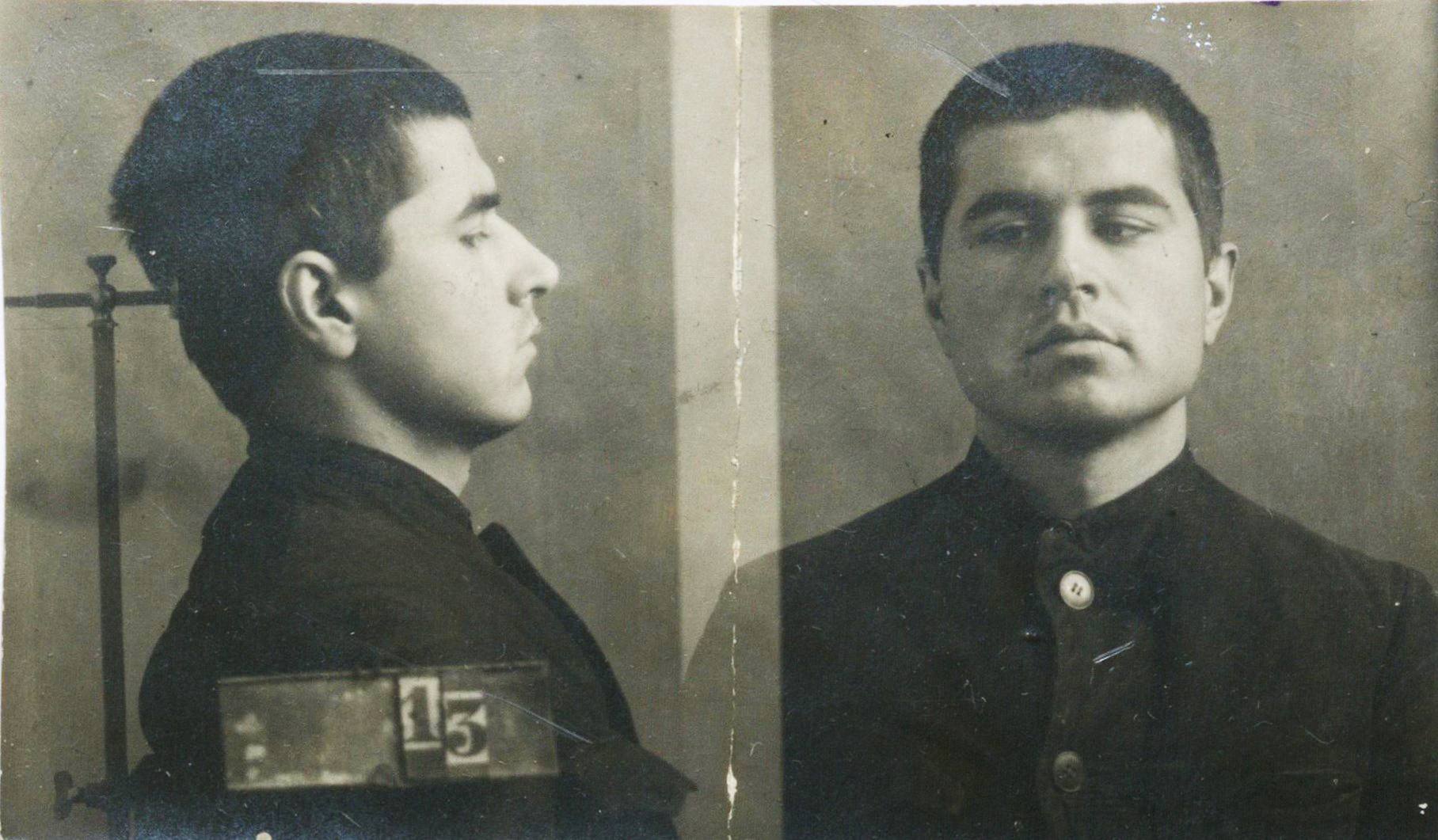
Some time later, a new request arrived from the mgb’s Berlin office. They asked to verify whether Yu. Blokhin had in fact been repressed in the past and for what reason. The search for these materials had unexpected consequences. The fact of his arrest was confirmed. An investigative case file on him was found in the archives. After reviewing the available materials, a summary report was written. It stated that Yurii Havrylovych Blokhin, born in 1909, a native of Mykolaiv, a Ukrainian of peasant origin, and a teacher by profession, was arrested on October 10, 1929, by the Mykolaiv district department of the gpu.
It was noted that during the active investigation in 1928–1929 into members of the counterrevolutionary organization “Union for the Liberation of Ukraine”, the gpu established that Yu. Blokhin, a student at the Mykolaiv Institute of Public Education, was involved in the Ukrainian nationalist underground. At that time, he was allegedly the organizer and leader of a nationalist circle that included a large number of young people and students from educational institutions in Mykolaiv. He also was associated with M. Lahuta, the head of the Mykolaiv branch of the “Union for the Liberation of Ukraine”, from whom he received nationalist literature and used it in his anti-soviet speeches. The report quotes several statements by Yu. Blokhin, including the following: “…he repeatedly emphasized that Ukraine has long been under foreign oppression and that, as a result, it has fallen behind culturally. It is necessary to organize Ukrainian youth into a tightly knit organization to restore Ukraine’s former glory” (FISU. – F. 1. – Case 10948. – Vol. 1. – PP. 79–81).
It goes on to say that, fearing arrest, Yu. Blokhin left for Odesa, where he enrolled at the local Institute of Public Education, established contact with Professor T. Slabchenko, the head of the Odesa regional branch of the “Union for the Liberation of Ukraine”, and, on his instructions, carried out nationalist activities among the Institute’s students. There, he was soon arrested and transported to Mykolaiv for investigation. During the investigation, he allegedly stated that he had not engaged in any anti-soviet activities. Consequently, due to a lack of substantial evidence, he was released from custody on February 3, 1930.
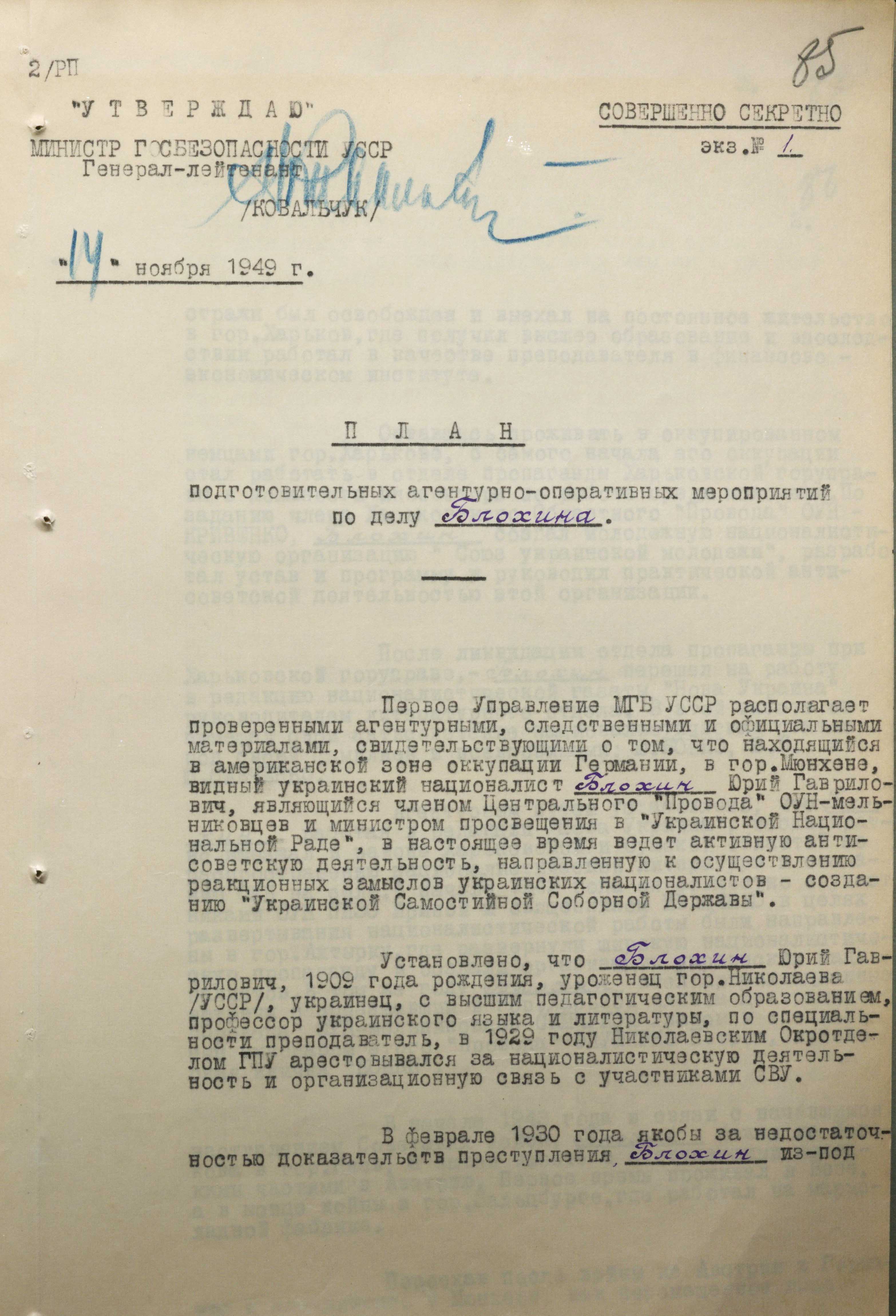
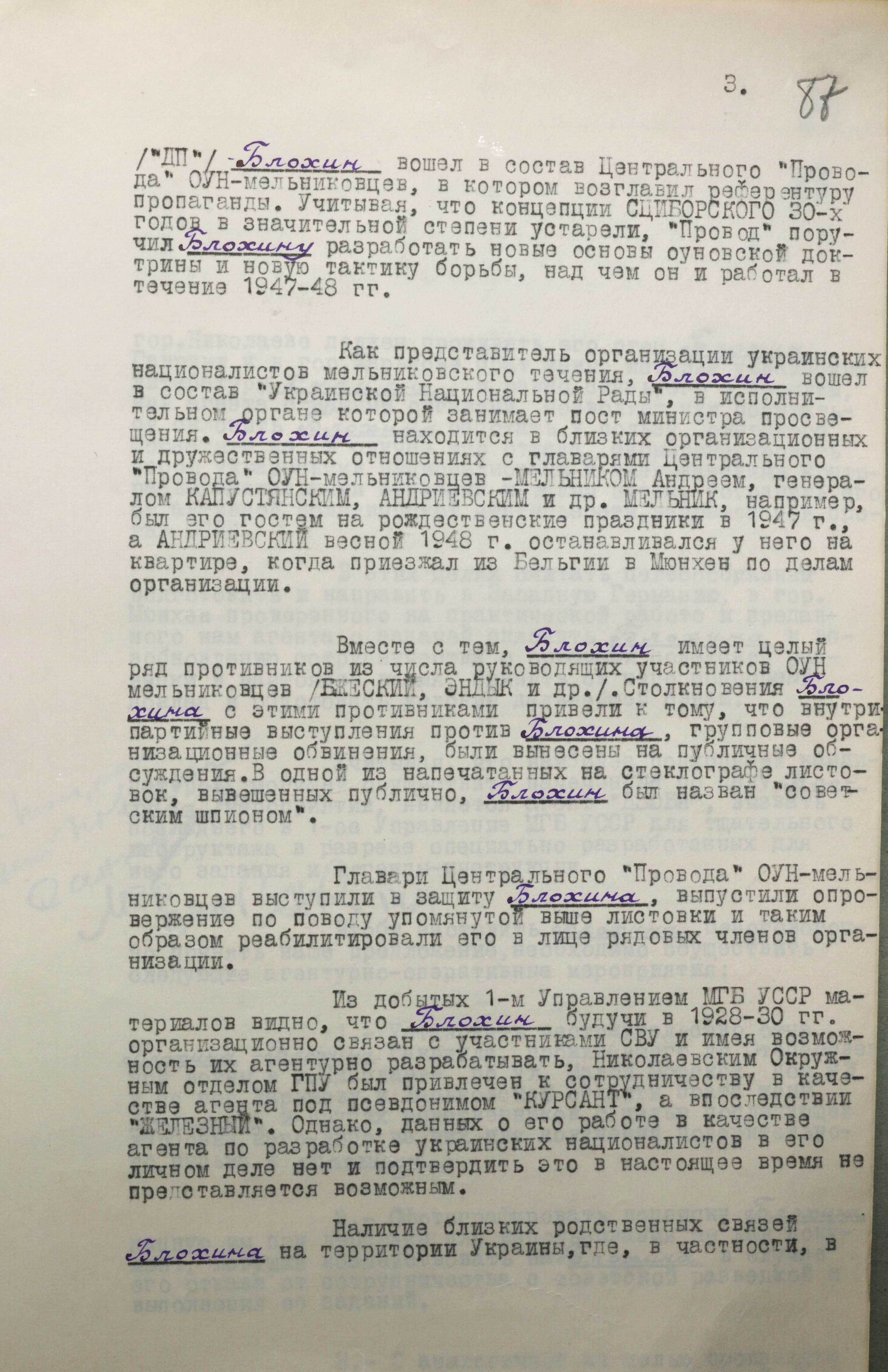
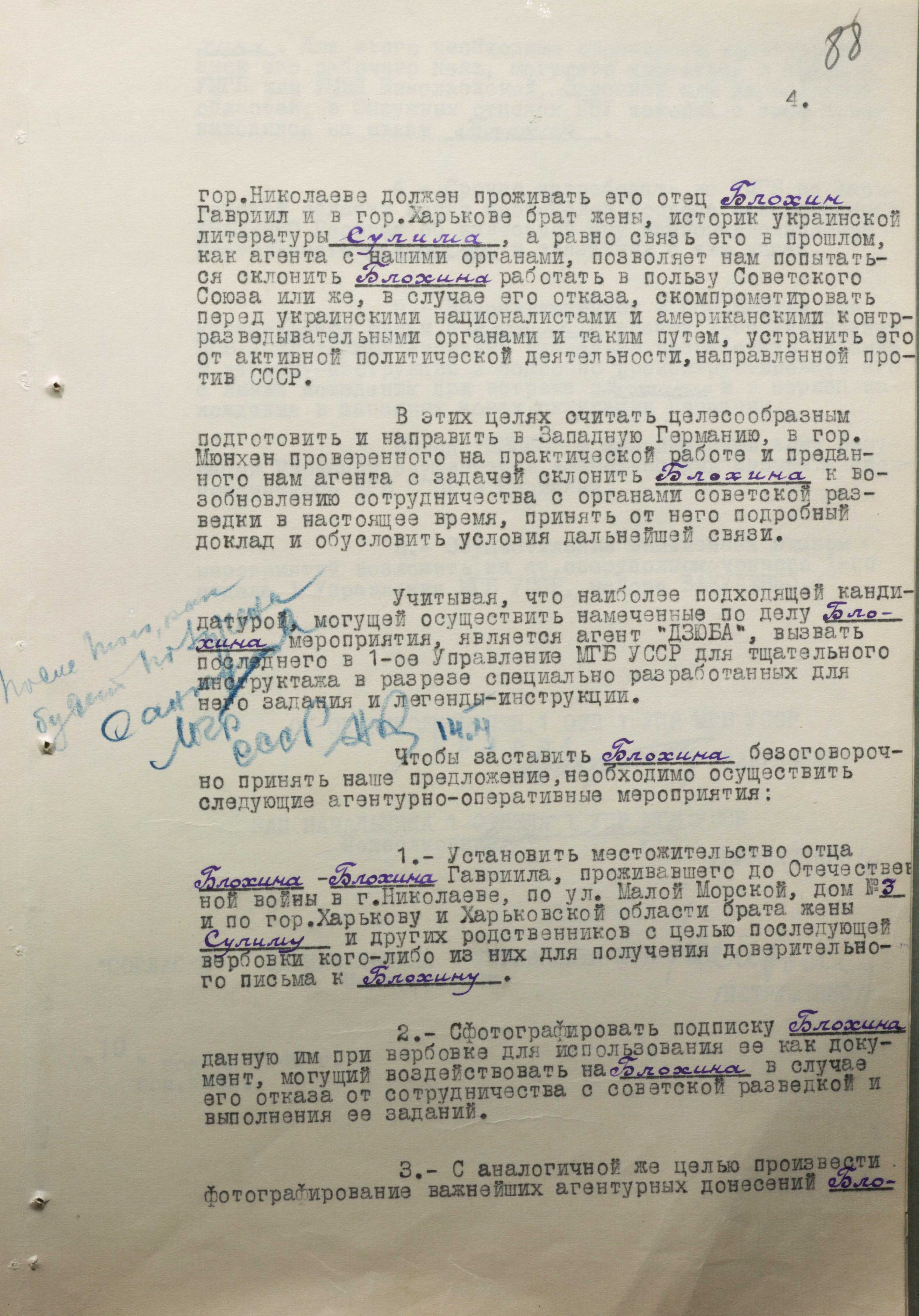
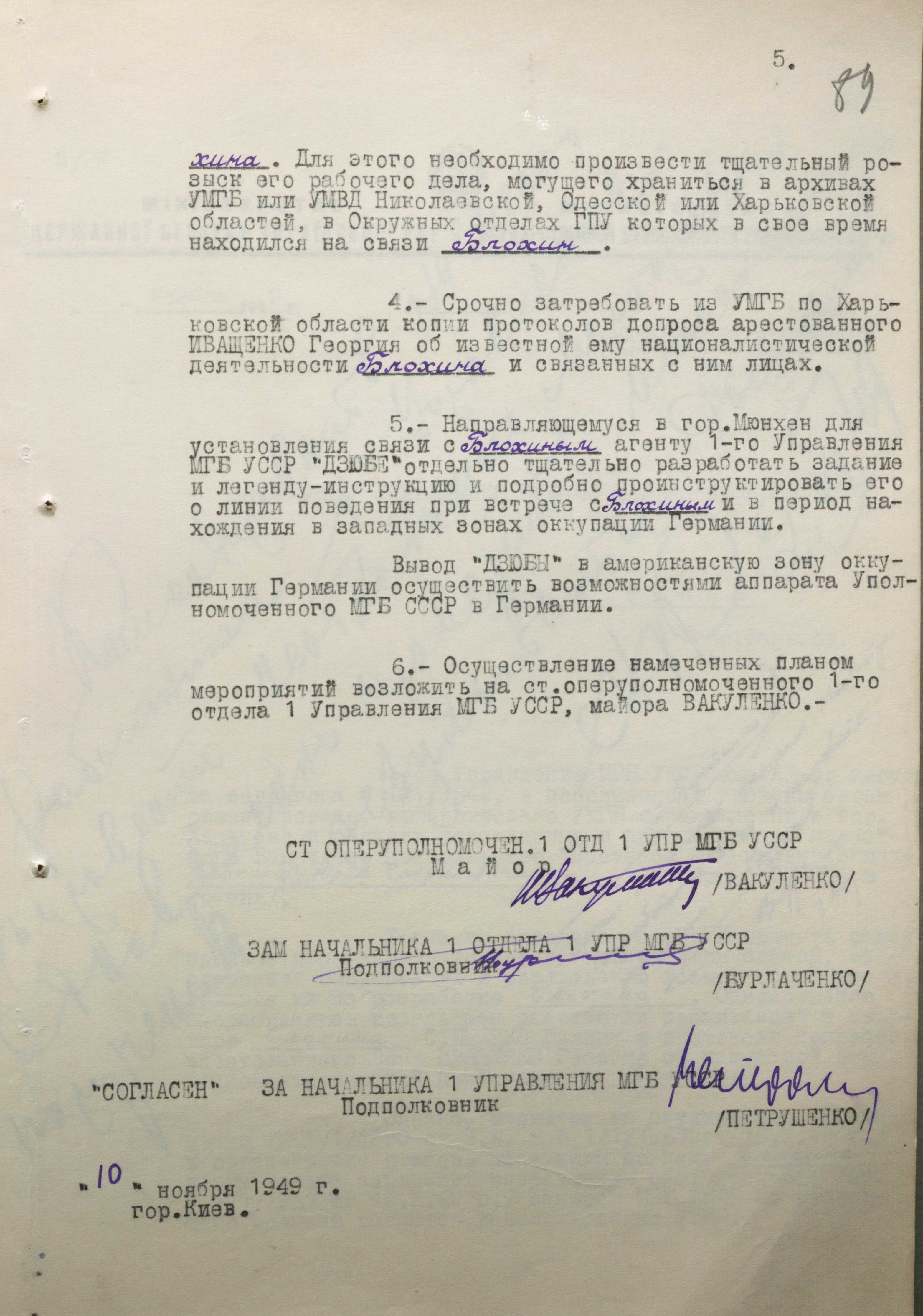
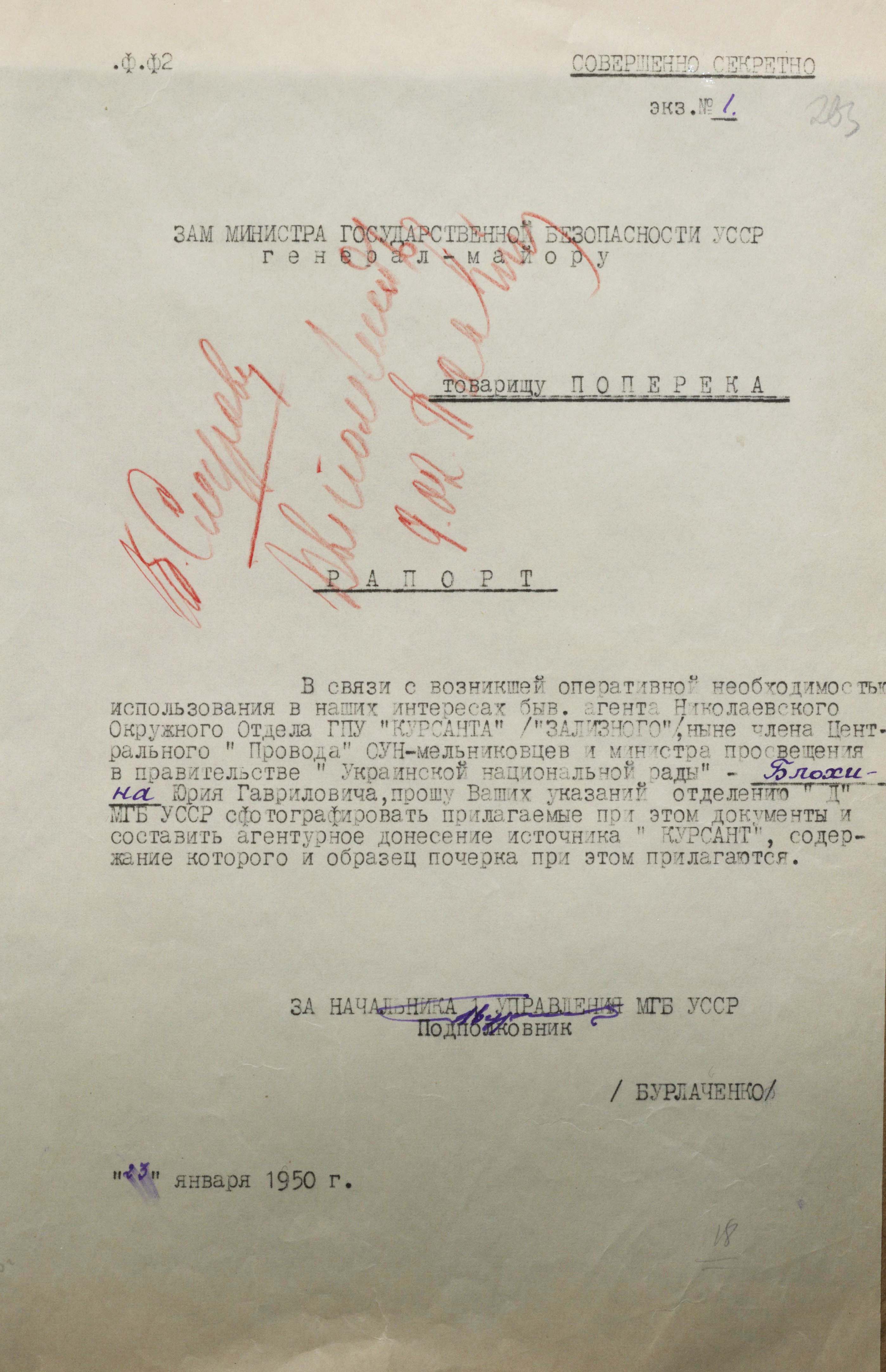
The Kharkiv directorate of the mgb was tasked with searching for and reviewing these materials; it soon received another document from Kyiv containing important clarifications. It was noted that, as a result of an additional review, it was found out that Yu. Blokhin had been recruited by the Mykolaiv regional department of the gpu and had the code name “Kursant” (“Cadet” – Transl.) and later “Zaliznyi” (“Made of Iron”- Transl.). Consequently, in a subsequent directive, the leadership of the mgb of the Ukrainian ssr set the following task: “Zaliznyi” must be made to work for us. But first, in addition to the existing investigative case file, the agent’s personal and work case files had to be located in the archives.
At the same time, another requirement was immediately set: “Select, train, and send our trusted courier-recruiter to Munich to establish contact with ‘Z’ [‘Zaliznyi’], providing the courier with a photocopy of ‘Z’’s signature and other materials that can be used to persuade ‘Z’ to cooperate with us” (FISU. – F. 1. – Case 10948. – Vol. 1. – P. 61).
This practice was quite common in the activities of the mgb agencies at the time. According to operational records, they investigated nearly everyone who found themselves abroad after the war. If it was confirmed that a person, under various circumstances during the years of brutal repression and mass arrests – whether under psychological pressure or for other reasons – had agreed to cooperate, attempts were made to persuade them to continue their covert collaboration while abroad. To persuade him more forcefully, they threatened to disclose materials from the case to his relatives and acquaintances and even in the press. But with Yu. Blokhin, things did not go according to the usual scenario from the very beginning.
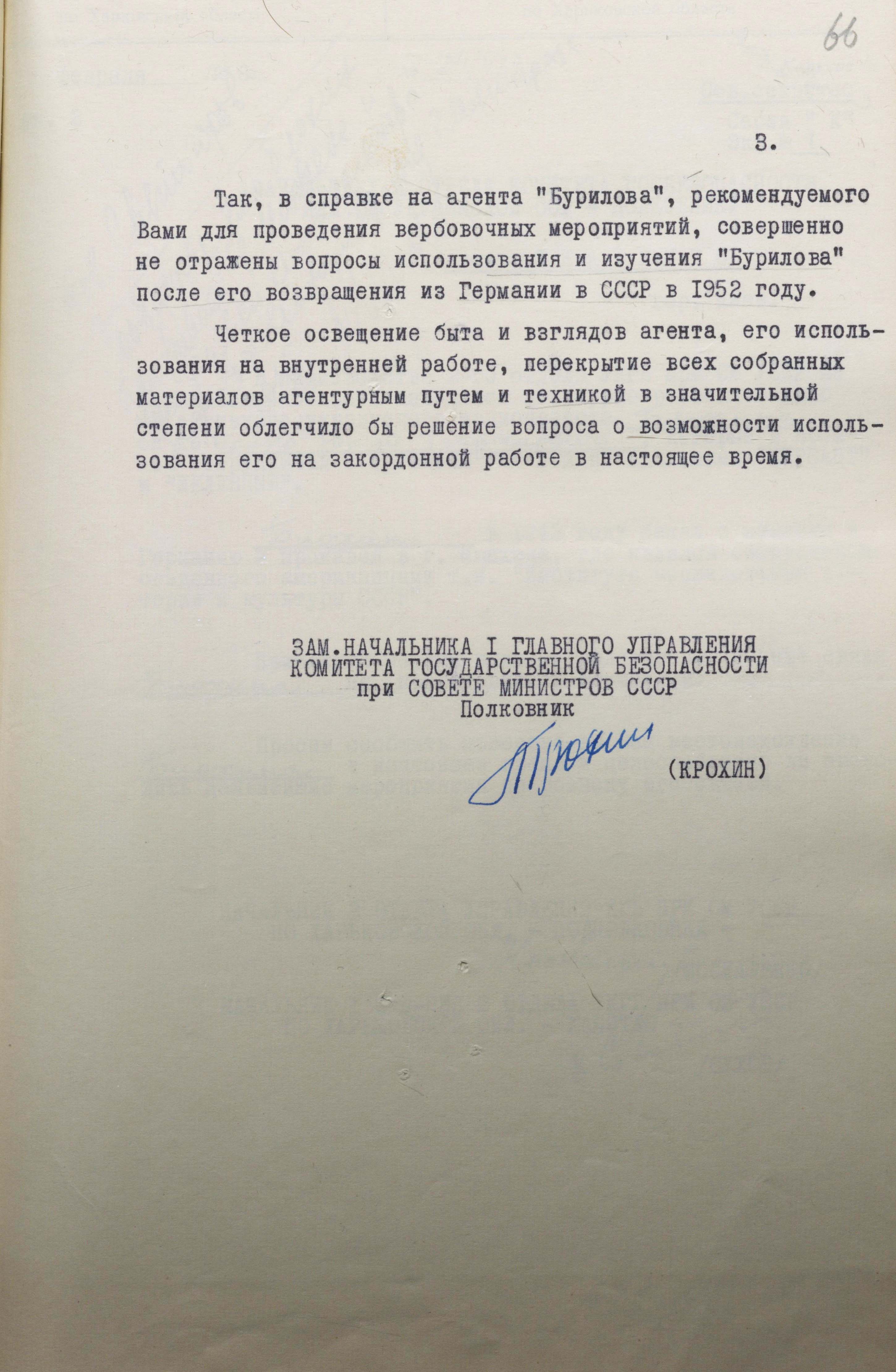
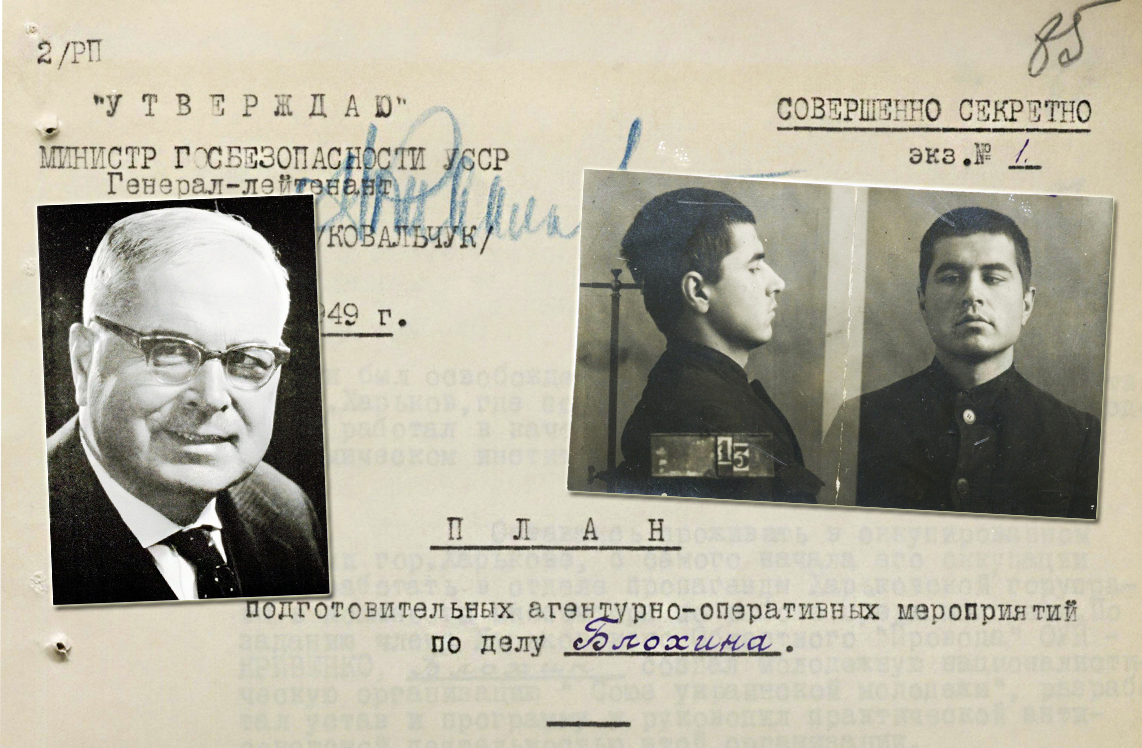
As shown by declassified documents, after a lengthy search, the chekists managed to find a case file on him. It consists of only 40 pages. The first document is a written pledge dated May 11, 1928. However, it was not a consent to covert collaboration, but a commitment not to disclose the fact of being summoned to the gpu. Such statements were typically collected from everyone summoned for interrogation, questioning, or for other reasons. There is no evidence in the case file of Yu. Blokhin’s work as a secret agent. The documents available indicate that employees of the Mykolaiv district department of the gpu of the Ukrainian ssr summoned him for questioning several more times, but to no avail. “…He worked for us for only a short time because he left the country,” one of the reports says, “he refused to work and was not punctual in attending his appointments…” (FISU. – F. 1. – Case 10948. – Vol. 1. – P. 240). A document approved by minister of state security of the Ukrainian ssr M. Kovalchuk, contains the same conclusions: “…There is no information in his personal case file regarding his work as an agent tasked with cultivating Ukrainian nationalists, and it is currently impossible to confirm this” (FISU. – Fund 1. – Case 10948. – Vol. 1. – P. 87).
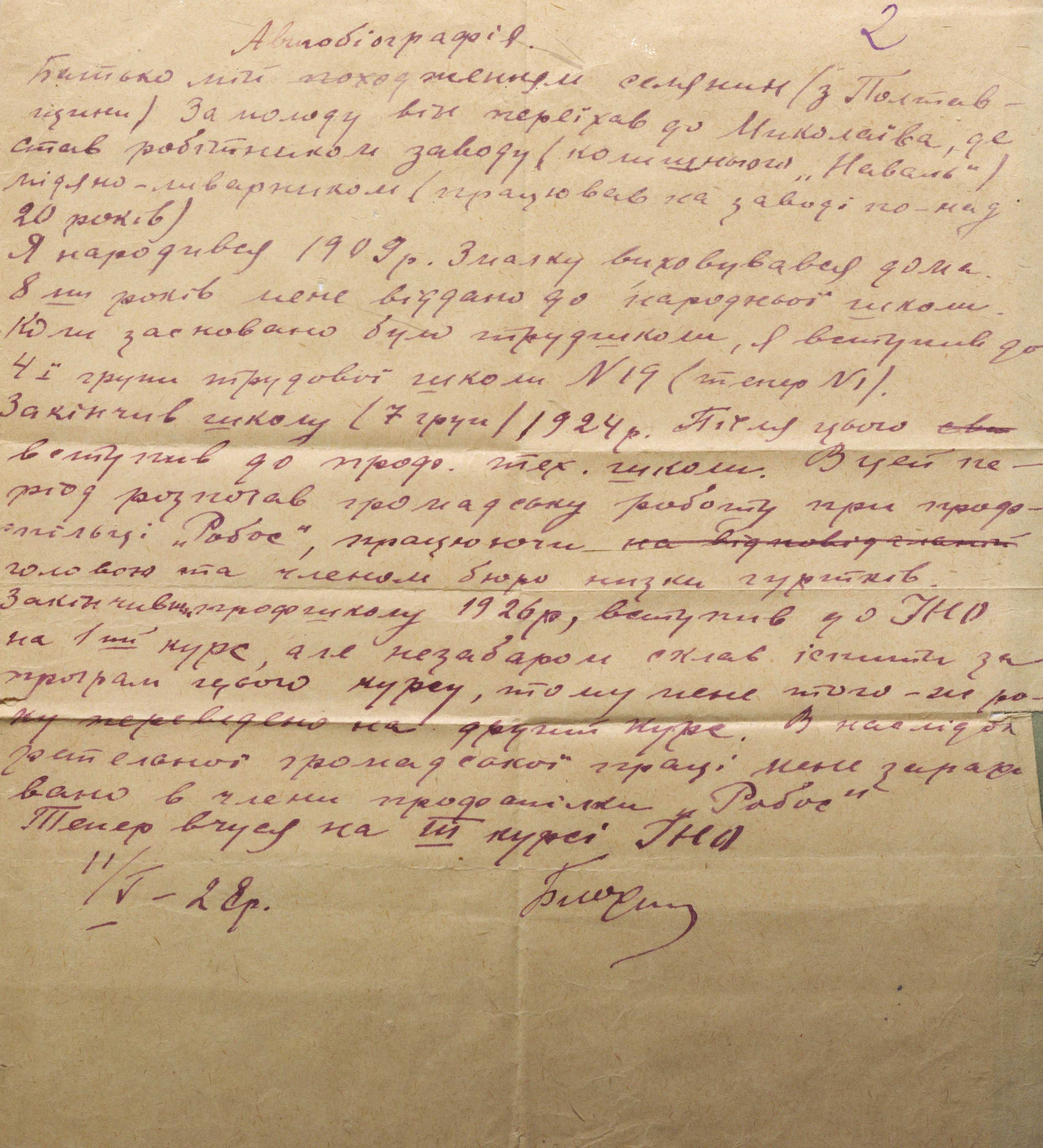
Most of the materials in “Kursant”’s personnel file – his autobiography, certificates from his place of residence and study, records of exams taken, certification giving the right to teach the Ukrainian language, and records of club activities – were clearly provided to Yu. Blokhin in absentia by the chekists themselves, as was often the case. Such materials were unsuitable for blackmail. Therefore, they decided to resort to another tried-and-true method – forging documents. To this end, they took the autobiography written by Yu. Blokhin and tasked the operational-technical unit with forging a report to the gpu in the same handwriting, purportedly written by him. The report stated that he had received an assignment from M. Lahuta, the chief leader of the anti-soviet nationalist organization “Union for the Liberation of Ukraine” (SVU) in Mykolaiv region, to personally deliver the Mykolaiv SVU organization’s report to Kyiv, hand it over to the writer Liudmyla Starytska-Chernyakhivska, and obtain information from her on how to proceed. “In light of the above, I request your instructions. ‘Kursant’” – the report concluded with this phrase.
The mention in the report of L. Starytska-Chernyakhivska, an active participant in the national-cultural movement who had previously been a member of the Ukrainian Central Rada, was no coincidence. In 1930, she was arrested for participating in the SVU organization, which had been fabricated by the gpu. The aim was to cast suspicion on Yu. Blokhin, implying that he was allegedly involved in this arrest – which was, in fact, untrue.
A copy of this forged report and a non-disclosure agreement – to which a photograph of Yu. Blokhin from the investigative file had been glued – was provided to the agent “Burilov”. He was to travel to Munich and, as noted in the documents, carry out a re-recruitment operation. A report to minister of state security of the ussr V. Abakumov regarding this operation stated that the agent had been instructed to “compel Yu. Blokhin to unquestioningly accept such an offer”. “If necessary,” the document stated, “the agent will declare that, in case of refusal, photocopies of his signature and intelligence reports will be forwarded – with an appropriate cover story – to the political opponents of the Melnyk faction – the Central Provid of the OUN-Banderites and the editorial offices of Bandera-affiliated newspapers – with the aim of compromising him and subsequently liquidating him as a soviet agent, and that his relatives residing in the soviet union would be subjected to repression. If, however, he agrees to our proposal and carries out the assigned task, he will be provided with the necessary financial assistance, which, according to our intelligence sources, he desperately needs due to his daughter’s serious disease. Besides, he will be provided with rehabilitation and a return to the soviet union” (FISU. – F. 1. – Case 10948. – Vol. 1. – P. 113).
“My Final Answer to soviet Intelligence”
On the morning of December 18, 1952, in Munich, an unremarkable man walked into the entrance hall of an apartment building, went up to the third floor, found a nameplate reading “Prof. Yurij Bojko”, pressed the doorbell, and waited. The door was opened by a sturdily built man, whom the agent described to himself as a “typical Ukrainian man”.
“Boiko has a large head,” the report’s physical description states, “his facial features are large and regular, as they say, ‘carved from stone’. His hair is thick, grey, combed to the side, and cut rather short. His eyebrows are very thick, but not as grey as his hair. His eyes are grey, somewhat slanted; his left eye, in particular, looks vaguely off to the side” (FISU. – F. 1. – Case 10948. – Vol. 2. – P. 35).
When they entered the room, “Burilov” stated that he had two questions for the Professor. The first was a consultation regarding classes at the university. But he immediately said that this was not so important and moved on to the main point. “I have a message for you from your relatives – from your father, sister, and others – a message and greetings.” Yu. Boiko-Blokhin, who had been about to gesture for the stranger to sit down, paused, looked at him warily, and changed his mind about inviting him to sit. They continued their conversation standing up. “Burilov” added that he also had greetings from those soviet agencies with which the apartment’s owner had had contact in the past as “Kursant” and “Zaliznyi”.
As noted in the report, Yu. Boiko-Blokhin stared intently into the agent’s eyes for about ten seconds, then took a step back and said sternly, “I do not wish to and will not negotiate with you on this matter.” His tone was clearly hostile. The agent sensed this immediately. He then tried to talk about his parents and other relatives – where they lived and what they did – and assured him that no one abroad would find out about this visit, urging him to be reasonable. But Yu. Boiko-Blokhin wouldn’t hear any of it and gestured toward the door.
“Burilov” tried to smooth things over somehow, promising guarantees of safety for the Professor’s relatives and for the Professor himself, saying that he would not have to work against the Germans or the Americans, but only provide information about Ukrainian emigration – which, he claimed, would be safe for him and not a criminal offense. Besides, he warned the Professor not to even think about reporting this visit to the police, as that would be tantamount to suicide. In that case, he said, soviet representatives would forward a copy of his written pledge and other documents from the case to the Ukrainian People’s Rada – of which he was a member – as well as to the Bandera Security Service and other émigré organizations.
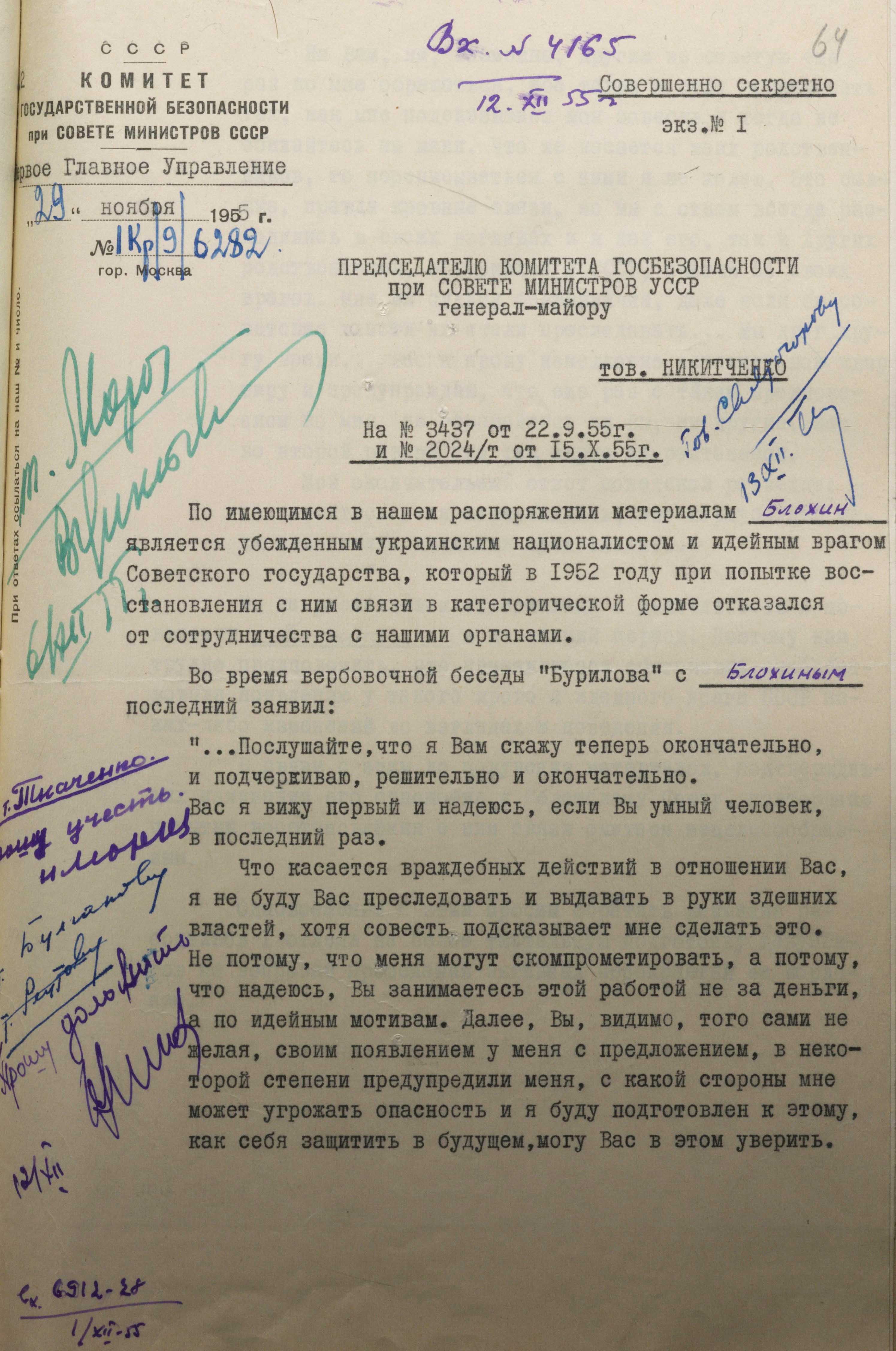
In response to these promises and threats, Yu. Boiko-Blokhin stated the following:
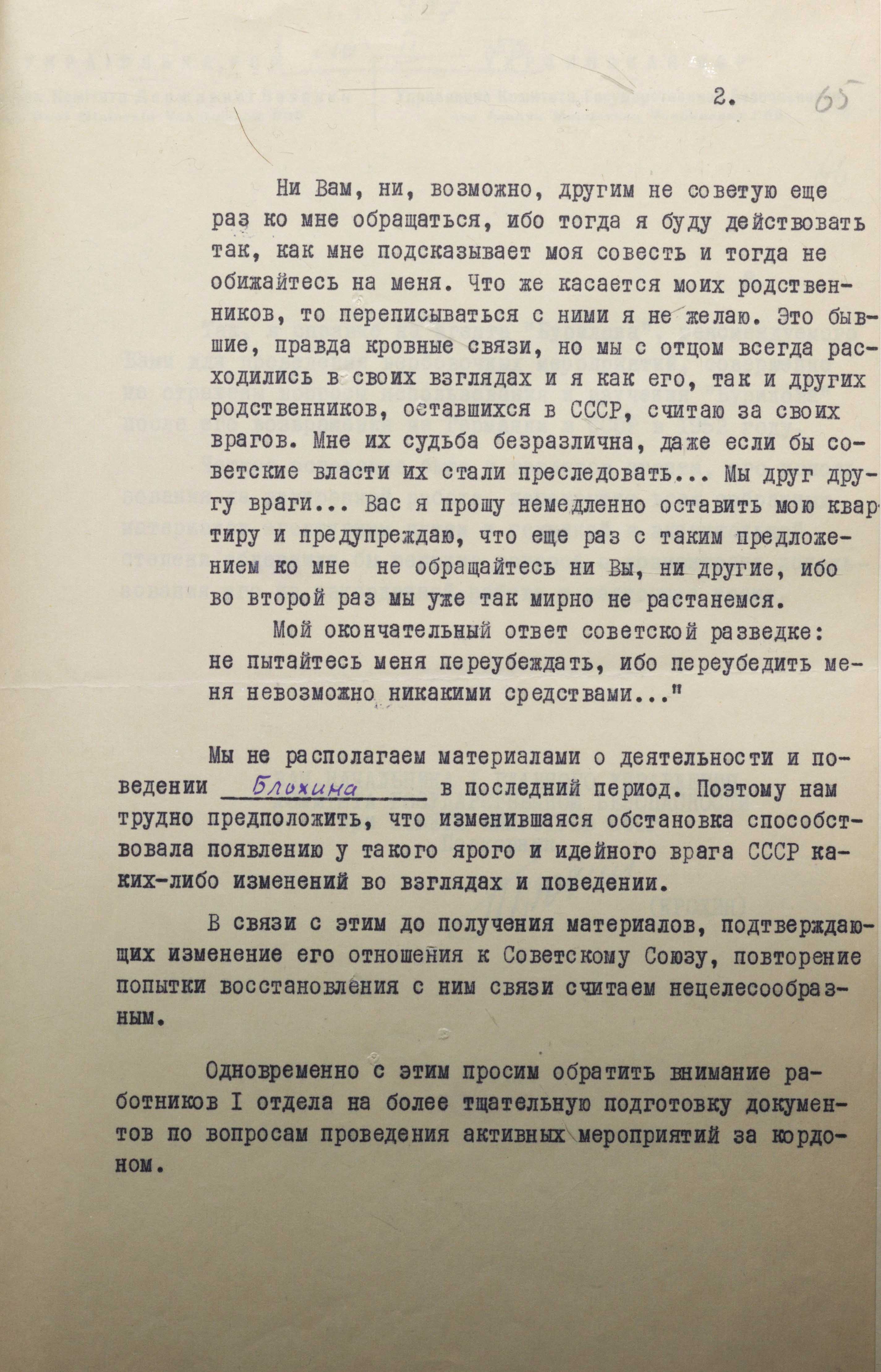
“Listen, this is what I am now telling you decisively and – I emphasize – definitively. I am seeing you for the first time – and, I hope, if you are a sensible person, for the last time… Now then. Without intending to, by coming to me with these proposals, you have in a way warned me of the source from which danger may threaten me, and I will be prepared to defend myself in the future. I can assure you of that. I advise neither you nor anyone else to contact me again, because from now on I will act as my conscience dictates, and please don’t take offense at me then. As for my relatives, I do not wish to correspond with them. These are, former, though true, blood ties, but my father and I have always disagreed on matters… I ask you to leave my apartment immediately, and I warn you that neither you nor anyone else should approach me with such proposals again, because next time we will not part ways so peacefully. My final answer to soviet intelligence: do not try to persuade me, because it is impossible to persuade me by any means.”
(FISU. – F. 1. – Case 10948. – Vol. 2. – PP. 40–41).
“Burilov” wanted to object, but Yu. Boiko-Blokhin sternly warned him “not to abuse my patience or push your luck”. After that, the agent went out onto the street, made his way to the railway station, and bought a ticket to Berlin. The next day, he reported on the trip and his conversation with the Professor to the ussr mgb’s representative office.
“Transfer the Materials to Banderites, So that They Liquidate Him”.
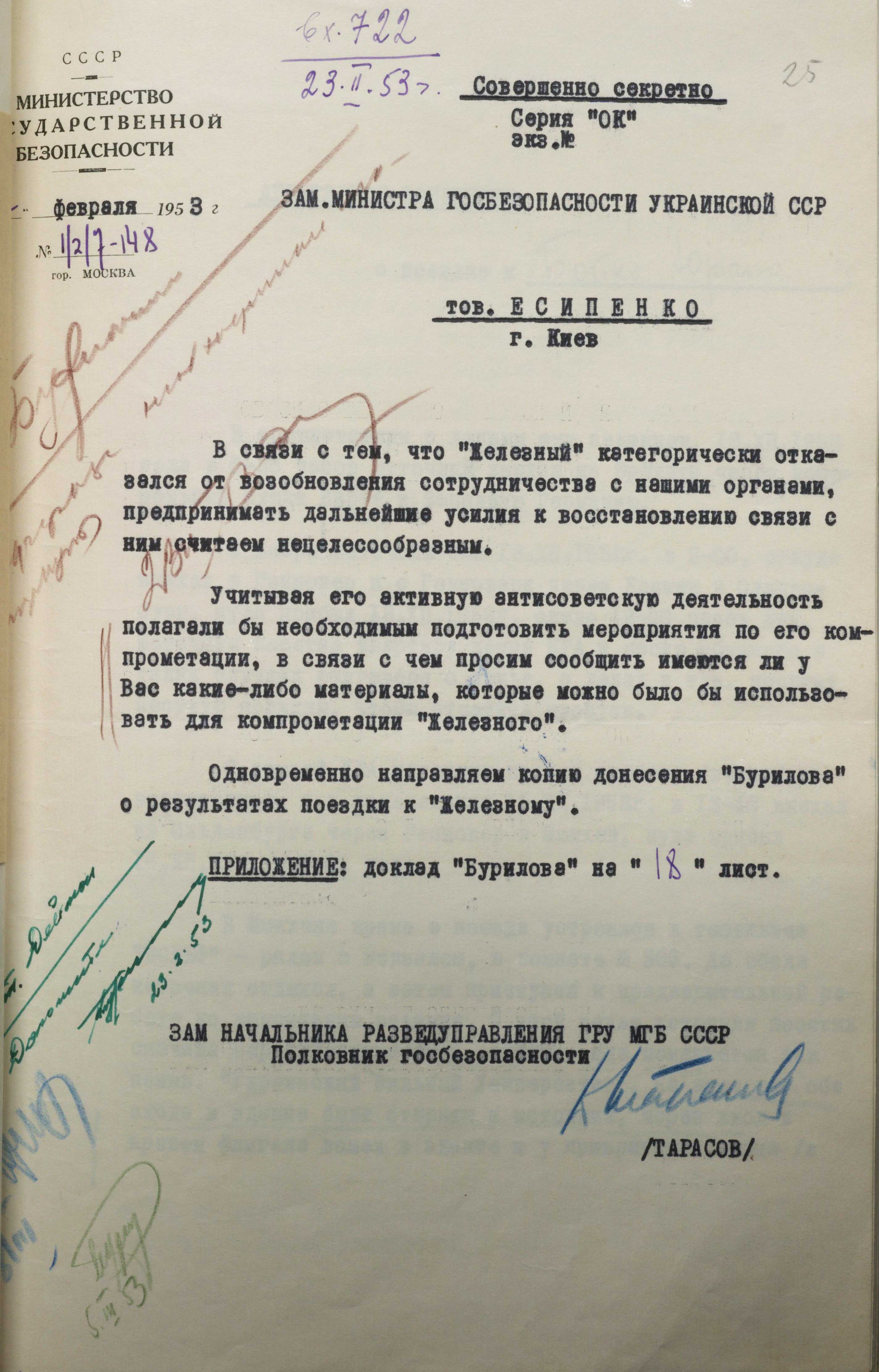
In early February 1953, a request was sent from Berlin to Kyiv demanding that Agent “Burilov” urgently provide a detailed description of Yu. Boiko-Blokhin’s apartment, as well as floor plans of the building, the approaches to it, the entrance to the building, and the interior stairwell. Additionally, they asked to mention whether the entrance hall door was locked at night, how much foot traffic there was on the street, and whether there was a police station nearby. At that time, the mgb was collecting the same kind of information regarding Horunzhyi General Mykola Kapustianskyi, the Minister of Defense of the Ukrainian People’s Republic’s (UPR) government-in-exile, whom they planned to assassinate, and shortly thereafter – regarding Lev Rebet and Stepan Bandera.
Due to Stalin’s death in March of that same year and a reorganization within the mgb system, a number of such special operations were put on hold and ultimately not carried out to completion. But the targets of those operations were not left alone. Yurii Boyko-Blokhin continued to be monitored. In late 1957, the kgb learned from its foreign agents that he had immediately informed the OUN-M leadership about “Burilov”’s visit and recounted everything exactly as it had happened. This story allegedly gained traction among Ukrainian émigré circles in Munich.
Despite this, the kgb of the ussr (by that time, the mgb had already been renamed the kgb) had not given up its plans to settle the score with the unyielding Professor. By that time, he had written important works such as “The Path of the Nation”, “Problems of the Historiography of the Ukrainian Nationalism”, “Foundations of the Ukrainian Nationalism”, “russian Historical Roots of bolshevism”, and others. He was one of the first to investigate, on an academic level, the question of the russian national nature of bolshevism, arguing that bolshevism triumphed and took root in russia because it is a distinctly russian phenomenon that corresponds to the worldview and character of the russian people. In his scholarly works, Yu. Boiko-Blokhin emphasized that a national victory for Ukrainians is possible if a “great spiritual revolution, based on a sense of unity among the ‘dead, the living, and the unborn”’, takes place within the nation. As a result of this so-called force, a mighty Independent and United Ukrainian State with a global mission will emerge.”
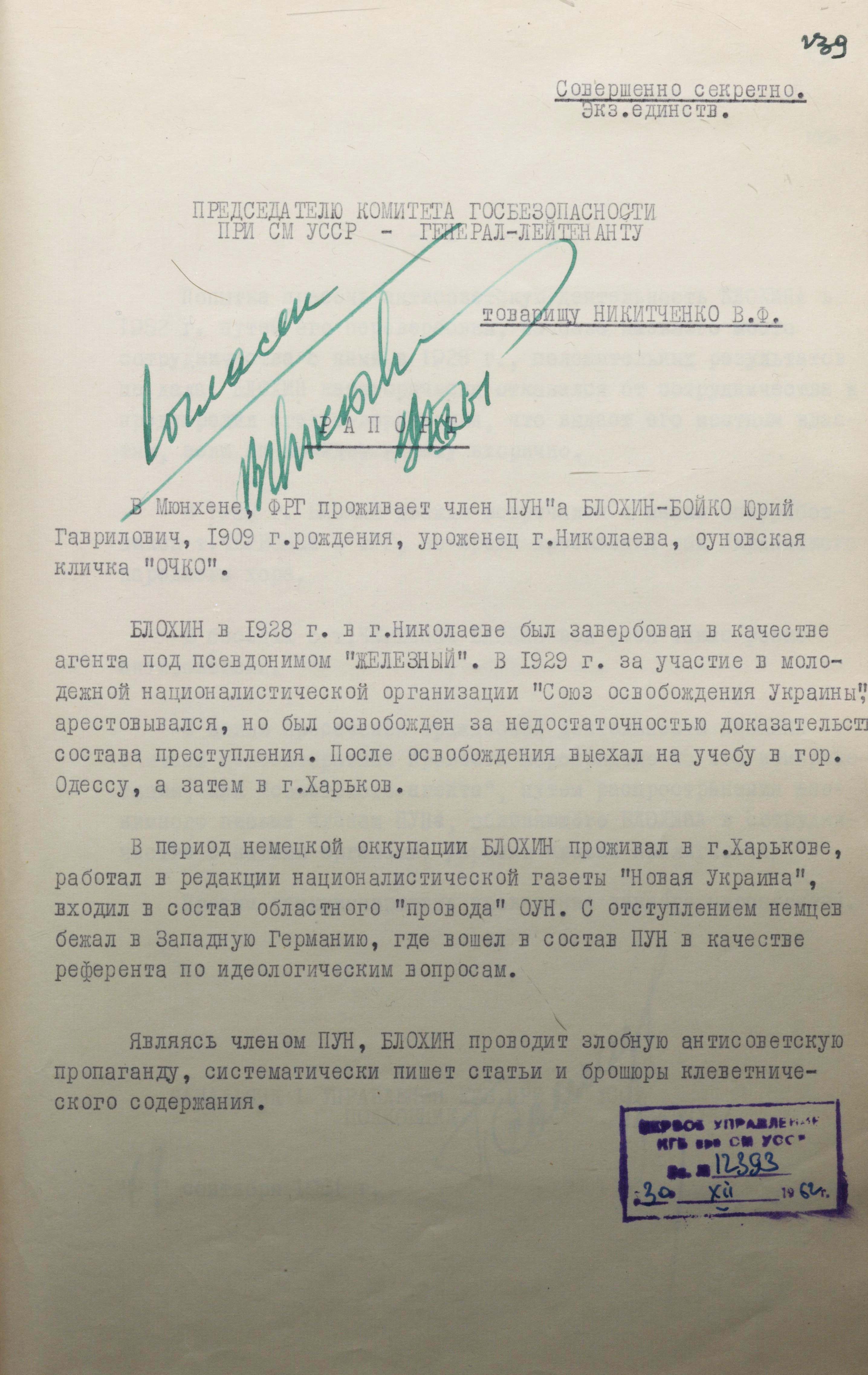
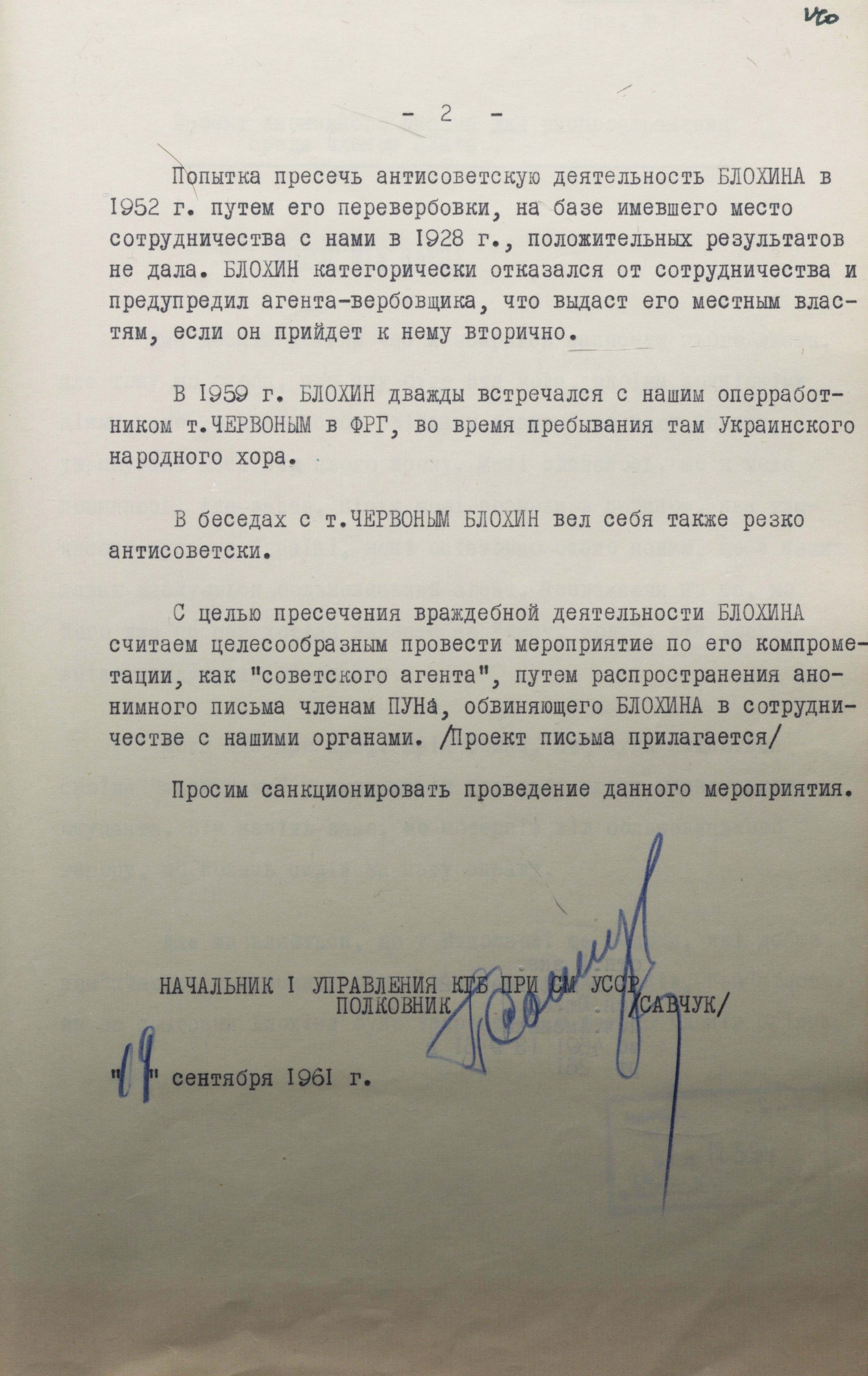
The kgb deemed such works to be seditious and harmful. “As a member of the Provid of Ukrainian Nationalists,” noted a report by S. Savchenko, the chief of the 1st (intelligence) directorate of the kgb of the Ukrainian ssr, to V. Nikitchenko, the chief of the kgb of the Ukrainian ssr, – “Blokhin engages in vicious anti-soviet propaganda, systematically writing articles and pamphlets containing slanderous content. An attempt in 1952 to halt Blokhin’s anti-soviet activities by recruiting him – based on his prior cooperation in 1928 – was unsuccessful. Blokhin categorically refused to cooperate and warned the recruiting agent that he would report him to the local authorities if he came to see him a second time… In order to put an end to Blokhin’s hostile activities, we consider it advisable to carry out a measure to discredit him as a “soviet agent” by sending an anonymous letter to members of the PUN accusing Blokhin of collaborating with our agencies (draft letter attached)” (FISU. – F. 1. – Case 10948. – Vol. 2. PP. 139–140).
In the letter, in addition to all his other “sins”, Yu. Boiko-Blokhin was accused of meeting with bolshevik agents abroad without supervision. In particular, the letter stated: “Why doesn’t he explain who he met with in the park on Karlsplatz and with whom he took nighttime taxi rides around Munich while the choir from Ukraine was here?” This accusation was not accidental. But the chekists distorted its essence.
A report on the trip abroad of an employee of the Lviv directorate of the kgb – who traveled under the cover of the deputy director of the Ukrainian National Choir – read that during a tour in Munich, he met with a number of Ukrainian émigrés. One of those who showed a keen interest in the concert introduced himself as Yurii Boiko, a Professor at the Ukrainian Free University. He briefly told the “deputy director of the choir” about himself and even mentioned that soviet intelligence had sent an agent to him to recruit him. They then agreed to meet again at Karlsplatz. That night, they walked around the city until 2:00 a.m., discussing Ukrainian art, culture, literature, the Holodomor, and the repression of the Ukrainian intelligentsia.
Having returned from abroad, the kgb officer provided a detailed account of those two meetings. In his conclusions, he pointed out that he had become personally convinced that Yu. Boiko was one of the leading ideologues of Ukrainian nationalism and a staunch enemy of the ussr, against whom one must “simply fight”. To this end, he proposed preparing an article for the newspaper “For Return to the Homeland” about this conversation, exposing the “enemy of the Ukrainian people”.
In the smear letter, all of this was portrayed as clandestine meetings with a bolshevik representative. A total of fifty such letters were produced. They were sent to leading figures in the Ukrainian émigré community and to the newspaper “Ukrayinske Slovo”. After some time, reports pointed out that there had been no public reaction to the letters. It was speculated that the correspondence might have been intercepted by German intelligence agencies. Therefore, the task was set to persevere and continue spreading the anonymous letters not only in West Germany but also in other countries with large Ukrainian émigré communities.
Following this long-term campaign, it was reported that the efforts had been successful and that the Melnyk faction had expelled Yu. Boiko-Blokhin from the PUN. Consequently, a resolution was passed stating that the objective had been achieved, and the case was closed and archived. In reality, however, the OUN leadership paid no heed to those anonymous letters and false accusations. After all, Yu. Boiko-Blokhin had told his fellow party members everything from the very beginning. As for his expulsion from the PUN, it stemmed from the fact that, at the invitation of the Bandera-led Union of Ukrainian Youth, he had traveled to England to give lectures on Taras Shevchenko. In other words, the conflict was rooted in party differences, not ideological ones.
As for Yu. Boiko-Blokhin’s worldview, it never underwent any significant changes throughout his life. Until the end of his life, he remained devoted to the idea of restoring Ukrainian independence and building the Ukrainian nation. At the Ukrainian Free University, he not only earned the title of Professor of Ukrainian Literature but also became Dean and later Rector. Besides, he was recognized as a renowned expert in linguistics, Ukrainian history, philosophy, ethnography, pedagogy, literary criticism, and art history. He served as Vice President of the State Center of the Ukrainian People’s Republic in exile (1984) and as Head of the Senate of the OUN-M until the end of his life.
Four volumes of Yu. Boiko-Blokhin’s selected scholarly works were published abroad during his lifetime. He visited his homeland three times in the 1990s after Ukraine had regained its independence. He participated in an exhibition of his works, as well as in academic and creative gatherings. For his outstanding achievements, he was awarded the Order of Merit, Third Class; received a diploma as an Honorary Academician of the Academy of Pedagogical Sciences of Ukraine; and became a member of the Writers’ Union of Ukraine. He passed away on May 17, 2002, in Munich. A street in Mykolaiv – where he was born, spent his youth, and was arrested for nationalist activities – has been named in his honor.