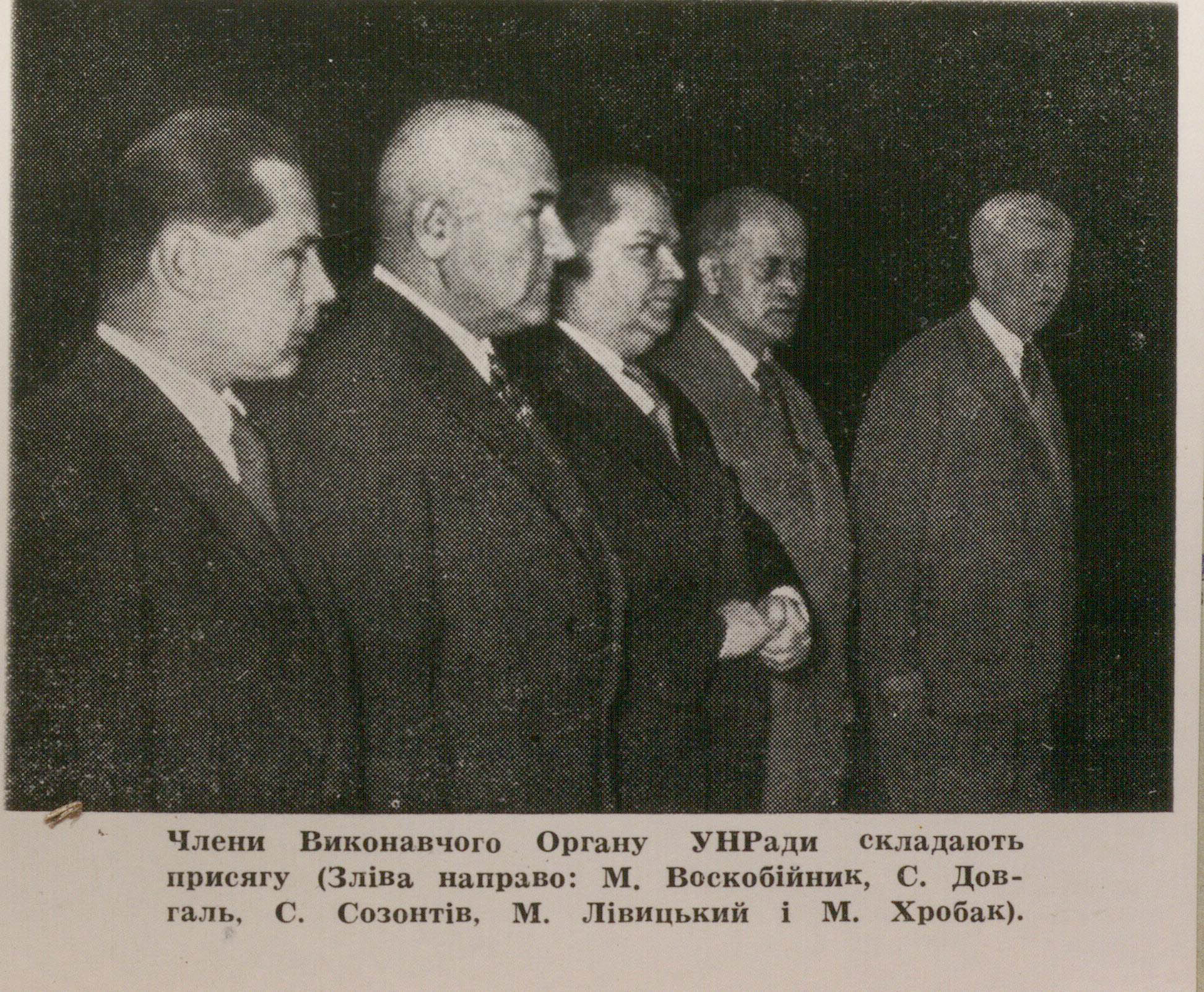
Mykhailo Voskobiynik. The Last Headof the Ukrainian National Rada
8/22/2026
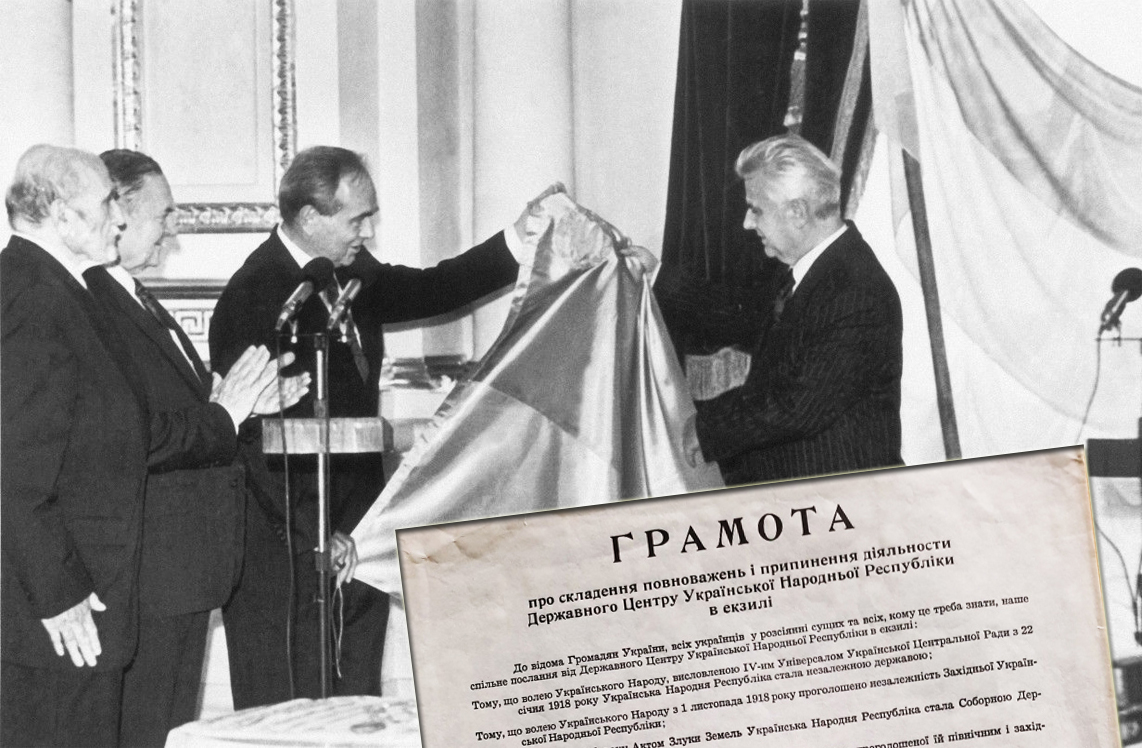
On August 22, 1992, during the celebrations marking the first anniversary of the restoration of Ukraine’s independence, the authorized representatives of the State Center of the Ukrainian People’s Republic in exile relinquished their powers and transferred them in Kyiv to the leaders of the restored Ukraine. In doing so, they affirmed the legal succession and continuity of Ukrainian statehood traditions. Among those who presented the first popularly elected President of Ukraine, Leonid Kravchuk, with the Charter declaring the termination of the State Center of the UPR, the presidential seal, the regalia of Hetman Ivan Mazepa, and the Flag was Head of the Ukrainian National Rada Mykhailo Voskobiynik. At that time, the archives of the Foreign Intelligence Service of Ukraine still contained a declassified file on him entitled “Elegantnyi” (“Elegant” – Transl.).
The case was opened in January 1951. At that time, M. Voskobiynik was Deputy Secretary General of the Central Committee of the Ukrainian Revolutionary Democratic Party (URDP), led by Ivan Bahrianyi, and editor of the party newspaper “Ukrainski Visti”. At that time, I. Bahrianyi was already under the soviet mgb’s close scrutiny. For five years, an operational-investigative case had been open against him, and plans were being drawn up to send a courier to Neu-Ulm – where he was living in West Germany – to establish contact with him and persuade him to cooperate. At the same time, chekists were also keeping a close eye on his fellow countryman and party comrade, M. Voskobiynyk, a co-founder of the Ukrainian Republican Democratic Party (URDP).
The dossier they had begun compiling on M. Voskobiynyk was gradually being filled with information. They learned that he was born in 1918 in Myrhorod. “My parents were farmers both before and after the revolution,” he wrote. “But then my father went to work as a laborer at a flour mill. I started school in 1926 and graduated from ten-year school in 1935. After that, I worked as an artist and musician at Flour Mill No. 7. This year, I completed my fourth year at the workers’ faculty” (FISU. – F. 1. – Case 11344. – P. 72).
He pointed out this in his autobiography for admission to the History Department at Kharkiv University in 1936. The University’s archives also contain his application for admission and a transcript confirming his graduation in 1941. His university groupmates and fellow villagers were located and asked about him and his close relatives. At that time, M. Voskobiynyk’s two brothers, Ivan and Oleksiy, and his mother, Maryna, were living abroad with him; his father, Hryhorii, had already passed away. The family learned of his fate after Ukraine gained independence. After the dekulakization campaign, he was executed in 1937 as an enemy of the people, while his family was told that he had been exiled to siberia.
M. Voskobiynyk’s graduation from the University coincided with the outbreak of the German-soviet War. During the occupation, he lived in his hometown of Myrhorod and edited the newspaper “Myrhorodski Visti”, through which he “spread anti-soviet propaganda”. This is stated in one of the reports on him by the mgb of the Ukrainian ssr. Furthermore, “he made anti-soviet speeches on the radio and was also a member of the OUN, which existed in Myrhorod. Voskobiynyk established contact with the OUN-Melnyk faction as early as 1940, when he traveled to western regions of Ukraine for an internship” (FISU– F. 1. – Case 11344. – P. 58).
Naturally, after the red army arrived, Mykhailo could not remain in the liberated territory. After the war, he ended up in a camp for displaced persons in Neu-Ulm, Germany. In that same camp, he met I. Bahrianyi. Together with him, he defended the rights of Ukrainians who were threatened with forced repatriation to the ussr. Soon, with the participation of other activists, they created a party and began editing a newspaper. At the same time, M. Voskobiynyk studied political science at the University of Heidelberg and, for a time, served as editor of the party journal on political issues, “Nashi Pozytsii” (“Our Positions”– Transl.). He also published his own articles in its pages. One of them was entitled “Territorial Foundations of Ukrainian Statehood.” In it, he analyzed why Ukraine lost its struggle for liberation in 1917–1920.
Around the same time, the text of M. Voskobiynyk’s speech at the regional conference of the Ukrainian Republican Democratic Party (URDP) in Germany on December 30, 1950, fell into the hands of the mgb. Among other things, they took note of the following words from the speaker: “The URDP is growing stronger and steadfastly striving toward its main goal – to win freedom and state independence for its people in alliance with all the progressive forces of our nation, to overthrow the stalinist empire in alliance with the progressive forces of all oppressed nations first and foremost, and with the progressive forces of the entire world… Our principles here stem from our ideology. And the fundamental one has been and remains the principle that in the struggle against the bolshevik totalitarian empire, we stand in the camp of the world’s democratic forces. But we immediately, clearly, and resolutely emphasize: only to the extent that they recognize the Ukrainian people’s right to freedom and state sovereignty. Our establishment – not only of a party – but of the entire Ukrainian people as a nation – will depend on this” (FISU. – F. 1. – Case 10812. – Vol. 3. – PP. 328–329).
All of this drew the mgb’s special attention to M. Voskobiynyk. The mgb’s representative office in the German Democratic Republic was conducting his operational cultivation. The reports received about him from foreign intelligence sources prompted them to keep a closer eye on him. One such report pointed out: “Voskobiynyk has decent organizational skills; people are drawn to him; he is young, energetic, and interesting; he is politically active; he is not confrontational; he does not boast excessively; and he is likable. I do not know of anyone who harbors anger toward him…” (FISU. – F. 1. – Case 10812. – Vol. 5. – P. 285).
Subsequent documents pointed out that in 1949, M. Voskobiynyk was elected deputy general secretary and, at the same time, head of the foreign relations department at the party’s regular congress; in 1952 – deputy chairman of the executive body of the Ukrainian National Rada, and in 1954 he participated in the creation of propaganda departments at the radio stations “Radio Free Europe”, “Voice of America”, and “Vyzvolennia”. At Radio “Vyzvolennia”, which was soon renamed Radio “Svoboda”, he worked as an announcer from 1955 to 1957. During that period, as noted in archival documents, he regularly visited the ailing I. Bahrianyi at a sanatorium; he was considered one of the leading contenders for the role of the party leader, while at the same time preparing to move to the United States.
In 1957, M. Voskobiynyk managed to leave for the United States with his family. Since the kgb had no operational capabilities to recruit him in the USA at that time, the case was closed and archived. The resolution closing the case cited another reason: “Due to the lack of prospects for recruitment”. In other words, they concluded that it was impossible to recruit him.
Meanwhile, M. Voskobiynyk earned a master’s degree in applied sciences from Syracuse University and a Ph.D. in philosophy from the University of Pennsylvania; he taught the history of Eastern Europe and Ukraine at Syracuse University and Central Connecticut State University. He was a member of the Ukrainian Free Academy of Sciences, the Ukrainian Academy of Arts and Sciences, the Shevchenko Scientific Society in the United States, and other organizations. He consistently held leadership positions in the URDP, which, following Ukraine’s declaration of independence, changed its name to the Ukrainian Democratic-Republican Party. From 1989 to 1992, he headed the Ukrainian National Rada – the Parliament of the State Centre of the Ukrainian People’s Republic in exile, which ceased its activities following the proclamation of an independent Ukrainian State.
In 1992, M. Voskobiynyk, Head of the UPR Rada traveled to Ukraine to participate in the First World Forum of Ukrainians, which took place August 21–24 in Kyiv at the “Ukraina” Palace of Culture. On August 22, during a solemn session of the Verkhovna Rada, President of the Ukrainian People’s Republic (UPR) in exile Mykola Plaviuk resigned, acknowledging that the independent State of Ukraine, proclaimed on August 24, 1991, was the legal successor to the UPR. On the same day, at the Mariinskyi Palace, a delegation from the State Centre of the UPR handed over to the Ukrainian authorities a Charter declaring the cessation of its activities, a statement on Ukraine’s succession to the UPR, and other state symbols.
“In resigning from our posts”, the statement read, “we declare that the Ukrainian State, proclaimed on August 24 and ratified on December 1, 1991, by the people of Ukraine, continues the state and national traditions of the UPR and is the legal successor to the Ukrainian People’s Republic”. The statement was signed by Mykola Plaviuk, President of the UPR in exile; Ivan Samiilenko, Head of the UPR Government in exile; and Mykhailo Voskobiynyk, Head of the UPR Rada.
M. Voskobiynyk passed away on September 15, 2001. He was buried at the Ukrainian cemetery in Bound Brook, New Jersey, USA.
See declassified documents from the archives.