Svitozar Drahomanov. The Struggle to Clear His Father’s Name… Under the Close Surveillance of the nkvd
9/18/2026
On the eve of the 185th anniversary of the birth of the distinguished Ukrainian historian, publicist, literary scholar, folklorist, philosopher, and social activist Mykhailo Drahomanov (September 18, 1841 – July 2, 1895) a number of documents have been identified and studied in the archives of the Foreign Intelligence Service of Ukraine. They shed light on some little-known chapters in the history of the Drahomanov-Kosach family. In particular, based on declassified documents, the dramatic fate of Svitozar Drahomanov can be traced; throughout his life, he was dedicated to popularizing his father’s scientific and literary legacy, defending his father’s good name against the oppression and distortions perpetrated by representatives of the soviet power, and searching for his father’s archives to return them to Ukraine.
“Viddanyi” Turned Out Not to Be That Devoted
In the spring of 1935, operative of the special department of the nkvd of the Ukrainian ssr for Kyiv region bondarenko received several reports from his undercover agents, who reported similar things. One of them reported that he had run into an old friend from his student days, Svitozar Mykhailovych Drahomanov, on the street. Drahomanov was very agitated and worried about the arrests of his acquaintances, particularly Mykola Zerov, with whom he had a good relationship. He lamented that he, too, might be arrested.
“I’m doing my best to leave for abroad”, the agent recounted Svitozar Drahomanov’s words. “Living conditions are so harsh that I have no strength left, and on top of that, there are sleepless nights and the fear of any knock on the door, which would mean they’ve come for me. I deeply regret moving from Switzerland, where my relatives are still living in good conditions. My cousin Kosach lives in Poland; he is doing well and living peacefully” (FISU. – F. 1. – Case 9861. – Vol. 1. – P. 57).
Regarding Drahomanov, the agent reported that he had previously lived in Kyiv at 14 Pankivska Street with the Kosach family – specifically at his aunt, the writer Olena Pchilka’s, whose daughter was Lesya Ukrainka. For some time, Andriy Makarenko, a future member of the Directory of the Ukrainian People’s Republic, allegedly also lived with the Kosachs. Regarding Makarenko, the agent pointed out that he had emigrated to Czechoslovakia and that Svitozar knew his address and corresponded with him.
At the end of one of the intelligence reports, the following was written: “Drahomanov is known to us. He is one of the prominent representatives of Ukrainian nationalist circles… We have been tasked with continuing to monitor Drahomanov, uncovering his connections, the nature of his correspondence with abroad, specifically with whom, and his concrete counterrevolutionary activities” (FISU. – F. 1. – Case 9861. – Vol. 1. – P. 56).
The surveillance lasted for three years and culminated in a summons to the nkvd directorate in early 1938. But Svitozar Drahomanov’s greatest fears did not come true. He was not arrested. In exchange for his freedom, he was offered the chance to become a secret agent. Under the dictation of the chekists, he was immediately forced to write a statement to the following effect: “I, Svitozar Mykhailovych Drahomanov, residing at 14 Pankivska Street, Flat 4, in Kyiv, had been committing crimes against the soviet authorities for years. Wishing to atone for my guilt, I voluntarily undertake to carry out the orders of the nkvd… I will sign my reports to the nkvd as ‘Viddanyi” (The Devoted” – Transl.) (FISU. – F. 1. – Case 9861. – Vol. 1. – P. 14).
But “Viddanyi” turned out not to be as devoted as the chekists had hoped. At first, he was asked to write an autobiography and a list of acquaintances. These multi-page texts made quite an impression. The handwritten autobiography, spanning 13 sheets of paper, is indeed of scholarly value. In it, Drahomanov detailed his entire life story. He briefly described his childhood and teenage years in Switzerland, France, and Bulgaria; his first meeting with his cousin Lesya Ukrainka in Sofia; his move to Kyiv; his stay with the Kosach family; and his studies at the gymnasium, the Polytechnic Institute, and the Commercial Institute.
Svitozar Drahomanov also wrote about his first arrest in 1912. At that time, he came to the attention of the Kyiv gendarmerie as a member of the Ukrainian Social Democratic Workers’ Party and a participant in an underground student organization. However, due to a lack of evidence, the case never went to trial. He made no secret of his acquaintances, dating back to his student years: Volodymyr Vynnychenko, Symon Petliura, Mykola Porsh, and other Ukrainian Social Democrats. Over several pages, he detailed his work in various government institutions during the periods of the Central Rada, the Hetmanate, the Directory of the Ukrainian People’s Republic, and soviet rule. In particular, he held senior positions in ministries and institutions of the national economy, served as a lecturer and Professor at educational institutions, was Rector of the Kyiv Architectural Institute, and worked for newspapers, magazines, and the Kyiv-based “Ukrfilm” studio.
At the end of his autobiography, Drahomanov described his difficult situation due to his past activities. In particular, he pointed out the following: “In December 1935, the social insurance commission deprived me of my pension ‘as a former head of a department at the Ministry of Internal Affairs of the Central Rada and an active member of the Ukrainian Social Democratic Party.’ On February 5, 1936, the Presidium of the Regional Trade Union Council dismissed my appeal, ‘since these facts cannot be refuted’” (FISU. – F. 1. – Case 9861. – Vol. 1. – P. 26).
To the list of those mentioned in his autobiography, Svitozar Drahomanov added Mykhailo Hrushevskyi, Borys Martos, Maksim Gorky, Hryhorii Kosynka, Vasyl Sedliar, Mykhailo Boichuk, Oleksandr Dovzhenko, Mykola Bazhan, Panas Lyubchenko, Dmytro Manuilskyi, Khrystyian Rakovskyi, and others. This piqued the chekists’ interest considerably. “Viddanyi” was tasked with providing information on those suspected of anti-soviet activities. At the same time, what they received proved disappointing.
“Agent ‘Viddanyi’ has quite extensive connections among Ukrainian nationalists”, reads one of the contemporary evaluations of Drahomanov, “but he describes them too cautiously, providing information of little value. He approaches his work negligently; he conceals certain details regarding the activities of specific individuals under investigation that are known to him, and he is insincere in his work” (FISU. – F. 1. – Case 9861. – Vol. 1. – P. 3).
Ultimately, in May 1941, it was decided to cease all contact with him and file the case away in the archives. The resolution to close the case noted that, while working with the nkvd, he had not provided any operationally significant information and, moreover, was suspected of spreading disinformation. Then the German-soviet war began, and he was temporarily lost from sight.
Wanted As an Especially Dangerous Criminal
In May 1946, the mgb of the Ukrainian ssr opened an intelligence and investigation case file on Svitozar Drahomanov as a person who had remained in the occupied territory during the German-soviet war and engaged in anti-soviet activities. Those activities allegedly consisted of his work at the All-Ukrainian Union of Industrial Cooperation, his role as a scientific consultant to the Museum-Archive of the Transition Period headed by Oleksandr Ohloblin, his participation in the commission examining the issue of Ukrainian emblems, and his position as head of the architectural department of the Kyiv City Council. In 1943, he left Kyiv with his family for Lviv, and from there to Prague, where he worked at the Ukrainian Museum of the Liberation Struggle. As the Red Army approached, he moved to the German city of Regensburg. There, he worked as a Professor at the Ukrainian Technical and Economic Institute.
Thus, Drahomanov went from being a subject of interest to becoming the target of intelligence and operational cultivation. Through informants, authorities began collecting information on him more meticulously, ordered a series of special investigations, and monitored all his family ties. As a result of those measures, it was discovered that as early as 1921, he had been accused of espionage by a special unit of the Kyiv military district. In 1926, this investigation case file was destroyed as “of little value”. In other words, all the testimony had been fabricated. He made no mention of this episode in his autobiography. This was the first case against him.
According to the latest intelligence and investigative case file, in which S. Drahomanov was listed as an especially dangerous state criminal, the manhunt had lasted several years. It was not until January 1950 that mgb agents read in the émigré newspaper “Ukrainski Visti” that he was living in Regensburg. They also learnt his address. They immediately began developing measures to recruit him. They looked for vulnerabilities in his biography, behavior, financial situation, psychological state, and relationships with close relatives living in soviet Ukraine. At the same time, they were preparing a courier to be sent to meet him in West Germany. But they didn’t make it in time.
In December 1951, the chekists received information that S. Drahomanov, after being appointed in New York as chairman of the committee organizing events to mark the 110th anniversary of Mykhailo Drahomanov’s birth, had left for the United States with his family aboard the ship “General Taylor”.
In Search of Mykhailo Drahomanov’s Archives
In the United States, S. Drahomanov worked for some time as a Professor and the first Rector of the Ukrainian Technical and Economic Institute in New York. At the same time, he served as chairman of the commission for collecting and studying M. Drahomanov’s legacy at the Ukrainian Free Academy of Sciences and wrote a series of biographical essays about him. In the USA, he continued to promote his father’s scientific and literary legacy and to defend his good name against all sorts of attacks. This stance remained unchanged throughout his entire life.
As early as 1935, in a report by the secret agent “Vaska”, the chekists identified seditious remarks directed at S. Drahomanov. The agent reported the following: “…Information about S. Drahomanov’s current political orientation is likely of some significance. He complains, first and foremost, about the undifferentiated approach toward his father: a nationalist, they say, whom lenin called a petty-bourgeois who idealizes the peasant with his pile of manure – that is all that the overwhelming majority of today’s public figures know about Drahomanov…” (FISU. – F. 1. – Case 9861. – Vol. 2. – P. 80).
In early 1941, nkvd agent “Nemo” reported on S. Drahomanov’s “encroachment on the “sacred”. He relayed Svitozar’s words regarding his intention to make corrections to the fourth edition of lenin’s complete works which was being prepared for publication. The point was that, through his influential acquaintances in moscow, he wanted not to correct lenin’s words – “for that is impossible” – but to make corrections to a footnote regarding the interpretation of M. Drahomanov’s character.
The nkvd authorities tried to closely monitor those contacts with influential acquaintances. Archival documents mention S. Drahomanov’s correspondence with the writer Maksim Gorky, Academician Nikolai Derzhavin from leningrad, and Vladimir Bonch-Bruevich, director of the state literary museum in moscow. In his letters, he sought to draw attention to his father’s legacy, ensure the correct interpretation of his views, promote his scholarly and literary legacy, and secure adequate honouring. He also specifically raised the issue of locating his father’s archives and the possibility of transporting them to Ukraine by various means.
The case file contains Svitozar’s handwritten text entitled “What Needs to Be Done to Compile the Archive of M. P. Drahomanov”. It begins with the following words: “From the very first days of the soviet victory, I have never stopped thinking about how to transport the archive of my father, Mykhailo Petrovych Drahomanov, to Ukraine. All my attempts so far have ended in failure. However, these failures have in no way diminished my ardent desire to make M. P. Drahomanov’s entire legacy the property of the working people of the ussr. On the contrary, the obstacles and difficulties only strengthen my resolve to overcome them, following the principle proclaimed by my father in one of his works: “That is what misfortune is for – to fight against it!” (FISU. – F. 1. – Case 9861. – Vol. 1. – P. 125).
S. Drahomanov went on to note that one way to seek and collect archival materials would be for him to travel abroad, specifically to Warsaw, Sofia, Prague, Paris, Berlin, London, and Geneva. He described in detail where and with whom he could discuss this matter. He referred to specific officials at scientific and museum institutions in the Ukrainian ssr who supported him and offered advice, particularly regarding the use of foreign currency funds from the presidium of the academy of sciences of the Ukrainian ssr for this purpose. In another handwritten text, he pointed out that the search for archives could be disguised as a trip to the annual Congress of the International Federation for Housing and Town Planning, which was to take place in Stockholm. He had been involved in this field in the past.
S. Drahomanov forwarded these multi-page texts to his supervisors at the nkvd, hoping that the agency would somehow assist him in his trips abroad and in transporting at least part of his father’s archives to soviet Ukraine. But he hoped in vain. The nkvd had no interest in promoting Mykhailo Drahomanov or preserving his legacy. Moreover, in operational documents, he was referred to as a “prominent anti-soviet nationalist figure”. It is unclear why he was considered anti-soviet, since he had died as early as 1895 – that is, long before the establishment of soviet power.
So, the chekists merely monitored those plans and documented them. Archival documents show that after S. Drahomanov wrote a letter to M. Gorky asking him to change his attitude to his father and give due recognition to his achievements, Svitozar was invited to the central committee of the communist party of Ukraine. He spoke with an official named Popov, who allegedly took a sincere interest in the fate of the archives. S. Drahomanov told him that after his father’s death in Sofia, part of the archives had gone to his daughter Lidiya, who was married to I. Shishmanov, the former Bulgaria’s Ambassador to Ukraine in 1918–1919. Popov allegedly even supported Svitozar’s trip to Sofia to meet with Lydiya, his biological sister, to discuss the possibility of transferring the archives, and said that they could be sent abroad along with diplomatic couriers. But the matter never progressed beyond these intentions. Archival documents reveal that Popov was repressed as an enemy of the people. The reason for this is unknown.
The kgb also monitored the correspondence between S. Drahomanov and V. Bonch-Bruevich, a soviet party official and doctor of historical sciences who at that time headed the state literary museum in moscow. Bonch-Bruevich allegedly supported all of Svitozar’s plans and promised, for his part, to promote his father’s scholarly and literary legacy in some way.
In a letter dated October 11, 1938, S. Drahomanov wrote to V. Bonch-Bruevich: “My older sister, Lidiya Mykhailivna, died last year in Sofia… While she was alive, she wrote to me that our father’s archive was safe and that, during her husband’s stay in Kyiv in 1919, my mother had placed the archive at his disposal. I have some information that the archive fell into the hands of Ukrainian nationalist émigrés… I have not lost hope; perhaps you will be able to assist me in this matter…” (FISU. – F. 1. – Case 9861. – Vol. 1. – P. 62).
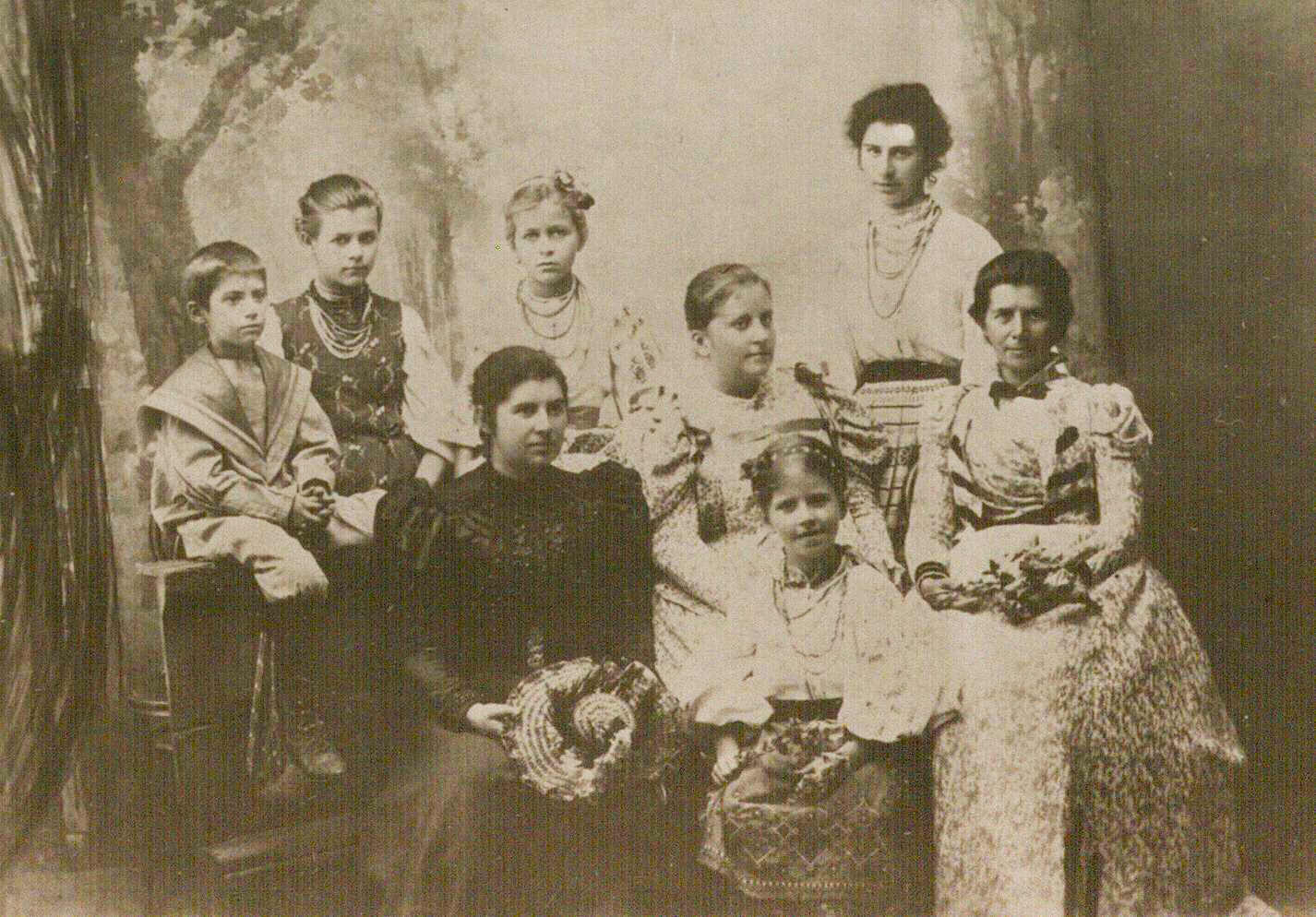
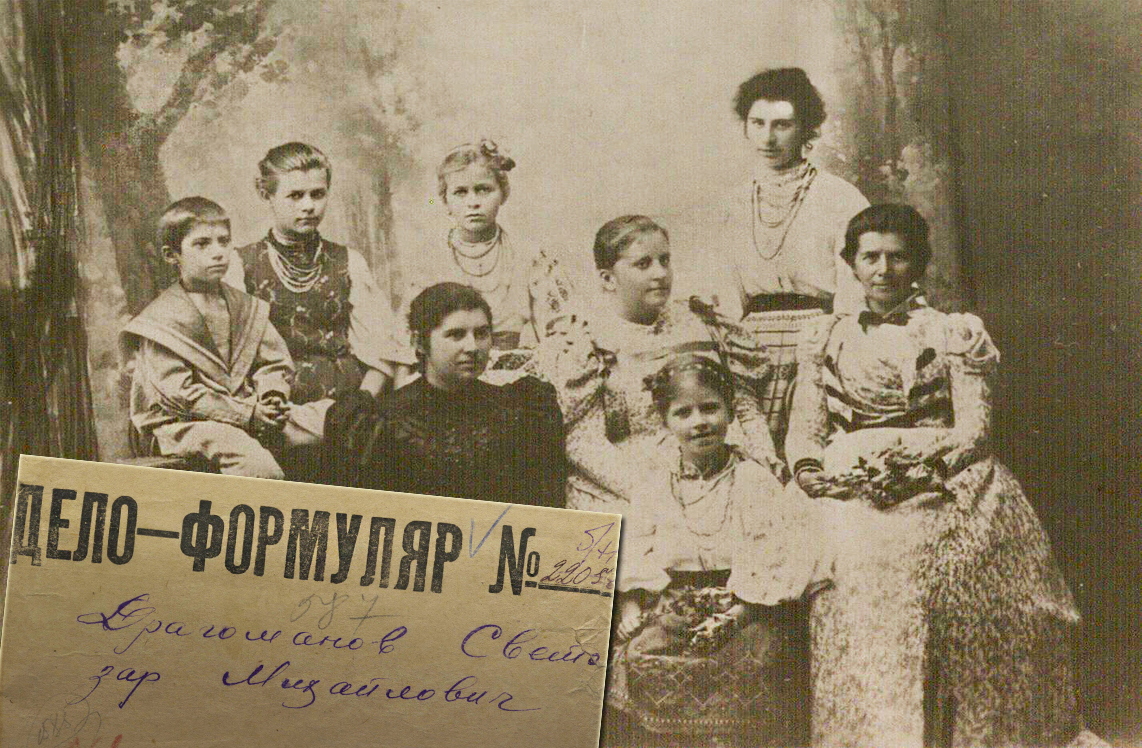
In that same letter, S. Drahomanov wrote that he had sent, in a separate package, his father’s letter to his mother, four postcards, and 39 photographs from among those in his possession. Among them were eight portraits of M. Drahomanov and a large photograph of M. Drahomanov’s study in Sofia, where he died in 1894. He also pointed out that the “secret police portrait” – a gift from a classmate at the Kyiv gymnasium, the son of a police officer – deserved special attention. That is, it was understood that that was a photograph taken by secret police agents while they were surveilling M. Drahomanov and persecuting him as a political threat to the tsarist regime. In his reply, V. Bonch-Bruevich informed Svitozar that some of his father’s works and the portrait – one of those he had sent – had been displayed at an exhibition. There are no copies of those photographs or materials in the case file. There is only a copy of a group photograph in which Svitozar is sitting next to Lesya Ukrainka.
In addition to his contacts with the director of the literary museum in moscow, the nkvd documented S. Drahomanov’s correspondence with Academician V. Vernadsky, who was also living in moscow at the time. He asked the renowned scholar to help clear his father’s name, as V. Vernadsky had known his father and had even preserved some of his letters. Besides, they received information about Svitozar’s correspondence with the scientific secretary of the T. Shevchenko Institute of Literature in Kyiv. The discussion centered on the possibility of obtaining copies of M. Drahomanov’s materials from the National Library in Paris. The chekists instructed their agents to immediately report any such contacts.
In carrying out this assignment, agent “Barvinskyi” reported in January 1941: “Svitozar is trying to make extensive use of the Institute of History of the Academy of Sciences of the Ukrainian ssr in order to publish articles about his father. He has met with the Institute’s Director, Bilousov, on this matter on several occasions, particularly regarding his father’s anniversary this year (the 100th anniversary of his birth). According to him, he has now developed a plan to commemorate M. Drahomanov’s jubilee… This includes: a monument to M. Drahomanov, scholarships named after him, renaming one of the streets in Kyiv, naming scientific institutions after him, and publishing his works.” (FISU. – F. 1. – Case 9861. – Vol. 3. – P. 68).
At the same time, as shown by archival documents, S. Drahomanov’s articles were published reluctantly in republican and all-union newspapers; more often than not, they were rejected under fabricated pretexts. The nkvd also played a role in this; not only did they have no intention of assisting him in returning his father’s archives from abroad, but they were already compiling a dossier on Svitozar himself as an unreliable individual. One of the reports from that time stated that he “had participated in counterrevolutionary activities until the very end” and was therefore subject to arrest. It is unknown how all this would have ended and whether all the plans to commemorate the 100th anniversary of M. Drahomanov’s birth would have been realized had it not been for the outbreak of the German-soviet war.
S. Drahomanov returned to the issue of adequate honouring of his father after the war, once he was back in the United States. However, there is no information about this in the archival documents. By that time, the mgb of the Ukraiian ssr had lost track of him, ceased the search, and transferred the case to the archives.
From today’s perspective, this case – which reflects not only little-known aspects of Svitozar Drahomanov’s life and work but also important episodes in the preservation of the scientific and literary legacy of his father, Mykhailo Drahomanov – could become a subject for specialized research by Ukrainian scholars.
See declassified documents from the archives.