The First Ukrainian in the United States to Become a University Professor and a Doctor of Philosophy
11/4/2026
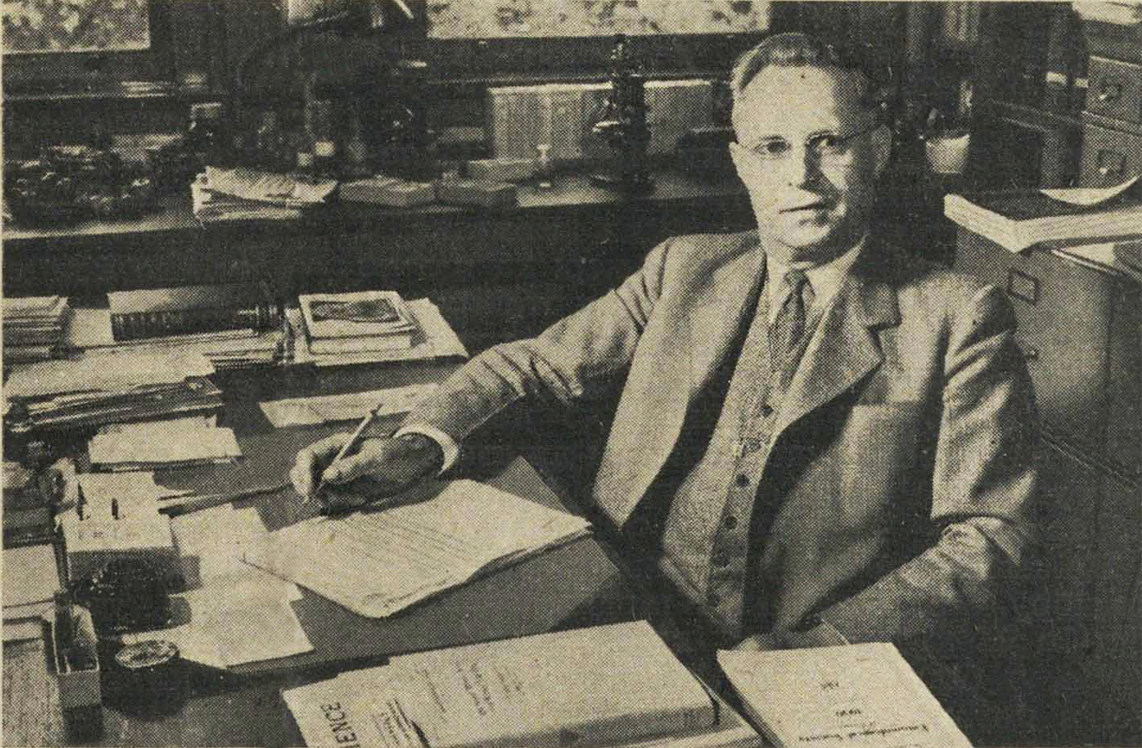
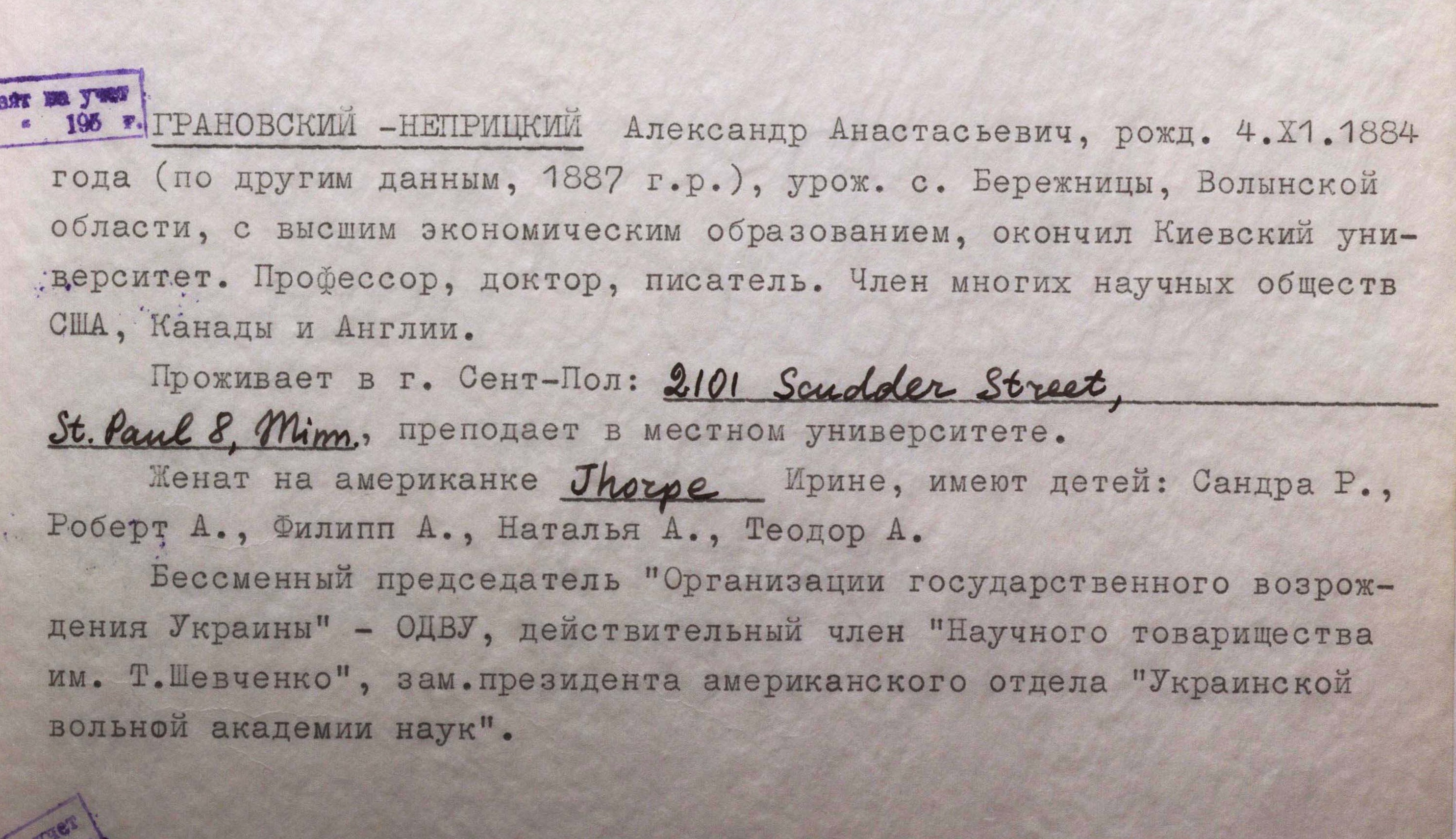
On the list of “Ukrainian anti-soviet figures in America”, compiled by soviet authorities in 1929, Oleksandr Neprytskyi-Hranovskyi is listed as number 24. At that time, he was the first Ukrainian in the United States to earn a Doctor of Philosophy in the biological sciences (1925) and the title of Professor at an American university. People like him – successful, influential, and promising figures – were placed under surveillance by the chekists, who compiled dossiers on them and, based on the information collected, decided what to do with them next.
An excerpt from this list, attached to the case file on O. Neprytskyi-Hranovskyi – which is preserved in the archives of the Foreign Intelligence Service of Ukraine – states the following: “Ukrainian poet. Emigrated to the United States long before the revolution. Not long ago visited Europe. Showed passive sympathy for the Petliura movement, and later – for the Shapoval movement” (FISU. – F. 1. – Case 10758. – P. 3).
The case file itself, entitled “Hlava”, was opened in 1938. It was opened in accordance with an instruction from P. Sudoplatov, whose resolution on this matter appears on one of the documents. Shortly before this, information was received that O. Neprytskyi-Hranovskyi had become the Head of the Organization for the Rebirth of Ukraine (ODVU) in 1935. This Ukrainian civic and political organization was ideologically linked to the OUN; its main focus was on preserving the national identity of Ukrainians in the United States and supporting the national liberation movement in Ukraine.
One of the intelligence reports from that time pointed out that O. Neprytskyi-Hranovskyi was elected Head of the ODVU allegedly because “this organization needed a figure with social standing”. And he was indeed already a well-known figure in academic and socio-political circles. The New York residentura of the nkvd of the ussr must have been aware of this, although the case files contain little information about his academic achievements or his life in general.
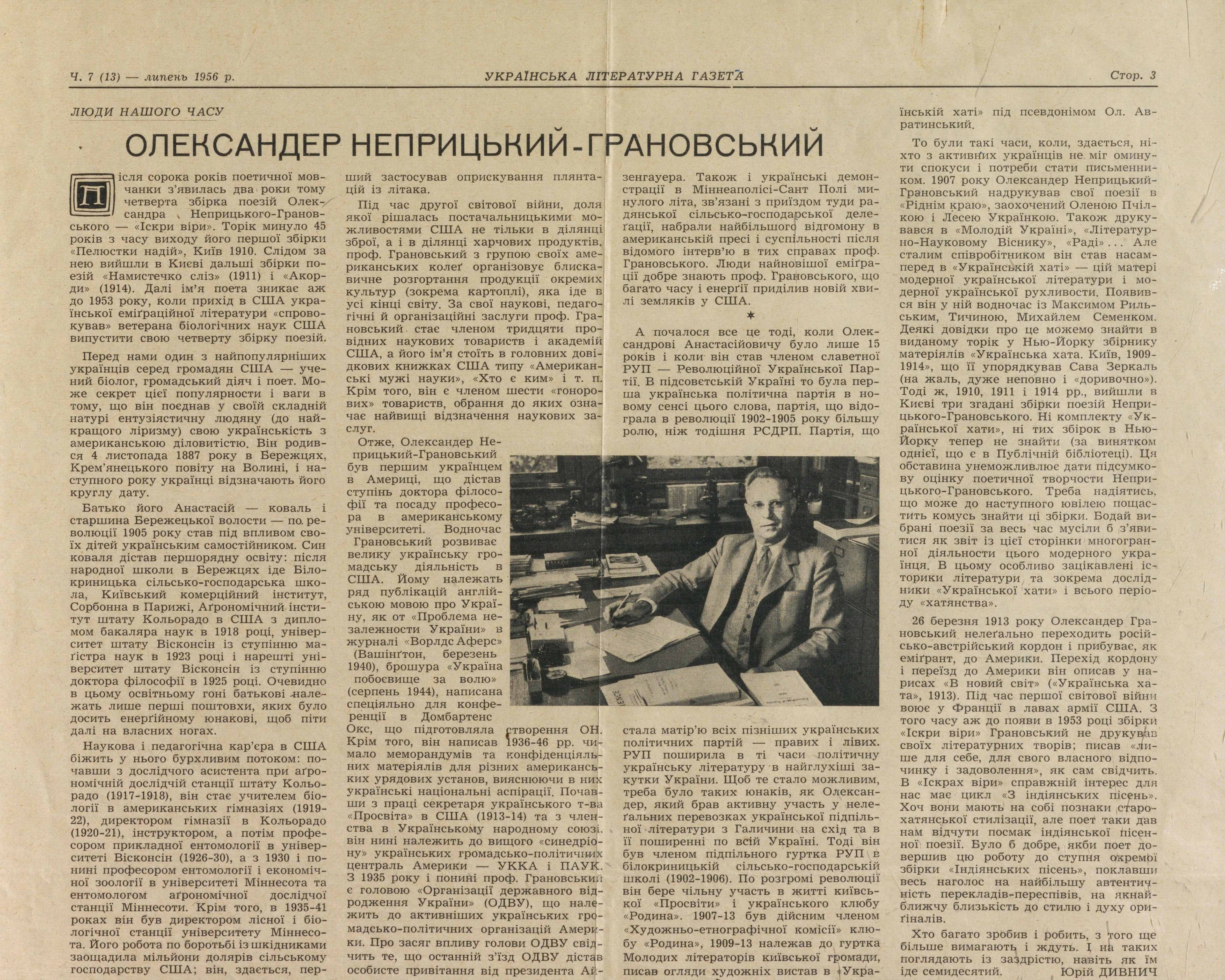
According to declassified documents and open sources, O. Neprytskyi-Hranovskyi was born on November 4, 1887, in the village of Velyki Berezhtsi (now in Kremenets district of Ternopil region). He studied at the Kyiv Commercial Institute, where he majored in economics, history, literature, and art. He participated in the cultural life of Kyiv, was a member of the Ukrainian club “Rodyna”, headed by Mykola Lysenko, was actively involved in the “Prosvita” Society and the Archaeographic Commission, headed by Olena Pchilka, and corresponded with Lesya Ukrainka, Mykhailo Hrushevskyi, Yevhen Chykalenko, Borys Hrinchenko, Mykyta Shapoval, Oleksandr Oles, Mykola Voronyi, Maksym Rylskyi, Pavlo Tychyna, and other Ukrainian figures. His works were published in the periodicals “Ridnyi Krai”, “Moloda Ukraina”, “Rada”, and “Ukrainska Khata”. From 1910 through 1914, three of his poetry collections were published: “A Necklace of Tears”, “Petals of Hope”, and “Chords”.
In 1908, O. Neprytskyi-Hranovskyi joined the Revolutionary Ukrainian Party. As a member of an underground circle, he distributed Ukrainian books banned by the tsarist government among the population. Facing the threat of arrest and deportation to siberia, he first went into hiding and later emigrated to the United States. He worked as a laborer on farms and in mines. He soon graduated from the Colorado State Agricultural College in Fort Collins, Colorado, taught biology, and devoted himself to scientific research in the field of entomology. In 1923, he earned a Master of Science degree from the University of Wisconsin, and two years later, he defended his doctoral dissertation.
Since 1930, O. Neprytskyi-Hranovskyi has served as a Professor of entomology and economic zoology at the University of Minnesota. He was one of the first in the world to conduct in-depth research into how insects transmit plant diseases and to develop methods for protecting crops from pests. In particular, he was the first in the United States to introduce the use of dust for protecting vegetable crops and proposed using airplanes to spray forests, parks, and gardens. His reputation grew rapidly, and he soon became a full member of the Entomological Society of America, the Washington Entomological Society, the American Ecological Society, the Royal Entomological Society in London, the International Academy of Sciences in Paris, and others.
Alongside his scientific research and international recognition as an outstanding entomologist, O. Neprytskyi-Hranovskyi remained active in civic, political, cultural, and educational endeavors within the Ukrainian diaspora. In the early 1930s, he became an active member of the Organization for the National Revival of Ukraine, and five years later he was elected Head of the Organization, a position he held for nearly thirty years. It was during that period that he was noticed by ogpu of the ussr. One of the first documents attached to the case file noted that, as a scholar and poet, he was rather naive, so it was supposedly possible to exploit this and “elicit candor” from him. Clearly, the intention was to extract information from him about the activities of the ODVU through agents operating abroad. But he turned out to be not so naive or trusting – and not so ready for the role of leader of a political organization – as the chekists had assumed.
In February 1939, the New York residentura of the nkvd of the ussr received information that Professor Neprytskyi-Hranovskyi was actively involved in campaigning in the United States for financial and military aid to Ukrainians defending the independence of Carpathian Ukraine in Khust. Another report stated that he had been a delegate at the OUN Congress in Paris in 1939.
In an intelligence report from 1942, O. Neprytskyi-Hranovskyi’s confident stance and his conviction that the government of the USA would not hinder the activities of the ODVU were attributed to his membership in a Masonic lodge. It was pointed out that he allegedly became a Freemason while in France during World War I. At that time, he enlisted as a volunteer in the US Army and was deployed to Bordeaux to participate in combat operations. Due to a spinal injury, he underwent treatment in Paris in 1918 – 1919 and studied at the Sorbonne during that time. The chekists did not obtain any further information about the Professor’s membership in a Masonic lodge, but even this was enough to prompt them to scrutinize the subject to operational cultivation even more closely. This was also prompted by one of his statements made at the annual meeting of the ODVU in New York in 1942. In his speech, he stated the following: “In competent American circles, our Organization not only enjoys sympathy and trust, but recently our Organization has begun to be regarded as the only one with which negotiations can be conducted when the issue of Ukraine’s liberation becomes a pressing matter” (FISU. – F. 1. – Case 10758. – P. 40).
Meanwhile, O. Neprytskyi-Hranovskyi remained at the center of events. In 1945, as an official delegate from the Ukrainian community in the USA, he participated in the first founding conference of the United Nations in San Francisco. In 1946, he joined the Political Council of the Ukrainian Congress Committee of America (UCCA). From this influential organization, he received the Shevchenko Freedom Award – the highest honor bestowed upon individuals who have provided significant assistance to the Ukrainian community and the Ukrainian people. In 1948, he visited refugee camps in Europe and did a great deal to assist Ukrainians who wished to emigrate to the United States. Beginning in 1956, he served as a member and Vice President of the Liberation Committee for Oppressed Nations. He was an active member of the US Republican Party and served as Chair of the Minnesota State Committee on Ethnic Affairs for that party. During the celebration of the 25th anniversary of the founding of the ODVU, he received a letter from US President D. Eisenhower commending his civic and political activities.
Apart from his scholarly and civic-political activities, O. Neprytskyi-Hranovskyi was also involved in literary pursuits; he published journalistic and literary works, left behind several volumes of poetry, and wrote numerous reflections on the cultural heritage of the Ukrainian people, such as “The Problem of an Independent Ukraine,” “A Free Ukraine Is Essential for Lasting Peace”, and “On the Path to Statehood”. He was also a great connoisseur and enthusiast of the Ukrainian art of pysanka (Easter egg painting) and owned one of the largest collections of pysankas. He raised his five children, who were born in the United States, to love Ukraine.
Other archival documents mention O. Neprytskyi-Hranovskyi’s involvement in the construction of the Taras Shevchenko monument in Washington, D.C., in 1964. He did a great deal to raise funds for the monument and led the delegation from the state of Minnesota at its dedication. At that time, the case file on him was forwarded from moscow to Kyiv for further processing. It was reclassified as an intelligence cultivation, but due to a lack of intelligence resources, it was soon closed and transferred to the archives.
The brief dossier on O. Neprytskyi-Hranovskyi in the archives of the Foreign Intelligence Service of Ukraine does not provide a comprehensive overview of his entire life or his multifaceted scholarly, civic, and political activities. Local historians were able to gather more information about him in his native village of Velyki Berezhtsi in Ternopil region, where a literary and memorial museum dedicated to this distinguished native son has been established.
O. Neprytskyi-Hranovskyi passed away on November 4, 1976, in St. Paul, Minnesota, where he is buried.
See declassified documents from the archives.