
Ukrainian Emigrants Under the Total Control of the kgb
8/11/2026
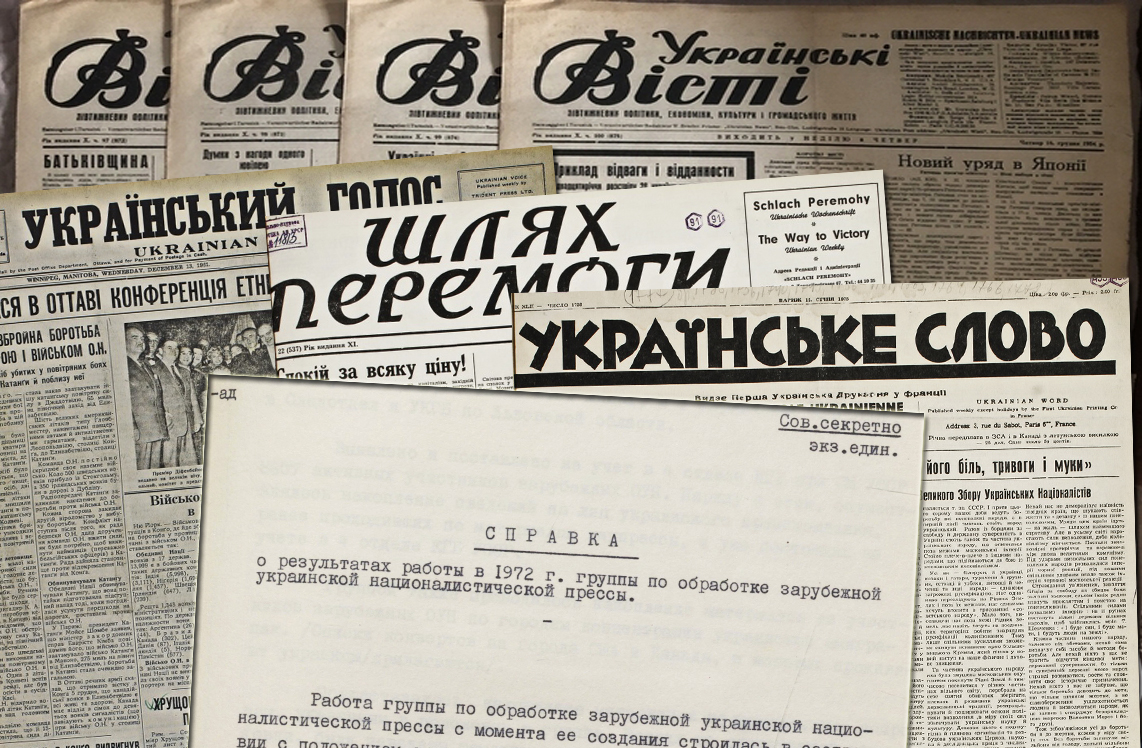
During the Cold War, the kgb of the ussr was arguably the only agency that possessed the most comprehensive information about the lives and activities of Ukrainian emigrants in virtually every country in the world. Declassified documents from the archives of the Foreign Intelligence Service of Ukraine reveal the areas and criteria used to monitor Ukrainians abroad, how and for what purposes information was collected, analyzed, and reported to party authorities.
Indeed, the comprehensive nature of this surveillance is evidenced, for example, by the classification of operational case files established in 1965 for the information and analysis unit of the 1st (intelligence) directorate of the kgb under the council of ministers of the Ukrainian ssr. The bulk of the files consisted of information on Ukrainian émigrés in capitalist countries – the United States, Canada, South America, Great Britain, West Germany, Austria, France, Belgium, and Australia. In other words, a separate file was maintained for each country. There were thematic sections for the collection and accumulation of information, including:
- the history of the organization’s formation, locations with the largest concentrations of members, membership numbers, and economic and socio-political status;
- progressive, nationalist, and other émigré organizations and groups, media outlets, publishing houses, and radio stations;
- educational institutions, cultural and educational societies, and scientific and technical societies;
- institutions, organizations, and individuals maintaining contact with government agencies on behalf of the Ukrainian émigré community;
- government institutions and organizations dealing with issues concerning Ukrainian emigrants residing within the country;
- individuals of Ukrainian nationality who are members of the government, as well as employees of the country’s government, academic, and military institutions;
- the government’s nationwide and foreign policy initiatives involving the Ukrainian diaspora;
- the country’s special services’ operations against the ussr involving émigré centers
(FISU. – F. 1. – Case 14487. – Vol. 4. – P. 34–35).
A separate section of the nomenclature contains a list of intelligence files on the main anti-soviet nationalist centers and organizations abroad, including the OUN’s overseas branches, the Anti-Bolshevik Bloc of Nations, the Overseas Representation of the Ukrainian Main Liberation Council, Provid of Ukrainian Nationalists, the Ukrainian Revolutionary-Democratic Party, the Union of Ukrainians in Great Britain, the League of Free Ukrainians, the Committee of Ukrainians in Canada, the Ukrainian Congress Committee of America, the Organization for the Defense of the Four Freedoms of Ukraine, the Ukrainian Union of Agrarians-Statists, and others. In addition to files on organizations and parties, separate files were also maintained on their leaders and active members.
Each case, as noted in the document, was to cover the following main points:
- general information about the organization (structure, leaders, membership, affiliated organizations, media outlets, location of headquarters);
- the organization’s ideological and theoretical foundations, its ideologues;
- tactics and subversive activities targeting the ussr;
- tactics and relationships with other nationalist organizations and groups;
- attitude to the government and relations with government agencies in the organization’s host country;
- ties to the enemy’s intelligence services;
- efforts to recruit youth of Ukrainian descent into the organization and indoctrinate it
(FISU. – F. 1. – Case 14487. – Vol. 4. – P. 23).
As for educational and scientific institutions, they attempted to gather information on each one individually. Consequently, the Ukrainian Free University, the Ukrainian Economic Academy in Poděbrady, the Ukrainian Scientific Institute in Berlin, the Ukrainian Scientific Institute at Harvard University, the Ukrainian Free Academy of Sciences, and others were under close operational surveillance. Files were compiled on the heads and professors of those institutions – Roman Smal-Stotskyi, Volodymyr Kubiyovych, Arkadiy Zhukovskyi, Yurii Shevelyov, Omelian Pritsak, Mykhailo Vetukhiv, Mykola Velychkivskyi, Yurii Boyko-Blokhin, Oleksandr Ohloblin, and many others.
Separate cases were against the Ukrainian clergy. These files contain documents detailing how soviet special services actively sought to destroy Ukrainian Orthodoxy not only within the ussr but also abroad. These were measures directed against the Ukrainian Greek Catholic Church and the Ukrainian Autocephalous Orthodox Church and their clergymen, who were prominent representatives of the national liberation movement. Among them were Metropolitan John (Ivan Teodorovych) of the Ukrainian Orthodox Church in the United States, Primate Ilarion (Ivan Ohiyenko) of the Ukrainian Greek Orthodox Church in Canada, Mstyslav (Stepan Skrypnyk), the First Hierarch of the Ukrainian Autocephalous Orthodox Church in the Diaspora; Josyf Slipyj, Patriarch of the Ukrainian Greek Catholic Church; Ivan Buchko, Archbishop of the UGCC; and others.
At different times, the chekists opened cases against them, placed them under constant surveillance and control, and collected information about their religious and political activities. In particular, a resolution on the opening of a case entitled “The UAOC Abroad” states that leaders of this denomination actively support Ukrainian nationalists of all stripes and are actively working against the ussr to establish an independent Ukraine. Another resolution points out that the Ukrainian Greek Catholic Church, under the leadership of the Vatican, is engaged in reactionary, anti-soviet activities in the interests of international reactionary forces and is subject to investigation. Consequently, in order to compile materials on the activities of this church and to cultivate its leaders, a case file entitled “UGCC Abroad” was opened.
At the same time, documents were found in the archives of the Foreign Intelligence Service of Ukraine, indicating that the kgb of the Ukrainian ssr systematically collected information on a specific category of citizens – US military personnel of Ukrainian descent. Such individuals were added to special lists. The lists contained information about their parents, place of residence, participation in Ukrainian organizations, address, places of service, branch of service, and career advancement. Along with these brief profiles, it was noted that the individual had been placed under operational surveillance. In just one “List of Ukrainian Emigrants and Americans of Ukrainian Descent Participating in the Activities of Emigrant Organizations” from 1964, information on more than a thousand people was compiled.
Here are just a few notes about those who ended up on such lists:
“Myron Andriyovych Diduryk, born in 1938, a native of the village of Muzhyliv, Pidhaitsi district, Ternopil region. In 1960, he graduated from St. Peter’s College in Jersey City with a bachelor’s degree in physics and, at the same time, as a cadet from a Military Academy with the rank of second lieutenant in the infantry. After that, he was supposed to… depart for a three-year tour of duty with a US airborne unit in West Germany. M. Diduryk is a member of “Plast” and the “Ukrainian People’s Union”…
Mykola Bohdanovych Kravtsiv, born in 1935 in Lviv, graduated with honors from the US Military Academy at West Point in 1954; later received specialized training in parachuting and guerrilla warfare at Fort Benning and served in US tank units in the FRG… According to the latest information, he is a Professor at West Point. Previously, he was actively involved in the activities of the youth nationalist organization “Plast” and served as the standard-bearer for the “Forest Devils” Kurin. His father, Bohdan Kravtsiv, is an active Ukrainian nationalist, one of the editors of the newspaper “Svoboda”, and a member of the board of the “T. Shevchenko Scientific Society”.
Roman Dmytrovych Kuzyk, born in 1941, graduated from the University of New Brunswick, New Jersey, in 1963, while also completing military training; then left for specialized training at Fort Benning, Georgia, with the rank of lieutenant.
Mykhailo Dmytrovych Skotsko, born circa 1935, having graduated from Brooklyn College, served for four years at the US Military Academy, while simultaneously studying Chinese. In 1961, he graduated from the US Military Academy at West Point and was assigned to a military base in Georgia…»
(FISU. – F. 1. – Case 14487. – Vol. 2).
A review of these documents indicates that such individuals were viewed both as subjects for operational studying and as a potential threat. In other words, it was believed that in case of a new global confrontation, they might join the effort to liberate the land of their ancestors from moscow’s imperialism. Consequently, the kgb leadership viewed with suspicion the intelligence gathered by its agents regarding “the Americans’ increased recruitment of young people of Ukrainian descent into the army”.
Apart from informational materials, they also attempted to obtain photographs. These were used to compile photo albums of active figures in the émigré community, which were sent to all regional kgb offices. The accompanying explanations stated that such individuals might visit the Ukrainian ssr under assumed names to gather biased information about the state of affairs in the republic, recollections of the Holodomor, and other details. So, the personnel was instructed to take this into account in the work and to add new photos to the album. Some individuals on those lists were placed under operational cultivation; others were targeted in attempts to influence them to change their views; still others were pressured to return to the ussr or there were attempts to recruit them; those who remained unyielding were subjected to pressure, as well as measures designed to discredit and compromise them.
A separate area of work was devoted to processing and analyzing press materials and radio intercepts. Staff members specifically assigned to this task studied newspapers and magazines arriving from abroad on a daily basis. The scale of this work is evidenced by a document sent from Kyiv to moscow, which provided lists of publications recommended for subscription in 1973. It lists 68 newspapers and magazines (24 from the USA, 21 from Canada, 10 from West Germany, 5 from the United Kingdom, 4 from France, 3 from Belgium, and 1 from Argentina). Among them were “Svoboda”, “Tryzub”, “Ukrainski Visti”, “Ukrainskyi Kvartalnyk”, “Smoloskyp”, “Homin Ukrainy”, “Kanadiyskyi Fermer”, “Shlyakh Peremohy”, “Ukrainske Slovo”, and others. In addition, the document requested that instructions be given to the kgb residenturas in New York, Ottawa, Bonn, London, and Paris to periodically send to Kyiv newspapers for which no subscriptions had been taken out. This included another 21 publications (“Kongresovi Visti”, “Plastovi Visti”, “Klych Natsii”, “Buleten Obyednannia Ukraintsiv u Velykiy Brytanii”, “Visti Naukovoho Tovarystva im. Tarasa Shevchenka v Europi” and others).
Separate index cards were created for each publication and the organization that published it. Similarly, an alphabetical card index was maintained for individuals mentioned in the pages of the periodicals. This information was provided to operational units for use in their work or for opening cases on individuals who fell under the relevant categories, such as Ukrainian bourgeois nationalists or those with anti-soviet sentiments.
“During 1972”, points out a report from the group responsible for analyzing the Ukrainian foreign press, “based on materials published in the national press that were worth operational attention, 20 intelligence reports were prepared and forwarded to the relevant authorities; 10 reports, compiled from materials in the national press, were included in the daily summaries of the central committee of the communist party of Ukraine… In connection with the arrest of Dobosh and other individuals-nationalists in Ukraine, approximately 100 photocopies of materials published by the nationalist press about these individuals were forwarded to the 5th directorate, to the investigative department, and to the kgb in Lviv region. A total of 3,607 active members of the OUN abroad were identified and placed on record by the 4th department of the kgb under the council of ministers of the Ukrainian ssr. At the same time, information was being gathered on individuals of Ukrainian origin who had previously been named in materials from the nationalist press and were already on record with the 4th department of the kgb under the council of ministers of the Ukrainian ssr…» (FISU. – F. 1. – Case 14487. – Vol. 5. – PP. 197–200).
Thus, based solely on press reports from different periods, tens of thousands of Ukrainians living abroad were registered as persons of operational interest. They were placed on the list simply for dreaming of an independent Ukraine, criticizing the national policies of the ussr, speaking negatively about the leaders of the communist party and the soviet government, russification, repressions against the Ukrainian population, the Holodomor, the persecution of dissidents, or simply for participating in cultural events organized by Ukrainian communities. As a result of the accumulation of materials on specific individuals, operational cultivation cases were subsequently opened. Such files are sometimes found in the archives of the Foreign Intelligence Service of Ukraine. They indicate that the basis for opening those files was publications in the foreign press. Already during Ukraine’s independence, all these clippings from newspapers and magazines from the 1960s–1980s were transferred to the V. Vernadskyi National Library of Ukraine.
Of special interest is the document’s concluding thematic section entitled “Information Files on Selected Current Topics Requiring Special Attention, In-Depth Analysis, and the Development of Specific Proposals for Organizing Work”. The following topics were identified for that period:
- The activities of progressive Ukrainian organizations and the development of the patriotic movement among Ukrainian émigrés in capitalist countries. The activities of our agencies regarding the development of this movement;
- the Ukrainian émigré community’s attitude to the “World Congress of Free Ukrainians” and the involvement of nationalist centers in preparations for its convening;
- the enemy’s use of Ukrainian émigrés’ legal travel to the Ukrainian ssr to spread anti-soviet propaganda;
- the situation of young people of Ukrainian origin in capitalist countries, and the possibilities for involving them in active patriotic work abroad;
- the experience of the kgb under the council of ministers of the Ukrainian ssr in carrying out measures to undermine nationalist centers and discredit their leaders from clandestine positions;
the Ukrainian émigré community’s reaction to our propaganda activities conducted from legal positions…
(FISU. – F. 1. – Case 14487. – Vol. 4. – PP. 24–25).
These materials served as the basis for conducting so-called “active” and other operational measures against Ukrainians abroad. In addition to this, there was comprehensive surveillance of correspondence and monitoring of telephone conversations between Ukrainian émigrés and their relatives and acquaintances in the Ukrainian ssr. All these measures, plans, tasks, regulations, and personnel were coordinated with moscow and subsequently monitored, adjusted, and steered in the desired direction by the central office of the kgb of the ussr. There was a separate line of work within residenturas abroad to carry out this work.
There is likely no parallel in world history to such a global phenomenon, on this scale, with these manifestations, and over this time frame. Studying and researching these processes is of vital importance – not only to understand the past, but also to ensure that we are prepared today to counter a similarly all-out intelligence and operational onslaught by russian special services against everything Ukrainian in every corner of the world.
See declassified documents from the archives.